Climate deniers deciding science funding in Canada

Pink and purple tulips

In yet another demonstration of the ongoing tensions between conservative political parties and science, Prime Minister Stephen Harper has appointed a couple of climate change deniers to federal science funding bodies. One has claimed that “the climate-change issue is somewhat sensational and definitely exaggerated.” The appointments seem likely to worsen the quality of scientific work being done in Canada, putting us further behind the rest of the developed world, when it comes to comprehending and appreciating the characteristics of the world in which we live, and in which important political choices must be made.

This is reminiscent of the appointment of a man seriously invested in the oil sands to the ‘Clean Energy Dialogue’ ongoing with the US. The Conservatives claim that they accept the science of climate change, but they cannot really take it to heart because of the degree to which it fundamentally conflicts with a laissez faire approach to economic regulation.

All we can hope for is for climate change denial to eventually become so patently ridiculous to the electorate that parties that continue to dabble in it seem to be arguing the equivalent of the Earth being flat and orbited by the sun. That may be the only time at which conservative parties have the impetus they need to reform their ideas to be compatible with what we now understand to be the state of the world.

The B.C. election and carbon pricing

From a climatic perspective, it seems that there are two reasons to be glad about the recent electoral victory of the Liberal Party in British Columbia:

  1. Firstly, it shows that carbon pricing (and carbon taxes, specifically) need not mean death at the ballot box. While it is still far too weak, the B.C. carbon tax is at least a progressive example for North America. Some have concluded that it is actually the most effective climate policy in effect on the continent at this time.
  2. Secondly, it shows that an unprincipled stand against carbon pricing can actually cost a party support. This is an essential development, if we are to deal with climate change. Succeeding will depend on carbon mitigation policies enduring and strengthening for many decades. As such, we need to reach the point where the electorate rejects those who would scrap them for non-environmental reasons.

While there are plenty of reasons to dislike both major political parties in B.C., at least this election didn’t prove to be yet another setback for effective climate policy in Canada.

Here’s hoping the US Congress is able to pass a cap-and-trade scheme before the Copenhagen meeting, and that Canada will finally roll out regulations on greenhouse gas emissions nationally.

Australia’s coal and China

Sasha Ilnyckyj on Andrea's porch

All regular readers of this site are familiar with Canada’s energy dilemma, as far as the oil sands, the United States, and climate change are concerned. The US has a huge appetite for oil, and is increasingly anxious about getting it from the Middle East. From a short-term perspective, this positions Canada’s unconventional oil very nicely. Of course, when you think long-term and realize the importance of climate stability, you become a lot more likely to think we would be better off leaving the stuff in the ground.

A similar dynamic seems to exist when it comes to coal, Australia, and China. In March 2009, China imported 1,716,802 tons of Australian coal. All told, it imported 211% more coal between January and March as in the previous year. Like Canada, Australia has extremely high per-capita emissions, a poor record on greenhouse gas mitigation, and a lot of export-oriented resource extraction industry. Also like Canada, it may well be the case that long-term climatic stability requires leaving most of that coal underground.

As such, it is disappointing that Australia has delayed plans to institute carbon pricing. When it comes to the negotiations at Copenhagen in December, dealing with the complexities of energy imports and exports will certainly be among the trickier issues that need to be sorted out in negotiations. While the climatic requirements are clear (sharply reduce global emissions), the economic and moral ones are trickier. After all, a fair bit of the coal China is burning is being used to make products for people in other states. Who, then, bears the moral responsibility for the emissions associated with extracting, shipping, and burning the coal? What sort of legal regime can be established to effectively incentivize decarbonization throughout such complex international production chains?

Ignatieff and climate change

Bridge over the Ottawa River

In sharp contrast to Stephane Dion, who put environmental issues front and centre, the new federal Liberal leader is much more restrained when describing his position on climate change policy. In addition, Michael Ignatieff seems to be going out of his way to show support for ‘the west’ and, by extension, the Athabasca oil sands.

It is possible that this is an electoral ploy, designed to isolate him from the perceived failure of Dion. It is also possible that Ignatieff has the intention of taking significant action on climate change, but has deemed it tactically appropriate to keep it quiet. Finally, it is possible that he thinks such action is either not necessary or not worth the political price he thinks it would involve. For those concerned about climate change, the last is a troubling possibility. If Canada is going to hit the targets established by the current government – much less, stronger targets as advocated by many scientists and NGOs – much bolder governmental action will be necessary, and higher costs will necessarily fall upon carbon-intensive industries.

With the eternal bubble of speculation about elections that accompanies a minority government, what do people think the real Ignatieff agenda on climate change would be, if he is able to bring the Liberals back into government? Would it likely be more or less aggressive if they did so with a majority, as opposed to simply replacing the Conservatives in the perilous minority spot?

Questions for the IPCC AR5

The Intergovernmental Panel on Climate Change (IPCC) is asking governments what sort of policy-related questions they would like to have examined in the Fifth Assessment Report (5AR), due out in 2014. Here are a few ideas that come to mind:

  1. How will fossil fuel production likely change over the next century? What effect will that have on climate change?
  2. Which strong positive feedback effects are likely to emerge at the lowest levels of warming? At what levels will they take place?
  3. Would any of the current proposed geoengineering strategies effectively combat climate change? What side-effects would they have?
  4. How will the regional impacts of climate change vary across time?
  5. What will the effects of ocean acidification be?

Do readers have other suggestions?

Incidentally, the fact that we need to wait five years for another IPCC report demonstrates one disadvantage of its complex and process-heavy approach to evaluation. It’s a real shame that, despite all these efforts, so many people continue to reject out of hand the fact that there is a robust scientific consensus on the issue.

Biofuels versus electric vehicles

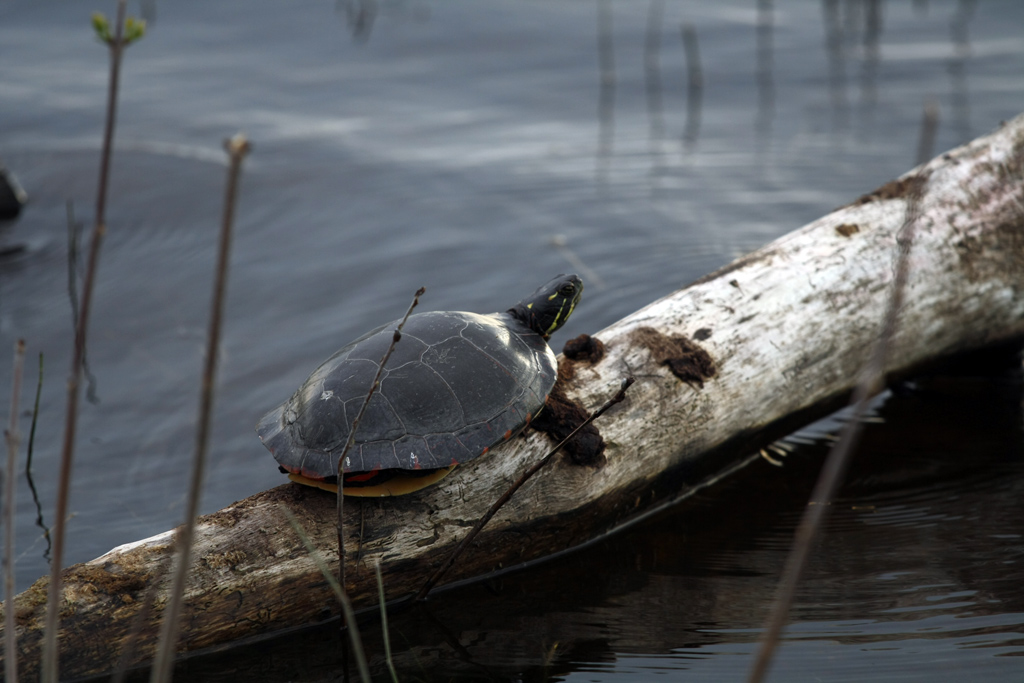
Ottawa River turtle

A study published by Science Expressed and discussed on Grist concludes that growing biomass for electricity production, and then using it to run electric vehicles, is more effective per acre than growing crops to produce liquid biofuels for internal combustion engines. This is true even if the liquid fuels are so-called ‘second generation’ or cellulosic biofuels, which it is hoped will provide an improvement over the poor climate change and energy security benefits of fuels like corn ethanol. The study estimates that the miles of travel enabled per acre are 81% greater when growing biomass for electricity, compared with cellulosic ethanol.

It seems like the most probable path to de-carbonized transport is the conversion of all short and medium-range vehicles to electric power, with liquid fuels reserved for vehicles that must travel long distances, aircraft, and vehicles operated in remote areas. Producing energy from biomass has another potential advantage, if carbon capture and storage (CCS) proves viable. By adding CCS to biomass-fueled power plants, net reductions in the atmospheric concentration of carbon dioxide could be achieved.

In time, it seems likely that the many government policies promoting the widespread use of biofuels were an ineffective response to both concerns about climate change and about energy security. In particular, ‘mandates’ that a certain fraction of vehicle fuels be biofuels do not necessarily do a good job of aligning outcomes with climate change objectives, since they are insensitive to both the lifecycle emissions associated with the fuels and to the economics of producing them.

How climate change is like fisheries depletion

Fisheries and climate change are both areas where severe common property failures exist: that is, individuals have an incentive to exploit the system, to the detriment of all. A recent RealClimate post ties the two together in a neat analogy, which also covers the evolving practice of climate change denial (or delay). Specifically, it is alluding to the North-South issues in the ongoing UNFCCC negotiations, and the tensions between developing world states who want the rich world to cut first and most deeply and developed states concerned about seeing any emissions reductions they produce overwhelmed by growth in developing states. Beyond the state-to-state negotiations, the tension also provides cover for those who want to avoid taking any action, no matter how severe the long-term consequences of doing so will be.

Both positions have validity, and the mechanisms for resolving the views remain under debate. That being said, the outlines are clear. Every significant emitter will have to take action. Rich states need to start doing so first and more sharply. They also need to provide assistance to developing states, in the form of technology and funding. Through coordinated global action, dangerous climate change can be avoided, and the world economy can be set on a path where it maintains climatic stability in the long term.

Crises and change

Wheel and chains

I came across a quote from Milton Friedman, the Nobel Prize-winning Chicago School economist, that seems well suited to the practice of trying to combat climate change:

Only a crisis – actual or perceived – produces real change. When that crisis occurs, the actions that are taken depend on the ideas that are lying around. That, I believe, is our basic function: to develop alternatives to existing policies, to keep them alive and available until the politically impossible becomes politically inevitable.

It certainly seems to apply well to all those who kept researching and debating climate policies in the U.S. through the long darkness of the Bush years. Now, some of the most compelling of those ideas are being voiced as serious possibilities.

The lesson for those hoping to change things, perhaps, is not to despair during times when necessary actions seem politically impossible, but rather to use those times for further preparation, as well as to try to provoke the kind of political crises that permit real change to occur.

Capping or taxing fossil fuels at import or production

Andrea and friends in red and blue light

Responding to a Nature article mentioned here before, George Monbiot has raised the issue of limiting fossil fuel extraction as a way to gauge the seriousness of governments in fighting climate change. It’s an idea with some virtues, both on climate change and energy security grounds.

Targeting emissions means keeping track of a mind-boggling array of activities: from cement manufacture to vehicle use to landfill gasses. By contrast, targeting fossil fuels would mean dealing with a modest number of firms. Instead of applying a carbon tax or cap-and-trade system to emissions, the alternative would be to use those instruments for fossil fuel imports and production. Doing so would require only that the output from gas fields, oil fields, and coal mines be recorded, along with imports of fuels. In the tax scenario, each fuel would require payments proportional to the greenhouse gasses it will produce when burned. In a cap-and-trade scheme, a set amount of carbon would be permitted to be extracted from the ground or imported, with firms competing for the permits in auctions. This would have the same prioritization effect as a carbon tax on emissions: firms that absolutely needed particular fuels would be willing to bid for permits, while those with alternatives would start to employ them.

Ideally, the scheme would also incorporate land-use change. Those wanting to convert land rich in biomass into something else would need to pay a tax or buy credits equivalent to the gasses being released. Conversely, firms planting forests on land previously poor in biomass could be given grants (under a tax scheme) or permits (under a cap-and-trade scheme).

It might also make political sense to differentiate between imports and domestic production, with the former getting stricter treatment. That would somewhat lessen the opposition of domestic industry, while also accelerating the movement of the state imposing the policy towards energy independence. It would probably be less economically and environmentally effective, but it might be a mechanism for gaining domestic support, while still making it clear that the overall objective is to reduce fossil fuel use to zero. Such a policy could also be justified with reference to higher volatility in fossil fuel prices and availability from abroad, as well as the implicit subsidies to users of imported fossil fuels in the form of military aid and military operations in oil-producing regions. Of course, there is a good chance that it would violate the equal treatment provisions in agreements like NAFTA and the enabling legislation for the WTO.

In the event that carbon capture and storage proves to be a safe, economically viable, and effective technology, it could easily be incorporated into such a system. You would simply make payments or grant permits to firms doing the storing, contingent on them providing whatever maintenance the sites require.

By creating incentives for an unending push towards the non-use of fossil fuels, such policies would make it clear that our ultimate objective must be complete global carbon neutrality. Nothing else is compatible with long-term climatic stability.

[Update: 8 March 2010]. BuryCoal.com is a site dedicated to making the case for leaving coal, along with unconventional oil and gas, underground.

Underground coal gasification is no solution

Writing in The Globe and Mail Thomas Homer-Dixon and Julio Friedman put forward a misleading argument about coal. Specifically, they argue that converting it to gas below ground makes it more acceptable as a fuel source, because underground coal gassification “uses an inaccessible, dirty resource for largely clean energy.” This is only remotely true when the technology is used with (as yet non-existent) carbon capture and storage technology. Until such technologies are proven to be safe, economical, and effective, it is not acceptable to contemplate the further use of coal as an energy source.

Simply put, the carbon trapped in coal absolutely must be kept in the ground, if we are to avoid catastrophic climate change. Trumpeting any coal-based technology that will add greenhouse gasses to the atmosphere is simply irresponsible, especially in a developed country like Canada that already has a shockingly high level of emissions.