National Geographic on the oil sands

Warning signs

National Geographic has released a feature article on Alberta’s oil sands. It highlights the immense scale of what is going on: geographically, economically, and in terms of water and energy usage:

Nowhere on Earth is more earth being moved these days than in the Athabasca Valley. To extract each barrel of oil from a surface mine, the industry must first cut down the forest, then remove an average of two tons of peat and dirt that lie above the oil sands layer, then two tons of the sand itself. It must heat several barrels of water to strip the bitumen from the sand and upgrade it, and afterward it discharges contaminated water into tailings ponds like the one near Mildred Lake.

In total, the oil sands extent through an area the size of North Carolina – half of which has already been leased by the Alberta Government. That includes all 3500 square kilometres that are currently minable. In exchange, leases and royalties provide 1/3 of government income: estimated at $12 billion this year, despite the fall in oil prices.

The article also discusses some of the toxins leached by the mining operations, their impacts of health, and the inadequate work that has been done to investigate and contain them.

In the end, it is hard to write anything about the oil sands that isn’t damning, unless all it includes is information on the size and economic value of the oil reserves. The article includes a good quote from Simon Dyer, of the Pembina Institute, highlighting how the extraction of the oil sands is a mark of desperation:

Oil sands represent a decision point for North America and the world. Are we going to get serious about alternative energy, or are we going to go down the unconventional-oil track? The fact that we’re willing to move four tons of earth for a single barrel really shows that the world is running out of easy oil.

The solution is not the ever-more-costly and destructive search for new hydrocarbon resources, but rather the eclipsing of the hydrocarbon economy with one based on sustainable energy.

In addition to the article, National Geographic has also produced a flash slideshow of oil sands photographs.


Coen brothers ad on ‘clean coal’

The Coen Brothers – directors of favourite films of mine like The Big Lebowski and O Brother, Where Art Thou? – have made a short advertisement debunking the notion of ‘clean coal.’ It doesn’t have enormously much substantive content, but it does a pretty good job of saying: “Those promising that coal can be clean are lying to you.”

The ad was commissioned by the Reality Coalition.

Good climate policy news: Ontario and the USA

Emily Horn and Morty

I am happy to be able to report on some promising developments, both within my own province and in the giant to the south.

Firstly, the Government of Ontario has tabled a new Green Energy Act. There’s a lot to the 75 page document, but one of the most promising elements is the introduction of feed-in tariffs for renewable generation. Here’s the idea: the bill will make it mandatory for those who own the electrical grid to buy energy from renewable power sources, after connecting them. The price paid for the energy will be set by the province, and it will vary depending on technology, resource intensity, project scale, and location. Tariffs of this kind have been effective at driving renewable deployment in the United States and Germany. The whole bill is online (PDF), as is an executive summary. There is also a guide on what more is required for ratification (PDF). In addition to feed-in tariffs, the bill contains provisions for developing a smart grid, the involvement of First Nations groups, the creation of two funding bodies, and a mandate for conservation. It will also adjust energy pricing (though the issue of how is vague) and streamline the approval process for renewable energy projects.

Secondly, it is worth noting that Obama’s new budget includes projected revenue from a national cap-and-trade system. Grist is discussing it in a three part series: I, II, III. While the projected revenues are low ($83 billion per year by 2020), this is further evidence of the Obama administration’s willingness to move forward on this file.

Carbon pricing and the promotion of renewables are both critical elements of a strong overall climate policy. There is reason to hope that after decades of inaction, things will really start to take off in North America within the next couple of years.

[Update: 2 March 2009] Over at Clean Break, Tyler Hamilton has written a good piece on the Green Energy Act. It includes more analysis than the other coverage I have seen.

Nuclear paper published

The February issue of the St. Antony’s International Review contains my article: “Climate Change, Energy Security, and Nuclear Power.” The article is meant to be an introduction to some of the important issues surrounding nuclear power, energy security, and climate change. It remains an issue that I am agnostic about. It may be that nuclear fission is an important transition technology, useful to smooth the transition to a low-carbon global economy. It may also be that it is a subsidized, dangerous boondoggle and a distraction from superior options.

The full text is available here (PDF). Comments would be appreciated.

Monbiot now conditionally supporting nuclear

Andrea Simms-Karp: camera cyclops

In his book Heat, George Monbiot rejects nuclear fission as a low-carbon source of electricity: arguing that it is unacceptably dangerous, and that we could make do without it. In a recent column on his website, he makes it clear that he has joined the ranks of those willing to reluctantly consider nuclear, on the simple grounds that he is so deeply concerned about climate change.

He does, however, have some conditions:

  1. Its total emissions – from mine to dump – are taken into account
  2. We know exactly how and where the waste is to be buried
  3. We know how much this will cost and who will pay
  4. There is a legal guarantee that no civil nuclear materials will be diverted for military purposes.

The first of these is important, but a fairly low hurdle. If there wasn’t good evidence that the life cycle emissions of nuclear are low (though they are not zero), it wouldn’t be getting the kind of attention it has been. The second matter is mostly a matter of not-in-my-backyard (NIMBY) syndrome. Nobody wants a nuclear waste dump in their area, though everyone knows that a safe dump will basically resemble: a deep and well-sealed hole in some very geologically stable rock. The fourth requirement may be a reasonable bar for states with pre-existing nuclear weapons capability, but it is a bit much to expect from states that lack that capacity and face threatening neighbours. In all likelihood, more civilian nuclear power will mean more states with nuclear weapons, a few decades out.

The third issue is the most uncertain: the cost of nuclear power. Regrettably, no government out there actually has the spine to make polluters pay the true cost of their carbon dioxide emissions. Likewise, no government seems to be willing to forego the political opportunities involved in subsidizing technologies like nuclear fission and carbon capture and storage. In all probability, more nuclear will result in taxpayers and electricity consumers subsidizing the mistakes of governments and energy utilities. It may also produce a clunky, dangerous, and expensive infrastructure that was slower to come online and less effective than focusing on conservation, efficiency, and renewables would have been. All that being said, the inevitable costs may be justified as a precaution. If it does become brilliantly clear to the public that climate change requires urgent action – to the extent that people are willing to accept the rapid decommissioning of coal plants – having nuclear as an option might be an important way to facilitate the route forward. Given the risks of climate change, its low-carbon status may also be worth the inevitable accidents and contamination.

I admit that this is an issue where my thoughts remain divided. That being said, barring some big unforeseen change, I think we can definitely expect to see Canada’s nuclear reactors replaced with new ones, during the next few decades, at the very least. The post later today will provide some further thinking on the issue.

Business-as-usual estimates from MIT

Shoe art

Researchers at MIT have updated their climatic models and reached conclusions generally in line with the Hadley Centre in the UK, in terms of the amount of warming that would occur by 2100 under a business-as-usual case, in which no significant emissions reductions are achieved:

[T]here is now a nine percent chance (about one in 11 odds) that the global average surface temperature would increase by more than 7°C (12.6°F) by the end of this century, compared with only a less than one percent chance (one in 100 odds) that warming would be limited to below 3°C (5.4°F).

It is difficult to express how enormous a change 7°C would be. Conservative estimates of the point at which anthropogenic climate change should be considered ‘dangerous’ tend to cluster around the 2°C target adopted by the European Union, and others. As the MIT model suggests, a world that does not mitigate emissions may face a 99% probability of experiencing average warming a full degree above that target.

When politicians talking about climate change say that they ‘accept the science,’ people should be asking them if these kinds of projections are part of the science they accept. If so, they ought to be asked why they are treating climate change with such an utter lack of seriousness, concentrating far more on matters of fleeting political concern. In retrospect, it seems that people three or four generations from now will judge our current leaders largely on the basis of their failure to respond effectively to this threat.

Tropical forest carbon sinks

Shadows in downtown Ottawa

A recent Nature article discusses the status of forest-based carbon sinks in general, with special emphasis on an African sink that is estimated to be absorbing 1.2 billion tonnes of carbon dioxide per year: nearly twice the level of Canada’s 2006 emissions.

Today’s launch of the Orbital Carbon Observatory should help scientists to gain a better sense of how carbon dioxide is moving through and between the atmosphere, hydrosphere, and biosphere.

All told, the article estimates that 18% of human carbon dioxide emissions are being absorbed by tropical forests. The article highlights the uncertainties involved in the future trajectory of absorption by this sink. It may be that additional atmospheric CO2 causes it to maintain or even increase its absorption in the medium term. Conversely, it may be that the trees will reach a maximum size and cease to absorb further carbon, or that temperature and precipitation changes caused by global warming will restrict growth.

In any event, humanity will be in a better position to plan for the future once we have a deeper understanding of the nature of existing carbon sinks, and better projections for how they will respond to future conditions. In the mean time, working to avert further tropical deforestation is an important precautionary step.

Public education about antibiotic resistance ‘footprints’

This report from the Canadian Press suggests that greenhouse gas emissions are, in the minds of some, becoming the common yardstick for all sorts of negative externalities. It argues that one mechanism for reducing the emergence of antibiotic resistance is to educate members of the public about how the misuse and overuse of the drugs helps the resistant genes to spread. It argues further that this idea can best be conveyed as an ‘antibiotic footprint’ – akin to one’s environmental or carbon footprint.

The suggestion is certainly indicative of the degree to which personal environmental indicators have gained prominence.

Climate change and Australia’s brushfires

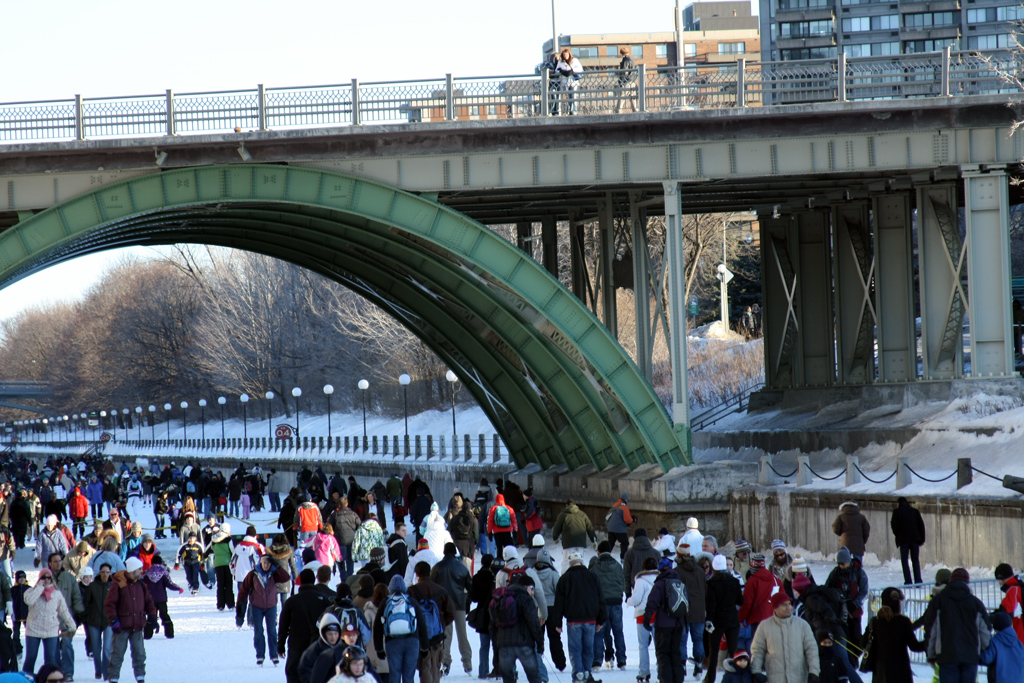
Skating on the Rideau Canal, Ottawa

Scientists frequently condemn journalists for being too quick to assert that particular events either support or call into question anthropogenic climate change. Indeed, reporting responsibly on the issue can be challenging. One the one hand, one cannot ignore the long-term contribution climate change makes to the frequency and severity of events; on the other, one doesn’t want to propagate the false idea that the accuracy or inaccuracy of climatic science hinges on a small number of extreme events of local weather trends.

A recent RealClimate post considers the case of Australia’s terrible recent brushfires. It considers a century worth of evidence on Australian brushfires, examining the importance of maximum temperatures, relative humidity, wind speed, and drought factors. Climate change trends are pushing in the direction of higher average temperatures and reduced rainfall. In the end, it comes to a measured by sobering conclusion:

While it is difficult to separate the influences of climate variability, climate change, and changes in fire management strategies on the observed increases in fire activity, it is clear that climate change is increasing the likelihood of environmental conditions associated with extreme fire danger in south-east Australia and a number of other parts of the world.

That may not be the kind of conclusion that translates easily into a headline for a popular newspaper, but it is the sort that we need to consider when making public policy on both climate change mitigation and adaptation.

The fourth report of the Intergovernmental Panel on Climate Change (IPCC) concluded back in 2007 that:

An increase in fire danger in Australia is likely to be associated with a reduced interval between fires, increased fire intensity, a decrease in fire extinguishments and faster fire spread. In south-east Australia, the frequency of very high and extreme fire danger days is likely to rise 4-25% by 2020 and 15-70% by 2050.

Those fires will naturally contribute to positive feedbacks within the climate system, as heat-induced dryness prompts the fire-induced emission of greenhouse gasses previously bound up in forests and grasslands.

A responsible position on carbon capture

Stairs and shadows

People reading this blog might get the mistaken impression that I am fiercely opposed to carbon capture and storage (CCS) technology. That is definitely untrue. There are few things that would be more helpful than safe, cheap, and effective CCS. It would ease the transition to a zero-carbon global economy, and it would allow for the actual removal of CO2 from the atmosphere, through the growing and burning of biomass.

All that said, it is deeply inappropriate for planners to count emissions reductions from anticipated future CCS in their plans, as the government of Alberta has done to an extreme extent. The technology is in its infancy. Indications to date suggest that it will not be as cheap as its biggest boosters hope. It may not be able to store carbon permanently or safely. Carbon capture certainly cannot do anything to mitigate emissions from mobile sources, making fossil fuel operations that generate fuels for them problematic.

On the basis of these concerns, I suggest that the following elements are important in any responsible consideration of CCS, from a public policy standpoint:

  1. Emissions reductions from CCS should not be estimated until information on the costs and effectiveness of commercial operations are known.
  2. It should not be assumed that CCS will allow high carbon activities such as burning coal or harvesting the oil sands to continue.
  3. While some public funding for CCS may be justifiable (especially investigations into using it with biomass fuels), industry groups that are predicting heavy usage of the technology should bear most of the development and implementation costs.
  4. CCS doesn’t make coal ‘clean.’ Even if it reduces CO2 emissions by 80-90%, coal will still be a climatically unsustainable technology. There are also a large number of environmental hazards associated with coal mining, coal ash, and so forth. Coal will probably never be clean, and will certainly never be clean just because it has CCS bolted on.
  5. Likewise, CCS cannot redeem the oil sands.
  6. We must develop alternative plans, in case CCS proves to be ineffective, unsafe, or unacceptably expensive.

As I have said before, we are in the Wright Brothers era of CCS technology, and it is far too soon to project whether it will be an important stabilization wedge or an expensive flop. It is definitely too early to be estimating the specific quantities of emissions that will be averted by as-yet-nonexistent technologies at unknown future dates.

If emissions are going to peak and descend to safe levels, we are going to need a lot of stabilization wedges: efficiency, protected and enhanced forests, zero-carbon electricity and fuels, and more. If we want to have a strategy that can survive the failure of a few major initiatives, that means we need extra wedges for contingency. As such, we probably can’t reject technologies like CCS and the increased use of nuclear fission out of hand.