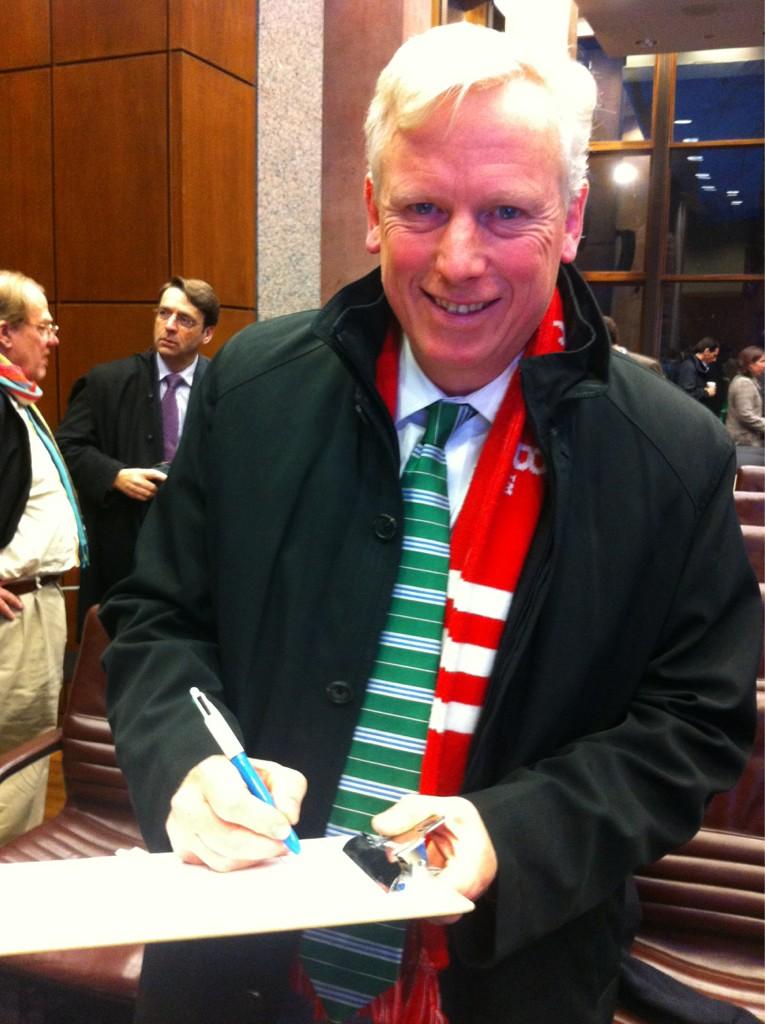
Toronto350.org photos from the Forward on Climate Rally

I am in the process of uploading my photos from this weekend’s rally in Washington D.C. calling on President Obama to reject the Keystone XL pipeline.

[Update: 19 FEB 2013] My six favourite photos from the Forward on Climate rally in Washington D.C. on Sunday February 17th, 2013:

Burke on rights and generations

“The political philosopher par excellence of the organic constitution was the Anglo-Irish theorist and statesman Edmund Burke, who wrote a century after Locke. Burke did not share the Age of Enlightenment’s optimism about the capacity for each rational individual to discern fundamental political truths. ‘The individual is foolish, but the species is wise.’ Instead of abstract natural rights, Burke believed in the real rights and obligations which grow out of the social conventions and understandings that hold society together. For Burke, the social contract which formed the foundation of society was not between individuals here and now but from one generation to another, each handing on to the next the product of its collective wisdom. The Burkean notion of an organic constitution has little appeal for those who, unlike the English, have not enjoyed a long and relatively uninterrupted constitutional history. But it was certainly congenial to the Canadian Fathers of Confederation who, though organizing a new country, did not for a moment conceive of themselves as authoring a brand new constitution.”

Russell, Peter. Constitutional Odyssey: Can Canadians Become a Sovereign Poeple? Third edition. p.10 (hardcover)

Climate and the second Obama administration

From Barack Obama’s second inaugural address:

We, the people, still believe that our obligations as Americans are not just to ourselves, but to all posterity. We will respond to the threat of climate change, knowing that the failure to do so would betray our children and future generations. Some may still deny the overwhelming judgment of science, but none can avoid the devastating impact of raging fires, and crippling drought, and more powerful storms. The path towards sustainable energy sources will be long and sometimes difficult. But America cannot resist this transition; we must lead it. We cannot cede to other nations the technology that will power new jobs and new industries — we must claim its promise. That is how we will maintain our economic vitality and our national treasure — our forests and waterways; our croplands and snowcapped peaks. That is how we will preserve our planet, commanded to our care by God. That’s what will lend meaning to the creed our fathers once declared.

We will see what kind of action the second term brings.

Previously:

Lisa Jackson and Keystone XL

U.S Environmental Protection Agency (EPA) administrator Lisa Jackson is leaving the Obama cabinet, apparently at least partly because of her opposition to the Keystone XL pipeline.

It’s worrisome that this one effort at controlling the growing North American fossil fuel industry – by blocking Keystone XL – has produced so much opposition. Meanwhile, there has been huge expansion in unconventional oil and gas production, including both fracking and the continued growth of the oil sands.

What we are doing now, continuing to invest the lion’s share in fossil fuel energy, is both environmentally destructive and economically wasteful. This infrastructure just isn’t compatible with what we are going to need in the future, once we finally start taking climate change seriously. Once we eventually find ourselves shutting down coal, oil, and gas infrastructure only partway into its economic lifetime we won’t be asking why Keystone XL was not approved, but why so many other misguided projects got built during these years.

Canada’s rules on charities and political activity

Canadian charities – especially environmental charities – now feel threatened that they will lose their special tax status if they engage in ‘political’ activity. The Canada Revenue Agency website describes the rules:

Registered charities are prohibited from partisan political activity, because supporting or opposing a political party or candidate for public office is not a charitable purpose at law. There are two aspects to the prohibition: the first restricts the involvement of charities with political parties; the second restricts the involvement of charities through the support or opposition to a candidate for public office. Charities engaging in partisan political activities risk being deregistered.

There is also a policy statement that further fleshes out the rules.

This means, for instance, that LGBT organizations cannot support candidates who support equal rights for their members or oppose candidates who want to restrict their rights. Environmental charities, likewise, cannot oppose parties or candidates that believe in the wholesale destruction of the natural world.

I think this overlooks the reality that large-scale social and political change always requires political agitation. Campaigns against child labour, or in favour of the rights of women, could never have succeeded if they did not engage with the political system. If society is going to continue to make progress, it seems sensible to recognize this and allow charities to pursue their aims through political means.

The current restrictions on political activity are especially objectionable in that they risk being selectively applied. Canada’s Conservative government is a strident defender of the oil sands and fossil fuel development generally, frequently advancing the laughable claim that this is an ‘ethical’ source of energy. Cracking down on charities for engaging in political activity is just another way in which the government can tilt the scales in favour of this destructive activity.

The scale of change which we need to achieve if we are to avoid catastrophic climate change is enormous. It requires major political change in countries like Canada. Allowing environmental charities to fund bird sanctuaries, but not to support or oppose parties or candidates, misrepresents the scale and character of our environmental problems. It also misrepresents the proper role of civil society in democratic societies, which does not end where the formal realm of ‘politics’ begins.