DDT and evolution

Naomi Oreskes’ book about climate change deniers makes some interesting points about the pesticide DDT. Apparently, there has been a kind of campaign recently to challenge the history of the substance and its ban, with some anti-regulation groups claiming the regulation of DDT was unneccessary and caused many human deaths. They argue that if DDT use had not been regulated, malaria could have been eradicated.

Oreskes seems to rebut this argument convincingly. Critically, she points out how DDT had been stripped of its effectiveness through over-use, particularly in agriculture. She makes the point that the consequences of different sorts of DDT use for the genetics of the mosquito population can be very different. Spraying indoors exposes only a small minority of mosquitoes to the chemical, leaving most of the population isolated from it. As a consequence, there is only a small advantage for those mosquitoes that are more resistant to the poison. By contrast, widescale agricultural spraying exposes whole populations of mosquitoes to the toxin. Those who are a bit resistant to it have a huge advantage, and soon come to dominate the population. Over time, the indiscriminate use of DDT breeds mosquitoes who are troubled less and less by the toxin.

Oreskes documents how the banning of DDT took place only after its effectiveness was lost, as well as how the environmental and human health effects of the substance were sufficiently worrisome to justify the ban. She argues that the recent attempt to change the historical narrative is not about DDT itself – which nobody is seeking to reintroduce. Rather, it is intended to foster and enlarge a general sense that taking precautions to protect human health and the environment is unjustified, and that science that supports the regulation of industry and individual behaviour is ‘junk’.

A related situation that I have written about before is the abuse of antibiotics in the livestock industry. Just as the agricultural use of DDT provided ideal circumstances for insects to evolve resistance, today’s factory farms may as well have been custom designed to render our antibiotics ineffective. Crowding huge numbers of unhealthy animals close together, flooding them with chemicals to make them grow as quickly as possible, feeding them unnatural diets, and then using antibiotics to try and keep them from dying too early, is a string of compounding errors. Not only does it demonstrate considerable disregard for the welfare of the animals in question, but it demonstrates a lack of foresight when it comes to maintaining the effectiveness of our drugs and the relative manageability of the bacteria out there.

Of course, the political system tends to favour the small group of farmers that benefits from the status quo and which would suffer significantly from a change in policy, rather than the great majority of people who are incrementally harmed by the emergence of ever-more-dangerous superbugs, and the dilution of the effectiveness of the relatively small class of chemicals capable of safely killing bacteria inside human beings, without causing undue harm to the person.

What’s possible?

Right now, the majority of educated Canadians seem to believe that one or both of the following is impossible:

  1. For the world as a whole to reach carbon neutrality – the state where net greenhouse gas emissions are zero – before 2100
  2. For the global economy to be restructured to run on forms of energy that are zero-carbon and renewable

And yet, both of these intertwined changes seem to be necessary if we are to avoid dangerous or catastrophic climate change.

My question to readers is: what would make the majority of people in Canada and around the world accept those two situations as at least possible? That is a necessary prerequisite to them being seen as desirable and, ultimately, necessary.

Ottawa’s ‘Beaver Barracks’

The rather unfortunately named ‘Beaver Barracks‘ is an ecologically oriented housing development, being put up by the Centretown Citizens Ottawa Corporation (CCOC). Two buildings are under construction now, at 464 Metcalfe and 160 Argyle, and they are expected to accept their first residents in November and January, respectively. The building on Argyle will be four stories, while that on Metcalfe will be eight, with a roof terrace. Two additional buildings are expected later. In the middle, community gardens will be put in when construction is finished. The whole complex is located just south of the Nature Museum.

I first found out about the place by means of Zoom’s blog.

Sustainability features

For me, the most notable feature of the buildings is how they will be the largest residential development in Canada heated and cooled using ground-source heat pumps. Sylvie Trottier, CCOC’s Green Animator, sent me some details on the system:

The system we are building is a central distribution loop designed to deliver a specific temperature (70 degree F) to heat exchangers located at each of the four buildings. As well, it will provide this same 70 degree temperature to the domestic hot water system via a double wall heat exchanger. The geothermal ground loop is designed to provide 70% of the peak load of the system via the heat pumps; this design actually provides 90% of the annual load. The boilers plumbed to the central loop are incorporated to assist the geothermal heat pumps in maintaining the design temperature of 70 degrees during the peak demand period. The Domestic Hot Water system (DHW) is connected to the central loop through a double wall heat exchanger. The central loop provides the DHW heat pump with a temperature of 70 degree. The DHW heat pump raises the temperature to 150 degree F. The boiler attached to the DHW system is used for the peak periods when the heat pump system requires assistance in maintaining the design temperature. During the cooling season the heat being removed from the building is captured by DHW heat pump system and used to supply the DHW. This feature enhances the overall efficiency of the central plant system. Also important to note is that the central distribution system will maintain itself through a balance of heating and cooling during the shoulder seasons, when the loop temperature is simply maintained through the space conditioning requirements of the tenants.

The central distribution loop will then feed heat pumps in each unit that will provide tenants with control over their own heating, cooling, and hot water.

Geothermal heating and cooling seem ideally suited to Ottawa, given how the city experiences extremes in both summer and winter temperatures. Other sustainability enhancing features include a green roof, low-flow fixtures, efficient lighting and appliances, and a high performance building envelope.

The architects are Barry J. Hobin & Associates Architects Inc.

Unit selection

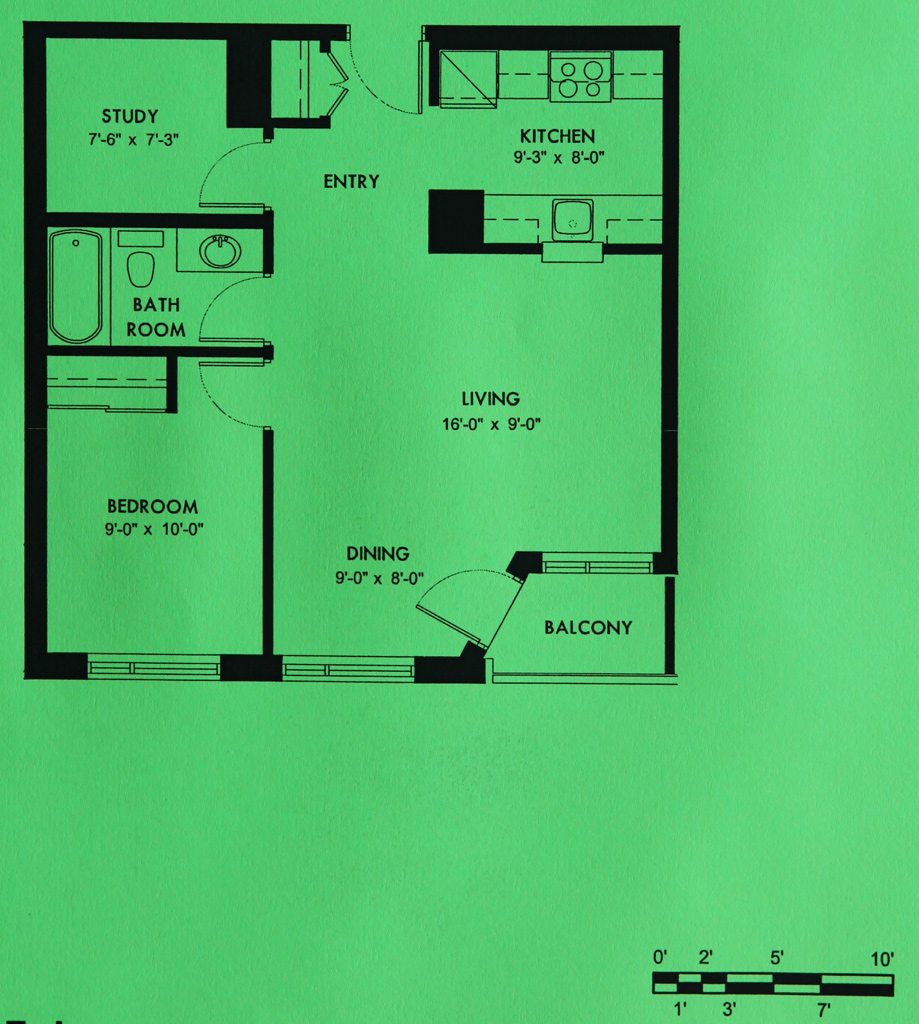
I attended one of their information sessions yesterday, and ended up submitting an application to live in B^2 (as I prefer to think of it). My top two applications were for 683 square foot one-bedroom apartments in 160 Argyle, with this layout:

The balcony and windows look south, into what will eventually be the central garden area. For the immediate future, they will overlook a construction site.

Reading floorplans isn’t something I have much experience with, so if any readers have the mental ability to turn these pictures into an image of what the apartments will be like, I would appreciate your feedback.

The other unit I applied for, as a third choice, is a 602 square foot one-bedroom apartment, located on the 5th floor of 464 Metcalfe. It has this floorplan:

The bedroom window would look north, toward the Museum of Nature, with the balcony above the central garden area.

The rent for each unit is $956, plus various expenses. For the units I selected at 160 Argyle, heating and cooling are $62.83 per month. For that at 464 Metcalfe, it is $55.39. HST, electricity, laundry, and internet would be on top of that. Both places are significantly more expensive than my current place, but I think it would be worthwhile for a couple of reasons: primarily, for the benefit of living in a situation where I would be more likely to meet new people, and in order to encourage more sustainable construction.

Lots of other unit types are available: ranging from bachelors to three bedroom units. Heating and cooling costs are set per square foot.

[Update: 1 October 2010] I got word from CCOC. I will be moving into a place modeled on the first floorplan, on 1 January 2011. It will be on the fourth floor of 160 Argyle. It will be my second non-university-residence home.

What will the future condemn?

Over on Climate Progress, Joseph Romm makes a good case that future generations will condemn us for ignoring climate change. He argues that there are three signs of a behaviour that is common in a society at one point, but which is later widely condemned on moral grounds:

  1. “people have already heard the arguments against the practice”
  2. “defenders of the custom tend not to offer moral counterarguments but instead invoke tradition, human nature or necessity”
  3. “supporters engage in what one might call strategic ignorance, avoiding truths that might force them to face the evils in which they’re complicit”

All of these factors seem to be in play, when it comes to greenhouse gas emissions and the changes in climate they are producing.

As I have done, Romm compares greenhouse gas emissions now with slavery in previous times. Both were once central to the economic sytems of some places, but both impose intolerable burdens on innocent people.

Sprawl and municipal services

On his blog, David Reevely makes a convincing case against urban sprawl that I hadn’t heard previously:

The trouble is, sprawl has costs. It’s incredibly expensive for us all. Light-density housing is great to live in, but it’s brutal to supply with public services. Take fire stations: their response times are primarily a function of how far the firefighters have to drive to get to a call. That means that to maintain minimally acceptable standards, you need to have a fire station every so-many kilometres. If 10,000 people live within that radius, then 10,000 people share the cost of supporting that fire station, its firefighters and their equipment. If you pack 100,000 people into that radius, then the cost is divided among 100,000 people, and you have a lot left over from their property taxes for other things. But if you have too few, and their property taxes aren’t enough to pay for the fire station, then you need to bring in money from somewhere else.

It’s a bit ironic, really. We discussed before how people living in rural areas can get a false sense of their own self-sufficiency. It’s ironic that rather than being bold frontierspeople, living off the land, those who populate the less dense fringes of urban centres might impose disproportionate costs on the municipal authorities.

But if Not

In 1967, Martin Luther King delivered a speech about civil disobedience, entitled “But if Not“. One passage from the speech – which was delivered at the Ebenezer Baptist Church in Atlanta – seems quite relevant to climate change today, particularly when it comes to people who have a high degree of knowledge about the subject:

I say to you this morning that if you have never found something so dear and so precious to you that you will die for it then you aren’t fit to live. You may be thirty eight years old, as I happen to be, and one day some great opportunity stands before you and calls upon you to stand up for some great principle, some great issue, some great cause and you refuse to do it because you are afraid; you refuse to do it because you want to live longer; you’re afraid you will lose your job; or you’re afraid that you will be criticized or that you will lose your popularity; or you’re afraid that somebody will stab you, shoot at you, or bomb your house and so you refuse to take a stand. Well you may go on and live until you’re ninety, but you’re just as dead at thirty eight as you would be at ninety. And the cessation of breathing in your life is but the belated announcement of an earlier death of the spirit. You died when you refused to stand up for right. You died when you refused to stand up for truth. You died when you refused to stand up for justice.

The point about integrity relates to one made by the physicist Richard Feynman, who argued that experts lose their integrity when they allow their conclusions to be publicized – when they are useful to those in power – and allow them to be buried when they are not.

[Update: 19 January 2015] I noticed that the YouTube link in the original post is dead, so here is an audio version.

Climate and HFC-23

I have mentioned before how the gas HFC-23 causes problems in carbon markets. A recent article in The Economist describes the ongoing problem and how it might be addressed. The basic problem is that firms can earn so much for destroying HFC-23, they actually have an incentive to produce it for that purpose:

You cannot simply set up an HCFC-22 plant and demand cash; eligibility is limited to companies which were already producing the gases in 2000-04, and companies are capped in the amount they can receive. But there is little incentive for approved incineration schemes to reduce the amount of HFC-23 that they produce. Quite the reverse, argues CDMwatch, a group that monitors the offset market. It says it has shown the CDM executive board that some plants have reduced their HFC-23 production during periods in which they were ineligible for CERs and upped it when they became eligible again, gaming the system. “They found the smoking gun,” says Michael Wara, a professor at Stanford Law School.

All told, offset systems have a lot of promise. They could allow emission reduction targets to be reached more fairly and at lower cost. It is essential, however, that they be designed and operated in ways that prevent this sort of abuse.

Two kinds of adaptation

When people talk about ‘adaptation‘ in the area of climate change, they usually mean all the activities by which human beings can reduce how vulnerable they are to the expected and unexpected consequences of greenhouse gas emissions. This includes everything from developing drought-resistant crops to designing infrastructure to be able to tolerate sea level rise.

In his essay “Ethics and Global Climate Change” University of Washington professor Stephen Gardiner highlights how human adaptation in response to climate change can take two forms: we can adapt to the unpredictable physical consequences that arise from humanity’s greenhouse gas emissions, and we can set up regulatory structures that restrict greenhouse gas emissions, requiring firms and individuals to adapt their lifestyles and business practices to be appropriate in a carbon-constrained world.

As he points out, the latter type of adaptation is preferable to the former in many ways:

On the one hand, suppose we allow global warming to continue unchecked. What will we be adapting to? Chances are, we will experience both a range of general gradual climatic changes and an increase in severe weather and climate events. On the other hand, if we go for abatement, we will also be adapting but this time to increases in tax rates on (or decreases in permits for) carbon emissions. But there is a world of difference between these kinds of adaptation: in the first case, we would be dealing with sudden, unpredictable, large-scale impacts descending at random on particular individuals, communities, regions, and industries and visiting them with pure, unrecoverable costs, whereas in the second, we would be addressing gradual, predictable, incremental impacts, phased in so as to make adaptation easier. Surely, adaptation in the second kind of case is, other things being equal, preferable to that in the first.

Gardiner, Stephen. “Ethics and Global Climate Change” in Gardiner, Stephen et al. Climate Ethics: Essential Readings. p.12 (paperback)

That strikes me as an elegant way of presenting the situation in which humanity finds itself. Governments can either take the lead and drive a preferable kind of adaptation, or they can ignore the problem until unfolding natural events force a more painful sort.

How to meet Canada’s climate targets

The biggest problem with Canada’s climate change policy is that our plans are not sufficient to meet our targets. Furthermore, our plans aren’t even being implemented.

The government says it wants to cut Canadian emissions to 17% below 2006 levels by 2020, and to 60-70% below by 2050. If they really wanted to do that, they could achieve that outcome simply by doing the following:

  1. Choose a series of annual emissions targets, starting this year and running out to 2050 and beyond.
  2. In each of those years, auction a quantity of permits for the production and import of fossil fuels. Also require permits for activities that generate other greenhouse gases, such as methane. Anybody who wanted to produce fossil fuels, import them, or emit greenhouse gases in other ways would require a quantity of permits equal to their emissions. The price of the permits would be determined by auctioning.
  3. Take the auction revenues and send an equal share to every Canadian each quarter by direct bank account deposit or cheque.

This approach would be simple and fair. It would not cost much to administer, since the permits would be auctioned at as high a level as possible. It would conform to the polluter pays principle, since they would do just that. It would send price signals to consumers, as the firms that bought permits passed along the cost. And the whole system would be revenue neutral, since all the revenues would be returned to Canadians. Critically, it would ensure that Canada hit its greenhouse gas emission reduction targets, each and every year.

This kind of approach is known as cap and dividend.

So, why doesn’t the government just go ahead and do this? The major reason is that people who have emitted greenhouse gases in the past feel that gives them the right to do so in the future. If this plan was put in place, all the industries that have been using the atmosphere as a free dumping ground for CO2, methane, and other greenhouse gases would suddenly need to pay for their waste disposal. This could seriously affect the growth prospects of some industries.

That said, since the cap would begin at current levels and gradually shrink down toward the target, no businesses would get obliterated immediately. They would simply need to adapt, in a fair way, to the kinds of business models required to meet the government’s stated climate change targets. The fact that the government is not pursuing an approach that would cause them to do so is the clearest indication that Canada’s government is not serious about dealing with the issue of climate change.

The ethics of eggs

I have long been of the view that vegetarianism is smart for three major reasons: because of the hygienic problems with how almost all meat is produced, because of the animal suffering associated, and because of the unsustainable character of modern agriculture, especially meat production. That being said, I do think that meat can be ethical to eat, when it is produced in ways that do not have these problems. Indeed, choosing to eat ethical meat may be morally preferable to eating no meat at all, because doing so could encourage the emergence of a better food system.

One problem with the hygiene/suffering/ecology justification is that it applies to things other than meat, including dairy products and leather. As The Economist points out, egg production may be an especially egregious violator of all three sets of ethical norms:

Over the past few decades every sector of American agriculture has undergone dramatic consolidation. The egg industry is no exception. In 1987, 95% of the country’s output came from 2,500 producers; today, that figure is a mere 192. Though the salmonella problem appeared to affect two dozen brands, those were all traced back to just two firms in Iowa, the top egg-producing state. Critics suggest that this shrivelling of the supply chain leaves consumers vulnerable to bad luck or bad behaviour. Inspectors from the Food and Drug Administration (FDA) reported this week that a recent visit to Wright County Egg, one of the Iowan firms responsible for the recall, found rats, maggots and manure piled several metres high at or near the egg-producing facilities. Robert Reich, a former labour secretary in Bill Clinton’s administration calls these “corporate crimes” and argues that “government doesn’t have nearly enough inspectors or lawyers to bring every rotten egg to trial.”

That points to the other culprit: poor regulation. Shockingly, state officials do not inspect eggs in Iowa, and federal authority is fractured among several supervisory agencies. This bureaucratic tangle is a well-known problem. Bill Clinton promised stronger regulations for eggs in the 1990s. Broader reform is needed, advocates have long insisted, as more Americans eat food that is imported, prepared in restaurants and produced at huge plants. In March 2009 Barack Obama created a “food safety working group” to study the existing maze of regulations and suggest improvements. But reform has been too slow. Officials at the FDA argue that stricter regulations that came into force on July 9th would, had they been implemented earlier, have probably prevented the egg crisis. An “unfortunate irony”, declares Margaret Hamburg, the FDA’s boss.

To me, the appropriate response to all of this seems to be threfold:

  1. When possible, avoid purchasing or consuming animal products that are produced in problematic ways
  2. Consider buying such products when they are produced according to high ethical standards, in order to encourage the emergence of producers who use such approaches
  3. Encourage the emergence of laws, regulations, and policies that curb the most problematic practices

Given the way in which most of the world’s meat, eggs, milk, etc come from very problematic sources – and given the degree to which there are animal products in everything – every person who is trying to be conscientious needs to choose a balance point, with convenience and the risk of offending friends and family on one side and ethical ideals on the other. Exactly where that should lie is a personal choice, though information like that in the quoted article certainly provides a stronger factual basis for favouring one side over the other.