Those much-hyped ‘Bloom Boxes’

Now that some figures are on their website, it is possible to comment a bit more meaningfully on Bloom Energy (beyond noting that they can attract a lot of heavyweights to their press events).

They seem to have deployed 3 megawatts of fuel cells in seven installations. That’s twice as much power as is provided by Grouse Mountain’s solitary wind turbine. Of these, two installations (with an output of 900 kW) are running on methane from renewable sources. According to Wikipedia, the fuel cells cost $7,000 to $8,000 per kilowatt. That is extremely high. An open cycle gas turbine power plant costs about $398 per kilowatt. Wind turbines cost something like $1,000 per kilowatt. Nuclear is probably over $2,000 and even solar photovoltaic is cheaper than $5,000. From an economic perspective, natural gas also isn’t the most appealing fuel for electricity production. It has significantly higher price volatility than coal.

Without more statistics, it is impossible to know how the efficiency of these fuel cells compares to conventional natural gas power plants, either before or after transmission losses are factored in. Bloom’s literature says that, when they are using conventional natural gas, emissions from their fuel cells are 60% lower than those from a coal power plant. Frankly, that isn’t terribly impressive. Coal plants generate massive amounts of CO2, relative to their power output. It also isn’t clear whether methane from renewable sources would be more efficiently used in these distributed fuel cells than in larger facilities based around turbines and combustion.

Many environmentalists assume that distributed power is the future, but there are definitely advantages to large centralized facilities. They can take advantage of economies of scale and concentrated expertise. They may also find it easier to maintain the temperature differential that establishes carnot efficiency.

It will be interesting to see how Bloom’s products stack up, when more comparative data is available.

Wave Hub

Despite moderate potential, wave power is one form of renewable energy that hasn’t really gotten off the ground yet. One project in Cornwall is helping to change that. Wave Hub will test four different kinds of equipment for converting wave energy into electricity, producing 20 megawatts of power in the process.

The equipment will be about ten miles offshore.

David MacKay estimates that the UK could deploy as much as 1,000km of wave power generators, yielding four kilowatt-hours per day for each person in the UK. That’s small beans beside the 116 kilowatt-hours that people in the UK actually use, but we need to be looking into all available renewable options.

Best books of 2009

Back in 2007, I put up a post listing my five favourite books of the year. Somehow, I missed 2008. Despite that, I am still happy to assert that the 2007 list includes some of the best books I have ever read.

Among the books I read in 2009, these are the five I most emphatically recommend:

It was a tough choice.

Margaret Atwood’s The Year of the Flood would be a natural successor to Oryx and Crake back in 2008. Unfortunately, the better book of the two remains the original.

If I had read Jared Diamond’s Collapse: How Societies Choose to Fail or Succeed soon after it had come out, it might have been one of my choices. That said, it is a compelling and important book.

Richard Dawkins’ The Greatest Show on Earth: The Evidence for Evolution certainly deserves a nod. For anyone who wants a comprehensible account of why we know as much about evolution as we do, this is the book to read.

You can read all my book reviews here.

I may eventually cook up a retroactive 2008 list.

Past lives of climate deniers

My friend Antonia sent me a nice article by Jeffrey Sachs, describing what today’s most prominent climate change deniers were doing, before they took up this cause:

Today’s campaigners against action on climate change are in many cases backed by the same lobbies, individuals, and organisations that sided with the tobacco industry to discredit the science linking smoking and lung cancer. Later, they fought the scientific evidence that sulphur oxides from coal-fired power plants were causing “acid rain.” Then, when it was discovered that certain chemicals called chlorofluorocarbons (CFCs) were causing the depletion of ozone in the atmosphere, the same groups launched a nasty campaign to discredit that science, too.

Later still, the group defended the tobacco giants against charges that second-hand smoke causes cancer and other diseases. And then, starting mainly in the 1980s, this same group took on the battle against climate change.

What this reinforces is how artificial the climate change denial movement is. Status quo actors, from Duke Energy to Saudi Arabia to Canada’s oil-sands-funded politicians, want to avoid climate change legislation. They have found some shills happy to spread confusion, in order to advance that aim. What is sad is how many ordinary people have lined up to be duped.

Evaluating existing climate change information

This may strike some people as abstract, but perhaps it will be of interest to someone.

Assume, to start with, that climate change is a major threat to humanity and that concerted global effort is required to deal with it. In that case, I see two possibilities:

  1. If all of humanity and all human knowledge were put in an abstract place together and given all the time they needed to educate one another, consider the data, and deliberate, they would come to a conclusion that strong climate change mitigation action ought to be undertaken.
  2. Even with all our current information and unlimited time, this conclusion could not be widely endorsed. It may, however, be the case that the people in this abstract space would reach the conclusion that we must act, if only they had some new information that we have not yet observed or collected.

Part of the answer involves the depths of human ideological and theological beliefs. If there are people who can never be shaken in their belief that the world is benevolent and concerned about humans, they could never be convinced otherwise by education or information. Part of the answer may have to do with the overall relationship in human beings between perceived risks and the willingness to take precautionary action. That said, I am convinced that an impartial assessment of climate science and the situation we are in would lead most any rational human being to endorse a precautionary approach.

I am similarly convinced that people in my ideal case would eventually overwhelmingly support aggressive mitigation actions. I don’t think human beings would be happy to expose all future generations to the risk of misery and possible extermination, just so they can avoid a transition to renewable energy that would be necessary regardless of climate change, and which can probably be accomplished for a few percent of GDP, spread over many years.

Of course, the real world is very different from my little imagined experiment. Time is important here. If climate change deniers can keep the public confused for another 20 years, that will have a huge impact, even if they could eventually have been unmasked as self-interested charlatans in my infinite-time case. Time can also work to our advantage, however. Striking new information can come to light and, in so doing, it can have an effect on what beliefs and priorities people hold faster than old information would be able to do in an education-and-discourse manner. For example, if we were to observe a drought of unprecedented scale and severity, it might have a big impact on the willingness of people to endorse the kind of high-level policies and actions necessary to curb the harmful influence of human beings on climate (or perhaps not).

What do you think? Would people reach a consensus in favour of strong mitigation action, given all the information and infinite time? If not, what further information might they require? In either case, what is the effect of the differences between my ideal infinite-time case and the real world, in which our choices in the next couple of decades will do much to determine where the climate ends up?

Seeking certainty about climate change

I have written before about the problem of what can and cannot be known about climate change, given that we only have one planet to experiment on, and our simulations will never be accurate beyond question. Here is another expression of the same basic idea. I am trying to figure out the most effective way to convey this information to people who don’t think we should be taking aggressive action on climate change.

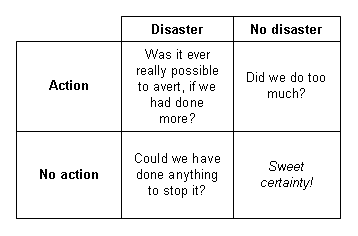
This chart shows four possible situations that humanity could find itself in, 100 years or so from now. Either climate change has been disastrous or it has not been, and we either took strong action to deal with it or we did not:

As you can see, there is only one situation in which we can be absolutely sure we made the right choice. Even that is a bit ambiguous, though. Imagine the decision isn’t about climate change but about Russian Roulette. If we are alive after the game, but we did choose to play, can we really be said to have behaved prudently? The sheer fact that the chamber didn’t turn out to be loaded doesn’t mean that we were intelligent to run the risk, back when we didn’t know that for sure.

Imagine two snakes, both of which look very similar. One is deadly venemous, and the other is benign. If the best information we have at hand suggests that there is a good chance we are dealing with the venemous one (say, because we are in the region where it usually lives), the prudent thing is certainly to behave as though the snake may be venemous. Even if you learn later that it was not, nobody will think you were a fool for acting that way. The climate science we have now is providing good reasons to think that we are dealing with a deadly snake of a problem.

In short, the science will never be settled in the sense that it will tell us exactly what to do. All it can do is become clear enough to make the prudent choice obvious to most people.

Obama’s nuclear loan guarantees

President Obama has announced that the federal government will provide $8 billion in loan guarantees for two new reactors: the first to be built in the United States since 1979. The guarantees mean that, in the event that plant owners cannot ultimately pay their bills, the government will step in with the promised funds.

There are many reasons to be wary of nuclear power as a climate change solution, with cost and deployment times perhaps the most important (climate change is more threatening than waste, accidents, and proliferation). That said, we need to nearly phase out fossil fuel emissions by the middle of the century. Despite the thirty-year gap in construction, nuclear is still the most important zero-carbon source of electricity in the United States.

It remains impossible to know the true cost of nuclear power, once all the explicit and implicit subsidies are taken into account, as well as connections between military and civilian programs. That said, it looks like we need every low-carbon energy option available.

China and other developing states

Leaked Chinese documents claim that Canada and other developed nations have “connived” in a “conspiracy to divide the developing world.” It’s not surprising that China wants to be treated in the same way as extremely poor developing states, from whom no costly action is expected. At the same time, we just cannot afford to treat China and India like Mali or Guinea. The kind of climate future generations will live in is being affected strongly by choices made in Beijing and Delhi. That needs to be recognized – as does the need for India and China to accept emissions curbs.

This isn’t to say that India and China don’t have any claim to special treatment. Their per-capita and historical emissions are both low. That being said, the special treatment they receive cannot take a form that allows them to pursue the sort of high-carbon development track they have been. Unfair as it may be, they are going to need to develop primarily on the basis of low- and zero-carbon forms of energy (at the same time as developed states are aggressively cutting back on fossil fuel use) or we will get into a situation where it becomes very difficult to imagine how catastrophic climate change could not occur.

The great majority of the world’s emissions come from a dozen or so countries. Getting them on track towards carbon-neutrality is essential. That isn’t the case when it comes to small and very poor states who can be brought in line later without serious consequences. There is no need to be conspiratorial about it, but China and India really must be divided from the rest of the developing world.

RealClimate on IPCC errors

RealClimate has put out a comprehensive assessment of the various errors that have come to light in the IPCC AR4 – IPCC errors: facts and spin. It includes the Himalayan glaciers claim, sea level in the Netherlands, African crop yields, disaster losses, Amazon dieback, and the ‘gray literature’ controversy.

They highlight the distortions the media has perpetuated in reporting these stories, as well as provide an assessment of whether climate science remains sound, in spite of these errors and controversies:

In some media reports the impression has been given that even the fundamental results of climate change science are now in question, such as whether humans are in fact changing the climate, causing glacier melt, sea level rise and so on. The IPCC does not carry out primary research, and hence any mistakes in the IPCC reports do not imply that any climate research itself is wrong. A reference to a poor report or an editorial lapse by IPCC authors obviously does not undermine climate science. Doubting basic results of climate science based on the recent claims against the IPCC is particularly ironic since none of the real or supposed errors being discussed are even in the Working Group 1 report, where the climate science basis is laid out.

To be fair to our colleagues from WG2 and WG3, climate scientists do have a much simpler task. The system we study is ruled by the well-known laws of physics, there is plenty of hard data and peer-reviewed studies, and the science is relatively mature. The greenhouse effect was discovered in 1824 by Fourier, the heat trapping properties of CO2 and other gases were first measured by Tyndall in 1859, the climate sensitivity to CO2 was first computed in 1896 by Arrhenius, and by the 1950s the scientific foundations were pretty much understood…

All of these various “gates” – Climategate, Amazongate, Seagate, Africagate, etc., do not represent scandals of the IPCC or of climate science. Rather, they are the embarrassing battle-cries of a media scandal, in which a few journalists have misled the public with grossly overblown or entirely fabricated pseudogates, and many others have naively and willingly followed along without seeing through the scam.

Unfortunately, it remains clear that a large amount of damage has been done by these media misrepresentations (both active and passive). They have helped to sap the energy that existed, pushing for meaningful climate policies. And they have given those trying to actively delay mitigation efforts much more fodder to confuse the public and encourage inaction.

BuryCoal.com

In brief, I am starting a new group blog at BuryCoal.com. It exists primarily to make the case for leaving coal and unconventional fuels underground, where they cannot harm the climate.

The reading I have done in the last year has highlighted a few important perspectives for me, when it comes to climate change. The most important thing is humanity’s total cumulative emissions. As such, it is not enough just to use fossil fuels more efficiently. We need to stop using them long before they run out: particularly, before the world’s massive reserves of coal and unconventional fossil fuels are tapped. The warming that would arise from burning all the coal, oil sands, shale oil, and methane clathrates would be far greater than that caused by burning conventional oil and gas.

Government plans that include serious restrictions on the use of coal and unconventional fossil fuels have a chance at being compatible with avoiding dangerous climate change, while those that treat this as a side issue do not.

In order to spread the word about the importance of leaving coal and unconventional fossil fuels in the ground, I have launched a new website at BuryCoal.com. It will be accepting submissions on all matters relating to coal and unconventional fossil fuels, including extraction, air and water pollution, climate change impacts, politics and activism, and more. I don’t think there is any other site out there with its main focus on the message that these fuels must be left in the ground, for the sake of improving our chances of experiencing catastrophic or runaway climate change, and on account of the other benefits that accompany moving beyond them. Those include reduced pollution and destruction of habitat, as well as reduced dependence on fossil fuels which will inevitably run out anyhow.

I would really appreciate if visitors to this site would do three things to help with the new project:

  • Please read and comment on the entries on the new site
  • Please let other people know about it
  • If you have something to say on a topic within the subject area, please submit a contribution

The kind of world our grandchildren and great grandchildren end up living in will depend a great deal on what proportion of these fuels we dig up and burn. BuryCoal.com has been established to be the antithesis to “Drill, Baby, Drill” and make a forceful and well-reasoned case for leaving all that carbon safely underground, while moving to a zero-carbon, renewable global energy system that can sustain human prosperity and civilization indefinitely.