Ice and solar power

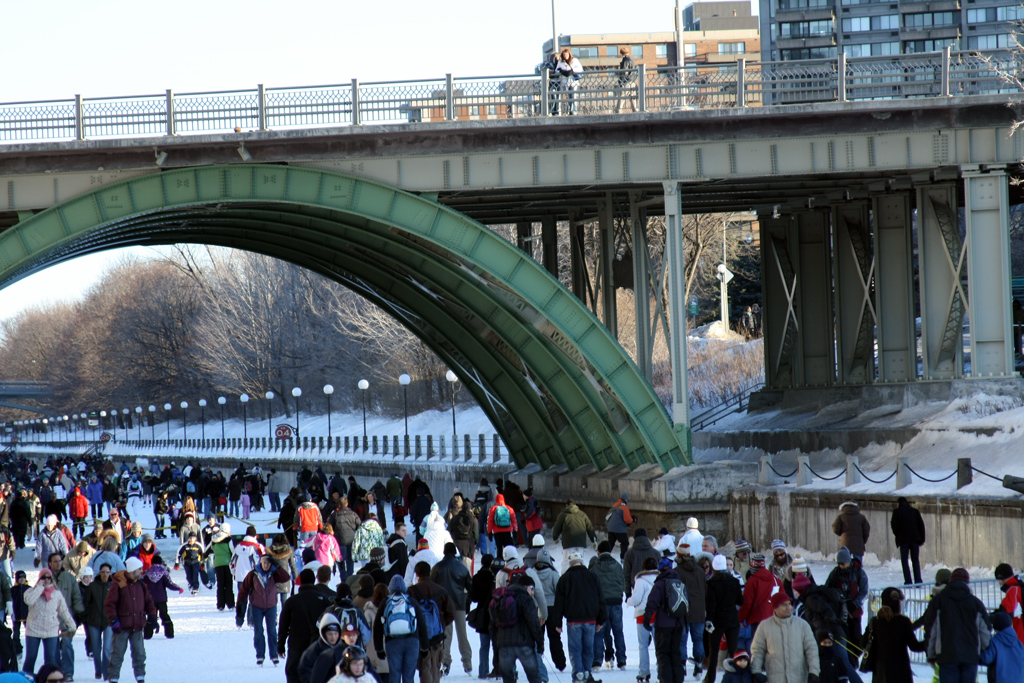
Indirectly, Ottawa winters provide a good demonstration of just how immense a quantity of solar energy there really is on this planet. Consider the fact that the Earth’s axial tilt produces thirty degree weather here in the summer and negative thirty degree weather here in the winter. Walk out onto the frozen surface of Dow’s Lake and think about how the only reason the lake is ever liquid is because of the massive amount of solar energy striking it in the spring and summer. Then, recall that all the lakes and seas everywhere on Earth would freeze solid without the constant solar influx. This is well illustrated by the frozen moons in the outer portion of our solar system.

Burning all the world’s fossil fuels wouldn’t let us keep oceans liquid, in the absence of solar assistance. Moving to an energy system that relies directly (solar photovoltaic and concentrating solar) or indirectly (wind, hydroelectricity, biomass) on the sun is an overwhelmingly important part of creating a sustainable society. The amount of energy available to harness vastly exceeds the amount we can drill or dig up out of the ground.

Winter moods

Today’s sharp, dry cold makes for a nice contrast to yesterday’s Slowly Melting City. As much as you might think a brief return to fall weather, in the midst of winter, might be pleasant, it seems to be the case that once this city is well frozen, it does best to remain that way.

The special hazards of the melting city are the combination of speeding cars with deep, slush-filled pools, as well as wind-blown tiny droplets of water that threaten any lenses or electronic equipment not well stowed in bags. Taking photos in wind-blasted rain or wet snow is nearly impossible, provided you don’t have an assistant to carry around a beach umbrella for you. Walking to work yesterday, there were three points where I had to choose between wading through a sidewalk submerged in ten centimetres of muddy slush water, or jumping the barrier onto the roadway and making a mad dash around the pool while the flow of cars was interrupted by a red light. Each time, I decided to take the rapid roadway approach – a series of decisions which left me with dry feet and a bit more aerobic exercise.

One effect of the bus strike has been to make me much more aware of the weather. Essentially, that is on account of having to spend longer spans outside, and having no transport alternatives to walking when the weather suddenly changes. As such, I have been lugging around enough wool at most points in time that, should the need arise to re-clothe a sheared sheep, I would probably be able to do so.

The cold in Ottawa

In my experience, Ottawa has a pretty standard multi-level system to how cold it is in any particular environment. This is reflected on two scales: a static scale based on how cold you would feel in ordinary indoor clothes and a dynamic scale based on what you were wearing in order to deal with the conditions shortly before.

This is the dynamic scale:

  • The hottest part of the scale is where you are seriously bundled up and unexpectedly delayed in a warm environment. For instance, you hop onto a bus to go a couple of stops and it gets stuck in traffic. You are about to go out, so you don’t want to disrobe, but remaining in the heat is very uncomfortable.
  • The level varies depending on the amount of wind. Sometimes, it is the ordinary transition from being outdoors to being in a warm building or vehicle. Sometimes, it is the transition from being somewhere windy to being somewhere outside but protected. In some cases, the latter transition is actually far harsher. There have been times when after waiting for a bus in an exposed area, I moved to a covered area and felt almost as warm as in the topmost scenario above.
  • Below those is the neutral level, in which you are basically adequately dressed for your surroundings and can operate comfortably for a good period of time at your current level of activity.
  • The next level is cold due to something lacking: either the result of being slightly less active than you were recently, or because you are missing one or two items that would make you comfortable. For me, those things are most often a hat, adequate gloves, or warm socks overlapping with long johns.
  • The next level is being significantly cold temporarily, either while your body heat spreads through clothing you just put on or while you ramp up to whatever stable level of physical activity you will be maintaining.
  • With the next level, minor persistent suffering arrives. Usually, this is the result of poor planning. Most often, this is a case of not expecting to leave a place as late as you did and ending up walking by night instead of by evening. Wind of unexpected ferocity can also cause this.
  • Beyond that, the levels aren’t really distinct. At the extreme edge – which I have experienced once or twice – you are actually cursing your way through savage winds from doorway to doorway. In this situation, you will actually feel that injury (and ultimately death) will result before long if you remain out in the cold and wind.

In my experience, the best way of coping with all this is to be prepared, try to anticipate the conditions in which you will find yourself, and dress in ways that are conducive to moving both up and down the scale. Having long johns, a wicking layer, two fleece layers, and a wind/waterproof outer is a lot better than having a wicking layer, one absurdly warm layer, and a shell. The former lets you move through the scale in one-step increments, while the latter commits you to two or more.

One odd consequence of the relationship between warmth and activity can be just how much those of us with stingy thermostats need to wear in order to sleep comfortably. On nights where walking around in moderate garb is perfectly tolerable, actually sleeping in my flat may require two wool hats, long johns, trousers, a fleece, two pairs of warm socks, a fleece sleeping bag liner, and a down duvet. The question then becomes whether you will be woken by cold as the night progresses (likely if you went to sleep early), or by unbearable heat when the sun finally starts to thaw the city at dawn.

Climate change and forest management

Forest management is an area where climate-related challenges are considerable, particularly insofar as they relate to other ongoing developments. A case in point is forest fires. At one point, the ecological view was that fire suppression was beneficial for forest ecosystems. Now, it seems that the tide of opinion has shifted to the belief that fires have an important role to play in regulating forests. For instance, they are important for the propagation of giant redwoods (Sequoiadendron giganteum). Fires both clear the underbrush of plants that compete with the redwoods and cause redwood cones to open and release seeds. Also, the suppression of fires in British Columbia has increased the proportion of aged pine trees, which are more vulnerable than young ones to mountain pine beetle.

At the same time as fires are being recognized as an important natural element in forest life, we know that climate change is causing more and worse fires in North America, and will continue to do so. Should we step back from fire management, in the hope that fires will bolster biodiversity and resilience, or should we be more active in suppressing fires, so as to partially balance-out the warming effect of our emissions?

This touches upon a related question for conservation lands: namely, how should we respond to shifting biomes in parks? If a northern park like the Wapusk National Park in Manitoba seems likely to transition from taiga and tundra to boreal forest, should those charged with protecting it try to resist that change? The same question arises in relation to parks like Prince Albert National Park in Saskatchewan, where a transition from boreal forest to savannah and woodlands seems likely. It is entirely possible that nothing meaningful can be done to slow or stop the transition, but the possibility of doing so raises the question of what it means to protect nature in an era where no corner of it is unaffected by human activities.

One thing that we should certainly consider is doing a lot less monoculture planting. Regardless of whether the threat in question is weather, pests, or disease, a forest that contains a mixture of plant and animal species will be more resilient than one containing only a few. Hopefully, that is one of the major lessons that will be drawn from the ongoing mountain pine beetle outbreak in B.C.

Mycelium Running

Paul Stamets’ Mycelium Running: How Mushrooms Can Help Save the World is an informative text, written by a true believer. While it contains a lot of practical information, the author’s unbridled enthusiasm sometimes makes you doubt how valid the more fantastic claims are. That being said, it certainly provides some concrete and believable examples of situations where the strategic use of fungi can have beneficial health and environmental effects.

After providing some basic information about the biology of fungi, Stamets covers four different kinds of ‘mycorestoration.’ He shows how patches of mycelium (the tangled, stringy mass that makes up the bulk of fungi) can be used to filter water flowing through – an application that might have particular value downslope from farm animals. The section on mycoforestry shows how mushrooms can accelerate the breakdown of debris from logging, allowing nutrients to return to the soil. It also addresses the ways in which mycorrhizal fungi on the roots of plants can enhance their growth and health. In a section on mycoremediation, Stamets highlights the ability of different fungi to digest or absorb toxic materials ranging from crude oil to nerve gas to radioactive strontium. Finally, a section on mycopesticides describes ways in which insect-attacking fungi can be used to prevent and cure insect infestations.

In addition to the sections outlining the potential of fungi in general, the book includes a lot of practical information about different types of mushrooms, their uses, and how to grow them. It covers different ways of going from spores to a mushroom patch, at scales ranging from a small garden installation to the very large scale. The last hundred pages is a species-by-species catalogue of different mushrooms: how they look, how to grow them, nutritional information, etc. The assertions about mushrooms having intelligence (partly on the basis of mycelium looking like neurons in a brain), I definitely have my doubts about. The step-by-step instructions on producing mushroom patches, I have no doubt could be invaluable to someone wishing to put fungal theory into practice.

Fungi are probably the class of organisms least well understood by most people, and it is rewarding to gain a deeper understanding of the roles they play in ecosystems. More information can be found on Stamets’ website, which also sells various types of mushroom kit and spawn.

Cyclists running red lights

A few minutes ago, while I was cycling east on Somerset in search of groceries, I came up behind another cyclist heading in the same direction. She was dressed in all black, wearing earmuffs, and not using any lights or reflectors. As we approached an intersection near the Umi Cafe, the light went red. She carried on for 1/3 of a block, went right through it, and carried on beyond there.

When I caught up with her in the next block, I stated bluntly that riding right through a red light is a crime, and that doing so when it is nearly completely dark, you aren’t illuminated, and when others may be about to make left turns is fairly dangerous as well. As cyclists, we cannot expect drivers to expect invisible, illegal moves on our part. We definitely bear primary responsibility for any accidents that result.

This being Somerset Street, I found myself stuck at the next red light, engaging in a very awkward (though not hostile) back-and forth-about the importance of illumination and following traffic rules. Less expectably, but more awkwardly, I ran into her again at the Herb & Spice checkout: she buying organic cranberries, me buying sun-dried tomatoes, red peppers, and hot sauce. To her credit, she was very courteous about the whole thing, and seemed to take my commenting as well-intentioned scolding rather than a maliciously motivated personal attack.

I do believe it’s very important for cyclists to make themselves visible and behave legally and predictably in traffic. A lot of drivers who are generally sympathetic to cyclists seem to consider the violation of traffic rules as the most objectionable thing about bikes. It is also sensible and efficient to require cyclists to follow minimum standards in terms of conduct and visibility: taking responsibility for those elements of their own safety they can actually control.

Despite her tactful responses, I hope I don’t run into her at a future dinner party, Ottawa event, etc.

Re-jacketed

I once again have cause to praise the excellence of Mountain Equipment Co-Op as well as W. L. Gore & Associates. Two years ago, I got one of their excellent but now discontinued Aegis rain jackets. Recently, I noticed that a patch on the back near my right shoulder was starting to de-laminate: the Gore-Tex was coming apart from the nylon.

I took the jacket into MEC today to ask if there was any way to stop the patch from spreading. They told me that Gore-Tex has a lifetime guarantee that their jackets will not delaminate and that they would refund me the original purchase price. I used it towards a new MEC Synergy Jacket. It is dramatically lighter than the Aegis and has waterproof zippers instead of flap-covered ones. The only obvious downside is that there are fewer and somewhat less capacious pockets. The new jacket is less cumbersome and takes up less space in a pack. It is also made from Gore-Tex Pro Shell, which is supposedly more waterproof and breathable than the Gore-Tex XCR the Aegis was made from. I hope I get the chance to climb some rainy mountains in the new garment – ideally back in British Columbia.

The frogs in the coal mine

A recent study conducted by the Zoological Society of London concluded that half of Europe’s amphibians could be extinct by 2050. There are two obvious ways to consider the news. Firstly, it is evidence of the enormously destructive effect human beings have on vulnerable ecosystems. Secondly, it raises questions about whether humanity itself will be able to survive the catastrophe is it creating. Amphibians have been around for 400 million years. While there have certainly been times in which a large proportion of them have died off, those times have been been listed among the catastrophic extinction events that have punctuated the history of life on Earth.

In short, the impact of the global economy is becoming comparable to that of major meteor strikes, mass volcanic events, large changes in sea level, and severe changes in atmospheric composition that have occurred in the past. For those who do not believe that humanity inhabits some special protected position in the cosmos, that seems like cause for very significant concern.

Ultra powerful bike lights

Want to make absolutely certain drivers will see your bike in even the worst weather conditions? Dinotte sells LED head and tail lights with up to 600 lumens of brightness. They run for 3.5 to 7.0 hours on lithium-ion rechargeable batteries and cost a hefty $160-$400 a piece.

Still, that is a lot cheaper than the total costs associated with getting hit by a car.