Precipitous morning

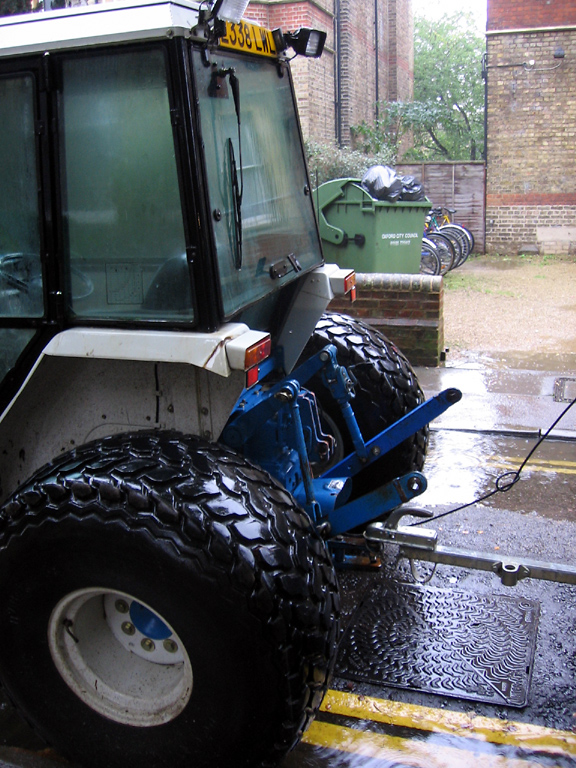
Church Walk inundated

Today’s morning deluge offered me the first real test for my present wet-weather ensemble. Amid very intense rain, I cycled with considerable exertion for several kilometres, while layered with Gore-Tex from toes to helmet. The mad people you see cycling in the rain with just hoods on may be keeping their bangs dry, but they are flirting with doom. Just imagine having to pass in front of a bus, at speed, with low visibility while skirting the cycle line that has become a moat after the rain overwhelmed the drainage system, and you begin to understand my concern.

The Helly Hansen waterproof breathable pants and North Face Gore-Tex shoes had proved their worth previously, (though the shoes become unusually hot and internally damp in very hot weather). As when I went hiking in North Van with Kate, I was impressed by the impermeability of the Mountain Equipment Co-Op (MEC) Aegis jacket that I got in Vancouver. Even more impressive is the breathability, which is substantially better than that of my old two-ply Eddie Bauer Gore-Tex jacket, even when it was new. Nearly getting hit by an Oxford City Council lorry that had decided to swerve to avoid a massive puddle in the middle of Banbury Road also made me glad for the choice of startling red as the colour.

All that said, I have always taken a certain pleasure in enduring despite the weather. As such, I am not bitter that I have a string of tasks to accomplish all over Oxford today – from having student loan forms endorsed by the college and jetted off to tracking down readings for tomorrow’s core seminar.

PS. This electron micrograph of the Gore-Tex membrane is pretty cool looking. Somehow, ‘thermo-mechanically expanded polytetrafluoroethylene’ fails to automatically conjure an image in my mind.

North Vancouver hydrology

In the last few days, I have twice been up to the Capilano Reservoir. Located behind Cleveland Dam, it provides much of the drinking water for this part of the city, though it does not generate electricity. I don’t think I have ever seen it at low as it is now. At the top of the dam is a kind of huge rolling blockade that can be raised or lowered to adjust the water level in the dam across a particular range. At present, it is all the way down and there is no water flowing over it. Likewise, there is a larger section of the lake bed exposed than I have ever seen before.

Since the reservoir is normally fed by snowmelt and glacial runoff, every time there is a warm winter we start having water problems. It is even worse when what little snowpack there is is melted early in the summer by high temperatures. Since the dam is unable to hold more than a set amount, it can be necessary to vent a great deal of that excess flow – flow that would be much appreciated a few months later.

As far as I know, there are no rigorous water use restrictions in place, so the hydro engineers must be confident that this supply will see us out until Vancouver’s most rainy winter season begins. For the sake of water supplies next summer – and friends moving to Whistler to ski – I hope that most of that precipitation comes in a solid form, both above a certain altitude and in the area to the north of the city.

Sunday hike adjustment

Because of problems securing both cars and drivers, there is a good chance that the hike on Sunday – following the party at my place on Saturday – will not actually be to Petgill Lake. It’s too far, and I cannot be sure that rides will be available.

The (very good) fallback is to catch the bus up to the Grouse Mountain parking lot, then take the British Columbia Mountaineering Club (BCMC) trail up to the top, since the Grind is closed. From there, we would progress to the majestic view that exists off the top of Crown Mountain.

If you care to provide a vehicle or a driver, speak now. If you are mortally opposed to Crown Mountain as a possibility (it is a bit strenuous, but the view is great), this is likewise the moment to air your grievances.

Jonathan journeying

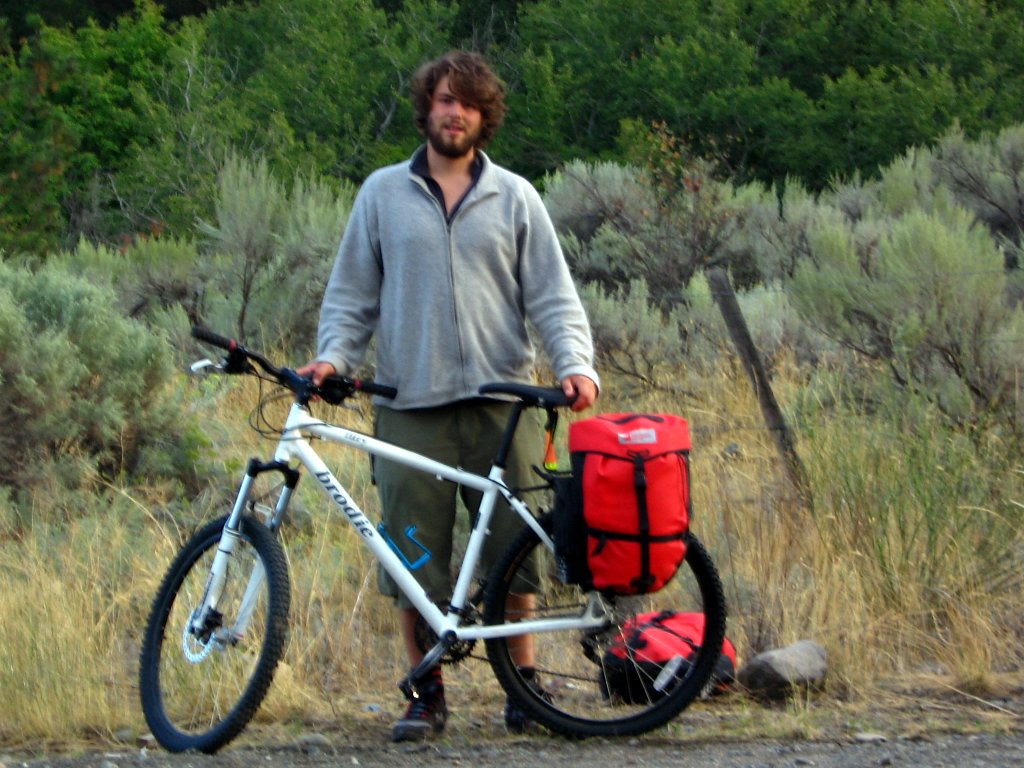
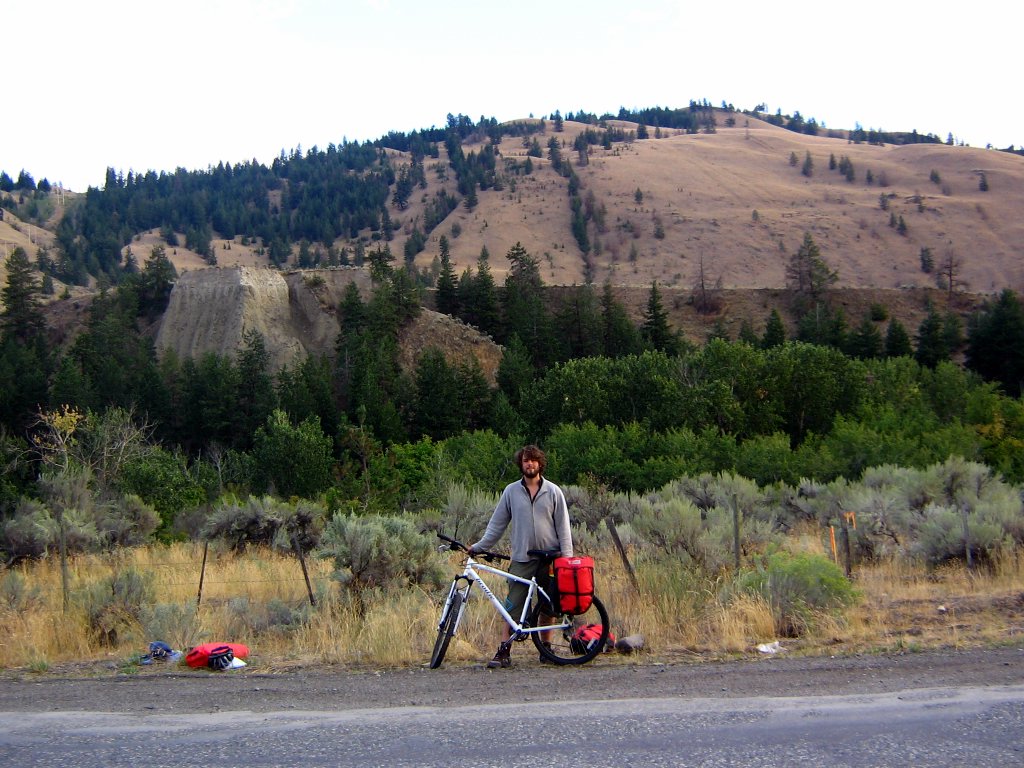
Rather than return home with the group, Jonathan was dropped off in Kelowna so as to cycle back to Vancouver over the course of several weeks. Lauren sent me a couple of photos of him, just as he was dropped off: one, two.

Altogether, it is an impressive undertaking. Driving from Kelowna took more than five hours, and he means to make some side expeditions as well. There is one in particular to a place that I have heard said but never seen written; as such, I cannot write it.

I hope the solitude and exertion of more than a week on various British Columbian roads proves enjoyable to Jonathan. Not seeing him again before I leave is a shame, but perhaps he will make it over to the UK before I leave there.

A bit on Oxford’s canals

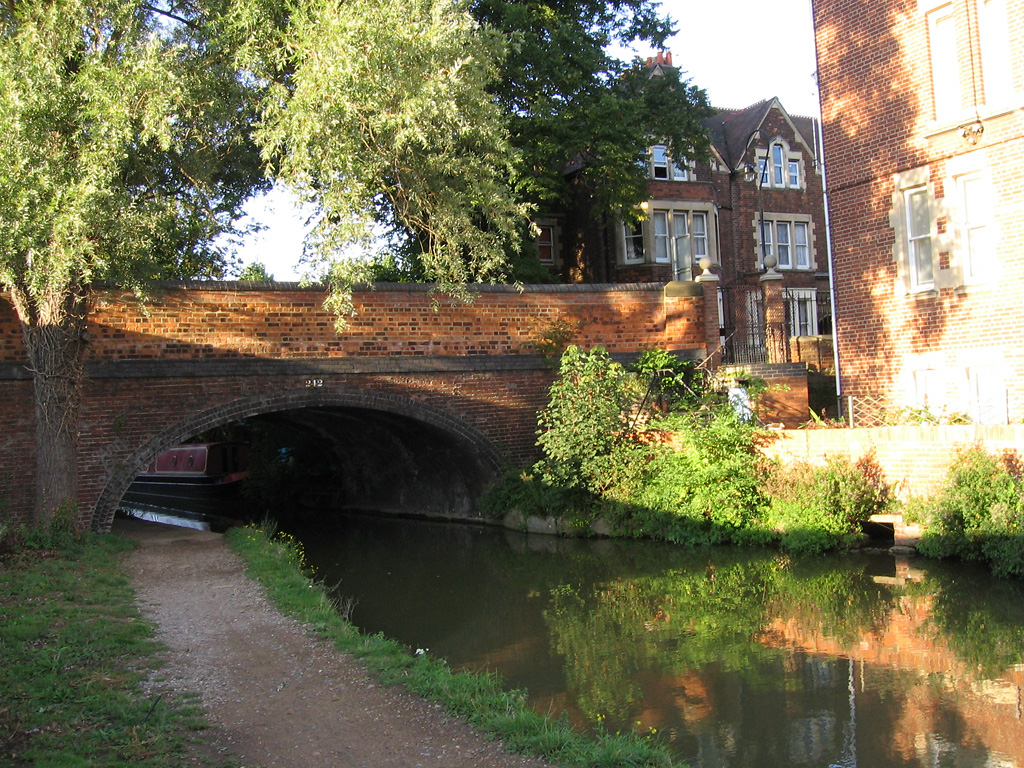
Bridge over the Oxford Canal

Oxford’s canal system is one of the more interesting parts of the county to explore. They certainly look as though they harken from a departed era of red brick and steam powered industry. Nonetheless, they have a good modern role as walking paths, cycling routes, and waterways for the longboats that seem to form a curious sub-culture of British life. There are a great many of these artificial waterways, criss-crossing the countryside and sometimes meeting with the Isis, but I have only traveled the length of a few. I mean to learn more about the canals and the longboat culture before I leave here; can anyone recommend a book?

There is an ongoing controversy about one stretch of the Oxford Canal that is owned by a company called British Waterways. I really don’t know enough about it to comment, but I have seem some pretty bold statements spray-painted on the plywood with which the former boatyard has been fenced around.

As I mentioned before, the primary danger relating to the canals, if you are a cyclist, is the probability of kamikaze insects blinding you for long enough to send you careening over the edge. This has nearly happened to me quite a number of times. As when boating, this is a case where the wise wear sunglasses.

PS. Despite being in Oxford all summer, I have yet to go punting. I hope once people from the program start returning en masse both the weather and the enthusiasm will be in place for a late summer bout.

Desert Island Discs

A friend of mine challenged me to come up with the collection of items that I would submit to ‘Desert Island Discs’ – a British radio show in which interview subjects are questioned about what they would bring along to soften the experience of being stranded on a desert island:

“Created by Roy Plomley in 1942, the format is simple: each week a guest is invited by Sue Lawley to choose the eight records they would take with them to a desert island.

The discussion of their choice is a device for them to review their life. They also choose a favourite book (excluding the Bible or other religious work and Shakespeare – these already await the “castaway”) and a luxury which must be inanimate and have no practical use.”

First off, I must complement the erudite Gideons who have already stocked the world’s islands not only with Bibles, but also with Shakespeare’s works. Am I allowed to bring Paradise Lost or a book with spiritual importance for me as my “Bible or other religious work?”

Music

Starting with the choice of musical albums, this is no easy matter of selection. I have 667 albums in iTunes alone, and this is a time at which the term ‘album’ is rapidly losing meaning. Thinking about, for instance, how often artists have taken to re-organizing, re-mixing, and re-combining their tracks, the medium of album is becoming more like that of the playlist, of which I have only a few dozen. Of course, each of those is rather too long to fit on a CD (even as data files) and would most definitely not fit on a record, so I am back to the contemplation of albums.

One natural way to proceed would be to choose eight critical artists and then simply select either their best work, or the work that you think would stand up best to very frequent re-listening. In the interests of fairness, I will treat two-disc albums (such at Tori Amos’ To Venus and Back or the Smashing Pumpkins’ Mellon Collie) as two albums, if chosen.

I have long treated music partly as a mechanism for altering moods. Given the dire desert scenario, it seems wise to think that way when planning.

In no particular order, then, my albums would be:

  1. Jason Mraz – Live at Java Joe
    This quirkly live album has an unusual ability to cheer me up, despite the fact that I have heard it so many times I know not only the words, but the timing of all the instruments, by heart. I expect this will be true of all the selections. This is a somewhat difficult thing to choose, because I think five of the thirteen songs are no better than mediocre, but I am going to stick with it for the moment.
  2. Spirit of the West – Save this House
    When going mad in the heat, it seems to me that it would be important to have some record of where you came from. Since Spirit of the West is from Vancouver, they get one such point. Given that they are a band and a style of music introduced to my brothers and I by my father when we were children, they get another. The fact that it’s an excellent album in and of itself cements the choice.
  3. The Doors – The Doors
    Choosing which Doors album to bring is awfully difficult. This is one of those situations where playlists are superior to albums. Likewise, it seems inappropriate to choose one of their many ‘best of’ collections. Despite the absence of some of their best songs, I would have to go with their 1967 debut album.
  4. Simon and Garfunkel – Bridge over Troubled Water
    Choosing a S&G album is even harder than selecting from among those of The Doors. Practically each has a song or two I would put on my own custom desert island disc. Choosing from among their original albums, this would be the one.
  5. Idan Raichel – Mimamakayim
    Bringing at least one album that isn’t in English seems well advised, and this is probably the best one I have heard. While I may not be able to speak a word of Hebrew at the moment, perhaps hundreds of hours of desert island listening would elevate my consciousness – or my imagination – to the point where I think I know what it is about. Even if such a thing doesn’t happen, it can be treated as a piece of classical music with an unusually versatile and emotionally engaging instrument.
  6. Led Zeppelin – IV
    This is an album that I feel myself growing into, to some extent. When I first got it, ‘Stairway to Heaven’ was the only song I could stand, and then only the relatively melodic bits. I would bring it in hopes that my steadily growing appreciation for the album as a whole would mature. I am almost tempted to bring an album that I flat-out do not like, but which friends rave about, but unfortunately haven’t the space for such an experiment.
  7. Pink Floyd – Wish You Were Here
    Not their longest or most celebrated language, I think it is their most sophisticated and intriguing. There is no denying that one would have time to sort out all the complexities given days and weeks.
  8. Tori Amos – To Venus and Back (Live Disc)
    All my friends will have seen this one a mile off. While I maintain that Tori Amos is a musical genius in general, she is especially capable as a live performer. While a recording cannot capture the energy of a concert, this one does an appreciable job.

Naturally, lots of albums were very close to making the cut. It is not necessarily that I think these are my eight best albums – the circumstances of where they are to be enjoyed have been taken into consideration. I have intentionally not considered classical or opera albums, because that would make the selection too daunting.

Book

This is a tough one indeed. The first obvious choice is between taking something you have read and enjoyed or bringing something new. I would opt for the former. Chances are, you will read this book many times. As such, however many times you read it before arriving will soon be trivial. Out the window goes Ulysses, then, which I have tried to read four times but never managed to progress more than fifty pages into.

I am fairly sure attempts to bring something like The Encyclopedia Britannica would defeat the purpose of this exercise, but if I could bring a really massive reference book on scientific, literary, and historical themes, I would definitely do so. I have always wanted an undisturbed chance to brush up on classical and art history, music, botany, and the many other topics about which I know little or nothing.

Given the length of time, the book should be a thick and complicated one. Much as I adore Lolita, it really doesn’t have the kind of physical bulk a person would want for a desert island book. In the end, I think I would go with Anna Karenina. I’ve only read it twice, so there is plenty of depth into which I could yet descend. Also, there might be a good market for an autobiography of someone who slowly went mad reading Anna Karenina, provided he is at some point rescued in a condition sane enough to write subsequently.

Luxury

To me, this is by far the least important. Luxuries are not useless items, but useful ones that are unusually fine. A fancy pen is a comprehensible luxury, as is a fine meal or expensive audio equipment. I assume, if I am being allowed to bring albums, that the audio gear is provided and acceptable.

Ultimately, I think I would choose a musical instrument. I have never learned to play one, and have long wanted to. Naturally, doing so alone on a desert island is not ideal. I would have no scores, no instruction, and no audience. Nonetheless, it would certainly help pass the time – and perhaps express the many longings and madnesses that are certain to arise in such a place. As for which one, the relevant considerations would be resistance to sun and sand, and a low need for maintenance. Anything that needs tuning or new parts is out. Given that I cannot think of any instrument that I would trust to survive the conditions and trust myself to learn, I am abandoning this idea in mid stride. The idea of myself stranded with a clarinet that I have no idea how to play is actually quite heartbreaking.

No musical instruments, then. Writing materials are both useful and not a luxury (at least in this day and age). A fruit tree would be both useful and animate, while the same goes for an olive bush.

Perhaps the thing to bring along is a corrosion resistant razor of a variety that will not dull for many years. In the first instance, it would provide a daily ritual that would help in the recording of the passing of time. In the second, imagine the surprise of your rescuers when they find you clean-shaven and very well versed in Shakespeare!

[Update: 25 February 2007] Since so many people were looking for them, some Idal Raichel lyrics translated into English have been added.

A coast mountain hike in September

One thing I definitely want to do while in Vancouver is one of the more beautiful mountain hikes. For logistical reasons relating to an excellent potential guest at the party on the 16th, it would be best to do so either that morning (time permitting) or one one of the days before or after.

The four possibilities that stand out to me are:

  1. Crown Mountain: Accessible by climbing Grouse Mountain and continuing onwards, Crown Mountain offers an even better view of both Vancouver and the Coast Mountain range. All told, the hike probably takes about six hours (such as I recall from when I last did it with Sarah Pemberton) and can be a little bit tricky at the top, especially if it is windy. One advantage is that no cars or drivers would be needed to get there.
  2. Petgill Lake: Located beside the sea-to-sky highway up to Whistler, this hike includes both an alpine lake at 750m elevation and a subsequent overlook with a grand view of Howe Sound. It is among my favourite hikes ever. It took about six hours when last I did it with my father.
  3. Stawamus Chief: Climbing the centre and northern peaks of the chief offers two nice views for a reasonable amount of legwork. While a bit crowded and a bit of a drive, the view over that sheer face is an inspiring one. Six hours is a reasonable timescale to climb both, as I recall from when I last did it with Jonathan and my father.
  4. Mount Gardner: A bit of a dwarf compared to some of these others, Gardner has the advantage of being on Bowen Island, which means a nice twenty minute ferry ride from Horseshoe Bay. Because Bowen is between North Vancouver and the Sunshine Coast, the climb affords numerous excellent views of both. It only took about four hours when last I did it with Meghan.

Who is interested in coming along? Also, could those who are please vote for one of the above. Suggesting alternatives is also welcome. My vote is for Petgill Lake, provided transport can be arranged.

PS. My injured camera has been returned, restored to health. Curiously, it seems like they opted to both clean the CCD and replace the lens assembly. That must have been where the leak introducing the dust was located. One nice feature of it being repaired rather than replaced is that the numbering of the photos will not start at zero. If it had, many of the new images would have filenames identical to those already on here. The camera is slightly noisier zooming in and out than it was before, but it seems to be dust-free. The money I had set aside to replace it if necessary has been added to the dSLR fund.

Update: 27 August: The hike is to take place at a sensible time on the morning of the seventeenth (the day after the big party in North Van). The destination remains undecided.

Inis Mór

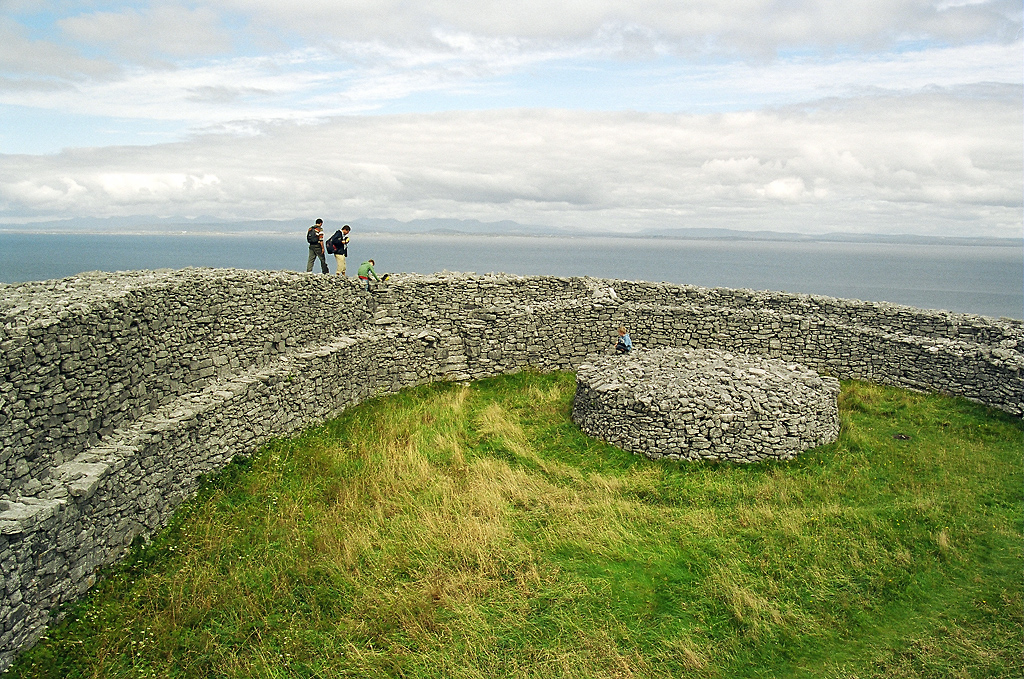
Ring fort on Inis Mor

Those visiting Inis Mór, the largest of the Aran Islands, take heed: with alacrity, you can improve your visit considerably. As soon as the ferry docks after the forty-five minute crossing, make a bit of a dash for the shop off to the right from the end of the pier, with ‘bicycle rentals’ written in huge letters on the side. For the reasonable price of ten Euros, you get a bike for the whole day (there is also a ten Euro deposit). If you go quickly, you will get one of the nice bikes I saw when I was returning mine in the evening. If you dawdle, you will get a bike several sizes too small and a bit creaky around the edges. I was reminded of the massive water-fights that used to take place in my neighbourhood when I was a kid. Borrowing a bike or a super-soaker of some variety was common, though a good fit in the latter case may not have been.

Over the course of today, I saw both ends of this 11km island (also called Inishmore), and much in between. The bus ride was spent aslumber, trying to make up for the stretched sleep schedule of the past few days. The ferry ride was scenic but unstable. I spent my first half-hour or so on the island profoundly seasick – a condition that is always much aggravated for me when I am tired.

Setting off in a random direction on my diminutive steed, I found myself winding up to the highest point on the island. At the top, there is a tower which you can pay to visit. For free, you can explore the circular fort Dun Eochla. Carrying on in the same direction, you will find a nice sandy beach, then another climb to the fort Dun Aonghasa, which is really quite amazing.

Located at the edge of a 90m cliff atop the crashing waves, this ancient fortress certainly seems as though it would have been easy to defend. I admire whoever has ensured that no fence or railing obscures the view off that great ledge. It is odd, I suppose, how cautiously people treated it. We walk along lethal edges all the time – 10m or so will do it – but when people are presented with something visually stunning, they become much more deferential. In several cases, I saw people lie on their stomachs with their heads about 3m back from the edge, then flop forward until they could see downwards to the rocks and breaking waves.

From Dun Aonghasa, I doubled back to the ferry terminal and then off to explore the other part of the island. Because the way the island consists of a series of hills, riding across it is an alternation between climbing gentle slopes and then coasting down the other side; it makes for a nice mixture of exertion and aesthetic appreciation. 99% of the tourist traffic of cycles and mini-buses goes in the other direction. As such, the northern part of the island is good for getting your fill of fields full of cows and sheep, horses and rabbits, and all other manner of grass-munching beast.

Before leaving, I picked up a very warm and sturdy pair of woolen hiking socks, made from the fibrous coats of the aforementioned sheep. I strongly considered buying one of the excellent looking sweaters, but decided that I wear insulating upper clothing so rarely that it would not be worth the (quite reasonable) price.

I am being hastened off the internet by six pairs of piercing eyes (those of fellow hostel members). Putting up the photos from today will be particularly gratifying, I think. Early tomorrow, I make my return to Dublin.

PS. If someone could find a few photos of those forts and link them as a comment, that would be wonderful. I would do it, but have not the time.

Cabin Fever 2 correction

Due to a scheduling error, it was previously announced that the retreat would be taking place from September 10th to 12th. In fact, it was meant to take place during the weekend before that: from Friday, September 8th to Sunday, September 10th. Please revise your schedules.

I really hope the change doesn’t cause problems for anyone. For those who are working, going on the weekend is clearly preferable. For those, like me, who are not, it doesn’t matter enormously much. That said, it is not quite ideal that I will be vanishing for three days within 48 hours of returning to Vancouver.

PS. Tristan has a post about this, also.

Manuscripts, horses, and Evensong

Jim Kilroy and his horse, Howth

Another great day has passed, in and around Dublin. After Brunch at Gruel (see the earlier entry where I describe it), I went to Dublin Castle and the Chester Beatty Library. You rarely see such an excellent free museum: packed with venerable and beautiful manuscripts, and boasting an attractive roof garden. It provided welcome solace from the driving rain.

The weather was so bad when I finally left that I decided to scrap my plan to go to Howth. Instead, I went into the nearby Christ Church Cathedral for an Evensong ceremony. This, I will admit, was quite uncharacteristic of me. Aside from one wedding and one first communion, this was the only time I ever attended a church during a religious function. Even though the hymns were entirely unfamiliar to me, it was a worthwhile and rather beautiful experience. Knowing how Claire is now part of an Oxford choir, I thought of her during much of it. Despite the size of the cathedral, the number of people in attendance was less than the number of people in the choir. Perhaps that related to how most of the church was closed for a television taping.

As I left the Cathedral, there were rays of sunshine hitting Dublin pavements. Despite it being after 6:00, I decided to take the half-hour train to Howth. It would prove a very wise move. The ride itself, in the evening light, offered an attractive transition from urban centre to countryside. Once I arrived, I walked a photogenic arc out one of the stone and concrete arms enclosing the harbour, pausing beside a small lighthouse to watch the birds floating like kites as they pushed against the incoming wind.

The hills overlooking the town seemed a good place to visit, to I took to trekking up road by road as far as I could make it. A man who I asked for directions when I reached the top of one such proved much more helpful than could possibly have been expected. Named Jim Kilroy, he is a retired architect, and he owns some of the land in the area I was exploring. He told me a bit about the history of the place, showed me his three beautiful horses, and directed me to a cliffside trail that follows the circumference of Howth (which is a kind of bulb-shaped peninsula). Further evidence of how open and friendly the people of Ireland are.

By the time I reached the much larger lighthouse a few kilometres around winding cliffs, it had become full dark. Another stranger who I asked for directions proved exceptionally helpful. She said that she was heading in the direction of the train station that was eluding me and offered me a lift. I am glad I accepted, because it was a much longer and more complex journey than my crude understanding of the layout of the place suggested. She is a veterinarian, specializing in horses, and apparently knows Mr. Kilroy. I expect that’s normal, in such a small community.

Now back in Dublin, I am to meet Mark Cummins from the Walking Club at some later point. I should be mindful, of course, of the early morning bus ride tomorrow and the low probability of a good night’s sleep tonight. That said, three hours on the bus will offer a bit of time for recovery.

I think I can say with confidence that Ireland is the friendliest place I have ever been. While it isn’t fair to compare with places where I don’t speak the language, the sheer number of strangers who have engaged with me and treated me with kindness here is staggering. Nowhere in North American or English-speaking Europe has been comparable. I even got into a conversation with a young woman from Dublin who happened to sit beside me on the train back from Howth. This is a country that I need to visit again and, next time I meet an Irish person somewhere else in the world, I will do my best to help them however I can.