Reminiscing about LIFE

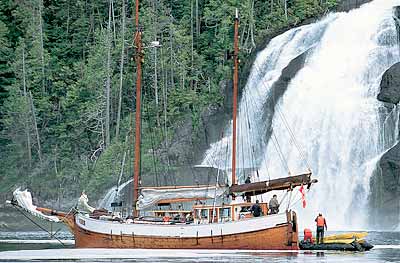
The Duen

Photo from www.thenaturalcoast.com

Since I was feeling vaguely ill all day, I made lunch and dinner stir-fries with large amounts of ginger. I don’t know why, but I’ve always found that ginger helps with nausea and general feelings of being unwell. The captain of the Duen first told me about it, during the first LIFEboat flotilla. A floating sustainability conference which took place on more than a dozen tall ships, the LIFEboat flotilla was one of the best weeks of my life, even though I was ridiculously seasick for much of it, on account of gale force winds and huge waves.

The Duen was a small ship – far smaller than the Pacific Swift, which was my berth for the second Flotilla. When tacking upwind, the boat listed at an angle of about thirty degrees, with me clinging to the upper lip in a borrowed survival suit: lent to me because I had to be on deck in the pouring rain all the time because I was so seasick. For years afterwards, I couldn’t stand the sight, smell, or taste of scones, because that’s what people kept trying to feed me. Despite all that, spending a week traveling through British Columbia’s Gulf Islands in a tall ship is an amazing experience. More so when you’re in a group like the one Jeff Gibbs created and which has been supported by people like David Suzuki and Jane Goodall, who I actually met during the first flotilla.

Leadership Initiative for Earth (LIFE) is a Vancouver based environmental organization that I was involved with for several years. I attended a conference of theirs at a high school with Jonathan. I then took part in two Flotillas, each of which required a large amount of environmentally related community service in order to be eligible. Jonathan and I worked at the Wild Bird Trust in North Vancouver, planting trees and pulling out poles from a frozen swamp. We also had to give presentations and slide shows afterwards. I gave one at the Vancouver Folk Festival, after the second flotilla. It was really excellent, because I got a free Folk Festival pass in the process.

One of the best things about the two flotillas was learning a bit of marine navigation. Because of the complexity of the Gulf Islands and their tides, the importance of maps, navigation, and location there are considerable. There are many passes that can only be used at certain times, because of the tides. During the second flotilla, I got to help with the coordination of the fleet overall: managing where different ships would stop at different times. The flotilla mostly took place on the ships, interacting with the members of your group, but there were also excursions on shore. We visited a sustainably harvested forest and got to touch sea cucumbers brought up by divers.

I wish I had some photos to post, but they are all in Vancouver in non-digital form. The one above wasn’t taken by me, but it does show the ship I was on for the first flotilla, in a place much like many we visited.

The original WildLIFE conference happened in 1995, when I was only twelve. As such, I probably didn’t get as much from it as most participants, nor was I able to contribute very effectively. The Flotillas were in 1997 and 1998, respectively. Since then, I’ve largely lost touch with the organization. The only participant with whom I’ve had any contact is Kevin Millsip, one of the two leaders of my group in 1996. He is now a Trustee on the Vancouver School Board; perhaps Sasha Wiley will meet him one day.

At one point, it seemed that LIFE had changed its name. At other points, I couldn’t seem to find anything about it at all. I am glad to see that they seem to be active at the moment. Apparently, “there have now been five Flotillas, all extraordinary learning adventures for the 750 youth who participated.” I wish I had stayed in contact with members of my two groups. At the time, I think being rather younger than most of the other participants impacted my ability to relate directly with them. Even so, I am incredibly glad to have been involved.

I strongly suspect the whole LIFE experience has impacted on my choice of discipline and sub-field. To be simultaneously exposed to a place as beautifully alive as the Gulf Islands and such a group of committed and motivated people is a powerful combination, as Gibbs must have anticipated. I am sure my fellow participants are also grateful for his imagination and initiative.
Spring deluges

In four consecutive cycles today, I got drenched, hailed upon, and the progressively drier in the period leading up to the next drenching. Between intense downpours of hail and icy rain, the day has been alternatively overcast in the cheerful way or actually sunny. While raining, the sheer volume of water falling in the air around me was enough to make me fear electrocution by the iPod standard headphones I’ve had to fall back upon since my better headphones broke.

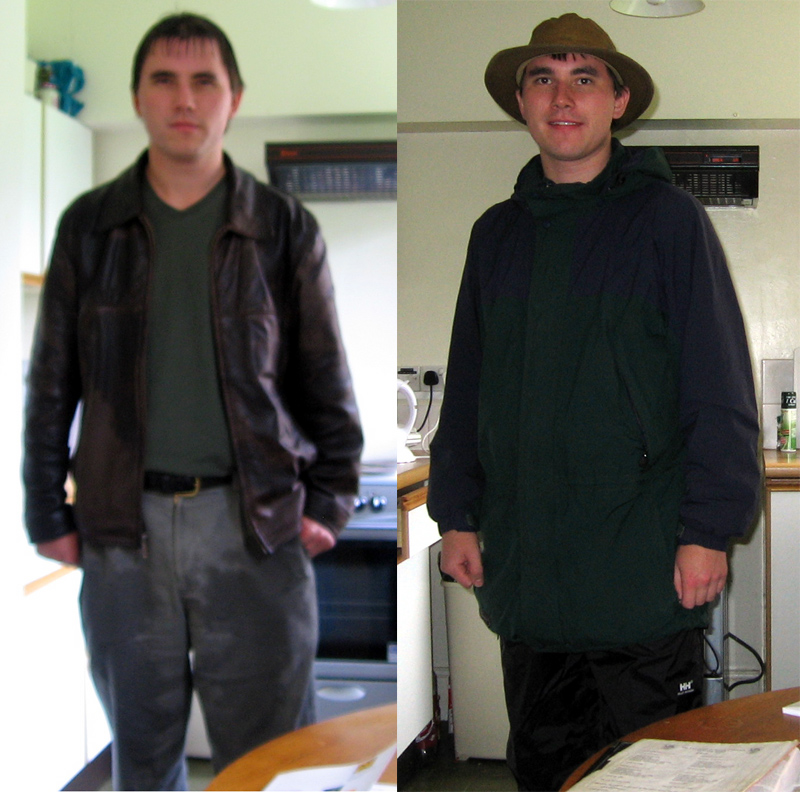
Unwilling to get tricked again, I responded in the afternoon in a manner familiar to all Vancouverites: Gore-Tex shoes, pants, and jacket – topped off with a waterproof hat. If you haven’t noticed, I am the sort to occasionally revel in the technical solution of problems. The shoes, I thank my mother for. She was kind enough to equip me with them while she was in the UK. The jacket I’ve had for ages; the pants, I recall testing with Meghan on a particularly stormy day along Wreck and Tower Beaches, on campus at UBC. The hat did sun protection service in Malta, as well as rain protection service on canoeing trips.

Naturally, now that I am thus equipped, the chances of it raining heavily again on the way to or from the Saint Antony’s International Review (STAIR) launch tonight are virtually nil.

PS. My congratulations to the newly-minted Louise Little, B.Sc (Hons), on the completion of her undegraduate degree.

PPS. Stir fries comprising olive oil, dried chillies, ginger, tofu, bell pepper, mushrooms, tomatoes, and black bean sauce are quite delicious. While they take approximately forty times longer to prepare than the caloric equivalent in bagel-cheese form, it’s probably a worthwhile investment, if only because it makes the house smell like black bean sauce.

Draft research design paper introduction

Preamble

‘Policy making’ can be understood as the application of judgment to problems, on the part of those empowered to make choices that will affect the matters in question. Global environmental policy making, in particular, involves heightened difficulties related to the process of acting upon the world. Firstly, with regards to such large and complex matters as climate change and the management of ecosystems, our understanding of the objective nature of the world is uncertain. This applies both to the functioning of the natural world in the absence of specific human prompts and to the impact that choices made by human beings and organizations will have within the context of natural processes. On the one hand, for instance, we have an imperfect understanding of the functioning of food webs in the absence of human involvement. On the other, we have an incomplete understanding of the effects of pesticide use on those processes.

The major vehicle through which questions about the nature of the world and the consequences of human action are accessed is science. ‘Science’ exists as a collection of methodologies, epistemic communities, and ideals. While the role of science as an entity involved in policy making may seem initially straightforward, complexities arise rapidly. Crucially, these involve the balance between making judgments about ontological questions under circumstances of uncertainly and the balance of making judgments between alternative courses of action. On one hand, for example, scientists can assess the distribution of fallout from atmospheric nuclear tests conducted above islands in the Pacific; on the other, groups of concerned scientists can call for the discontinuation of such tests.

The perceived appropriateness of each of those roles, on the part of scientists, is reflective of the credibility of scientists as individuals and members of communities and organizations, as well as the political understandings that exist about the relationship between expert knowledge and power. All viable environmental policies must be created in light of existing and emerging expert knowledge, but the question of arbitration between descriptive and prescriptive claims is one that raises fundamental issues about how science and policy do, can, and should relate.

The question

This thesis will examine the relationship between science and global environmental policy making on two conceptually separable but intertwined levels. It will so so firstly on the practical level of how environmental science and scientists have been involved in the development of laws and institutions and secondly at the more theoretical level of the understood relationship between the actual communities and idealized roles of scientists and policy makers. While the general answers for each level will be generated through different methodological means, it can be hoped that the insights generated will be mutually reinforcing.

In order to engage with the practical questions of how science has affected policy making, this thesis will examine two case studies: the 2001 Stockholm Convention on Persistent Organic Pollutants and the 1997 Kyoto Protocol to the United Nations Framework Convention on Climate Change. The first can be seen as an example of a mechanism where a scientific understanding emerged of the issue in question and a reasonably effective legal regime for its mitigation emerged. The second example demonstrates a situation in which, for reasons which shall be examined, a similar progression from issue identification to effective policy action has not taken place. The contrast between the cases will hopefully allow for the isolation of important variables, on the basis of the comparative study of preparatory documentation and the first-hand impressions of the participants.

The theoretical component of this thesis will use the controversy surrounding the publication of Bjorn Lomborg’s The Skeptical Environmentalist in 2001 as a starting point for addressing the internal debate within the scientific and policy communities about the role that science and scientists should play in the making of decisions that entail both potentially enormous costs and equally serious risks. The theoretical discussion will also involve the examination of the secondary literature on the philosophy of science, as well as the relationship of science and policy in related fields: such as global health and development studies.

The thesis will consider the competing hypotheses that the general understanding of science as a descriptive adjunct to the prescriptive policy making process is broadly valid, that is is overly simplistic given the multifaceted nature of the epistemic communities involved, and that it might be a fundamentally inappropriate way of representing a corpus of thinking, institutions, and individuals which is actually incapable of operating without concealed normative maneuverings. These possibilities will be assessed through consideration of the examples listed above, as well as the analysis of primary and secondary documentation.

See also: Research design essay planning (15 May 2006)

Deflated oval

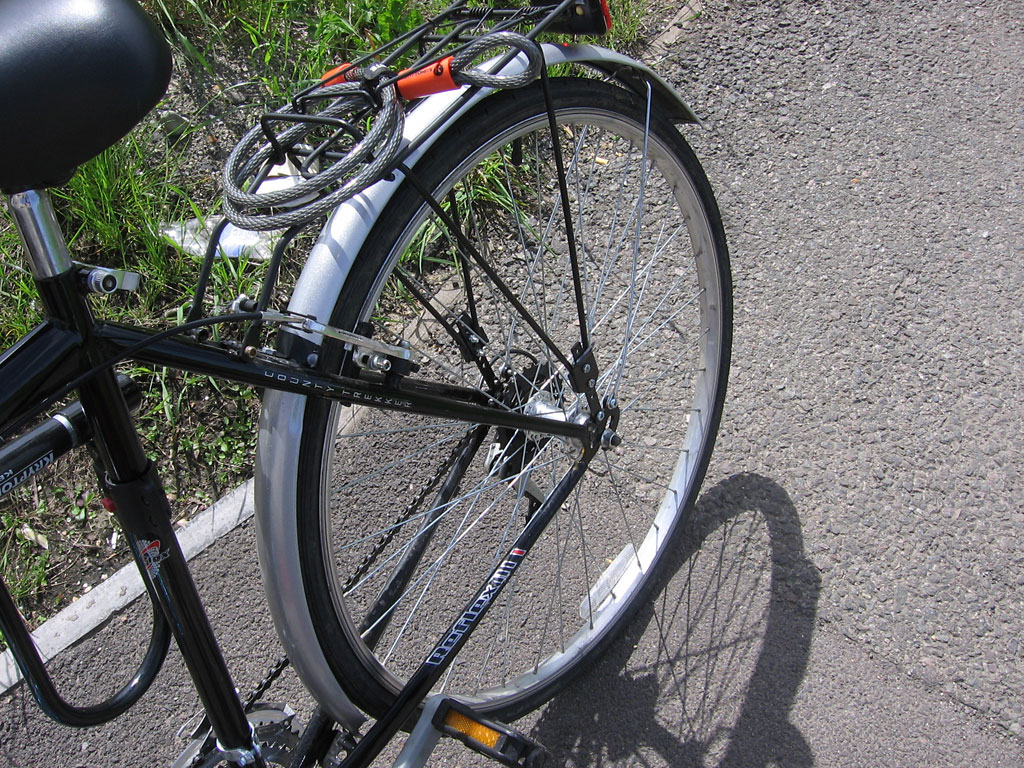
Flat hybrid bike tire

On account of the gorgeous weather early this afternoon, I took a break from the research design and great powers/unipolarity essays to go cycling. Having already gone out and back to the north and south, I decided to head out west from central Oxford, then divert north, east, and then back south to Church Walk. I went 27km all told, along a route resembling a misshapen oval. Starting by passing under the train tracks beside the Oxford station, I rode west through Botley and Farmoor, before diverting mostly north to Eynsham – where sandwiches were secured. From there, I took the A40 to Cassington.

At the top of the long arc, north of Oxford, I had the misfortune of suffering a puncture in my rear tire. Nervous about ruining the wheel, I walked the bike just shy of six miles: from between Cassington and Yarnton, back into north Oxford. That was necessary because none of the buses entering Oxford from the north are allowed to carry bikes and years of educational videos made me too hesitant to try hitchiking, despite having recently read Kerouac. Thankfully, I was able to do reach Church Walk just before it began to rain.

Fixing a punctured rear tire exceeds my bike maintenance experience. The need to deal with the derailleur is a complicating factor. Additionally, my bike pump has been missing for weeks and I don’t have a suitable wrench, nor plastic levers for the removal of the tire. I will find out how much it would cost to have fixed in a shop, before I decide whether or not to make an oily attempt at it myself. I have already searched my room and all common areas of the house at least three times for the pump, without luck. I’ve also interrogated my roommates and pondered who I could possibly have lent it to. I distinctly remember telling someone that I had my doubts about whether it was really high pressure enough for road bike tires, but that they were welcome to give it a try…

Warm night

Streetlamp base

Tonight was the first time this year I’ve walked home at night in short sleeves and felt entirely comfortable doing so. Naturally, it reminded me of all the best times when I’ve been able to wander around in cities on bright, cool nights just after the sun has set: after Judo lessons back in North Vancouver, with Alison and Viktoria in Toronto last summer, and during the summer language bursary program in Montreal. In all those and other cases, I remember the incredible sense of ease that accompanies being free and comfortable in uncrowded streets.

The psychological effect of the pleasing climate is enormous, because it changes the way you feel about being in territory that isn’t under your control. During the icy morning in Chichester, frigid walks in Helsinki, or confused meanderings in London during the winter, I was always plotting where I would get some food, where I could get warm, where I could sleep. This leads to calculations of how long you can linger in a Starbucks with or without buying a drink, what time warm open spaces like malls and bookshops close, and how far you have wandered from the nearest place that you have a key or friend that can yet you into.

Wandering on a warm night, by contrast, projects at least the fiction that all the world is reasonably hospitable: that you can wander almost anywhere with few worries and comfort and adventure are simultaneously possible.

Oxford spring

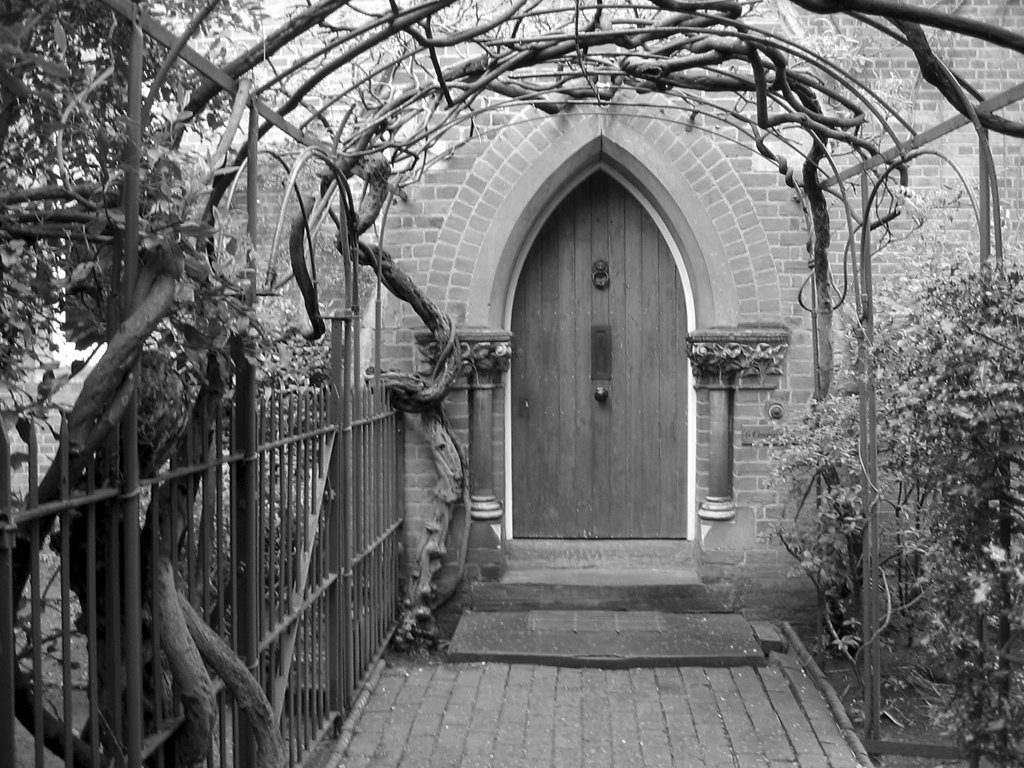
House in northern Oxford

Living in leafy northern Oxford as everything is coming to life again is quite lovely. Taking a break from working on my paper, I went for a bit of a walk this evening and discovered a whole district of intriguing houses to the northeast of Church Walk: the sort with unusual architecture, big gardens, and streets that are not subject to the indignity of traffic. There were even the semi-circular sweeping rows of connected houses that seemed to be so common in Bath, but which I had not yet seen here. The next time I am ambling with someone, I will try to find the place again.

The best place to experience Oxford in the winter, I think, is the Christ Church Meadow. Walking along the Isis in the chilly wind, looking up at denuded trees which readily reveal the mistletoe colonies inside, there is a sense of pristine desolation. The waterfowl, then, seem like sympathetic fellow victims of the cold and gloom. It isn’t clear to me yet where the embodiment of spring in Oxford will reside, but it may well be in some leafy suburban street, amongst the twittering of birds in the evening.

Tomorrow, I have most of my week’s mandatory activities compressed together over a period of about twelve hours: the core seminar, the Changing Character of War seminar, the research design seminar, the strategic studies dinner, the strategic studies meeting, and the obligatory brief strategic studies foray to The Turf. During that time, perhaps I will meet someone interesting again this week.

Possibly as the result of trying to work on an essay for most of the day (with welcome conversations with Kai and Emily as asides), my brain is feeling a bit like a slightly crushed paper cup: as though it has had too much caffeine or too little, or is trying hard to suppress a relatively mild illness. It doesn’t make me keen on the process of finalizing and editing my Cold War paper tonight, but that’s my own fault for not getting it done earlier. Oxford has definitely been worsening my study skills; work I would have once done well in advance and had checked gets finished at the last minute instead. When the workload is just a series of hurdles and none of your work actually gets graded, the incentives tend towards encouraging such an approach.

Long summer bike ride

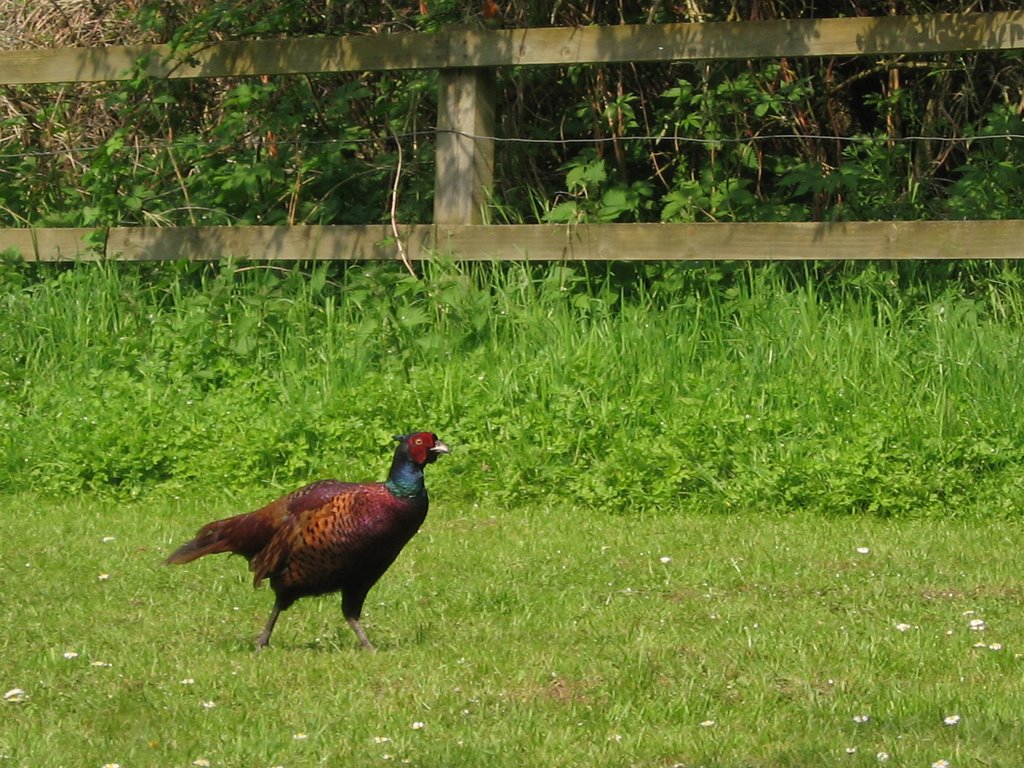
Unidentified bird

Happy Birthday Greg Polakoff

Today was unambiguously the first summery day in Oxford. As seemed to befit it, I went on my longest bike ride so far: 42.6km from Oxford to Blenheim Palace and Woodstock, then back via Kidlington. I’ve heard that Blenheim Palace and gardens are really nice, but I definitely wasn’t willing to pay eleven Pounds to get in. Instead, I found a shady spot outside Woodstock and read Kerouac’s On the Road for a few hours. While sitting in the shade, molested but unbitten by flies, I actually saw what I can only conclude was a pheasant: a big, red, darting sort of bird that ran off and hid when I tried to photograph it. I also saw huge numbers of cow, sheep, and horses – as well as rabbits and lots of birds.

After leaving Woodstock, I found the road between Kidlington (which is on the way to Oxford) and Deddington (which I walked to one night). Once I realized that Deddington was a further nine miles from where I found that road, I veered off eastwards and found the much smaller town of Tackley. Throughout the ride, there was nice countryside. It would have been perfect but for the strangely insistent sun and the truck that caused me to slam my hand against a metal fence by not signaling when it was exiting from a roundabout. If I hadn’t checked, it would have been overall splattering from under-correction, rather than one nasty bang from over-correction.

I am enjoying On the Road. It has what I would call a Catcher in the Rye narrator: someone focused on being self-sufficient, somehow outside the system, but still caring and generous. The book makes me want to take another road trip in the US.

Instead, I should spend the rest of tonight burnishing thesis ideas for presentation to Dr. Hurrell tomorrow.

Late night May Day plans

At 2:17am I made plans to attend the May Day celebration on the Port Meadow at 6:00am. Given that I am already feeling excessively awake – for no reason I can easily identify – I think I will just stay up until then. There’s nothing like a neo-pagan fertility rite to welcome the arrival of springtime. According to Wikipedia:

Traditional English May Day rites and celebrations include Morris dancing, crowning a May Queen, celebrating Green Man day and dancing around a Maypole. Much of this tradition derives from the pagan festival of Beltane. May Day has been a traditional day of festivities throughout the centuries. It is most associated with towns and villages celebrating springtime fertility and revelry with fetes and community gatherings. Perhaps the most significant of the traditions is the May Pole, around which traditional dancers circle with ribbons.

There is more information available here.

Apparently, Emily’s sculptor-father is in charge of the celebrations taking place on the Port Meadow. This makes them especially interesting for those of us in the program, and especially those of us who have met him.

Oxford exploration

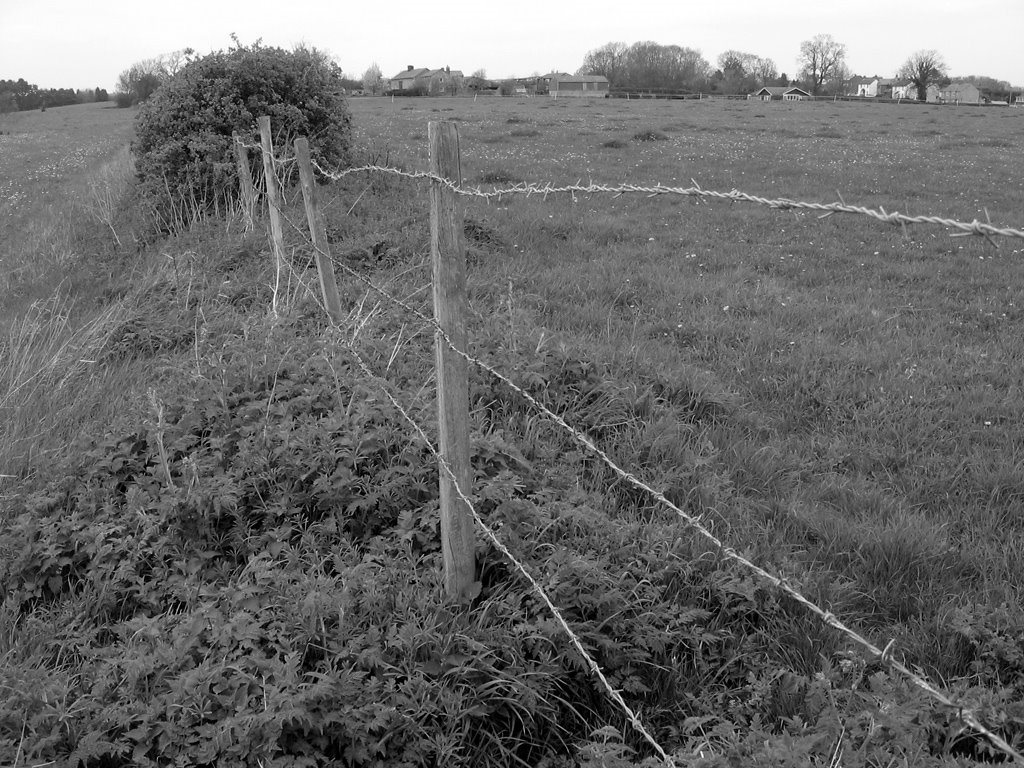
Hilltop barbed wire

This morning, I was woken by the 9:00am booming of our local clock tower. Since it was already the time when I was meant to meet Sheena and Emily to start the Oxford tour for Martin Ziguele, the former Prime Minister of the Central African Republic, I had to roll straight out of bed and into a suit: arriving outside St. Antony’s at six past nine.

The tour itself was very generic: Christ Church meadows, the Radcliffe Square, and up Parks Road. One notable sight was an actually Greylag gosling, beside the Isis. It was your stereotypical yellow puffball, and the parents visibly and audibly disapproved of my attempts to photograph it. Emily and I made efforts to describe things in French, where feasible, and impart some of the anecdotal Oxford history that gets absorbed by all students here.

In the afternoon, I took another bike ride out into the village-strewn countryside surrounding Oxford. This time, I headed southward, across Magdalen Bridge and way down the Cowley Road. I went past the BMW plant at the end of the Cowley Road, then up the hill near Garsington (N51 43.191, W001 09.678). From Church Walk to there and back is 22km.

He hill didn’t offer as nice a view as the hills around Bath did, but it was nonetheless the most pronounced elevation I’ve climbed near Oxford. In response to Tristan’s post requesting top speeds, I made an attempt to see how fast I could go before my gears became more or less useless, on a slight downslope in the countryside south of Oxford. I managed 48.2km/h, which isn’t bad for a bicycle.

PS. I need to remember to email Peter Dauvergne about my thesis idea. Since I need to go a presentation on it in our methods seminar next Tuesday, I need to have a decent idea of the important methodological questions involved.

Pastoral wandering

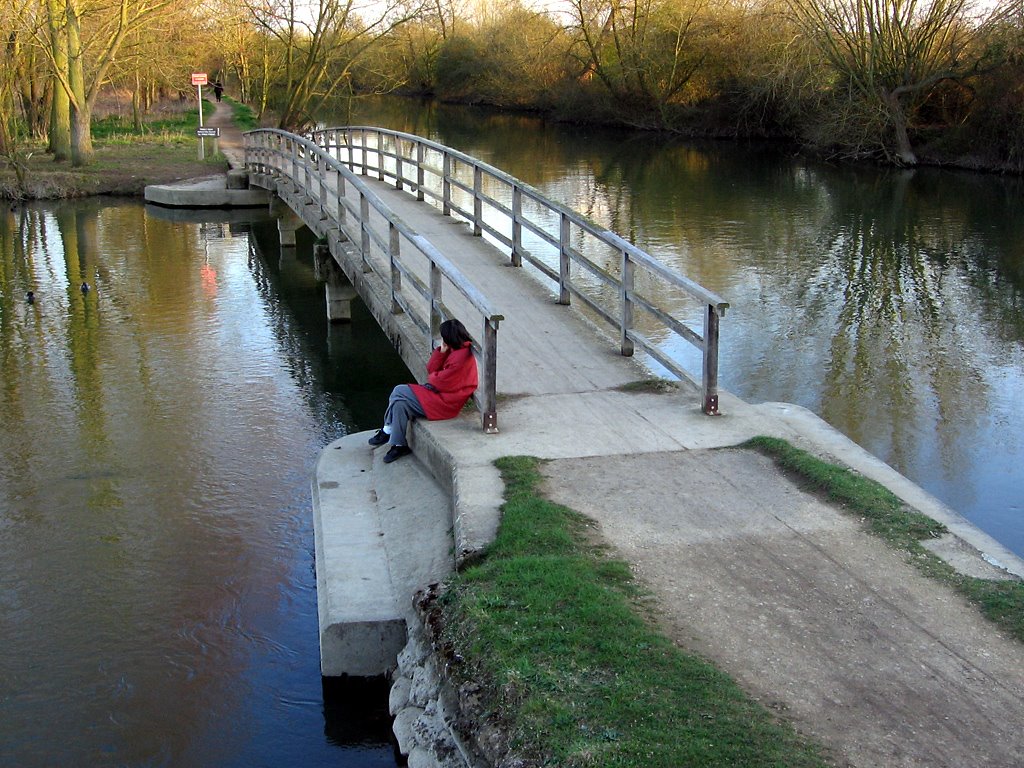
Woman beside bridge beside Port Meadow

I spent most of today exploring the area around Church Walk. The best discovery, by far, is that we are only two turns and six minutes away from the Port Meadow. Sitting beside the flooded portion of the meadow, immersed the direct afternoon sun, there was the uncanny sense of being profoundly disconnected from my whole environment. I could even see the blood vessels in my retinas: silhouetted in green against the grass and sky.

Out there in the late afternoon, with sun, breeze, and a brie baguette, it was a supremely attractive place. As the sun set, and its light grew redder, all the trees and church spires in the distance were cast with shadows and gorgeous hues. Living right beside a church spire conjures a really effective sense of place.

Seeing all this made me look forward to the summer, when I will have only financial and vague thesis commitments with which to concern myself. Our local environment seems to be the kind of place in which you need to spend a lot of time wandering alone, before you might bring some trusted individual along with you. As most of my trusted individuals are very far from here at present, it’s an arrangement that suits me well.

QT strategy

Thinking about the QT, the question now seems to be whether it is worthwhile to push for a distinction. On the basis of the revision I have already done and my practice exam, Dr. Hurrell predicts that I will score in the high sixties. The amount of effort required to push that into the low seventies is probably very high: considering only a couple of people among the 28 in the program are likely to achieve that. The benefits are mostly prestige vis a vis the faculty and fellow students. The best plan, I think, is simply to prepare to a good extent – focusing on the shortfalls that Dr. Hurrell identified – and hope for inspiration to strike on the day of the exam.