

Greyhound bus security

Having spent much of the last week waiting for or riding on Greyhound buses, all the news stories about the man who was beheaded on one caught my eye. Some people are calling for airport-style screening procedures for buses. There are at least two reasons for which this is inappropriate.

The first concerns the mobility of buses. With a plane under their control, hijackers can fly to distant states that might assist them. The only way to stop them is to shoot down the plane, killing everyone on board. Buses are comparatively easy to stop. You can shoot out the tires, put spiky strips across the road, or simply block the route with something heavy. Nobody is likely to escape to sunny Cuba on a hijacked bus. Another element of mobility is multiple stops. Bus companies would need to (a) put security at every permitted stop (b) only allow people on at big bus stations or (c) allow some unscreened people aboard buses. Someone determined to commit a violent act on a bus could take advantage of (c), while (a) and (b) would seriously inconvenience people at many smaller stops.

The second is that someone in control of an ordinary plane can kill a lot of people. They can certainly kill everyone on board. They can also kill many people on the ground. Similar risks do not exist in relation to buses. At the very most, someone with a machine gun or explosive device could kill most of the people on board. There is no clear situation where being on a bus increases the amount of harm a person can do. Someone who wants to kill a particular person can do it at least as easily off a bus as on it; the same is true for someone who just wants to kill people at random.

There is certainly a certain risk of violence on board a bus, but that does not mean that excluding weapons is a sensible use of resources. For one thing, it would increase bus fares substantially and require the redesign of bus stations. For another, it isn’t clear that it wouldn’t simply displace any violence that was to occur to a different venue. Living among humans naturally entails risks, which we can mitigate to greater or lesser degrees in various ways. Reducing risk always involves some kind of cost: sometimes in money, sometimes in freedom. The level of news coverage this incident is receiving highlights just how slight a risk this actually is. The kind of risks that make the news aren’t the sort to worry about, since they are rare by definition. It’s the stuff that is too common to constitute news that you really need to fear: things like domestic violence and heart disease, for instance. Screening bus passengers is not an intelligent use of our resources.
Central Park Studios hostel, Manhattan

[Image removed at the request of a subject (2019-10-01)]

While in New York, Emily and I stayed at the Central Park Studios hostel. It seems worthwhile to say a few things for the benefit of future travelers, as I have often found the general hostel rating sites less than useful. The hostel consists of a number of apartment buildings that have been converted: each with several multi-bunk bedrooms, along with shared bathroom and kitchen facilities. The rooms are pretty good: cool, fairly clean, and bug free. They provide decent sheets and towels. The kitchens are tolerable. The bathrooms are bad enough to make you wonder if there are any YMCA facilities nearby, but not quite bad enough to actually make you go looking for them. Ours featured a particularly nasty tub, icy shower, and spreading black fungus on the ceiling. The location is decent: two blocks from a subway line and close to a grocery store. One morning, Emily and I assembled avocado and cheese sandwiches on the sidewalk, rather than brave one of the less-than-sanitary and far-from-vegetarian looking restaurants in the immediate vicinity.

Bunks in the shared rooms are around $45 a night.

In my experience, the place is definitely better than the Hosteling International facility on Amsterdam, near Columbia University. That being said, first time visitors to Manhattan should be aware that they will probably pay twice as much as normal for a hostel, and have to settle for somewhere significantly louder and dirtier than would be available in most other cities.

New York bound

The planned trip to small town Vermont has grown a big city offshoot. For the next three days, Emily and I will be visiting Manhattan. It has been five years since I was last there, and I am excited about the prospect of seeing some new things. Because of the 2003 blackout, for instance, the Guggenheim was closed during my last visit.

Is it ethical to fly?

Continuing our long debate, here is another entry.

It seems to me that there are four possible long-term outcomes of the conflict between preventing climate change and travelling long distances quickly:

  1. We come up with a way to keep flying without doing too much climatic harm. This could be sequestration of carbon from biomass, it could be carbon neutral fuels, it could be something unanticipated.
  2. We come up with another transport technology that is carbon neutral and just as good or almost as good as flying, such as very high speed trains.
  3. We cannot reconcile long-distance high-speed travel with the need to mitigate, so we essentially stop doing it. A few people are still able to get from New York to London in a day, but it becomes out of almost everyone’s reach.
  4. We cannot reconcile long-distance high-speed travel with the need to mitigate, so we choose not to mitigate and wreck the planet.

How does the choice to fly look, in relation to each possibility?

  1. It’s not your fault you lived in the era before green flying was possible. That said, it may have been immoral to choose a mode of transport you knew to be (a) unsustainable and (b) harmful to others. It may be laudable or morally necessary to minimize flying and/or compensate for your impact by purchasing offsets.
  2. It’s not your fault you lived in the era before non-flight green travel was possible. That said, it may have been immoral to choose a mode of transport you knew to be (a) unsustainable and (b) harmful to others. It may be laudable or morally necessary to minimize flying and/or compensate for your impact by purchasing offsets.
  3. Again, you are on the hook for choosing an unsustainable option – specifically, one that had to be harshly curtailed in the future. Of course, if you are (a) selfish and (b) desirous of seeing the world, the danger that flying will be either restricted or far more expensive in the future creates an incentive to do a lot of it now.
  4. Flying was hardly a laudable thing to do, but it probably didn’t affect the outcome. Once we get into a runway climate change situation, it doesn’t matter much whether emissions in year X were Y megatonnes or 1.5Y megatonnes.

The larger question of whether future outcomes affects the morality of present decisions must also be contemplated. It does seem a bit odd to say that an action in 2007 was right or wrong as a consequence of technologies developed later. This post really cannot provide any answers to these questions – though my position remains that virtually all flying taking place at present is immoral – but perhaps it will provide a new way to consider things.

B.C. Climate Action Dividend

Since I filed my 2006 taxes in British Columbia, I was eligable for the $100 Climate Action Dividend that accompanies their new carbon tax. It was an unexpected thing to receive, since I have been a legal resident of Ontario for almost a year, but welcome nonetheless.

The question is: how could I spend $100 in a way that would yield the most climatic benefits?

  • Transport: I don’t drive and am trying to avoid flying to the greatest possible extent. Within the Ottawa-Montreal-Toronto area, I travel by bus, train, and bicycle almost exclusively. There don’t seem to be too many opportunities here.
  • Home: I have been replacing light bulbs with compact fluorescents as they burn out, but could take the plunge and replace them all at once. The oil furnace and poor insulation in my flat are big problems, but they are the property of my landlord and cannot be meaningfully improved for $100 anyhow. I suppose I could offer to contribute towards an efficiency improvement of some kind.
  • Food: I am already a vegetarian, but spending the $100 on local organic produce would probably have some small carbon impact. That said, it is possible that the net carbon impacts of local food in this area are actually greater than those for some imported choices. Food calculations are very tricky.
  • Carbon offsets: For C$100, I can buy about 8.3 tonnes worth of offsets from Native Energy. They offer methane capture offsets, which are much more credible than forestry offsets, but there will always be questions about whether the gasses were captured specifically because of your payment, or whether the capture would have happened anyhow.
  • Donations: I could give some or all of the money to a political or non-governmental group that is having a positive impact on climate policy.
  • Books: While buying books about climate change science and policy will not directly lower my emissions, they may help put me in a better position to help aid the transition to a low-carbon society.

Do people have any other ideas?

EU taxing aviation carbon

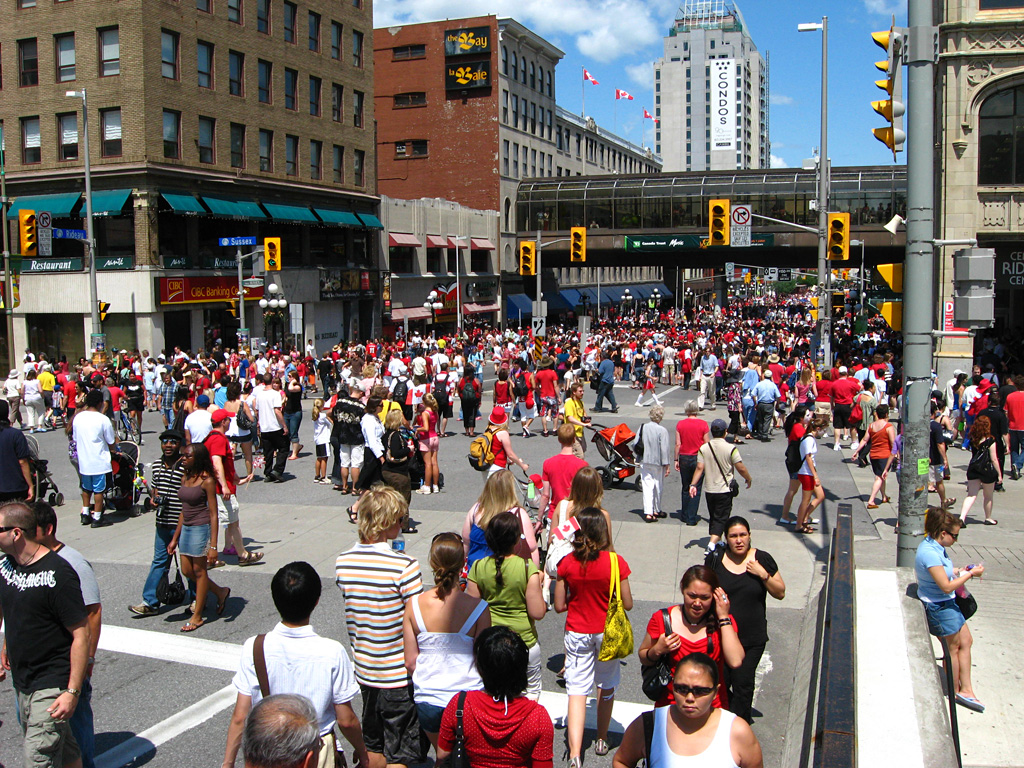
Canada Day 2008, Ottawa

The European Union has agreed to start integrating air travel into its emissions trading system. This is a big step, given how the industry has often been excluded from carbon pricing schemes – especially where international travel is involved.

Arguably, the biggest piece of news is that they want to charge non-EU carriers for emission permits when they enter EU countries. This is certainly going to kick up a stink in the WTO and other multilateral trading bodies. That being said, if a global regime of carbon pricing is not to be forthcoming, the regional arrangements will need mechanisms for ensuring that imports meet their standards.

Hashing out how such standards can be applied is sure to be a difficult and extended affair.

Summer streets

For three Saturdays in August, New York City will be making six miles worth of city streets exclusively the domain of bikes and pedestrians. It’s an impressive undertaking, and a good method for making people think twice about their assumption that streets exist for the sake of drivers. For a long time, city dwellers have mostly assumed the roadways to be the exclusive territory of two-ton steel beasts. Taking them back is a step towards more cohesive communities, as well as a lower-carbon future.

If feasible, I would love to take the train down and have a look.