On the possibility of leading an ethical life

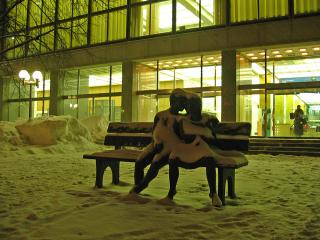
Statue outside the National Archives in the snow

In response to a recent post, somebody asked: “Is it possible to live ethically in our society?”

The question is a surprisingly difficult one. One way to begin picking away at it is to present a common form of the argument that we cannot:

Premise 1: Society, as it exists, is unsustainable (here is an excellent and concise definition of the term)

Premise 2: By participating in society, we perpetuate that unsustainability

Premise 3: Unsustainable behaviour will eventually destroy the planet’s capacity to support humans and other species

Premise 3: It is wrong to destroy the planet’s ability to support future humans

Premise 4: It is wrong to destroy the planet’s ability to support non-human species

Conclusion: It is wrong to participate in society.

There are a number of possible responses to this argument:

1) Questioning the fact of unsustainability

The first is based purely on physical facts and projections about future physical facts. It is what might be called the MalthusLomborg axis, using the names of the most famous pessimist and optimist respectively. If you successfully disprove the claim that present society is unsustainable, you don’t need to worry about the other premises or the conclusion. The next possible approach is to say “Society isn’t monolithic, some bits are sustainable and some are not. As long as I am only supporting the sustainable bits, I am being ethical.” Beyond this, another approach is to say: “Society isn’t sustainable yet, but it will naturally become so in the future.” This is a version of the environmental Kuznets curve and it is an argument that has some possibility of being true.

2) Restricting the scope of who matters

One possibility that you will rarely hear argued is that we have no duty whatsoever to either (a) future generations or (b) people other than ourselves. If we can treat group (a) or both groups in any way we desire, the fact that society is unsustainable doesn’t matter. That said, you will not find many people arguing this position, probably because it offends virtually any general theory of ethics.

Many people reject the idea that it is wrong to harm non-human living things, except where such harm eventually causes harm to people.

3) Stressing the limitations of individuals

Another possible set of rebuttals are based around the scope of individual agency. A person can say: “The whole structure of society is unsustainable. I cannot change that. As a consequence, I am not responsible for the destruction induced by society.” This claim has a strong form – ‘I cannot change the whole world, so I have no duty to improve it at all’ – and a weak form – ‘I have a duty to improve the world, but don’t expect much from me.’ Another way of phrasing this is as a ‘no acceptable alternatives’ argument: “What am I supposed to do? Live naked in the woods, eating grubs and tree bark?”

4) Utilitarian arguments

Two more arguments are based around a kind of ethical calculation. The first says: “It is tolerable to do immoral things in some circumstances, provided the total sum of my actions is beneficial for humanity.” In this case, as long as a person has a net positive sum of morality, they can legitimately engage in limited forms of immorality. A somewhat different formulation is based on an idea of rationed wrongness: “Nobody can be expected to be perfectly good. As such, we each have a kind of ‘allowance’ for unethical behaviour. As long as we are spending within our allowance, we are ok.” The big difference here is that the ‘allowance’ is automatically disbursed as a recognition of human frailty, not earned through good deeds.

5) Competing duties

Yet another set of rebuttals is based on competing moral claims. A person can say: “I have a duty to care for my family, even if doing so involves participating in an unsustainable society.” This is a tricky one. It is also one that strikes close to why the kind of ethics being discussed here are so hard to achieve. In general, the unsustainable things we do provide relatively immediate benefits that are specific to us and the people who we know personally; the costs they impose are distant, diffuse, and largely born by people we will never know.

Tentative conclusions

What can we conclude about this? To begin with, it seems fair to say that most people are unaware of some significant ways in which actions they consider personal (driving a car, eating a sort of food, etc) impact others in a harmful way. It is also fair to say that no individual can possibly anticipate or understand the complete set of all outcomes arising from their behaviours. In addition to this, we must recognize the way in which contemporary economic structures can create huge distances between cause and effect. Just as a London banker’s cocaine-fuelled evening has affects in the coca growing regions of the Andes, much of what we consume as individuals affects other people at enormous distances.

Collectively, these realities imply a certain ‘duty of awareness.’ It is not ethically tenable to live in wilful ignorance about the consequences of our actions. Whether based on one of the forms of rebuttal above or something different, we need to have some kind of justification for our actions that measures up to what we consider their total set of effects to be. Estimating our impact and developing a justification almost certainly does not satisfy all our moral requirements, but it is probably a necessary step in any series of actions intended to do so.

The question of how we evaluate the relative plausibility of every person’s excuse is the really difficult one.

Passionate Minds

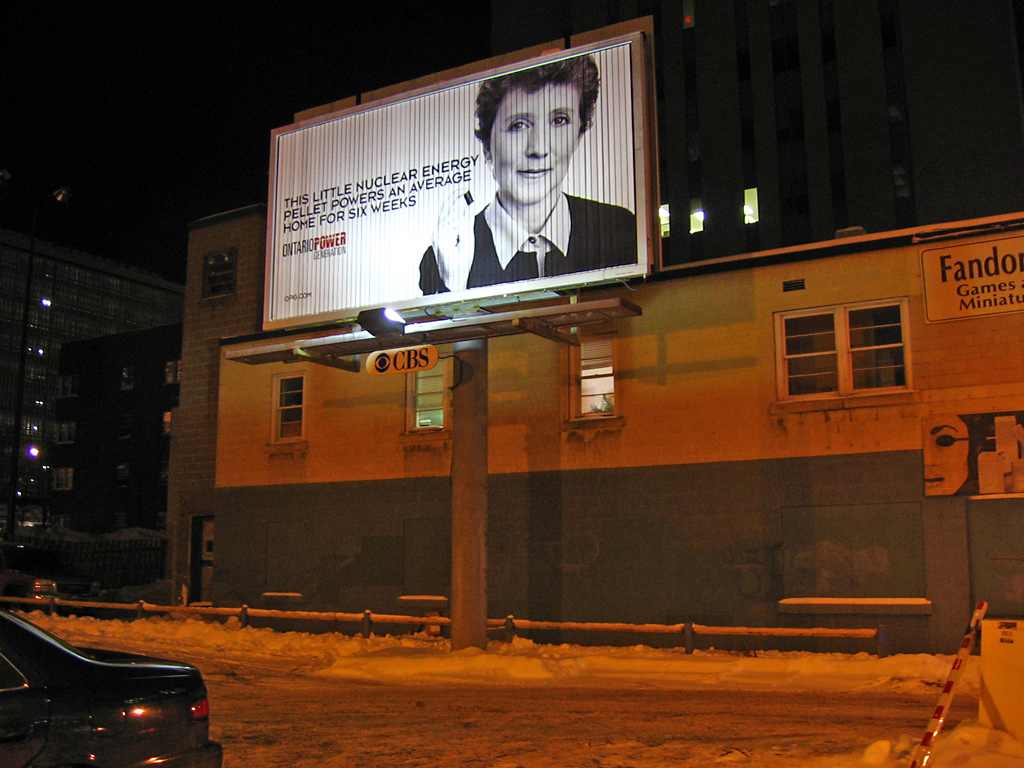
Billboard advertising nuclear power

I started Passionate Minds: The Great Love Affair of the Enlightenment, Featuring the Scientist Émilie du Châtelet, the Poet Voltaire, Sword Fights, Book Burnings, Assorted Kings, Seditious Verse, and the Birth of the Modern World with high hopes. It promised science, literature, and history in an accessible package. That promise is only partially realized. While the book does reveal some of the most remarkable (and the most flawed) characteristics of both Voltaire and du Châtelet, it sometimes makes claims that stretch the evidence provided. Often, the book simply asserts things rather than seeking to prove them.

Bodanis’ central thesis – that Émilie du Châtelet has been given insufficient historical attention – is fairly robust. Clearly, hers was an extraordinary life: born into nobility, but driven towards science and the sometimes hapless literary life of Voltaire instead of occupying a more traditional position in the Court. At times, the book demonstrates startling contrasts between the way of life at the time and the present. This is especially true of the marriages: purely political and economic unions in which years of habitation with a prominent lover were apparently not too exceptional. When a court rival attacks Voltaire through a lawsuit, her husband comes to his defence – despite how Voltaire has been living with his wife for years and they are a highly prominent couple.

In the end, the book would have been better if it had focused less on intrigue and more on what significant scientific contributions du Châtelet actually made. Saying that “[m]ore technical aspects of her work played a great role in energizing the French school of theoretical physics, associated with Lagrande and Laplace” isn’t a very convincing way of showing historical importance. Likewise, the assertion that “[t]he use of the square of the speed of light, c2, in Einstein’s most famous equation, E=mc2 is directly traceable to her work” is never adequately argued.

The book does an excellent job of describing how atrocious the medicine of the time was, contributing to du Châtelet’s own relatively early death in childbirth. It also relates some fascinating historical episodes in an engaging way: for instance, the rigged lottery through which Voltaire made his fortune.

A book about du Châtelet written by someone with more of a focus on studying and explaining science would be a better tribute to the woman than this interesting yet flawed volume.

Major climate change issues

After many years of writing on whatever came to mind, I am now trying to be more systematic in some areas. In particular, I am trying to come up with a comprehensive collection of blog posts covering all important aspects of climate change. This serves a number of purposes: it helps me to synthesize information, it should be informative to others, and it should foster discussion that helps increase the sophistication of positions and arguments. The posts are organized here:

Climate change posts

The index page isn’t the most gorgeous looking thing on the web, but it is resilient and can be updated easily. Do people see this as a useful undertaking? What would make it more helpful or worthwhile? This initiative was mentioned before, but received little attention.

Here is the code for the link above:

<a href="http://www.sindark.com/wiki/index.php?title=Major_climate_change_issues"><img src="http://www.sindark.com/photo/CCmedium.png" alt="Climate change posts" /></a>

Feel free to link it on other sites, if desired.

How trustworthy is Wikipedia?

Every page on Wikipedia has an accompanying ‘Talk’ page, where people discuss the main article and propose changes to it. Having a look at some of the talk pages is informative because it really shows off the lack of expertise among the people who are working on these articles. Much as I enjoy and admire Wikipedia as an effort, seeing things like the discussion on ‘tar sands’ makes me wonder how trustworthy the site is as a source of information. Often, the arguments on talk pages seem to be superficial and unsupported by evidence or strong argumentation.

As with everything else, we need to try to retain healthy skepticism about new information without becoming dogmatic about what we already believe. That is a tough thing to accomplish – especially given the scope and complexity of issues affecting us all.

Reloaded with non-fiction

I have officially abandoned my earlier initiative to finish all my pending books before purchasing more. Mostly, that is because I finished all the non-fiction on my list and all of the fiction I have read recently has been depressing. While much of the non-fiction can also be dispiriting, it feels less like emotional self-flagellation to read it.

My new crop of non-fiction:

  • Bodanis, David. Passionate Minds. 2006
  • Collier, Paul. The Bottom Billion: Why the Poorest Countries are Failing and What Can Be Done About It. 2007
  • Easterly, William. The White Man’s Burden: Why the West’s Efforts to Aid the Rest Have Done So Much Ill and So Little Good. 2006.
  • Overy, Richard. Why the Allies Won. 1995.

The Easterly book was endorsed by Emily Paddon during one of our pre-seminar conversations in Oxford. It is also one of those books that I have heard mentioned in conversation often enough to feel concerned about not having read. The Collier book is clearly on a related theme. I saw Paul Collier speak many times at Oxford and always found him candid and informative. Richard Overy’s book was one of the best I read in the course of two history seminars at Oxford; I look forward to having the chance to take my time in reading it, rather than having it as one of several urgent items in an essay’s source list. Finally, I got the Bodanis book because I have heard it well recommended and know little about Voltaire and even less about Emilie du Chatelet.

I will certainly finish the fiction eventually, but I will do so interspersed with meatier stuff.

Gladwell on criminal profiling

Walking boy graffiti

Malcolm Gladwell, author of The Tipping Point and Blink, has an interesting article in the most recent New Yorker debunking police profiling of violent offenders. He basically argues that their methods are unsound, but that this is concealed by the same kind of cheap psychological tricks used by telephone psychics. In particular, the article discusses a set of tactics described by Ian Rowland: a magician and the author of a book on cold reading.

The tactics included focus on calculated vagueness, exploitation of known or highly probable information, and mechanisms for reducing the chances of being decisively proved wrong. The last of those is particularly crucial, as it can allow you to retain your reputation despite the inevitability of making some incorrect guesses.

Be advised that the article has graphic content.

Index of climate posts

Fruit bar

For the last while, my aim on this blog has been both to entertain readers and to provide some discussion of all important aspects of the climate change problem. To facilitate the latter aim, I have established an index of posts on major climate change issues. Registered users of my blog can help to update it. Alternatively, people can use comments here to suggest sections that should be added or other changes.

The index currently contains all posts since I arrived in Ottawa. I should soon expand it to cover the entire span for which this blog has existed.

Fugitive Pieces

Grief Grafitti

Anne Michaels’ Fugitive Pieces is too overwhelming a book for me: overwhelming with sadness, with detail, with history, and with language evocative of inescapable grief. As such, it took me many weeks to read. One passage does a particularly good job of succinctly encapsulated the inescapable historical anguish that makes this small book so heavy:

History is the poisoned well, seeping into the groundwater. It’s not the unknown past we’re doomed to repeat, but the past we know. Every recorded event is a brick of potential, of precedent, thrown into the future. Eventually the idea will hit someone in the back of the head. This is the duplicity of history: an idea recorded will become an idea resurrected. Out of fertile ground, the compost of history.

That kind of curse extends to all the characters in the book. None find any comprehensive solace; none manage to lift their feet above the boggy terrain of the past and make their way to a firmer present shore. The book presents a number of brief illuminations, but each has the ultimate character of being palliative rather than redemptive:

But sometimes the world disrobes, slips its dress off a shoulder, stops time for a beat. If we look up at that moment, it’s not due to any ability of ours to pierce the darkness, it’s the world’s brief bestowal. The catastrophe of grace.

These people are swept along like houses carried by hurricane waters – whether floating towards tragedies or temporary reprieves from grief. The point is hammered home with talk of tornadoes transporting people or ripping them apart; lightning providing unexpectedly cooked geese, straight from the sky, or simply flattening people. Michaels’ people do not possess agency of the kind that we perceive ourselves to have, and which is essential to optimism.

The author’s approach to thought is almost completely unlike my own. Rather than focusing on patterns, both the author and the protagonists focus on details. Rather than drawing comprehensible conclusions from extrapolated data, they draw opaque, personal, emotional conclusions – as veiled as modern poems. The book is beautiful and powerful, but also soul-sapping and exhausting. It is a book with depths to reward you for your struggle.

In a way, this book is the antithesis of Nabokov’s Lolita. There, inherent ugliness is flawlessly concealed by language that has the power to immerse your whole mind in the succession of sounds and syllables. In Fugitive Pieces, your mind can never quite get to the language because it is hampered at all times by the heaviness of grief.

…in order categorical

All of the entries on this site have been sorted into one or more categories. Just for the sake of experimentation, I will use the next 21 daily posts (the ones with photos are generally the ‘official’ daily posts) to go through my whole list of categories one by one. This will occur in no particular order. Some posts are likely to fall into multiple categories, but they will only count as the most relevant one for the purposes of the tally:

The numbers beside each category indicate the number of posts so far.