A thought experiment on free will

Rusty fence and snow

Consider the following: what we know about physics and chemistry suggests that matter and energy interact on the basis of two things – physical laws and random chance. The fact that iron oxidizes is the result of physical characteristics of energy and matter that we understand well. Similarly, our understanding of the random elements in quantum mechanics is critical to a number of optical and electronic technologies. Acknowledging that we don’t fully understand either the laws of physics or the processes of randomness, it seems plausible to say that those two factors account for all the physical interactions in the universe.

If this is true, we can imagine a hypothetical computer with the capacity to store information on the nature, position, and trajectory of every particle in a human body, as well as all the types of energy acting on them. This model would allow us to project the behaviour of that collection of molecules in the face of any stimulus, at least on the basis of a range of outcomes as determined by the random elements in physical laws. Our model human could thus be exposed to any kind of prompt – from being attacked by another simulated human to being tempted by some unguarded treasure to being betrayed by a loved one – and a range of responses could be projected, with probabilities attributed.

Now, if human beings really do consist of particles and energy governed in the manner described, the behaviour of the computer model would be in no sense different from that of an actual person. The trouble here, of course, is that the model person cannot be said to have any free will. It is just a complex machine that responds to inputs in relatively predictable ways. Where outputs are not predictable, it is because of random chance. Our model person is like a computer game where the enemy you encounter is determined by a random number generator; while the outcome for any input is not entirely predictable, the system is nonetheless completely devoid of ‘will’ in the sense that we generally understand it.

How can free will be fit into a materialist model? Is free will something that exists outside of the laws of physics? Or is there some mechanism through which a macro-level entity like a person can be said to affect the particle level interactions that define them fundamentally?

Regardless of the answer, the thought experiment raises serious questions about whether we are responsible for our actions.

[Update: 2:06pm] Tristan wrote a post in response to this.

In Defense of Food

No parking sign

Having recently read and enjoyed Michael Pollan’s The Omnivore’s Dilemma, his newer book caught my eye this morning. I had seen a review contrasting it negatively with his prior work, but decided to take the plunge anyhow. I am glad I did. While there is less value added in terms of general knowledge, it is a much more practical guide to how the realities of contemporary food production affect the choices of conscientious modern omnivores.

The book does an excellent job of combining a good breadth of consideration with the production of manageable advice. Opening with “Eat food. Not too much. Mostly plants,” it elaborates those simple sentiments into a pretty good set of suggestions. Critically, ‘food’ refers only to things that would be recognized as such by people from a few hundred years ago. After going through the decidedly unnatural list of ingredients for a loaf of bread, Pollan declares that:

Sorry, Sara Lee, but your Soft & Smooth Whole Grain White Bread is not food and if not for the indulgence of the FDA [in not longer requiring the use of the word ‘imitation’] could not even be labelled “bread.”

Pollan does an excellent job of critiquing food science and the ‘nutritionism’ that reduces the complex chemistry of food and eating to simple affirmation or condemnation of individual chemicals and chemical classes, such as saturated fats. He provides a compelling description of the nature and evolution of the Western Diet, as well as the societal and economic reasons for its emergence and the health consequences that emerge from it.

In addition to discussing what to eat, Pollan provides some good tips on how. Basically, he suggests that people return to forms of eating more rooted in culture. Constant snacking, eating alone, and consuming massive portions are problematic even if the foodstuffs in question are relatively good. He also endorses gardening and cooking from scratch as ways of weeding out non-foods while also gaining more appreciation for the relationships involved in growth and eating.

Pollan provides a list of 24 bits of concise (and sometimes counterintuitive) advice. He provides some good tips on where and how to shop (avoid the centre of supermarkets – stick to the unprocessed foods at the edges). I was particularly delighted to learn about the strong case for how a glass of wine with dinner can do a fair bit to promote cardiovascular health. Since reading his previous book, I had already made some pretty significant dietary changes. Barring the occasional pot of Knorr soup, I have eaten virtually nothing that wasn’t “food” as he defines it. I have also been thinking a lot more about what I eat, where it comes from, how I prepare it, and so forth. Overall, the process has been meaningful and enjoyable.

It is pretty rare for me to buy a book and read it though in a day. The fact that I did with this one demonstrates both how engaging and accessible it is. For those wanting some sound dietary advice, rather than a more extensive discussion of the nature of various food systems, this book is well worth examining. I am planning to foist my copy onto as many people as possible.

Sensitivity versus throughput in reading

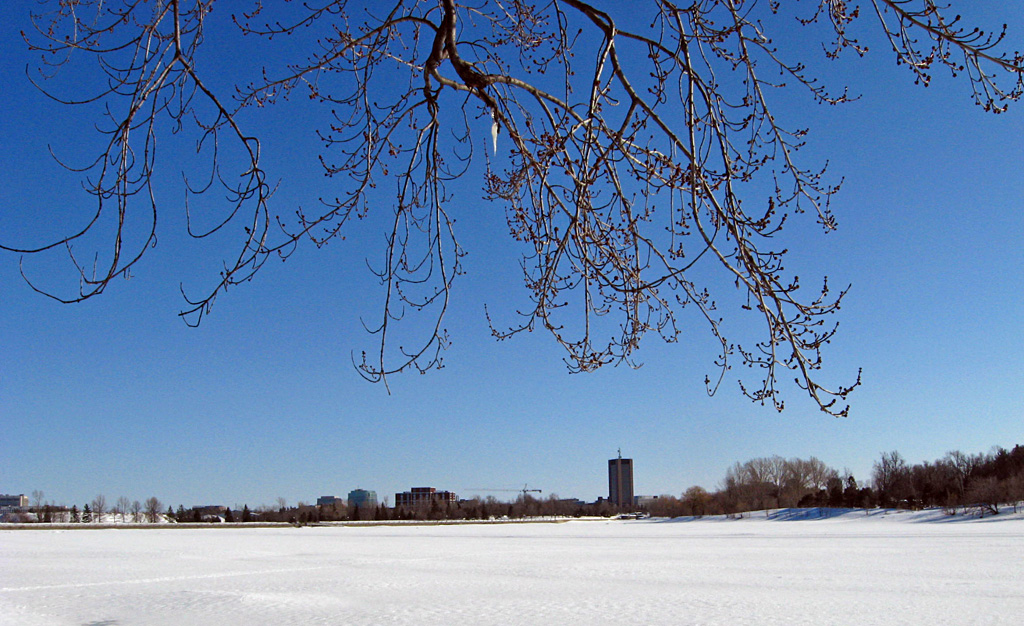
Ice and sky, Ottawa

At some point in the past five or six years, skimming became my default form of reading. Depending on the material, as little as a few seconds per page might be devoted to initial assessment. While this does allow for a person to process much more information, there is an extent to which it forces the atrophy of close reading ability. It seems as though the skills for processing an 80 page document in and hour and the skills for engaging with a dense poem are not only different, but may actually exclude one another.

There is no question about which of the two skill-sets is most useful in academia or information-focused work environments. At the same time, it is always somewhat tragic to lose a skill – especially when it is easy to recall a time when densely packed writing was often an intriguing mystery to explore, rather than a nuisance to be untangled.

Do other people feel the same way about the relationship between the volume processing of information and the precise examination of small samples? If so, is there anything that can or should be done?

Richard Casement internship

The Economist’s Richard Casement internship is seeking applicants once again. The winner will spend three months this coming summer in London, writing about science and technology. They are most keen on people with a scientific background who are inclined to try their hand at journalism. The work environment would probably be incredibly stimulating, and the intern would likely make a lot of useful contacts. Partly because of that, they get a lot of applicants. Despite how the job offers only a “small stipend,” they got 220 applicants for the position last year.

I am not applying this year, though I encourage others to do so. The article I wrote last year, about the importance of hash functions, can be accessed online.

Laughter in the Dark

Milan’s foot in Nick’s living room

Nabokov’s book is a cruel one: a love story without love, and a mystery with the ending announced in the opening lines. It lacks everything that saves Lolita from being a hopelessly ugly story, notably the sense that there is something of value in what transpires, if only for the descriptions it evokes. When the characters in Laughter in the Dark are aware at all, it is generally only for the shallowest of self-serving purposes. The only character with any force of understanding – Paul – is nonetheless unable to effectively protect anyone of importance to him. He just ends up carrying the grief that is beyond the capabilities of everyone else in the book.

As with Nabokov’s other work, allusions to other literature are fairly frequent. While Lolita calls most loudly to Edgar Allen Poe’s poetry, Laughter in the Dark spends a fair bit of time whispering to Anna Karenina, though Margot and Rex acutely lack the depth of character that partially redeem Anna and Vronsky. The German setting creates an alien and alienating feeling quite different from Lolita – the book with which this one must inevitably be compared. The characters all seem better suited to vindictiveness than joy, as demonstrated by everything from the shallowness and hypocrisy of Albinus’ interest in Margot (abandoning his family, but immediately inclined to kill her for straying from him) to the uncalculated malice underlying the triumph of her confidence trick.

Nabokov has a talent for irony and devastating understatement. At several points, I was moved to mark the margin with a hasty exclamation point. The clarity of his work is well displayed in this novel, though his talent mostly evokes an appreciation for how trivial, manipulative, and unredemptive human relations can be at their worst. The straightforwardness of the language is extreme even for Nabokov, who does not generally play games with opaque and experimental prose. Laughter in the Dark is intensely cinematic. Particularly during the last portion – in which Albinus has lost his vision – you can imagine how the shots would be framed, how his willful blindness and the callousness of his tormentors would be displayed on celluloid.

Having read this book, I think I will need to go back and read Lolita and Anna Karenina again – though that was inevitable before I ever picked up this volume.

Comprehensible art

Perhaps my favourite thing about Vladimir Nabokov is how he never sacrifices clarity for the impression of brilliance. So many great modern authors seem to take delight in baffling their readers, whether with torturous sentences, incomprehensible plots, or surrealism. James Joyce is especially guilty, but hardly alone, in his use of such approaches. While such writing can push the boundaries of language, it is likely to try one’s patience as well. As such, it is especially pleasant to see genius expressed in a straightforward form: excellence in a fairly traditional format.

It’s rather like the different kinds of modern art. There may be some profound idea in the mind of the artist who has splattered a crumpled canvas with Burger King condiments, but I have a lot more respect for the one who made the elegant sculpture in wood or marble or bronze.

Best books of 2007

The five best books I read in 2007:

I unreservedly recommend them all. The links go to my reviews.

Fiction, non-fiction, and memory

Milan Ilnyckyj in a red coat

I have a new theory about why I do so much better with non-fiction than with fiction. It has to do with the way I read and the relationship between reading and kinds of memory. There has probably been no point in the last decade in which I was reading only one book at a time. At present, I am reading thirteen. It is routine for me to leave a partially completed book for weeks or months, while engaging with something more immediately interesting or urgent.

With non-fiction, every sentence and chapter you read gets integrated into your general schema of knowledge on the topic in question. You can read one chapter on cryptography or ice core sampling or the life of Voltaire and it will henceforth be stored along with related thoughts and memories in a general databank of knowledge. Admittedly, the databank is full of rats that chew their way through ideas long left uncontemplated. The point is that there is a single and relatively well ordered web of knowledge in one’s general library.

Fiction, by contrast, demands the recollection of a lot of specific facts in an organized way. You need to remember the world of that book or story: a world potentially very distinct from the ‘general world’ about which non-fiction knowledge is collected. Remembering characters, world characteristics, relationships, and plot points all calls upon us to treat a fictional universe with a similar kind of importance to the real universe. While this is simple enough when reading a single book at a time, it does not fit very well into a reading pattern based on reading many books in parallel, sometimes abandoning any particular one of them for months at a time.

Love and Hydrogen

Bubble blowing graffiti, Vancouver

The twenty-two stories in Jim Shepard’s Love and Hydrogen cover a lot of ground: from gay love aboard the Hindenburg to Dutch soccer to a first-person narrative written by the Creature from the Black Lagoon. While a common style and repeated themes connect the collection, a great deal of effort is demonstrated in creating a rich scenario for each. I appreciated the degree to which each story felt like an initiation into a new area of knowledge, while also feeling united by a kind of unfathomable emotional edge – intentionally vague and melancholic.

Shepard clearly likes disasters, dysfunctional families, aviation, and monster-style early science fiction. The prevalence of the latter theme makes the book feel older than it is: as though it was written in the age of drive-in movies rather than as a response to it, about five decades later. The whole collection has strong overtones of post-war America, though with violence as a near-constant theme.

The sports stories elicited much the same reaction in me as the sports themselves: soccer interesting, football brutal, and baseball hokey with an American twang. Among the aviation stories, the one describing the experience of German trainee pilots with the infamous Messerschmitt Me 163 “Komet” was perhaps the most compelling. I can see why the vehicle appealed to Shepard; as the first rocket-powered manned fighter, with corrosive fuel and no landing gear, it was an incredibly perilous thing to fly. That particular story resonated nicely with the recently completed Why the Allies Won, both touching upon the theme of Germany pushing technology forward, but often doing so in ways that were not tactically or strategically useful.

Shepard has a talent for simple yet powerful statements. In a story about the first bathysphere, the narrator notes calmly that he “passed the point below which only dead men had sunk.” In a story written from the perspective of John Entwistle, the bass player in The Who, the narrator remarks that: “Rage in the service of self-pity was what we’d always been about. It was what rock had always been about.” Similar elegant tidbits are sprinkled through the volume – counterpointing descriptive passages that sometimes come off as an evocative but elusive tangle of words. I found myself getting particularly lost in some of the dysfunctional family narratives – most of my mind warning that “this isn’t something we want to wander into.”

Having the daring to write the supposed thoughts of contemporary figures is an impressive if somewhat off-putting characteristic. “John Ashcroft: More Important Things than Me” is probably the most elusive story in the collection. It is written as a collection of aphorisms, focusing on Ashcroft’s personal convictions and life experiences. I don’t know to what extent it faithfully reproduces the life or views of the controversial figure, but – as a story – it remains quite opaque in its motivations. In a sense, it is a humanizing text, seemingly contributing to a more balanced understanding of the public figure. At the same time, it leaves the reader suspicious: both the supposed author (Ashcroft himself) and the actual author are presumably trying to forward a political agenda or perpetuate some sort of satire or criticism. As it stands, it remains unclear what either message is meant to be.

Overall, the collection is the kind of literary work where you are constantly thinking “I will understand this better the second time around.” Given the quality of the stories, it is plausible that this will be one of the few books that actually earns a second reading.