
Holidays ahead

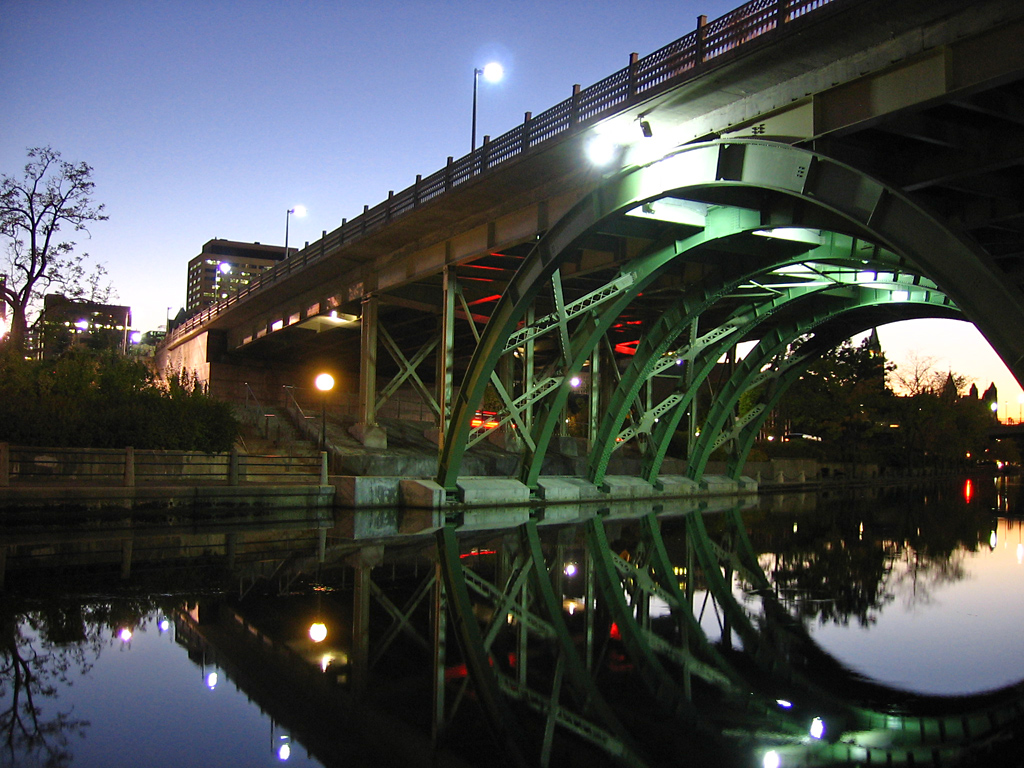
Rideau Canal bridge

Though it feels like the Labour Day weekend just happened, I now find myself on the cusp of another three day break from work. The Thanksgiving weekend is shaping up to include a good combination of activities. Some cycling will doubtless occur. On Sunday, I am doing my first trip with the Ottawa Hostel Outdoor Club (mentioned before). About twenty people are going on an exploratory hike to Ramsay Lookout. That evening, I have been invited to Thanksgiving dinner by a co-worker. I will have to make some kind of interesting veggie dish. Any suggestions (or recipes) would be most welcome.

Next Thursday, Meaghan Beattie is arriving in Ottawa. The next day, Tristan is coming from Toronto. Spending the weekend exploring Ottawa with them promises to be excellent. We should, for instance, finally visit the Civilization Museum over in Gatineau. October 16th marks the three-month point in my job. Between the 24th and 28th, I will be in Montreal. The first three days are for a conference, whereas the weekend is reserved for having fun in the city. I really enjoyed living there for a couple of months, back in 2003. I am told the train ride from Ottawa to Montreal – through all that autumnal deciduous landscape – should be very beautiful.

December should be really exciting. By taking four days off work and using the various statutory holidays, I should be in Vancouver from late on the 21st until the 3rd of January. It will be my longest span of time in the city since the summer of 2006. A big gathering of friends in North Vancouver should definitely be arranged, akin to my pre-Oxford departure party and previous such food-and-friend-laden gatherings. I feel guilty about the flight (0.8 tonnes of CO2 for the total journey of 7100km), but I am regrettably unable to take two months off work to cycle there and back.

The Storm Worm

The Storm Worm is scary for a number of good reasons. It acts patiently, slowly creating a massive network of drone machines and control systems, communicating through peer-to-peer protocols. It gives little evidence that a particular machine has been compromised. Finally, it creates a malicious network that is particularly hard (maybe impossible, at this time) to map or shut down.

This is no mere spam-spread annoyance. If it takes over very large numbers of computers and remains in the control of its creators, it could be quite a computational force. The only question is what they (or someone who rents the botnet) will choose to use it for, and whether such attacks can be foiled by technical or law-enforcement means. Hopefully, this code will prove a clever exception to the norm, rather than a preview of what the malware of the future will resemble.

Normally, I don’t worry too much about viruses. I use a Mac, run anti-virus software, use other protective programs, make frequent backups, and use the internet cautiously. While those things are likely to keep my own system free of malware, I naturally remain vulnerable to it. That’s where most spam comes from. Also, there is the danger that a network of malicious computers will crash or blackmail some website or service that I use. With distributed systems like Storm, the protection of an individual machine isn’t adequate to prevent harm.

Previous related posts:

Voice echoing off cave walls

Posting two entries a day with little or no personal content is: (a) time consuming and (b) seemingly uninteresting to the long-suffering readers of this blog. As such, I am declaring one post a day to be the standard, with unlimited allowance for additional posts if I feel inspired.

Sometimes, it is hard to know if anyone is even reading. If you have been, but you never leave comments, I would really appreciate if you did so here.

Sputnik at 50

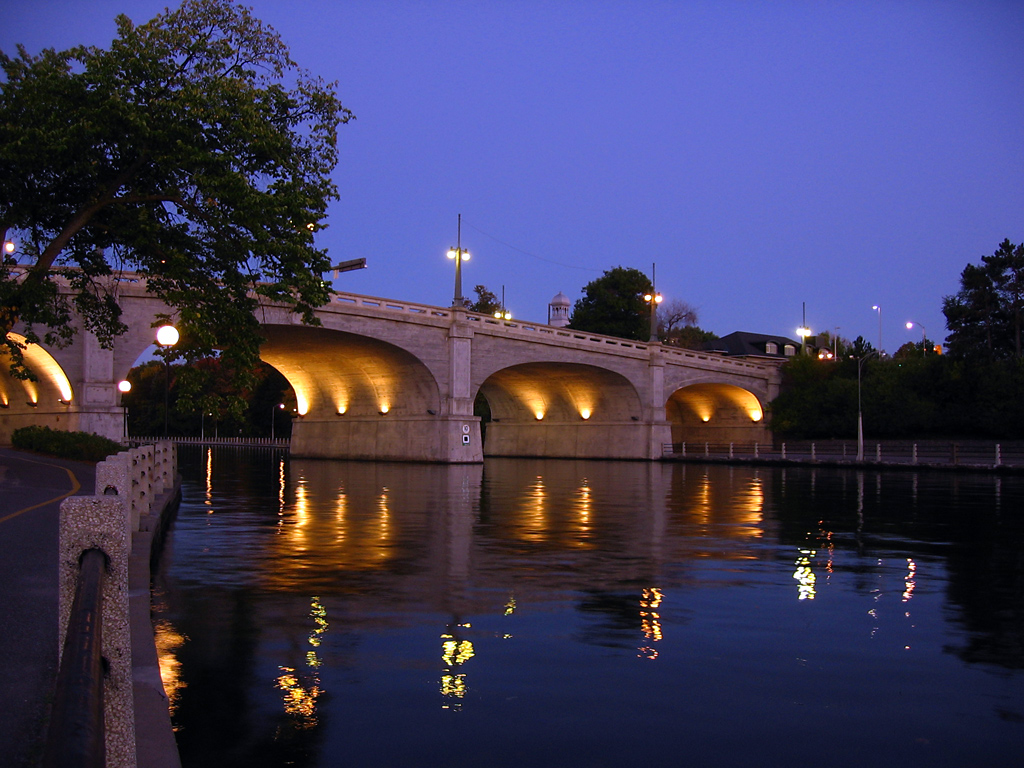
Bridge on the Rideau Canal

Even the Google logo has been altered to commemorate the 50th anniversary of the launch of Sputnik 1: the first artificial satellite. As someone who spends a very considerable amount of time thinking about how things are going to be in 2050 and 2100, it is remarkable to reflect upon both how different the world is from that of 1957 and how similar it is. The big changes that occurred have often been in areas that few if any people would have anticipated the importance of back then. Areas of great enthusiasm, such as nuclear power and space exploration, have only progressed incrementally since the 1950s and 60s.

I mentioned one Sputnik-related irony in a paper published back in 2005:

At the end of August, 1955, the Central Committee of the Communist Party approved the Soviet satellite program that would lead to Sputnik and authorized the construction of the Baikonour Cosmodrome. This facility, the largest of three Soviet launch sites that would eventually built, was the launching place of Sputnik I (and subsequent Sputniks), and the launch site for all Soviet manned missions…

This former stretch of Kazakhstani desert was also, fatefully, the place to which Nikifor Nikitin was exiled by the Czar in1830 for “making seditious speeches about flying to the moon.” He might have taken cold comfort in the fact that in 1955, the Central Committee gave control of the site to the new Soviet ‘Permanent Commission for Interplanetary Travel.’

For all the drama, it remains unclear to me that manned spaceflight serves any useful scientific or practical purpose at this point in time (see previous). In that sense, perhaps Sputnik – rather than John Glenn – was the true template for humanity’s future involvement in space: an 83.6kg ball of metal with a radio transmitter.

PS. My thesis mentions one somewhat surprising connection between Sputnik and climatic science:

A fortuitous bit of funding produced one of the most famous graphs in the climate change literature: the one tracking CO2 concentrations at Mauna Loa in Hawaii. Examining it closely, a gap can be seen in 1957, where David Keeling’s funding for the project ran out. The Soviet launch of Sputnik I on 4 October 1957 led to a marked concern in the United States that American science and technology had fallen behind. One result of the subsequent surge in funding was the resumption of the CO2 recording program, which continues to the present day.

This graph is the jagged, upward-sloping line that Al Gore devotes so much attention to near the beginning of An Inconvenient Truth.

A notable volcanic outburst

Most people probably will not have heard 1816 referred to as the Year Without a Summer, but that is exactly what the eruption of Mount Tambora in what is now Indonesia seems to have made it. That May, frost killed or ruined most of the summer crops. In June, two large snow storms produced substantial numbers of human casualties. Hungary and Italy got red snow, mixed with ash, while China experienced famine associated with sharply reduced rice production. In total, about 92,000 people died and the global mean temperature fell by 3°C.

One random yet positive consequence was constant rain causing Lord Byron to propose a writing contest, which Mary Shelley eventually won with Frankenstein. The increased cost of oats may also have driven a German man named Karl Drais to invent the first bicycle. (He called it the ‘velocipede,’ which sounds like a fast-moving and dangerous insect.)

Such incidents are inevitable on a planet that remains geologically active, but they certainly demonstrate the degree to which natural patterns can change rapidly, as well as the degree to which human beings are dependant upon them not doing so.

Ice and pollen

Brick and electrical metres

With good reason, ice cores have been getting a lot of attention lately. Their careful analysis gives us priceless insights into the history of Earth’s climate. Using cores from Greenland, we can go back more than 100,000 years, tracking temperature, carbon dioxide concentration, and even solar activity (using beryllium isotopes). Using cores from Antarctica, it is possible to go back about 650,000 years.

Ice cores can be even more valuable when they are matched up against records of other kinds. Living and petrified trees can be matched up, year for year, with the ice record. So can pollen deposits at the bottom of seas and lakes: arguably the richest data source of all. By looking at pollen deposits, it is possible to track the development of whole ecosystems: forests advancing and retreating with ice ages, the species mix changing in times of drought, and the unmistakable evidence of human alterations to the environment, going back tens of thousands of years.

Lake Tanganyika, in Tanzania, offers an amazing opportunity. 676km from end to end, it is the worst’s longest lake. It is also the second oldest and second deepest – after Lake Baikal in Siberia. Core samples from Tanganyika have already documented 10,000 years worth of pollen deposition. With better equipment and more funding, scientists say that it should be possible to collect data from the last five to ten million years: increasing the length of our climate records massively.

I am not sure if such an undertaking is already in the works. If not, it seems like the kind of opportunity we would be fools to pass up. If no government or scientific funding body is willing to stump up the cash, perhaps a billionaire or two can be diverted from their tinkering with rockets.

Polar opposites

By now, everybody knows that the Arctic summer sea ice is at an all-time low. What I only learned recently is that the extent of Antarctic ice is the greatest since satellite observation began in 1979. At the same time, it is undergoing “unprecedented collapses” like the much-discussed Larsen B collapse. Such realities hint at the complexities of the climate system.

Whereas the Arctic doesn’t have any effect on sea level, because it floats, the Antarctic rests on land. As such, changes in its ice mass do affect the depth of the world’s oceans. Antarctica is also the continent for which the least data is available, making it hard to incorporate into global climate models. As with all complex dynamic systems, there are non-linear effects to contend with. That makes it dangerous to extrapolate from present trends, especially when it comes to local conditions.

All this makes you appreciate why scientists frequently sound less certain about the details of climate change than politicians do. The harder you look at systems like the Earth’s climate, the more inter-relationships you discover, and the more puzzles there are to occupy your attention.

The coming cold

Mean monthly temperatures for Vancouver, Ottawa, and Oxford

Presenting the mean monthly temperatures of Vancouver, Ottawa, and Oxford on the same graph generates an interesting image. Vancouver is basically Oxford plus a couple of degrees in the winter and about five degrees in the summer. Ottawa is much more variable. In the zones where the lines intersect (around April and October), the mean temperatures for all three places are fairly comparable. That may partly explain why I have been finding the weather so pleasant recently.

I wish I had some data that included standard deviations of temperature on a month-by-month basis. I really have no idea which of the three places would have the most intra-month variability, though my suspicion is that it would probably be Ottawa.

The data for Oxford is from the Radcliffe Meteorological Station. The data for Vancouver and Ottawa is taken from the Meteorological Service of Canada.

Shake Hands with the Devil

There isn’t really any appropriate way to talk about a film like Shake Hands with the Devil (2007), given the way in which it is a recasting of a historical episode such as the Rwandan genocide. I suppose one can direct blame, as a response: at the great powers, at the United Nations, at Belgium, at the belligerents, at the genocidaires. Appropriate as that may be, the sheer appalling character of what was undertaken by human beings makes me wonder whether it would have been better if nothing in the universe had ever awoken to cognition, if all the atoms in all the rocks and stars had just interacted dumbly from the unfathomable origin of space and time to the entropic silence that will be the end of it.

One thing that is demonstrated by the experience of watching is the power of film as a medium; having read Dallaire’s book and even seen him speak, the horror was never conveyed with anything approaching the same visceral quality. In response, you can’t help but wonder what we really ought to be doing in Afghanistan now, or in Darfur.

Yorke asks you to name your price

In a publicity stunt / experiment in the changing climate of the music business, Radiohead is selling their new album “In Rainbows” online, for whatever the buyer wishes to pay. The website where this is done looks so ugly that it made me initially suspect that the thing is a scam (reading about it here doesn’t mean for certain that it isn’t). The mainstream media seem to have bought it, so it is probably genuine. No matter when you pay, they won’t send you the download link for the album until October 10th.

For my part, I paid the mean price of an Oxford pint. That is more than they would have gotten from me in the alternative, as I stopped buying their albums long ago, during the long slide from the brilliance of “OK Computer” into the mediocrity of their later work.

[Update: 10 October 2007] I received my copy of the album. It arrived in the form of ten DRM-free 160 kbps MP3 files. I will comment on the quality of the music once I have had more time to absorb it.