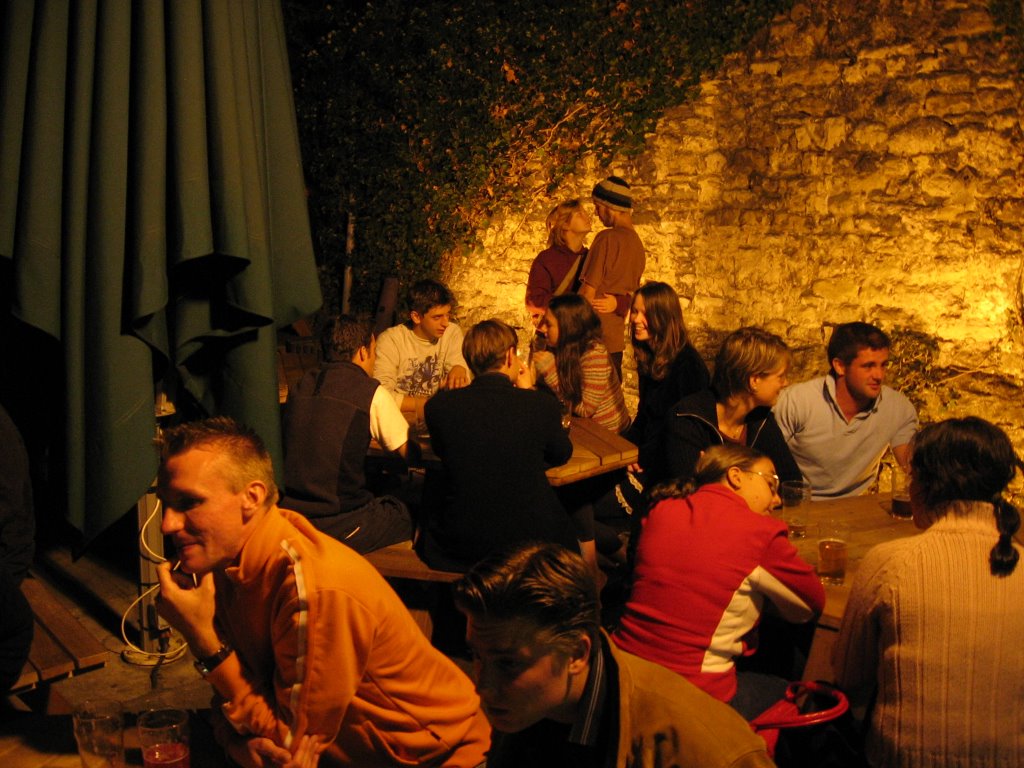
Twenty months in Oxford

Antonia Mansel-Long in the Wadham Gardens

With a few weeks left before exams and about a month left before leaving Oxford, I find myself thinking backward and forward more than in the present. As such, even though I have every reason to be quite busy, I am feeling somewhat in the lurch. Those bits of life that feel most immediate don’t have anything to do with the M.Phil program. Actually, now that seminars have ended, I rarely see any members of the group aside from the ones I live with and a couple of others who are neighbours. I am looking forward to our post-exam barbecue on the 14th as the last instance in which I am likely to see more than a dozen of the program’s twenty-eight members in one location together.

Thinking back to the first few months in Oxford is unusual. They seem much more alien to me than the last year, as well as any of my time at UBC. To begin with, I was living in Library Court. I was eating bagels and cheese, more than anything else. I was spending quite a bit of time in pubs, as that seemed to be the major venue for social interactions. Largely on the basis of where I am living now, life has a much more normal and natural feeling. As revision has been showing, even the material that I was working through back then has become rather unfamiliar in the interim. It would be hard to say with certainty whether a paper I wrote in October 2005 was actually written by me, or by someone with the same reading list and a similar style of writing and analysis.

In any case, I am looking forward enormously to knocking off the last few academic items that need to be completed in Oxford. I am hoping that I will then have the chance to focus on what has been best over the last two years. I certainly hope that I will get to try punting at least once before departing, as well as see some of the friends who have been fixtures of life at various times, but who I now hardly ever see.

Quicktime movies from iPhoto

Here is a useful iPhoto trick that Mac users may not already know: if you select a batch of photos, then select “Share > Export” you can create a QuickTime movie. You can have each image show for whatever length of time you like, set the size of the movie generated (in pixels) and add music. You can do this by simply selecting a collection of images in the library, by selecting an album, or by selecting a slide show. If you want to add music, you need to do the last of those.

Exported Quicktime movies seem like a pretty good option for sending photos of a trip or party to people who request them. The file sizes are very manageable, the image quality is decent, and it is easier than mucking around with sending dozens of individual files.

Here is a random example. It consists of some graffiti from Paris, Vancouver, Helsinki, Dublin, Tallinn, and Oxford. One annoying quirk is how adding music massively increases the file size. The same collection of images with an mp3 playing in the background produced a file of over 65 megabytes.

After iPhoto?

I have always found the slide show system in iPhoto a bit awkward, largely because of how you cannot drag images out from it into other applications, as you can with normal albums. That means if you want to edit one of those images in Photoshop, you need to track down the original in your library or an album.

If I ever do get a dSLR, I will probably need to switch to something more robust for storing image files. Even working with the jpeg files from my 3.2 megapixel camera, it gets cranky when too many are being worked with at once. That is with 1.25 gigabytes of RAM, drop shadows off, thumbnails at one of the three default sizes, and a minimum of other programs running. One can only imagine how it will treat 10 megapixel RAW files.

Another problem with iPhoto is that it doesn’t offer many options for having different versions of the same file. At the very minimum, I want to retain the original jpeg at maximum resolution and then have a 1024×768 pixel version that has had the contrast and levels adjusted an appropriate unsharp mask applied. Being able to store additional versions would be an advantage, especially if they are intelligently linked to the original. I don’t want it to be confusing which is which: a situation largely unavoidable in iPhoto, unless you want to look at the image properties for every file you glance at.

Millennium Development Goal 7

Church Walk sign

Prompted by my international law and developing world revision, I had another look at the eight Millennium Development Goals which were adopted by the 192 UN member states in 2000, and which are meant to be achieved by 2015. All eight are quite ambitious and represent worthy ambitions and intentions.

Some of the goals give themselves over easily to quantitative evaluation. For instance, reducing the maternal mortality ratio by three-quarters. While there are the ever-present concerns about data quality and the danger of people fudging their numbers, at least there is an empirically verifiable objective being targeted.

The environmental category (MDG7) has the general heading “Ensure environmental sustainability” and among the most vague provisions in the whole list:

  1. Integrate the principles of sustainable development into country policies and programmes; reverse loss of environmental resources.
  2. Reduce by half the proportion of people without sustainable access to safe drinking water.
  3. Achieve significant improvement in lives of at least 100 million slum dwellers, by 2020.

To begin with, ‘sustainable development’ is not as objective a concept as it is sometimes considered. If it requires a society that could continue to operate in its present form indefinitely, then no society that exists today meets the standard. Of course, the term ‘development’ contradicts the idea of stasis. So too does the inclusion of the term in the MDGs generally, since all of them would require large-scale changes in both domestic and foreign policies.

When it comes to sheer vagueness, “reverse loss of environmental resources” must take the cake. What are ‘environmental resources?’ And what would ‘reversing their loss’ involve? With a few exceptions, such as the breakdown and slow recovery of stratospheric ozone, it is not terribly clear what this could mean. Even in cases where the general thrust of the idea seems applicable, such as reforestation or the protection of coral reefs from damaging fishing practices and increasingly acidic oceans, it doesn’t provide much in the way of guidance, or much of a standard for achievement.

Access to water

The second goal, about access to water, is much more in keeping with the qualitative targets that the MDGs generally seek to establish. A map of the world showing who has poor access to water and another showing the incidence of deaths from cholera demonstrates just how unequal quality and availability of water around the world is. All the technology required to provide safe drinking water to everyone exists. The degree to which the present situation is the result of a lack of will makes it a very appropriate target for a high-profile initiative like the MDGs.

While I have never believed that water is a likely cause for large-scale wars (countries that can afford to fight large-scale wars can afford desalination plants, which are expensive but cheaper than wars), there is every reason to believe that water will become a more acute problem in coming decades. One minor example is how a sea level rise of about 100cm could essentially eliminate Malta’s major sources of fresh water. Expect bigger problems in places like India or Bangladesh.

The Economist printed a good Survey on Water back in 2003. Accessing it requires a subscription.

Slum dwellers

Slums were mentioned here quite recently. Improving the lives of 100 million slum dwellers is certainly a worthy aim. As many as 1.2 million people may live in just the Kibera slum in Nairobi. In sub-Saharran Africa, where more than 70% of the urban population already lives in slums, the rate is growing at 4.53% per year. Improving their lives probably requires two sets of approaches. One is based around providing basic needs, including water, health care, sanitation, lighting, security, and education. The other is based around reforming legal systems. Providing secure title to land, for instance, would likely reduce opportunities for bribery, provide access to credit, and generally reduce the level of insecurity in people’s lives. Actually implementing either set of approaches is an awfully tricky proposition, not least because of entrenched interests that value slums as a source of bribes from those who live there as well as a source of cheap labour for the city in which they are embedded. That being said, there are potentially huge improvements in human welfare to be achieved from success in this area.

All told, there seem to be a lot of reasons to be hopeful about the MDGs. They demonstrate, at least, that there is universal awareness within the international system about some of the most pressing problems of the present day. There is likewise at least some energy and initiative being committed to their resolution. The extent to which such efforts are successful will probably have a big impact on the kind of world in which we find ourselves in fifty years time: one in which most of humanity has reached a situation in which their basic needs are met and their basic rights are respected, or one that may be even more unequal and conflict-prone than the situation at present.


Economics, games, and choices

In two unrelated instances today, I ended up speaking with friends about the kind of games economists make people play in experiments. The objective in doing so is to learn how people reason, when presented with economic choices. This has a lot to do with heuristics and often generates results that do not make sense, if people have the sole objective of maximizing how much money they will earn from the game itself. That is what happened when I played one of these games during my first month in Oxford.

The form I was discussing with Mark is called The Traveler’s Dilemma (not to be confused with The Salesman Problem). Being good at games like the Traveler’s Dilemma will help you in negotiations with tricky insurance companies. Solving the Salesman Problem would earn you the esteem of mathematicians everywhere.

In a act unrelated to either conversation, Nick Howarth – an Oxonian and former Olympian who I met a couple of days ago – sent me a link to a Nobel Prize lecture on the emerging discipline of behavioural economics.

Ignatieff speaking in Oxford

One upcoming talk that may be of particular interest to Canadians in Oxford is being given by Michael Ignatieff in the hall of Wolfson College this Thursday. The talk is the annual Isaiah Berlin lecture, and it is on the topic “Political Judgement: Theory versus Practice.”

Ignatieff is one of the most well known Canadian academics, as well as a recent contender for leader of the federal Liberal Party, so I suspect this talk will attract a fair bit of attention. It starts at 6:00pm.

One of his books – Blood and Belonging – was mentioned here before.

Four hurdles left

Cacti

And so, fifth week has begun. In three weeks, I will be sitting down in the Examination Schools and writing my final exams. Developing and maintaining motivation with regards to final exams is a lot more difficult than it was in the case of the thesis. I suppose that comes down to how one of them is meant to be the culmination of a great deal of thought and effort, whereas the other is just the requirement to throw some good essays together on topics that you could more or less forget the next day, if you wanted to.

Motivated or not, I need to get on top of this. If I am going to have time to write practice examinations to discuss with Dr. Hurrell, I am going to need to finish revising for at least two of my exams post-haste.

Victoria Day

Natives of the United Kingdom may be surprised to learn that today is a royal holiday – in Canada, at least. Celebrated on the Monday before May 25th, Victoria Day is a celebration of both Queen Victoria‘s birthday and that of whoever the current monarch happens to be. It replaces the rather less politically correct ‘Empire Day,’ which was renamed ‘Commonwealth Day’ in 1958.

While it is pleasant enough to have the Queen’s well-composed visage on the back of currency and Regina v. whomever as the standard form for criminal cases, Canadians might be forgiven for thinking the monarchy is a archaic throwback to an earlier era. Most Canadians probably don’t know that Elizabeth II is the Commander-in-Chief of Canadian Forces, as well as Colonel-in-Chief for nine different military units, including the Military Engineers and three groups of Highlanders. While Canadians do appreciate opportunities to differentiate themselves from their southern neighbours (especially as they grow even more unpopular internationally), at least some people have been watching Austalia’s flirtations with republicanism with marked curiosity.

Given her smooth but bland rein, perhaps Elizabeth II would be a fitting final monarch for Canada.

Interesting gear

Wadham College espresso machine

People with a fascination for gear should have a look at Cool Tools. The sort of people who make a point of reading through the MEC catalog are likely to enjoy this site. Some of the pieces of gear look highly useful. For those unlikely to lose it, a windproof umbrella might be a worthwhile investment. Some of the kitchen gadgets are decidedly strange, or serve very rare and limited purposes. For creative sorts, there is a kit for those who want to assemble their own dulcimer. Damsels with dulcimers cannot be guaranteed “a sunny pleasure-dome with caves of ice”, but they can be offered tools to help in building their own igloo.

Some of this may end up on my gear wish list.

A more aggressive collection of useful gadgets is described at Kit Up. While much of it is specifically military, some of it is appropriate for hiking and camping as well.

PS. This metal pencil is also quite cool. It uses some kind of metal alloy that writes on paper in a way that looks like pencil, yet cannot be rubbed out. For years, I have wanted some neodymium magnets to play with.

On road pricing

Over the next couple of decades, many people expect road pricing to evolve from its present state – focused on highway tolls and city centre congestion charges – to a model in which all road use is taxed. In such a system, all movement of automobiles would be tracked and taxed on a per-kilometre basis, subject to secondary considerations like vehicle fuel efficiency and level of road congestion. Singapore, London, Oslo, and Dubai have all introduced charges intended to reduce congestion and pollution in their city centres. Expanding such systems to cover all roads would involve some considerable benefits, though there are also problems that would likely arise.

Benefits

National systems of road pricing would have a number of benefits:

  • The high cost of building and maintaining roads could be more accurately directed at those who use them.
  • Externalities relating to CO2 emissions from automobile use can likewise be dealt with.
  • By charging more to drive on congested roads, people can be encouraged to avoid traffic jams. This helps people who need to use the road avoid wasting time. It also saves on the amount of fuel being wasted by hundreds of idling engines.
  • Some of the funds raised could be directed towards the improvement of public transport options.
  • The use of more efficient vehicles could be encouraged through variable pricing.
  • The use of vehicles that do less damage to road surfaces (that is to say, those other than heavy trucks with bad shock absorbing systems) could likewise be encouraged.

The benefits are thus split into two big categories: those concerning a fairer allocation of costs to those benefitting from publicly provided roads, and those serving to internalize the previously ignored social and environmental costs of driving. If one considers the geopolitical costs of oil dependence, the latter looks even more justified than if one concentrates on particulate emissions and climate change only.

Problems

Naturally, there are a number of significant problems associated with such systems. One is equity. Road pricing may impose high burdens upon individuals with low incomes. For instance, those who cannot afford to live near where they work. Solutions to this could include the provision of some set level of free usage, over and above which people start getting charged. Better options include encouraging the development of efficient and popular public transport systems, as well as reduced charges for light and energy efficient vehicles. Zero-emission vehicles (such as electric cars charged on nuclear or renewable power) could likewise be taxed at a lower rate.

More serious are the privacy implications. I think it would be naive to imagine that the tracking information generated by such systems will not be retained by the state and used, for good or ill, without a great deal of public accountability. This is part of the much broader problem of how to manage data control and privacy protection in an age where surveillance is increasingly ubiquitous and data storage is ever cheaper. In recent years, there have been many cases of government employees found using access to such databases in improper ways. Doubtless, the vast majority of such inappropriate use is never discovered. Further to that, there is good reason to believe that access to such databases will be gained by outsiders through flaws in internal security protocols. The creation of systems for oversight would therefore be essential, and it seems wise to have a general policy of deleting stored data after a set amount of time has elapsed, with exceptions granted only through an explicit process of approval subject to external scrutiny.

An appeal for bike subsidies

One suggestion I would make to improve this system would be to include an optional component for cyclists. Those willing to cycle around with a transponder would be credited at a modest rate for distance traveled. This would be in recognition of the non-market advantages of cycling, such as the value of physical fitness as a component in preventative medicine. In 1998, Health Canada estimated the total cost of cardiovascular diseases on the health sector of the Canadian economy to be $18,472.9 million (11.6% of the total cost of all illnesses). Cardiovascular disease is also responsible for 36% of deaths. As such, a subsidy of a few cents a kilometre makes economic sense, as well as potentially generating some good publicity for a system that is likely to be highly unpopular with commuters.

There are also network benefits to be had from increasing the number of cyclists. The emergence of suburbs was made possible by automobiles, at the same time as such urban trends made them increasingly necessary. A more positive version of such feedback effects can be brought about for cycling: as higher numbers justify a more cycle friendly infrastructure which, in turn, encourages more people to cycle. In particular, the creation of designated bike lanes and routes, the provision of cycle parking facilities, and integration of bike carrying capabilities into public transport seem sensible.