
When people say that ‘the science of climate change is settled’ they are often being problematically imprecise. Elements of the science are certainly settled beyond a doubt – for instance, the simple fact that adding carbon dioxide to the atmosphere raises global temperatures. Other elements are certain but less precise: overall warming of the planet will alter air and water currents, though we do not know exactly how. Still higher order questions have answers at lower levels of both precision and certainty.
This graphic sketches out a bit of what I mean:
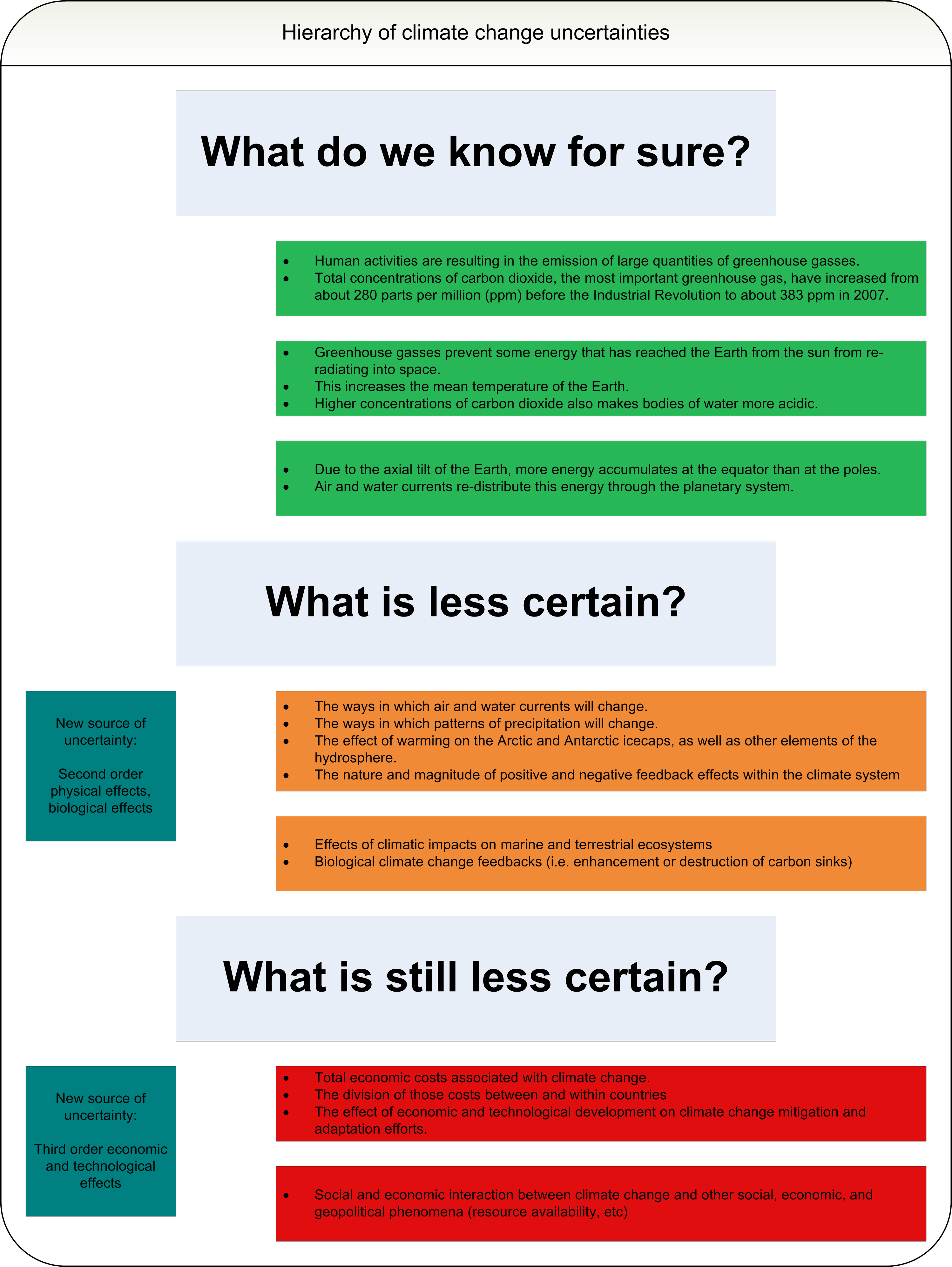
Responding to climate change is perhaps the ultimate case of needing to make decisions under conditions of uncertainty. Simplistic conceptions of what it means for something to be ‘certain’ must give way to a more nuanced appreciation of the nature of knowledge and evidence.

I think this is an excellent post – I’m considering printing out this graph and posting it on some telephone poles.
As you probably can assume, I have a beef with certainty, and this is a case where any notion of truth based on certainty is going to be useless in decision making. As you say, simplistic notions of “certainty” need to “give way to a more nuanced appreciation of hte nature of knowledge and evidence”. What is the nature of knowledge and evidence? I think the best way to start is “that which you could always be wrong about/be misled by”.
Ugly. Ugly Visio.
I think it’s a great doc. Clear and succinct.. But it’s the size of Texas when you open it..
Can you resize it so it opens to a normal size?
It was intended for use as a wall-sized poster, illustrating the concepts therein for underlings…
Excellent post, Milan. As a non-scientist, I’ve often found the arrogance of some in the scientific community astonishing. There is plenty of historical evidence after all that scientific certainties become less certain and even refuted as time, experience and other influences intervene. Medicine is a prime example of this.
XUP,
Scientists have made mistakes in the past. That said, people are sometimes far too quick to dismiss their work, just because it clashes with something they want to believe.
If you want to gain some appreciation for how meticulous and precise a lot of climatic science is, read Richard Alley’s “The Two Mile Time Machine.”
Although there remains uncertainty in many aspects of climate science, as in all science, over the past few years an overwhelming and well-founded acceptance has emerged, not only in the scientific community, but among the general public and in political arenas, that human activity, and in particular the burning of fossil fuels, is warming the planet. Far from the debate being over, with this awareness the discourse on climate change has largely moved from one of questioning the science to disputing what ought to be done about the problem.
The rational for the FPS publication of this note was to ‘open up the debate’ on climate change. The obvious ineptitude of this contribution underlines quite effectively how little debate there is on the fundamentals if this is the best counter-argument that can be offered.
“Yes, science has clearly revealed that humans are influencing global climate and will continue to do so, but we don’t know the full scale of the risks involved, nor how rapidly they will evolve, nor indeed—with clear insight—the relative roles of all the forcing agents involved at different scales.
Similarly, we endow analyses about the economics of climate change with too much scientific authority. Yes, we know there is a cascade of costs involved in mitigating, adapting to or ignoring climate change, but many of these costs are heavily influenced by ethical judgements about how we value things, now and in the future. These are judgments that science cannot prescribe.”
“Uncertainty about the consequences of climate change makes it hard to persuade people to spend money on it, for where the damage is uncertain, so are the benefits of averting it. Yet uncertainty is also why mankind needs to take the problem seriously. If we were sure that the temperature would rise by 2-3ºC, then we could choose to live with that. But we do not know how far the rise might go. The Intergovernmental Panel on Climate Change (IPCC), the body set up by the UN to establish a scientific consensus on the subject, puts the range of possible increases by the end of this century at 1.1-6.4ºC. At the bottom end of the range, the difference would be barely noticeable. At the top end of the range—well, guesses about what the world would look like then read rather like science fiction.
Although the benefits of averting that sort of catastrophe are incalculably large, the costs of doing so should not be enormous—as little as 1% of global output, if policy is well designed. This newspaper reckons that the world should fork out, rather as householders spend similar proportions of their income on insuring their homes against disaster.“
THE overwhelming consensus among climate scientists is that human-caused climate change is happening. Yet a fringe minority of our populace clings to an irrational rejection of well-established science. This virulent strain of anti-science infects the halls of Congress, the pages of leading newspapers and what we see on TV, leading to the appearance of a debate where none should exist.
In fact, there is broad agreement among climate scientists not only that climate change is real (a survey and a review of the scientific literature published say about 97 percent agree), but that we must respond to the dangers of a warming planet. If one is looking for real differences among mainstream scientists, they can be found on two fronts: the precise implications of those higher temperatures, and which technologies and policies offer the best solution to reducing, on a global scale, the emission of greenhouse gases.
For example, should we go full-bore on nuclear power? Invest in and deploy renewable energy — wind, solar and geothermal — on a huge scale? Price carbon emissions through cap-and-trade legislation or by imposing a carbon tax? Until the public fully understands the danger of our present trajectory, those debates are likely to continue to founder.