On the importance of hope and dedication

Happy birthday Elise Haynes

Tonight, I have been speaking with friends of mine about the challenges of these living generations, and the opportunities afforded to us. On the basis of our wealth, we can diminish and subdue the greatest scourges that impact humanity: scourges of poverty and disease. On the basis of our compassion, we might overcome the forces that drive us apart from one another, when we are fundamentally so close. We are inescapably pressed together in such a tiny corner of the cosmos.

Imagine if John Kennedy’s inaugural address could be modified, so as to serve the great challenge of our time:

We choose to [end extreme poverty] in this decade and do the other things, not because they are easy, but because they are hard, because that goal will serve to organize and measure the best of our energies and skills, because that challenge is one that we are willing to accept, one we are unwilling to postpone, and one which we intend to win.

We can deal with the horrors of infectious disease and poverty. We can work to mitigate the warlike and genocidal qualities of dictators and governments. We can and must work for a better world. It is my enduring hope, and all my faith in humanity, that we shall.

On luxury notebooks

Encouraged by the approval of friends like Emily and Tarun, as well as the endorsement on Tony’s blog, I bought a Moleskine notebook today. I am quite ambivalent with regards to the symbolism of the things: they try to cultivate artistic chic, but through their absurd price, coupled with ready availability, they can easily be seen as absurdly pompous. This might be called ‘Powerbook syndrome:’ only very marginally better than iBooks, yet nearly twice the price.

I was able to justify spending eight quid on a 120-page notebook only because it is an eighteen month weekly calendar. As such, it is worth spending more for something that will not fall apart or lead to you cursing it daily for a year and a half. It is a better alternative to telling people: “Yes, Thursday might be good. Just email me and I will check in Outlook that I don’t already have something sorted out.”

The choice was between developing a memory for appointment-type details and getting some kind of day-planner. The redeeming qualities of spending money on something long-lived should be a useful antidote to accusations of notebook snobbery. As for the question of whether Moleskine notebooks are really all they’re cracked up to be, I will get back to you.

The World is Flat

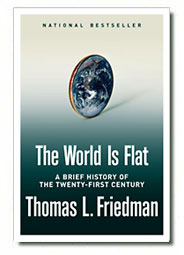
The World is Flat coverIn The World is Flat, Thomas Friedman provides a reasonable introduction to some aspects of globalization for the general audience. The strength of the book lies much more in the examples than in the analysis, which can sometimes be glib and patronizing. Even so, I would personally have appreciated fewer wonder stories about the internet transforming business and more discussion of the kind that concludes the book: on the complexities and caveats of the globalization process.

Friedman’s argument that the ‘world is flat’ strikes me as little more than a different way of saying that it is ‘smaller.’ Further perpetuation of the outrageously false notion that the world was thought flat pre-Columbus is never welcome. Sorry, Mr. Friedman, but Eratosthenes of Cyrene identified the size and shape of the Earth correctly back in the 2nd century BCE. That trifling correction aside, it can be little disputed that Friedman uses his analogy far, far too often.

At its best, the book is a fairly robust defence of the practice of outsourcing. Friedman argues effectively that the benefits are nearly universal, while still pointing out the importance of having societal systems to assist those who are harmed by the changes. Insofar as the book demonstrates the extent to which change and competition look set to become ever-more constant features of the lives of all people, I find it worrisome. India and China might not be quite as ready to take over as he seems to indicate, but the extent of competition in an increasingly globalized world has undeniably expanded. Like most people, I worry about whether I am going to be able to manage.

Friedman’s analysis of global terrorism includes some insightful discussion: especially with regards to the importance of humiliation as a motivating phenomenon. Understanding the psychology of terrorism – and why well-educated Saudis have become suicide bombers, but virtually no Indian Muslims or any type – is clearly essential for dealing with the problem.

In summary, while the book is overly long and sometimes lacking in analytical quality, it is worthwhile to have a look through, especially if you’re looking for examples of how business practices are changing as the result of increased global communications, competition, and supply chains. I don’t think The Economist was entirely justified in calling the book “a dreary failure,” but it certainly isn’t a stunning success.

Changing gears, I am going to read Alain de Botton’s Essays in Love next. It has been on my discretionary reading list for so long now that I can’t remember who was the other party to my promise that I would read it.


Ratchet of the year

Ratchet diagramThe psychological gulf from May to June is enormous. That boundary is the ratchet; it’s the point beyond which the advancements of September through May are locked down. The feeling of crossing it is that of being secured and unleashed at the same time. A few more loose ends to tie up (four papers and a presentation) and it’s just me and Europe for the summer. Some kind of European job, many European books, and at least a few quick sojourns to the continent itself.

With four whole months now before classes will resume, I can scarcely imagine what will transpire in the interim. I need only compare the present day to May Day to be instantly reminded of how quickly things change here. Oxford terms and relationships operate on accelerated time scales, as they tend to within communities of people in transit.

This coming Friday, it looks as though I will be going to London. Despite it only being a few hours away, by bus, this will be only my third visit to see things within the city itself, rather than simply pass through on the way to an airport. Key objectives are the British Museum, the Tate Modern, and the search for certain things I’ve been unable to find so far in Oxford. I imagine that anything that can be found can be found somewhere in that broad, flattened, ancient metropolis.