
On patriotism

Having been exposed once again to the summer light show outside parliament, I find myself thinking about patriotism once again. It seems to me that you can approach it from two different directions. In the first case, you develop a list of virtues that a country might possess. These could include a good human rights record, international generosity, the rule of law, and so forth. You then evaluate any particular state on the basis of your pre-existing preferences. The alternative is to simply assert the unique value of a particular state, as derived from its history and so forth.

The first approach strikes me as far more valid. It is absurd for someone to assert the superiority of their country in a non-comparative fashion, or without relation to particular characteristics which establish a state as worthy or unworthy of admiration. Admiring states as means to desirable ends has a fundamentally liberal quality, while the alternative is mythical, with a distinct whiff of fascism.

In general, love of country seems more dangerous than beneficial. We can certainly admire states that do a good job of advancing human welfare, but we should value the states only as vehicles to those ends, not as inherently valuable entities. The doctrine of “my country, right or wrong” seems unacceptable in a world with so much experience of nationalist war and state sponsored moral outrages.
Nanomaterial safety

When it comes to geological periods of time, our intuitions about how things work cannot be trusted. This is a reflection of the parochial character of many of the heuristic shortcuts in our minds. The same thing applies to the behaviour of objects at a minute scale. For instance, sufficiently tiny machinery is hampered enormously more by friction and surface tension than a larger equivalent would be. Because they have more surface area relative to their volume, they also tend to be much more reactive.

Indeed, asymmetries of behaviour at different scale raise serious concerns about the safety of newly developed nanotechnologies. Just as our brains are calibrated to deal with the kind of experiences that have been normal to human lives for thousands of years, our regulatory procedures are calibrated to respond to known risks like toxicity or corrosiveness.

There have certainly been serious problems that arose from regulation lagging innovation in the past. Think of ozone-destroying chlorofluorocarbons, or mesotheliomas caused by chrysotile asbestos. Balancing safety concerns with the desire not to stifle innovation is extremely challenging, especially when the entities with the most sophistication in relation to a new technology are its commercial backers.

In some cases, nanomaterials have almost completely escaped regulation because it has been assumed they behave like their non-nanoscale equivalents. That said, nanoscale titanium dioxide is not the same as a macroscopic bar of the stuff. The same is true for carbon nanotubes, silver nanoparticles, and so forth. Indeed, if the substances were equivalent, there would be no promise in nanotechnology itself. Especially when it comes to the exposure of nanoparticles to human beings (though food, cosmetics, etc), it makes sense for the nano-versions to be regulated as new substances, with the onus on the manufacturers to demonstrate safety.

Long-term natural climatic variation

One thing that only seems to be understood to a limited extent in most quarters is the degree to which humanity faces very serious long-term climatic challenges, even in the absence of human greenhouse gas emissions. This is simply because there is no reason to believe that the kind of climate that has existed for most of human history is one that is uniquely probable and likely to persist. Ongoing forces like plate tectonics, the development of carbon-rich rock through the weathering of mountains, and orbital variations (Milankovitch cycles) all have marked and overlapping effects in the long term. Paleoclimatological evidence shows a world that has differed considerably in temperatures, weather patterns, and continental layouts. Oxygen only emerged in the atmosphere 1.7 billion years after the Earth formed (though because of biological developments, rather than climatic ones). During the late Precambrian period, Earth was essentially a giant snowball. At times, evidence suggests that Antarctica hosted deciduous forests rather than an ice sheet. It seems that sometimes the forces that caused transitions from one state to another were relatively minor in and of themselves: they just pushed the overall climate system in a self-sustaining direction.

Of course, long-term natural climatic variation on the scale of hundreds of thousands or millions of years is a much less immediate concern than the consequences of humanity’s continued use of the atmosphere as a carbon dioxide dump. The latter is a real and massive immediate threat, while the latter is more of an academic consideration for the moment. That being said, it does seem important to understand that our present conditions are not some robust preference emergent from the fundamentals of the climate system; rather, it is one equilibrium among many. In a manner somewhat akin to learning that our planet/solar system/galaxy is just one of a vast multitude, this should prompt humanity to re-examine some of our beliefs about our own importance and about the stability and habitability of the planet we inhabit.

Juno

Juno, a gently comedic and mature-feeling story of teen pregnancy, is really quite a charming film. Other films had so thoroughly ingrained the notion that a teen pregnancy was necessarily utterly disastrous that I spent most of the film waiting for the axe to drop. The fact that it didn’t was a nice deviation from the kind of hysteria that often accompanies the treatment of social issues.

The film is grounded in strong performances by Allison Janney (who I remember from the West Wing) and, of course, Ellen Page, who was previously unknown to me. She manages the Gilmore Girls ‘too charming to be a real teenager’ persona with unusual skill. Indeed, it is the combination of the strong script and Page’s impressive but plausible self-possession that principally make this a film worth seeing.

McKinsey ranks mitigation technologies

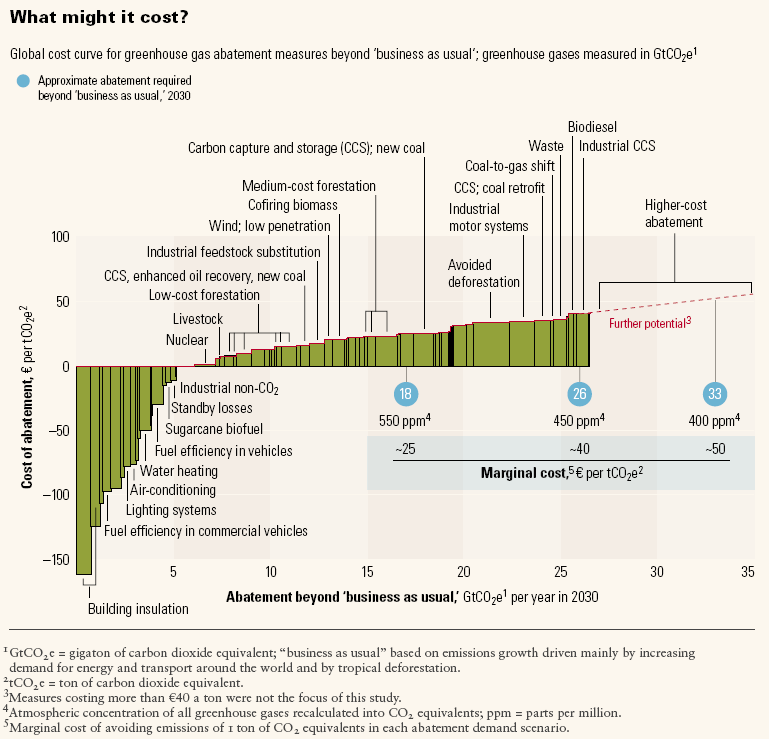
In the past, I have mentioned both marginal abatement cost curves for greenhouse gasses (curves that describe the cost of eliminating each successive tonne of greenhouse gas) and the economic analyses done by McKinsey. Recently, a friend reminded me of an informative graphic from one of their reports:

The whole report is available online. All the options listed on the left hand side, below the horizontal line, are actually projected to save money as well as reduce greenhouse emissions. Those to the right are progressively more expensive, up to about 50 Euros a tonne.

The graphic is quite interesting because it shows a ranking of the cost at which different technologies can achieve emission reductions. It’s also interesting that they projected how many technologies need to be implemented – and to what degree – to achieve stabilization of greenhouse gas levels at 550, 450, and 400 parts per million of CO2 equivalent.

Put on a graphic like this, it all looks very achievable.

Shifting baselines, oil and ice

One of the more interesting environmental blogs I read is Shifting Baselines: a fisheries focused site that concentrates on how our changing expectations about life in the sea conceal from us the gradual emergence of long-term changes. A couple of other shifting baselines have caught my attention recently. They have to do with the long term trends of Arctic sea ice depletion and increasing oil scarcity. In both cases, exceptional shifts in the recent past have given way to what look like temporary reprieves.

Last summer’s Arctic sea ice minimum was a major record-breaker. It sparked serious thinking about whether the Arctic summer could be ice-free within a decade. This summer’s melt now seems likely to be less severe. Does this mean our level of worry should diminish, or is this simply oscillation around a worrying downward trend? It certainly gives ammunition to those who would like to deny that there is a trend at all. In the long run, it probably doesn’t matter enormously whether the Arctic melts in ten years or thirty. Where it may matter considerably is insofar as awareness of Arctic melting either prompts the emergence of strong climatic policies or provides fodder for those who want to continue to delay.

The same might be said about the recent slip in the price of gasoline. That being said, the nature of the causal factors at work there seems more straightforward. Prices do not seem to be falling because supply constraints have been lifted. Rather, they are falling because people are cutting back on usage: both as a result of general economic weakness and as a result of high energy prices themselves. High gasoline prices are something of a double-edged sword for environmentalists. On the one hand, they do help to encourage investments in efficiency. On the other, they encourage the development of truly filthy alternative sources of fuel (like the oil sands), encourage the development of false solutions (like corn ethanol), as well as making it more challenging politically to support sound environmental policies.

Whether it is ice or energy under consideration, the general lesson of shifting baselines is pertinent. We need to see past short term trends and our focus on how the recent past and the present compare, looking onwards to fundamental forces and long-term developments. Of course, when it comes to systems as massive and complex as the global climatic and economic systems, doing so is enormously difficult.

Back from Vermont

Today, Emily and I made our way safely back to Ottawa. We also played what may have been the first ever game of Scrabble Hold-Em, with generally positive reviews.

Tomorrow, it is back to work – to face a ‘pending’ pile of unknown size and content.

P.S. As native Vancouverites, it is unusual for Emily and I to come home and find significant growth of fungal and insect life inside of our dwelling after twelve days away. Evicting the fruit flies seems likely to be a time consuming process. Ottawa’s heat and humidity takes getting used to, on several quite different fronts.

The Pilot G2 lineup

Lovers of the Pilot G2 series of pens, take note: the so-called G2 ‘Pro’ version of the writing implement is only very marginally superior to the disposable model. Both are made of similar plastic, and the clicking system for retraction actually feels a bit cheaper on the $5 ‘Pro’ pen than on the $1 disposable pen. Since the ordinary version takes refills just as well as the more expensive one, there is no real reason to make the switch. In fact, the cheaper pen actually comes apart more elegantly to be resupplied with ink.

If you want a genuine step up, using the same ink cartridge system, hunt around for the metal bodied, $12 G2 Limited.

On a side note, it strikes me as odd that, while I have dramatically more expensive pens than the G2, I rarely feel comfortable carrying them around. As such, they languish in boxes in my apartment while everything from letters to to-do items on 3.5″ cards emerge from the tip of Pilot’s low-cost devices.

Honey and veganism

This Slate article on honey and veganism makes some good points: most notably about the inconsistency between refusing honey on ethical grounds and accepting fruit that is pollinated by domesticated bees. Not eating anything that requires bee labour for production rules out “almonds, avocados, broccoli, canola, cherries, cucumbers, lettuce, peaches, pears, plums, sunflowers, and tomatoes.” In theory, one might be able to find some of these things grown only with the assistance of naturally occurring pollinators, but I doubt it is something most honey-shunning vegans have even considered.

My personal position, as described before, is that there is no fundamental problem with using animals for food. The problems arise when it is done in an environmentally unsustainable, unhygienic, or morally unacceptable way. The latter condition means that, when animals above a certain threshold of sentience are involved, they cannot be treated in a way fundamentally contrary to their nature. In the case of bees, I would argue that they fall below the sentience threshold. While it is impossible to determine, at this time, whether they are capable of experiencing suffering, forming complex thoughts, and so forth, it seems plausible to conclude that they generally cannot, and are thus more on par with protozoans, plants, and fungi than with complex animals. I don’t claim that this moral code is entirely comprehensive or internally consistent, but it presently strikes an acceptable balance between my level of concern and the amount of time I am willing to spend pondering such questions and taking actions required in order to not contravene them.

In addition to honey, I generally disagree with the vegan objection to wool. There doesn’t seem to be any fundamental cruelty or desecration involved in the shearing of sheep, though I should probably investigate the conditions in which sheep used for wool production are raised and live.

More on food, ethics, and the environment:

There are many more, but that list should get the curious reader started.