SARS-CoV-2 Omicron variant

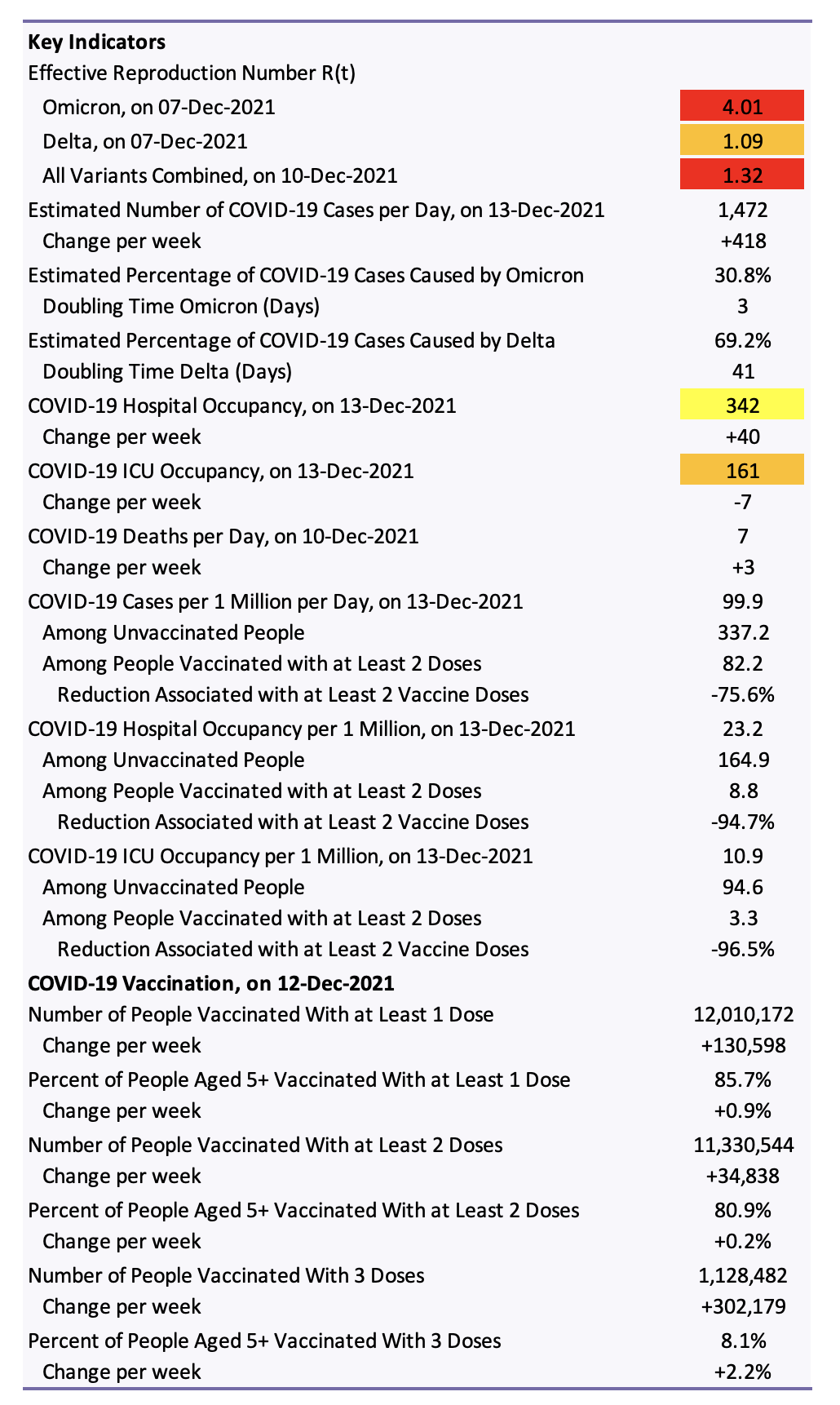
Ontario’s COVID-19 dashboard is showing a shocking effective reproduction number for the omicron variant:

The figure is highly concerning both because it suggests higher transmissibility for omicron than for past variants and because, by extension, a larger fraction of the total population would need to be vaccinated to control its spread.

What we each choose to do affects the people around us, and we can’t allow exhaustion with the pandemic to let us abandon protective behaviours. The road to ending the pandemic as fast as possible remains for everyone to get vaccinated and to continue to employ protective measures including masks and physical distancing.

Toronto considering a net zero target for 2040

Next week, the Toronto city council is considering a proposal to adopt a net zero target by 2040. I have written to my city councillor and the mayor supporting the idea as better than nothing, but also explaining why net zero promises risk prolonging rather than curtailing fossil fuel use:

Councillor Mike Colle and Mayor John Tory,

I am writing to you in support of the effort to establish a net zero CO2 target for Toronto by 2040, but also to warn you about the risks of the net zero concept and to advocate fossil fuel abolition as a preferable policy. Please do not be mistaken about my intent: a net zero target is better than inaction, and ought to be passed. Addressing climate change, however, will require much more.

There is a major risk that “net zero” is a delay and distraction tactic which aligns with the interests of fossil fuel producing states and corporations. It’s a way of distracting from the cause of climate change — fossil fuels — and to conjure a misleading sense that the problem can be solved without getting rid of them. By endorsing net zero targets, advocates of climate action risk playing the role of doctors advocating low-tar or filtered cigarettes: extending the life and profits of a noxious industry through the false suggestion that we can get the benefits while avoiding the consequences.

One of the clearest signals that net zero is being used to extend rather than constrain the history of the fossil fuel industry has been the enthusiasm with which such targets have been adopted by fossil fuel producers. For example, Saudi Arabia has made a net zero promise for 2060 while Saudi Energy Minister Prince Abdulaziz bin Salman has said: “We are still going to be the last man standing, and every molecule of hydrocarbon will come out.” This ought to be a warning sign that net zero is a Trojan horse designed to delay policies and regulations to abolish fossil fuels before we catastrophically destabilize the climate.

An examination of scale also calls into question the plausibility of achieving net zero by any means other than ending fossil fuel use. Global oil production was about 88.4 million barrels per day in 2020. That’s about 32.3 billion barrels, each with about 136 kg of oil. That adds up to about 4.3 billion metric tonnes (gigatonnes) of oil taken from the ground every year. Even with COVID-related reductions, global CO2 output in 2020 was about 34.81 gigatonnes. That means to bury all the CO2 from our fossil fuel use, we would need to replicate the global oil industry more than eight times over, except with equipment to extract, compress, and bury CO2. All of this would cost energy and money to run and would produce no profit. It has also taken a century to build that level of oil infrastructure. The idea that we can solve our CO2 problem by burying it simply doesn’t make sense physically, even before you start comparing the cost of avoiding the emissions in the first place to the cost of separating and burying them.

In addition, there are enormous non-climate co-benefits from fossil fuel abolition. A 2021 journal article estimated that just the fine particulate pollution from global fossil fuel combustion causes 10.2 million premature deaths annually. This is another demonstration of how the apparent profitability of the fossil fuel industry arises only because we do not deduct the amount of harm arising from their products. Fossil fuel abolition has the promise of saving ten million lives per year, and more when pollution beyond just particulate matter is factored in.

The other risk of a net zero as opposed to a fossil fuel abolition approach is that it will fail to incentivize the right investments. If families and businesses in Toronto knew that fossil fuel use was going to be coming to an end before mid-century, it would no longer make sense to construct new buildings heated with gas, or countless other pieces of infrastructure that reinforce and prolong our fossil fuel dependence. If we let that investment continue and only get serious about fossil fuel abolition later, it will raise the total cost because we will have wasted money on inappropriate infrastructure which we will need to scrap and because we have delayed the deployment of appropriate infrastructure compatible with a stable climate.

To repeat my main point: adopting a net zero target by 2040 would likely have some benefits and is better than inaction. At the same time, the city council must be mindful of the risk that net zero targets are a concealed fossil fuel promotion strategy, not a strategy to stabilize the climate. It is always tempting to be told that you can get the benefits of a damaging activity while avoiding the harms, but with net zero there are strong reasons to fear that it is a marketing strategy designed to keep letting fossil fuel producers profit while others absorb the costs.

Thank you for your attention,

Milan

We’re not going to bury our way out of the fossil fuel catastrophe. What needs burying is the fossil fuel industry itself.

David Brooks on Burkean conservatism

Writing in The Atlantic, David Brooks has produced a good short summary of Edmund Burke’s classical conservatism and how it relates to contemporary US politics:

This is one of the core conservative principles: epistemological modesty, or humility in the face of what we don’t know about a complex world, and a conviction that social change should be steady but cautious and incremental. Down the centuries, conservatives have always stood against the arrogance of those who believe they have the ability to plan history: the French revolutionaries who thought they could destroy a society and rebuild it from scratch, but who ended up with the guillotine; the Russian and Chinese Communists who tried to create a centrally controlled society, but who ended up with the gulag and the Cultural Revolution; the Western government planners who thought they could fine-tune an economy from the top, but who ended up with stagflation and sclerosis; the European elites who thought they could unify their continent by administrative fiat and arrogate power to unelected technocrats in Brussels, but who ended up with a monetary crisis and populist backlash.

…

Another camp, which we associate with the Scottish or British Enlightenment of David Hume and Adam Smith, did not believe that human reason is powerful enough to control human selfishness; most of the time our reason merely rationalizes our selfishness. They did not believe that individual reason is powerful enough even to comprehend the world around us, let alone enable leaders to engineer society from the top down. “We are afraid to put men to live and trade each on his own private stock of reason, because we suspect that this stock in each man is small,” Burke wrote in Reflections on the Revolution in France.

My view is that what we need more than anything is a movement of the right demanding climate change mitigation. Otherwise we end up with an endless sea-saw between strengthening and repealing fossil fuel abolition policies, at the same time as voters are only offered climate change action as part of an intersectional agenda which they may not otherwise agree with. We need to split the right between fantasists who decide what they see based on what they believe politically and empiricists who accept evidence as the adjudicator of truth.

The progressive climate movement has been a crucial development and remains the main force pushing for action. At the same time, this perspective is conspicuously lacking in humility about re-making long-standing societal institutions, with the assumption that most of what is pernicious politically in the world will disappear once everyone is wise enough to accept their ideology. It’s a perspective that concentrates support inward with ever-greater demands for moral purity and ideological conformity, whereas what we need to produce a consensus behind fossil fuel abolition in the US, UK, and Canada is the understanding that nobody’s political project is served by radically destabilizing the climate. If we want to preserve institutions that have endured and shown value over time, we need to eliminate the fuel sources that are destabilizing the physical environment in which they have evolved. There’s nothing more conservative than that.

Related:

Podcasts and audiobooks

Because the spoken word content on Spotify is so-so most of the time (aside from podcasts like Ologies and the Spycast), I have been trying Audible to provide better quality listening material during walks.

So far I have finished James Donovan’s book “Strangers on a Bridge: The Case of Colonel Abel” about the espionage trials and eventual prisoner exchange of a KGB colonel living as an illegal in New York (also depicted in the excellent film Bridge of Spies) and Lyndsay Faye’s “Dust and Shadow: An Account of the Ripper Killings by Dr. John H. Watson” which I learned about from an interview with the author on the I Hear of Sherlock Everywhere podcast and then finished in two days.

Donovan’s book was quite interesting, if read a bit mechanically. Faye’s book is a great pastiche, interestingly written with both deep knowledge of the canon and a willingness to innovate, and very well read in this edition.

Over several weeks I have listened to the first half of “Anna Karenina” read by Maggie Gyllenhaal, which is superb. She brings a great saucy enthusiasm to the text and language, and it’s easy to imagine that one is being read to by her character from the film Secretary.

Finally, in the hope of better understanding American conservatism in order to better strategize about climate change, I have been listening to Geoffrey Kabaservice’s “Rule and Ruin: The Downfall of Moderation and the Destruction of the Republican Party, from Eisenhower to the Tea Party.” I’m still working through the 1960s, which is still fairly little-known history to me. The book is a bit challenging both because a lot of the names and events are unfamiliar and because the narrator is a bit monotone in a way that tends to enhance the difficulty of paying attention.

I found that such narration was commonplace in the books and spoken word content on Spotify, so generally I have been very happy about how Audible has shifted my listening toward fully accomplished published works with enduring social importance, rather than just the (sometimes excellent) present-focused podcast and news content.

Listening to the Abel espionage case

Because of its restrained and historically accurate storytelling, Bridge of Spies is one of my favourite films.

Looking for something a bit meatier than podcasts to listen to on my exercise walks, I am trying out an Audible account with James Donovan’s Strangers on a Bridge: The Case of Colonel Abel. It’s the perfect kind of book for someone overly preoccupied with an academic project, insofar as it is interesting and detailed enough to be mentally engaging as well as mercifully unrelated to any work I need to do.

Into the fall

My friend Richard’s visit has provided opportunities, at this turning point of seasons, to bring friends together and enjoy multi-person conversations in contexts like distanced outdoor walks. It has been a great reminder of the world beyond the specialized niche of the PhD program, not to mention the sort of pre-pandemic social interactions which we all must value more highly now that we’ve felt and adapted to their absence.

My main task remains the same: finish the PhD and find something worthwhile to do after.

I’m grateful that I have such friends to enrich my life while I’m working.

This uncivil city

780 km of exercise walks since August have brought me much into contact with people on the sidewalks and pathways of Toronto. Particularly in the last couple of months, I have had the sense that people in general are stressed, frayed, and emotionally on-edge. I see this in their egocentrism: their determination to do as they wish and let hang any who question or obstruct them in doing whatever they feel entitled to, from walking dogs off-leash which then come charging up to me, to driving as though taking out a few pedestrians is a fair exchange for getting where they want faster, to raging out and screaming at people when asked to follow some basic legal requirement or expectation of civil conduct. Toronto strikes me less and less as a place where a desirable sense of community exists, and more as the anarchic arena in which millions of selfish desires overlap and clash.

It has now been a year — since the last March 8th — since I have been in voluntary COVID isolation, going beyond whatever confusing and contradictory public orders are in force to simply do what I can to minimize human contact and the risk of virus transmission. I’m certainly worn down myself, from lack of life-sustaining activities like voluntary associations with in-person meetings, from the stress of Toronto’s horrible housing market and the abuses it perpetuates, from the drawn-out uncertainty of never knowing when my dissertation will be done because there are always more comments and changes, and from the lack of any exercise but walking (and that increasingly done in fear of the people who I will encounter).

This micro-level frustration and alienation from others arises in part from and parallels the macro-level ways in which the world has gone wrong. Rather than snapping sharply back from the aberrant direction of the Trump administration, the U.S. seems to have bent irretrievably into a new shape, further calling into question its long term stability and even coherence as a single polity. As Canadians peering across the border, that is surely an ominous development, not least because whatever political storms arise from America coming to terms with its own diminishment will not stop shrieking and toppling trees when they cross north into us. Nor can we look to much of the rest of the world for encouragement. Europe is weak and divided, with a political elite happy to sell out to the Russians for oil money, and the political institutions and legitimacy of the EU under constant strain. China is an authoritarian, crassly nationalistic and militaristic threat to its own citizens and the global order. India is increasingly governed on the basis of religious nationalism. At the political level, decision makers everywhere are responding to stresses in the global situation counterproductively, by reinforcing the selfish tendency to reject multilateral cooperation for noisy nationalistic confrontation, contributing toward the tendency of nuclear arms to proliferate, and valuing short-term fossil fuel profits over the perpetual safeguarding of a living prosperous Earth.

Quite possibly it is wrong to see most of this as new. Even in the ancient world plenty of people were happy to stomp others for their own advancement. Maybe part of what makes it piquant — or which helps to explain the intensity of our current alienation from one another — is that people have stopped believing archetypal stories about power generally being benevolent and about a universe, society, or diety with a comprehensible notion of ethics and the willingness to apply those rules with greater consistency and determination than people do. Instead, we see the universe as an accident in which there is no automatic tendency for goodness to be repaid with goodness or vice versa, and in which people who hold authority do so as the victors of the egocentric struggle, talking about the public good for public relations purposes but truly only interested in an idea like justice as a means for further advancing their own power and interests.

Open thread: British Columbia’s Site C Peace River dam

There’s already a thread on dams and climate change, but B.C.’s Site C project raises many different subjects of interest: how different climate-safe energy options compare, what purposes new generation will be serving, and who gets to make the decisions, with particular regard to Indigenous rights.

Related:

Canada and military procurement

Writing for Maclean’s, Scott Gilmore suggests that Canada should “ban the buying of made-in-Canada warships” because politicians have a bad record of fiddling with the process for their own purposes, and shipyards have a poor record of delivering. He presents it as a job protection scheme rather than national security, and a shockingly expensive one:

“But what about the jobs?!” I can hear the lobbyists cry. Yes, let’s talk about the jobs. According to the government of Canada’s own figures, only 11,100 people are employed in Canada’s shipbuilding industry (we have more massage therapists). If we were to add on those indirectly employed, that number creeps up to 15,200. Now, let’s pretend the Canadian frigate contract is the only shipbuilding job out there, and buying from France would mean every one of those 15,200 people would be out of work. If we were to give each of them $1 million in compensation, Canada would still save over $50 billion (in addition to getting the ships faster).

Similar political patterns seem evident in Canada’s long-running imbroglio about replacing fighter jets, though that may have more to do with the nuances of maintaining the Canada-US security relationship than with subsidizing Canadian firms and workers.