
Author: Milan
In the spring of 2005, I graduated from the University of British Columbia with a degree in International Relations and a general focus in the area of environmental politics. Between 2005 and 2007 I completed an M.Phil in IR at Wadham College, Oxford. I worked for five years for the Canadian federal government, including completing the Accelerated Economist Training Program, and then completed a PhD in Political Science at the University of Toronto in 2023.
First thorough manuscript review
I am deviating somewhat from the planned timeline here, moving forward the first soft edit of the whole manuscript for coherence and structure to before finishing the literature review and incorporation of material from interviews.
In part, that’s just an effort to break out of a low productivity pattern of toiling at the same very long tasks over and over. More substantively, it seemed unanswerable that somebody ought to have read the whole manuscript by now and that doing so will improve the flow and comprehensibility of the final product while letting me complete the incorporation of extant literature and empirical observations more intelligibly.
So far, I have been pretty happy with the draft. I think it does a reasonable job in justifying the research question and approach, which will be among the main requirements enforced by the examination committee.
Academic journals and conferences have given me the belief that to anybody well briefed on a subject beforehand almost all scholarly work comes across as a consolidation of the known and obvious rather than a set of blazing and unfamiliar new ideas. One of the books I read on thesis writing stressed repeatedly how a PhD thesis is a basic demonstration of competence in research at a professional level. It’s not meant to be a grand opus. Even Einstein’s doctoral thesis was about comparatively mundane matters of how things dissolve in fluids, rather than grand ideas about the ordering of the universe.
As I discussed with my brother Sasha the other day, I think writing long documents needs to be a process of successive approximation. It’s impossible to simultaneously work all elements into their final form, and it’s impossible to give an unlimited amount of uninterrupted time to any task. The writing process must be designed so that every part can be set aside and returned to, and each set of alterations should bring the whole closer to the final state. That’s how I have dealt with long documents before, and I am hopeful that the approach will take me to the end here.
BMV Books, Bloor Street

Guelph divests
The Guelph University board of governors committed to divest from fossil fuels on Wednesday, after a sub-committee of their finance committee concluded that doing so was compatible with fiduciary duty and that a divested portfolio would have performed as well or better in the past. I was a guest on the board’s call, and it was remarkable to hear administrators making they key legal and financial arguments in favour of divestment. It shows how at least some administrators have internalized some of the central arguments of the divestment movement.
This follows divestment by Laval, Concordia, and UBC.
Net zero climate targets
In the lead-up to the Canadian federal election in October, Justin Trudeau’s Liberals promised legally binding targets for Canada to be at net zero emissions by 2050. Specifically, they promised:
- “We will set legally-binding, five-year milestones, based on the advice of the experts and consultations with Canadians, to reach net-zero emissions by 2050”
- “We will exceed Canada’s 2030 emissions goal”
Ignoring for now how we’re not on track for the 2030 target, let’s consider what “net zero” means. Essentially, the idea is that through a combination of emission reductions, carbon offsets, and negative emissions through CO2 removal (through air capture or bio-energy with carbon capture) Canada will no longer produce a net positive contribution to the accumulation of greenhouse gases including CO2 into the atmosphere.
The most credible way to reach net zero is to actually end fossil fuel production, import, and use. That we could call “true zero” and it would be a better kind of target for ambitious organizations. It would be focusing because of the long-lived character of infrastructure. If the University of Toronto, for instance, was to be true zero by 2050 then it would need to stop putting natural gas boilers into new buildings wherever they would be expected to run past that date. Similarly, they would need to stop buying gasoline-powered vehicles and everything else that depends on fossil fuels for energy, and do so early enough for everything they operate to be replaced with a climate-safe alternative before the deadline. This is a much more radical and demanding idea. When I promoted a “true zero” promise as a plank in the new “Beyond Divestment” campaign at U of T, which was planning to offer the administration the same easy escape of net zero by hoping to fund reductions elsewhere and hoping for carbon removal at scale, the idea was rejected by the campaign organizers as too demanding and incompatible with pledges being made elsewhere.
The reason to promise “net zero” instead — as a country or a university — is in the optimistic case a sincere belief that offsets and negative emissions can be meaningful and significant. In what’s perhaps a more plausible case, it’s a way of avoiding the politically intolerable suggestion that we’re actually going to stop using fossil fuels to combat climate change. That avoids antagonizing the industry and its supporters, while placating those who may not be paying much attention with the belief that this is equivalent to true decarbonization. It is telling that fossil fuel corporations also like net zero targets, since they allow the current leadership to continue with expanding production and emissions while leaving the problem for someone else to fix later. That position is delusional because every year of delay in starting with true decarbonization makes it far harder to stabilize at any temperature limit while raising the cost of doing so by requiring the projects we built to be shut down before the end of their economic lifespans and increasing how quickly emissions must be cut when we finally get serious.
In the case of the Canadian promise, it seems like another manifestation of Trudeau’s determination to promise action to protect the climate in the long term as a way to legitimize and justify actions that worsen the problem while they actually hold power. While in office, you approve major new fossil fuel infrastructure projects, while saying with no authority to do so that future governments will counteract those choices. This proposition doesn’t even make sense in the short term because of that long-lived infrastructure problem. No oil pipeline, LNG facility, or bitumen sands mine that is built in 2020 is intended to be shut down before 2050. And so, today’s pro-fossil expansion policies directly and immediately contradict the net zero target. It’s another sense in which we have been drawn toward shadow solutions by our unwillingness to take the actions really required to stabilize the climate. It’s a sign of how little Canadians understand the problem, and how much they choose to believe what they prefer over what is supported by evidence, that many have accepted such promises as evidence of commitment and seriousness on the issue.
Alone in a time of coronavirus
Looking back through my calendar, I think the last time I deliberately met anyone was March 7th. I foolishly skipped a couple of Massey College social events in the next couple of days and helped my ex-flatmate Silas move out, but by the time another friend was visiting town on the 14th, she cancelled her social plans and left Toronto shortly after arriving. My dentist’s office closed on the 16th, during the same timespan as I was trying to cancel my appointment because of a sore throat.
Since then, all my social gatherings have been cancelled. So was the Mark Jaccard talk at U of T on the 23rd, Massey Grand Rounds on the 25th (which I had been strongly suggesting to medically-minded friends), and my mother’s intended birthday visit on her way back from helping her mother in North Carolina, along with the U of T Festival of Dance which we planned to attend. The big Queen’s Park climate rally planned for April 3rd by Fridays for the Future was ‘shifted online’, producing no effects which I observed (in fairness, that’s true of in-person climate rallies too). The UBC alumni lunch I was invited to on the 9th was cancelled.
There’s a reasonable chance this is the longest I have gone without a deliberate meeting since I first had any control over my life, say in elementary school, when agreeing to meet a friend after school was already normal. Running into my supervisor or member of the provincial parliament on the sidewalks is certainly welcome and a change from solitude, but it doesn’t diminish the oddity of having nothing scheduled except forgettable group videoconferences (I pity those whose schooling will increasingly take that tedious and unengaging form).
Particularly as I am working through an audiobook on Stoicism I am mindful about the pointlessness and perhaps inappropriateness of complaining, which isn’t precisely what I intend to do with this post. It’s more to share life experience and preserve a contemporaneous account than to advance any claim that what’s happening is intolerable or undeserved. Indeed, I am exceedingly fortunate in that my most important work is largely unimpeded by all this. My data collection and research for the PhD are done. Now it’s just a matter of incorporating the literature into my manuscript and editing it to the point where I can send it to the committee. I can do all that alone, as odd as a solitary life continues to feel.
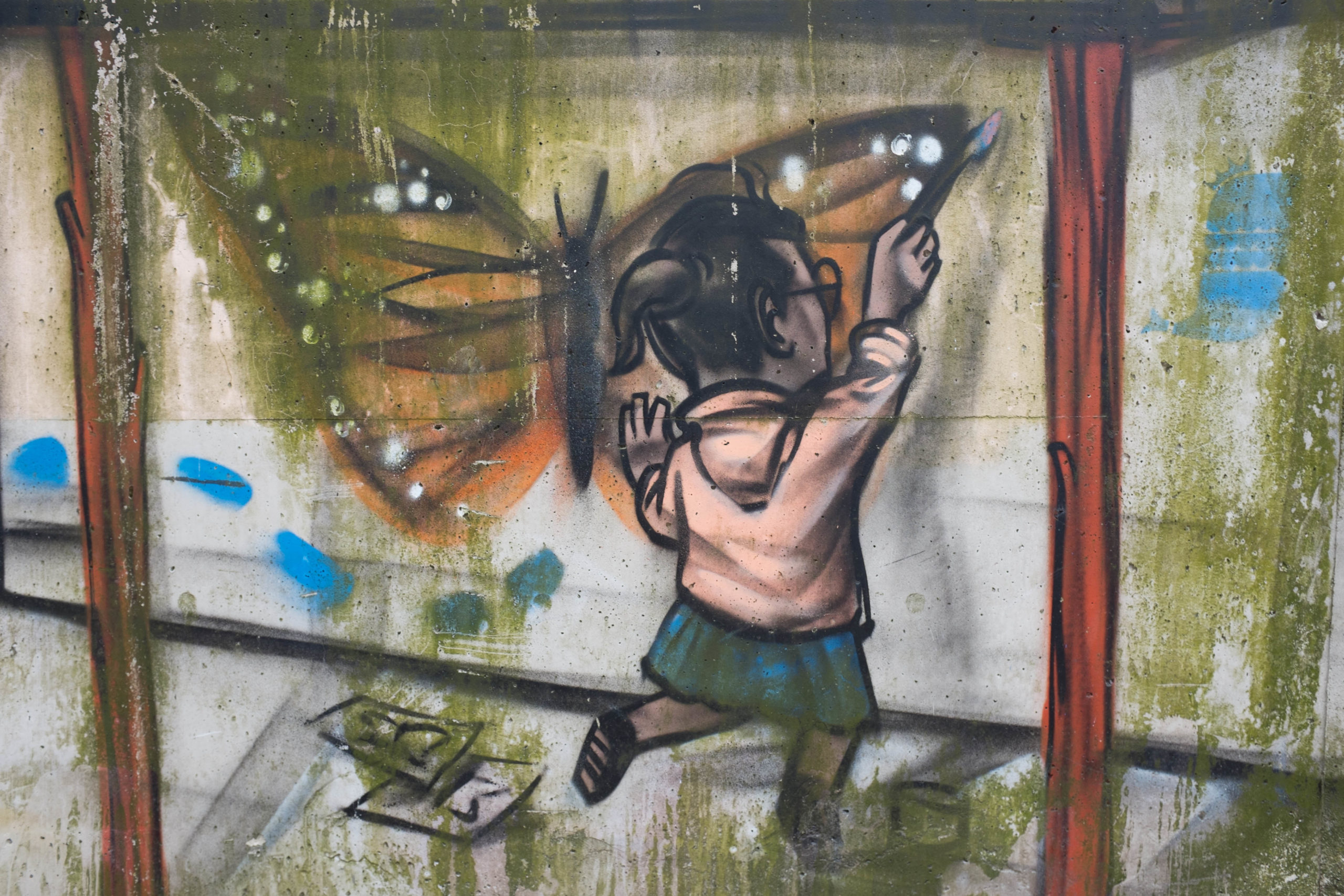
Painting a monarch
The coronavirus pandemic
I’ve avoided posting about the SARD-CoV-2 virus and COVID-19 outbreak, largely because anything I say is redundant when the news is largely comprised of saturation coverage.
Two stories did stand out today though:
- Even with strict containment measures, COVID-19 could claim 22,000 lives, federal officials project
- The hard truth: Be prepared to live like this until November, says [Newfoundland] health minister
I saw this yesterday: Coronavirus could push half a billion people into poverty, Oxfam warns
Still, despite all the claims that this will be transformational and alter life forever, I am skeptical. We tend to engage in hyperbolic discounting, assuming that what’s happening right now is the most important thing in history. At the same time, we have a tendency toward historical myopia, forgetting things soon after they are over or even losing interest before they have ended. I’m not saying there won’t be echoes and cultural callbacks to the pandemic — especially if we do end up physically distancing from one another for another six months or more — but I do suspect that we’ll ultimately weave the memories of this pandemic into what we take to be normal, along with mad cow disease, SARS, AIDS, H1N1, Ebola, and all the other biological risks which have troubled us and altered our lives in recent decades.
For my part, I have been in social isolation since mid-March: probably the longest I have ever gone without intentionally meeting someone.
Sanders is out
Bernie Sanders has withdrawn from the US Democratic primary process, leaving Joe Biden as the presumptive nominee. I personally find the support for Sanders in the climate movement hard to understand and frustrating, as I can’t see what he has done that convinces them that he would lead effectively on climate change. Rather, it has seemed clear as state after state voted that Sanders’ political revolution was never going to happen. He wasn’t really part of the Democratic party and didn’t really have their support, and nor did he have the support of any influential constituency in America (progressives obviously don’t count as influential, in part because of their love for no-hopers like Sanders).
Hopefully a great majority of Americans will have the clarity of thought to see that virtually anyone is better than Trump, and vote accordingly in November.
driftwood
