Automation and the jobs of the future

A recent article in The Economist discussed the likely impacts of technological development on jobs, with an emphasis on which jobs are especially vulnerable to being replaced with hardware or software automation.

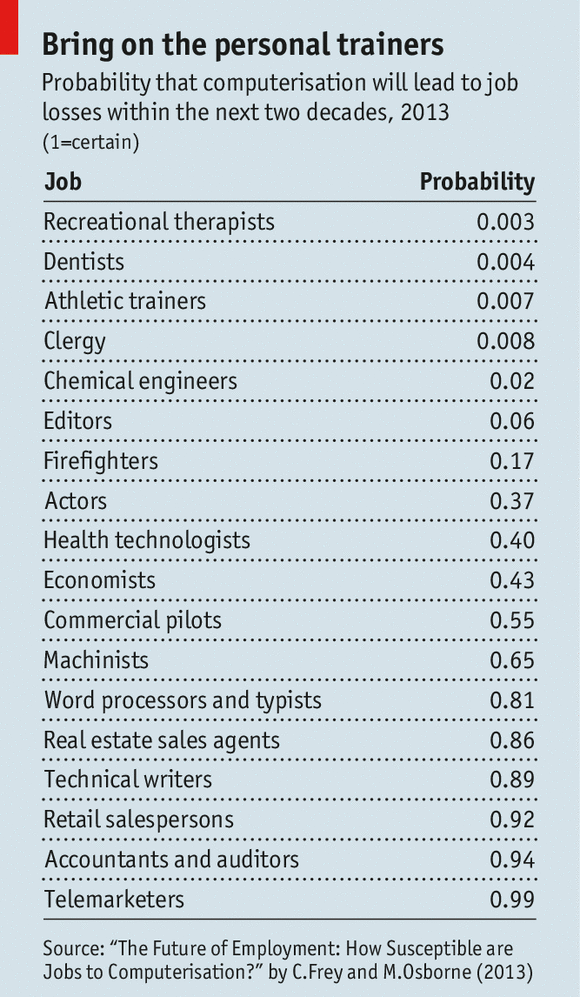
The article included a chart listing some of the jobs projected to be most and least vulnerable, respectively:

Probability that computerization will lead to job losses within the next two decades, 2013

Some bad news for both people working for telemarketing firms and everyone with a telephone is that the telemarketers of the future are expected to be robots.

More disruptive, in terms of people’s career planning, is the set of presently white collar jobs potentially at risk to automation: accountants and auditors, technical writers, and real estate agents are all identified as being at risk. Pharmacists can probably be added to that list.

For now, dentists, athletic trainers, and clergy remain safe from being replaced by software or robots.

Googling the Cyborg

In his engaging essay “Googling the Cyborg”, William Gibson effectively argues that the expectation that ‘the cyborg’ will be a human being with an electronic eye and a robot arm is mistaken. The cyborg – he argues – exists in the physical interactions between human beings and machines: “The electrons streaming into a child’s eye from the screen of the wooden television are as physical as anything else. As physical as the neurons subsequently moving along that child’s optic nerve”. (The terminology there is strangely incorrect. Cathode ray tube televisions emit photons, which are produced when the electrons fired from the back of the vacuum tube hit a phosphor screen – and the optic nerve is made of neurons, it isn’t a channel that conveys them. No matter.)

Gibson argues that the cyborg is the “extended communal nervous system” that humanity has grown for itself, with all these sensors and processors and network connections.

He also argues that there is a short-changing that occurs, when we deny that the humans who are behind machines are using them as true extensions of their own being. In the context of remote-controlled rovers on Mars, he says:

Martian jet lag. That’s what you get when you operate one of those little Radio Shack wagon/probes from a comfortable seat back at an airbase in California. Literally. Those operators were the first humans to experience Martian jet lag. In my sense of things, we should know their names: first humans on the Red Planet. Robbed of recognition by that same old school of human literalism.

Gibson, William. Distrust that Particular Flavor. p.251 (hardcover)

I am not sure what should be counted as the first cyborg on Mars. Specifically, did it need to be able to move on human command? Or is moving camera shutters enough to count? In any case, hardly anyone knows the name of the person who was controlling it when it first activated on the Martian surface.

Recovering keystrokes from audio recordings

Those trying to compromise the integrity of computer systems have a large variety of attack options to work with: everything from mathematical approaches to breaking cryptography, to TEMPEST attacks based on unintentional signal radiation, to social engineering methods designed to trick people into granting them access. A recent Economist article highlights a danger likely to be unfamiliar to most, namely how it is possible to convert audio recordings of typing back into text:

Such snooping is possible because each key produces a characteristic click, shaped by its position on the keyboard, the vigour and hand position of the typist, and the type of keyboard used…

That said, the method does have one limitation: in order to apply the language model, at least five minutes of the recorded typing had to be in standard English (though in principle any systematic language or alphabet would work). But once those requirements are met, the program can decode anything from epic prose to randomised, ten-character passwords.

The software being employed seems fairly clever. It augments the audio data with frequency analysis, based on how often individual letters and specific pairs of letters come up in English text. With refinements, it seems plausible that it could be made to work with a smaller sample.

Making a computer system secure against a capable and resourceful attacker is extremely difficult. That said, the basic principles of security continue to hold. For instance, using defence in depth can reduce the severity of any breach – for instance, by keeping critical files encrypted. Also, it must always be remembered that security involves trade-offs. Increasing security against these audio attacks is no different, and it will always be accompanied by some cost, in terms of finances, convenience, or security of a different type.

Ethics and autonomous robots in war

The increasing use of autonomous robots in warfare raises questions about how they can be used ethically and in concordance with international law on armed conflict. While unarmed robots like those used by bomb squads are ethically unproblematic, those with both weapons and an independent capability to make decisions about their use are quite different. This is especially true if they will be used in environments where civilians could be injured or killed.

The BBC has an article about some of the concerns that have been raised and issues that have been considered. In some ways, the trade-offs are similar to those with existing technologies. For instance, there is often a trade-off between how much risk an army exposes its own personnel to, and how effectively it can avoid causing civilian casualties.

Increasingly clever machines

It seems my mountain climbing, robot-building friend Mark has a relatively new blog. He works with autonomous robots of the kind that competed in the recent DARPA Urban Challenge.

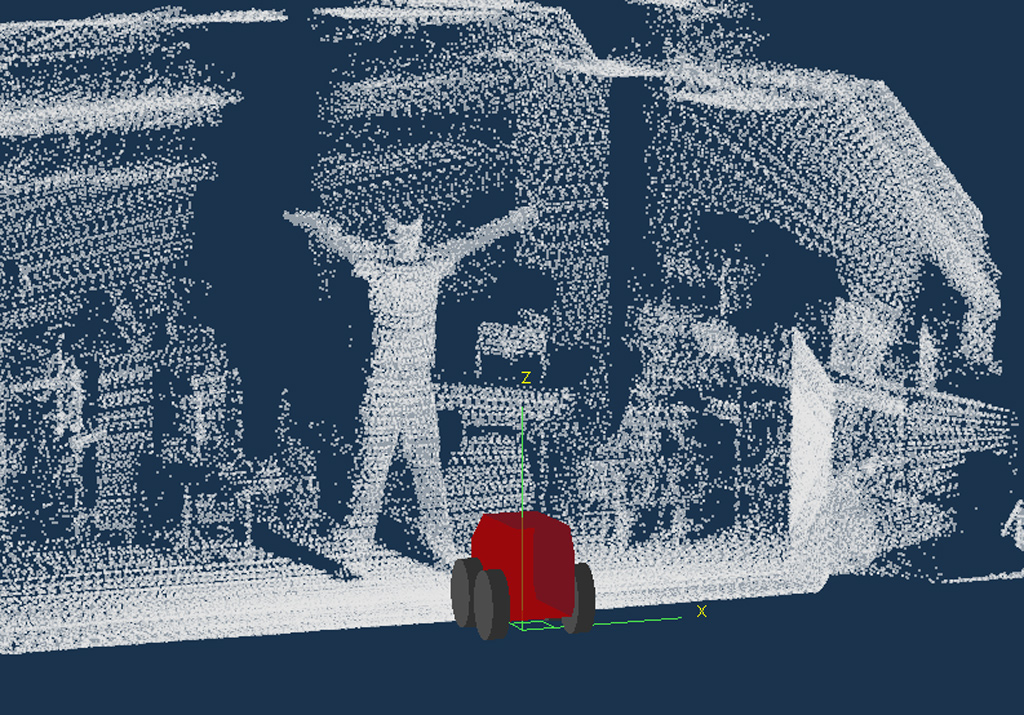
Here is one way in which such robots see the world: as a set of laser determined ranges.

Previous robot-related posts: