
Category: Bombs and rockets
Military matters and state security: the hard-edged kind of international relations
Pullman on authoritarianism and eroded democracy
Along with The Good Man Jesus and the Scoundrel Christ, Phillip Pullman’s essay “Malevolent voices that despise our freedoms” must be one of his most radical pieces of writing. It corresponds to his general concern about lack of oversight over powerful institutions and speaks out powerfully against the authoritarianism that can arise in parallel with public fear:
And the new laws whisper:
We do not want to hear you talking about truth
Truth is a friend of yours, not a friend of ours
We have a better friend called hearsay, who is a witness we can always rely on
We do not want to hear you talking about innocence
Innocent means guilty of things not yet done
We do not want to hear you talking about the right to silence
You need to be told what silence means: it means guilt
We do not want to hear you talking about justice
Justice is whatever we want to do to you
And nothing else
One early passage in his new novel La Belle Sauvage evokes a similar theme:
She tried to keep a steady pace. She had nothing to fear from the police, or from any other agency, except like every other citizen she had everything to fear. They could lock her up with no warrant and keep her there with no charge; the old act of habeus corpus had been set aside, with little protest from those in Parliament who were supposed to look after English liberty, and now one heard tales of secret arrests and imprisonment without trial, and there was no way of finding out whether the rumors were true. (p. 153–4)
Authors like Pullman and Margaret Atwood play a valuable societal role in drawing attention to such dangers: that fear will drive us to hand over control to unaccountable entities and that a drift toward dystopia is possible. Among all the dangers we face, we mustn’t forget the nightmares the state is capable of imposing.
Related:
Interstellar asteroid
For the first time, we may have just detected the a large object that has entered our solar system from interplanetary space: C/2017 U1 PanSTARRS.
It’s a shame we don’t have a spacecraft ready to go get a closer look, or maybe even get a sample.
End of the Cassini mission
After a 20-year mission, and to avoid any risk of contaminating Saturnian moons with microorganisms from Earth, the Cassini space probe was deliberately crashed into Saturn’s atmosphere today.
The science it has returned has been stimulating and the imagery spectacular. The watery moon Enceladus now joins Europa among the solar system’s most intriguing life-compatible bodies.
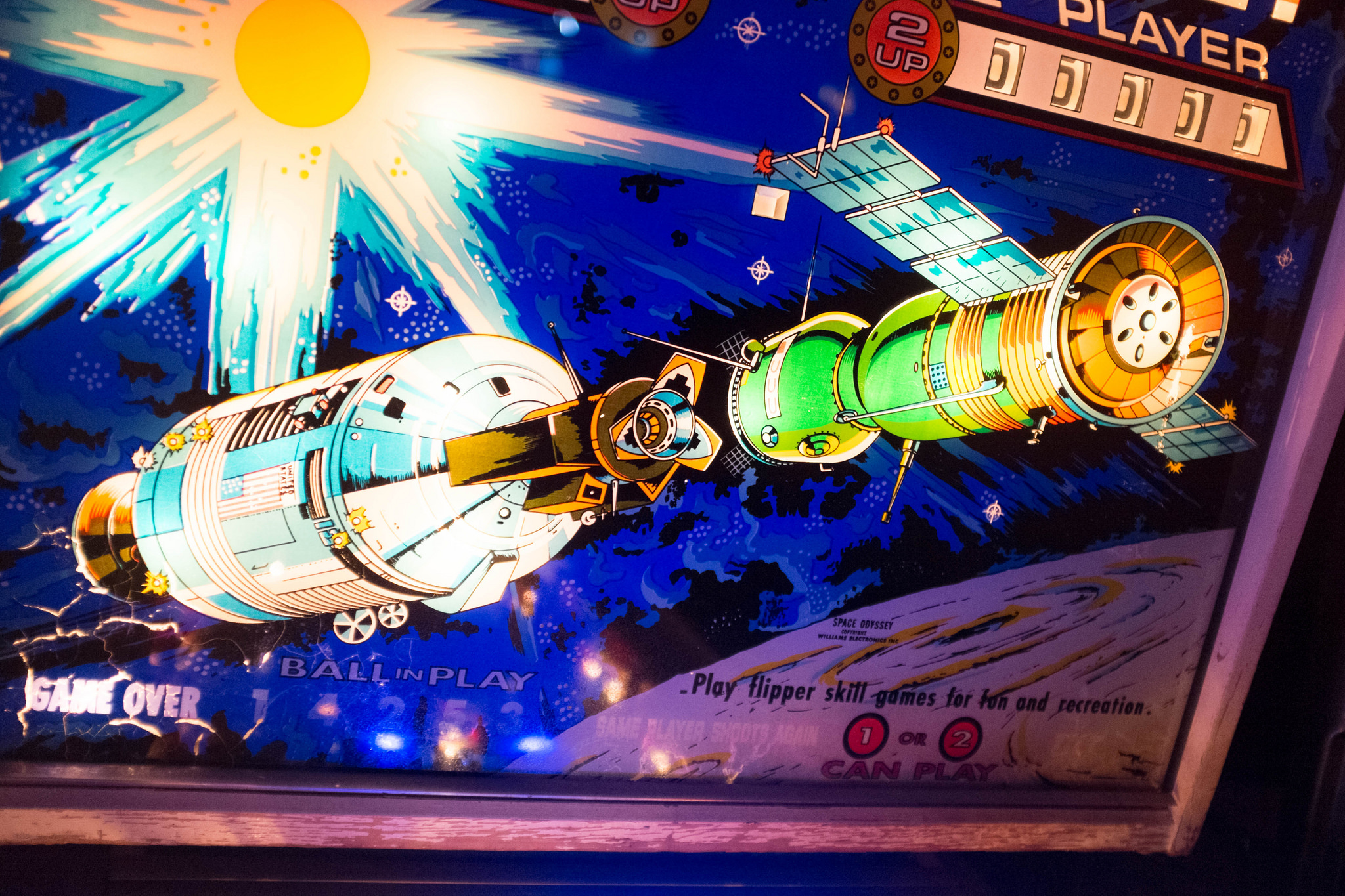
Apollo-Soyuz Mission
Dunkirk
I saw the 70mm film version of “Dunkirk” last night and found much to appreciate about it. The production values are excellent, and it generally seems an unusually realistic depiction of history and combat, with less of the spectacle and fewer of the implausible dramatic storylines that often dominate the genre. The non-linear storytelling adds to the sense of chaos, and perhaps adds a bit more dramatic tension to a story where — for anyone who has taken high school history — the broad outlines of the ending are known in advance.
The film is unusual in part because almost no characters have names which are mentioned or emphasized. Rather, most of the storytelling is visual and told in overlapping vignettes: sinking ships and air combat, and repeated portrayals of the men of the British Expeditionary Force waiting on the beach for its evacuation.
In some ways, I felt the film consciously subverted some of the tropes of spectacular high budget war films like the notorious “Pearl Harbor“, and even the more unified and neatly structured storytelling of classics like “Saving Private Ryan“. For instance, a successfully tense scene centres around whether an oil slick from a sinking ship would catch fire; in a “Pearl Harbor” type film, the leaking ship probably would have exploded in the shot when it was first shown. Only two moments struck me as transparently unrealistic: when the senior officer on the beach somehow knew exactly how many people had been rescued just as the last boats were leaving, and an odd scene in which men trapped in a sinking ship somehow believe that throwing a man or two overboard will address the problem of bullet holes below the waterline in the hull.
All told, the film was evocative and memorable, as well as generally non-moralizing (though the heroic Winston Churchill quotation in the closing minutes might have been usefully tempered with some reference to his disastrous involvement in the Gallipoli campaign of 1915-16). The absence of well-known actors (though I certainly recognized Mark Rylance from the excellent “Bridge of Spies“) added to the sense of watching a plausible historical reenactment more than a standard Hollywood drama.
Recommended for those with an interest in history, real-world sets in place of heavy CGI, and perhaps seeing very expensive ship sets being rotated and submerged. I’m curious about whether some genuine WWII aircraft were used in the air combat scenes that linked together the disparate bits of the plot.
Arming Saudi Arabia
I find the debate about Canadian arms companies selling weapons and vehicles to Saudi Arabia a little perplexing. The media coverage seems to turn on the question of whether the arms and equipment are being used to oppress the civilian population of Saudi Arabia. I find this perplexing because there seems to be ample evidence that oppression at home and abroad is the main business of the Saudi government, and that anybody selling them anything should expect it to be used that way.
On one hand, it’s appealing that moving to non-fossil fuel sources of energy could undermine countries like Saudi Arabia. On the other, it’s frightening to think what would happen to the region in a future where nobody wants or is willing to use their oil.
Activism as being a catalyst
When we think about global trends, we tend to focus on their importance and how rapidly things are changing. China’s economic rise, along with massive economic development and urbanization around the world, all have unambiguous importance, though we will endlessly disagree about how they will interact and few of us will live long enough to feel confident we saw the final outcome (there are major limits to knowledge and prediction).
If one makes a sincere effort to understand what is happening in the world and feels compelled to try to encourage some of the best possible outcomes, given the state of the world right now, perhaps it makes sense to think in terms of which trends you hope to speed up and which you hope to inhibit.
The key question in effectiveness has to be: am I / are we making a difference in terms of an important objective.
So perhaps it makes sense to think about being a catalyst or accelerant (to choose a more obviously violent analogy) hoping to create as substantial a ∆ifference as possible in the final chemical equilibrium.
Robots at the edge of the explored universe
The New York Times has a good piece on the late stages of the Voyager missions as they pass into interstellar space. It’s especially interesting to read about some of the unexpected faults they have encountered, and the ways they need to work within the limits of the 1977-era hardware.
Palantir and data analysis
Writing in The Guardian, Jacques Peretti has compiled an interesting summary of the technological capabilities and government-to-business relationships of Palantir, a secretive technology company focused on identifying patterns within large data sets and making them accessible to people without specialized training.
With sensors getting cheaper all the time, the tricky part of ubiquitous surveillance isn’t collecting the data. It’s making it intelligible and applicable. These kinds of powerful data linkage and analysis tools also undermine common-sense expectations and procedures for the protection of privacy. No human being might be able to look at a set of large supposedly-anonymized databases and pick out individuals, but it’s increasingly within the scope of what can be routinely done with computers.