Saddam to be hanged

Ceiling of the Merton College Chapel, Oxford

Reading the news that Saddam Hussein, former president of Iraq, has been sentenced to die by hanging created a ambivalent combination of feelings. On the one hand, he is certainly guilty: if not of the particular atrocity for which he was tried than for crimes against humanity in general. Likewise, launching the Iran-Iraq War probably constituted ‘conspiracy to wage aggressive war’ – the crime for which the subjects tried at Nuremberg were hanged.

Problems with the trial

That said, there are procedural issues that draw the result into question. One major legal problem is the genesis of the Supreme Iraqi Criminal Tribunal (formerly known as the Iraqi Special Tribunal). This body, where Saddam Hussein is on trial, was not established by an elected Iraqi government, but by the Coalition Provisional Authority: a bureaucracy composed of and supported by the occupying army. To say that this is domestic Iraqi justice is therefore somewhat disingenuous.

Other serious problems have been the lack of security for those involved in the trial: including witnesses, judges, and lawyers. By the end of the trial, Saddam Hussein only had one legal representative left: Khalil al-Dulaimi (largely because others were dismissed, though three were killed). The absence of a stable security situation in Iraq, and Baghdad in particular, further reduces the changes of a free and fair trial being conducted, at an internationally certifiable level of due process.

A further problem is the absence of an adequate process of appeal. There is only a ten-day window in which an appeal can be launched, and it is widely expected to end in failure within weeks. Related is the issue that it is over-hasty to execute Saddam Hussein on the basis of one set of allegations, relating to 148 killings in Dujail in 1982, when so many more charges remain to be considered. The importance of being systematic and fair lies in generating an accurate accounting of the various crimes committed by Saddam Hussein and his regime. If the stated objective of the coalition in “drawing a line” under the Saddam era is genuine, such a comprehensive accounting seems like an important step.

Problems with the death sentence, generally

In general, the international community has condemned the sentence of death. The European Union has spoken against it. As have India, Ireland, The Netherlands, and New Zealand. Even Tony Blair said that he is opposed.

Personally, I don’t feel that execution is an option that should be available to any court. As a form of justice, it is little more than crude retribution. While the danger of convicting innocent people does not apply in this case, the general moral and pragmatic position against the death penalty seems very strong to me.

That said, imposing what has become the international consensus upon the Iraqi court carries problems of its own. To grant the new Iraqi governments powers and then circumscribe their usage does not conform to the project upon which the coalition has supposedly embarked. While it is clearly legitimate for outside actors to urge a reconsideration of the death sentence, it would probably be illegitimate to force the hand of the court in any significant way.

Primarily because of the flawed trial process, the insufficient appeal system, and the importance of rigorously cataloging the misdeeds of the former regime, Saddam Hussein should not be put to death.

All that said, I encourage someone to argue the opposite.

Three Kings

Tonight, I watched Kai’s copy of the film Three Kings. I remember the advertisements portraying it as some sort of comedy; at best, it is a pretty dark satire. The point it makes indirectly and well is that the on-the-ground realities of warfare can be starkly different from the press conference versions generally presented to us.

The odd thing about the film is the way in which it plays with your sympathies: there is certainly some for the reservists (part time baggage handlers, those who never finished high school, etc). There is plenty for the general populace of Iraq. Saddam and the first President Bush are only ever in the background, each presenting as truth things that have nothing to do with the immediate reality of the film: Saddam has his smiling portraits everywhere, Bush provided the printed sheets or orders the American soldiers wave at Iraqi troops and civilians from time to time.

While the film is, in many ways, unrealistic it manages to convey a truthful message about human greed and brutality. It becomes harder to hold liberal values when the reality of how imperfectly that are applied in many circumstances is revealed.

Revitalized

Bike beside St. Antony's College, Oxford

Essentially back to back this evening, I had two of the best lectures since arriving in Oxford. It was a well-timed reminder of why it is so valuable to be here, and the kind of knowledge and people one can be exposed to in this environment.

The first speaker was Hilary Benn, appearing as part of the Global Economic Governance series. He is the Secretary of State for International Development in the current British Government. His speech took in everything from institutional reform at the World Bank to what should be done in Darfur. While he may have oversimplified a great deal at times, it was nonetheless refreshing to hear a government official saying some very sensible and progressive things about the role Britain should play in the world. During the question session, I asked him about his department’s policy position on West African fisheries. He advised me to write him a letter, and promised a detailed response. Thanks to an aid, I have the real email address of a British cabinet member in my pocket. I will come up with a cover letter that addresses the major points, then include a copy of the article in print in case he (or a staffer) wants more detail.

The second speaker, through the Strategic Studies Group, was Rear Admiral C.J. Parry. I spoke with him during dinner about his aviation experience (he actually flew a V-22 Osprey). His talk, in the capacity of Director General of Development, Concepts and Doctrine for the Ministry of Defence at Shrivenham, was a look forward into major strategic threats in the next thirty years or so. That said, it was a candid and engaging presentation that has sparked a lot of thought and debate – exactly what the mandate of OUSSG is to provide.

§

Sorry if this is all a bit breathless, but I suddenly feel as though I have a lot to do – and not just in terms of the thesis work I have been dreading.

PS. Both Kai and Alex are back, which adds to my sense of rejuvination. Likewise, the opportunity that has been afforded to see the friendly trio of Bryony, Claire, and Emily was most welcome. Indeed, seeing all members of the program has felt a bit like suddenly being surrounded by friends in Vancouver. Things with my new college advisor – Robert Shilliam – are also going well.

PPS. I have my first free Wadham high table dinner booked for tomorrow, as part of the Senior Scholarship.

More split nuclei

On 16 July 1945, the United States did it. The Soviets followed suit on 29 August 1949, followed by the UK on 3 October 1952. The French followed on 13 February 1960, followed by China on 16 October 1964. On 18 May 1974, India joined the club, with Pakistan doing so on 28 May 1998. Israel and/or South Africa may have tested on 22 September 1979, in an incident detected by an American satellite.

As of 9 October 2006, North Korea seems to have tested a nuclear bomb. It makes you wonder how many more states will do so in the next fifty years, as well as what the security character of the Southeast Asian area, in particular, will be by then.

That said, while they seem to have scientists and engineers capable of making nuclear weapons, the North Koreans don’t seem to have staff capable of producing a particularly cogent English press release:

The nuclear test was conducted with indigenous wisdom and technology 100 percent. It marks a historic event as it greatly encouraged and pleased the KPA and people that have wished to have powerful self-reliant defense capability.

Since this test was pretty clearly meant for American audiences, you might have expected them to pay more attention to their wording. I suppose multi-kiloton underground blasts speak louder than press releases.

Despite such nationalist rhetoric, the test seems more likely to endanger the average North Korean than help them. In the short term, there is the danger that someone will try to strike their nuclear capability before they develop credible delivery systems. Also, as The Economist identifies: “[T]he immediate threats from North Korea’s new capability come from radioactive leaks into the atmosphere and North Korea’s groundwater.” Finally, the test risks sparking a nuclear arms race in Asia that threatens the security of the whole region, at least.

[Update: 1:30pm] Based on my server logs, lots of people have been looking for these photos of test sites in Nevada during the last few days. Google still hasn’t figured out that this site has moved to WordPress. In any case, the photos show one of the ugly legacies of testing and reinforce the point that, while world should be moving towards nuclear disarmament, the converse seems to be taking place.

Truth and American politics: approaching the mid-terms

Written by Tariq Ramadan, a fellow at St. Antony’s, this statement about his lengthy troubles with trying to get a US visa is well worth reading. In part, he says:

I fear that the United States has grown fearful of ideas. I have learned firsthand that the Bush administration reacts to its critics not by engaging them, but by stigmatizing and excluding them. Will foreign scholars be permitted to enter the United States only if they promise to mute their criticisms of U.S. policy? It saddens me to think of the effect this will have on the free exchange of ideas, on political debate within America, and on our ability to bridge differences across cultures.

This hits straight at what I see as the biggest foreign policy problem in the United States. It is not the holding of convictions; nor is it the willingness to act upon them. It is willful ignorance and self-delusion applied to information that contradicts the existing stance of the administration. While this trend extends into domestic politics, the most stark examples exist in the area of foreign affairs.

It is fair enough to argue that, at the time of the invasion of Iraq, Saddam Hussein was widely considered a threat. This is a judgement that was not confined to the British and American intelligence services. The British and American administrations could say: “We may have been wrong, but we were honest in our beliefs.” To say, instead, that they have been right all along, or deny making claims that have been undeniably recorded makes you them either insane or cynically disinterested in the truth. The indictment here is not based on the truth or falsehood of the original claims, but on the unwillingness of a group of people to revise their positions, or even admit fault, when facts have proved them wrong.

When an intelligence report confirmed the absence of WMD at the same time as the administration was claiming that the report said the opposite, Jon Stewart cleverly remarked:

The official CIA report, the Duelfer Report, has come out. The one that they’ve been working on for the past two years that will be the definitive answer on the weapons of mass destruction programs in Iraq, and it turns out, uh, not so much. Apparently, there were no weapons of mass destruction in Iraq, and their capabilities had been degraded, and they pretty much stopped trying anything in ’98. Both the President and the Vice President have come out today in response to the findings and said that they clearly justify the invasion of Iraq. So, uh, some people look at a glass and see it as half full, and other people look at a glass and say that it’s a dragon.

A notorious example of the trend of denying past statements is Donald Rumsfeld on WMD: “We know where they are. They’re in the area around Tikrit and Baghdad and east, west, south and north somewhat.” on ABC’s This Week With George Stephanopoulos, 30 March 2003. When challenged, Rumsfeld has repeatedly denied having ever claimed certainty about the existence of Iraqi WMD. Dick Cheney has likewise lied about previous statements (example) in which he claimed that such weapons certainly existed. Numerous other examples are obvious: the administration has misjudged the seriousness of the Iraqi insurgency, entirely miscategorized the relationship between the former Iraqi leadership and Al Qaeda, and continually misrepresented the human rights records of friendly but abusive regimes, including Saudi Arabia and Pakistan.

While politics has never been a discipline where practitioners adhere closely to the truth (look at Taylor Owen’s article in this month’s Walrus about the scale of US bombing in Cambodia during the Johnson administration), there are times when the disjoint between official statements and observable reality becomes so broad as to indict all of those who cling to the former. The fact that the run-up to the mid-term elections is being dominated by a scandal that, while disturbing, is quite peripheral to the governmental record of the dominant party demonstrates how narrow and polarized political debate has become.

Let us hope that, whatever the results are, the November 7 midterm elections will lead to a more candid discussion of the most pressing issues regarding America’s place and actions in the world.

Republican torture ‘compromise’

Despite the thin rhetoric to the contrary, it is clear that the current American administration tolerates and abets torture, indefinite detention without charge, and other basic violations of human rights. This is an astonishing error on their part. It contradicts international law, including laws that have helped to protect Americans captured by foreign regimes. It significantly diminishes whatever claim to moral superiority the United States can use to help guide regimes entirely dismissive of human rights on to a more acceptable path. Finally, it neglects the very ideals about the respect for the human person that form the basis for the American constitution and the general American consensus on the nature of political ethics.

We can only hope that a saner administration will follow in the wake of this myopic crew.

The mainstream media is reporting on this here, here, here, here, here, and in many other places.

Blood and Belonging

Sasha Ilnyckyj in Deep Cove

While flying home, I finished Micheal Ignatieff’s Blood and Belonging. The main subject of the book is the examination of a number of contemporary examples of ethnic nationalism, both more and less violent in character. As he intended, it is a fairly chilling depiction of some of the uglier elements of human relations, in the more disputed parts of the world today. His description of the use of chemical weapons against the people of the Kurdish enclave in northern Iraq makes his initial support for the American led invasion more comprehensible.

At the same time as this book makes one fearful about the kind of world we will inhabit in twenty years, it also provides some hope. While I have not personally visited Quebec or Northern Ireland, it seems, on the basis of the coverage I have seen, that things are not as bad as they were when this book was written in the early nineties. Economic prosperity and civic forms of nationalism have the capacity, at least in theory, to slowly erode the bases of hatred and violence. Let us hope that this trend can win out in the long run over the one that seeks to define nation by something as arbitrary and damaging as an ethnic notion of identity.

I started reading this book in order to get a better sense of Ignatieff as a thinker and as a prospective leader. While my new sense is not sturdy enough to be definitive, I definitely think more of the man than I did in the period before I had read any of his writing. His understanding of difficult issues seems to have a subtlety and a compassion that is definitely not the mark of your standard politician. I will have to read more of his thinking, however, before I can issue or withhold a final endorsement.

Early morning politics

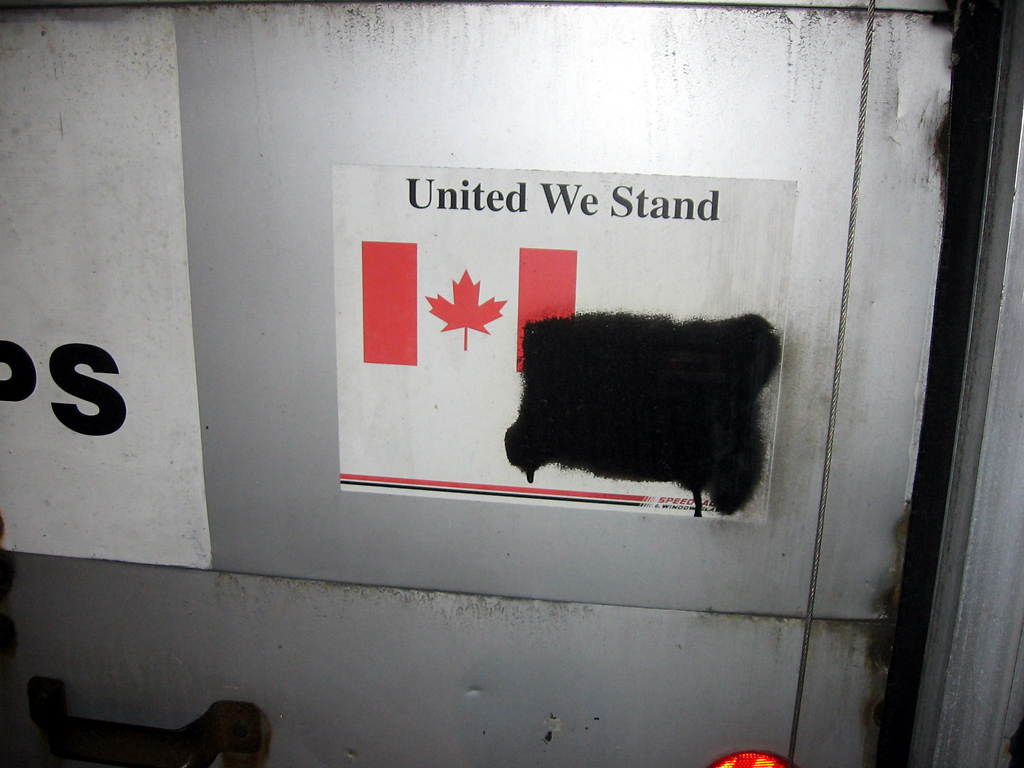
United we stand?

Now, I could – and probably should – write about my enjoyable hike up Dam Mountain with my father today. Likewise, the subject of this early morning post should be the fine dinner at Palki on Lonsdale with my mother, father, and brother Sasha. Failing that, I should certainly write about exploring English Bay with Nick, Neal, and Lauren, then getting a jumbo poutine with extra war sauce at Fritz, just off Granville. But people are quite rightly sick of me just narrating life, so I will present a bit of a puzzle instead.

The image above was taken of the back of a utility truck of the kind used by many of the Vancouver schoolboards, at Georgia and Granville at about 2:00am. A fairly odd looking character in a jacket was using various tools on the newspaper vending boxes at that intersection: unloading newer looking units for selling The Vancouver Sun and The Province – local newspapers with content of varying quality.

§

The real questions are, who attached the original sticker, who blacked out one flag with spray paint, and why. Presumably, it previously showed an American flag that has been blacked out subsequently due to the widespread hostility in much of the world that has developed towards the United States, particularly since the invasion of Iraq in 2003.

I don’t really know how I feel about this display, but I took a photo for much the same reasons I often photograph graffiti: any expression of a genuine sentiment is at least worthy of cursory examination, and frequently worthy of deep thought. Right now, I am far too exhausted to think it through.

Dangerous Afghan skies

I was talking with Edwina today about the possibility that the British Hawker-Siddeley Nimrod MR2 reconnaissance aircraft that crashed in Afghanistan recently was shot down by a FIM-92 Stinger missile, as Taliban representatives claimed. Fourteen British airmen were killed in the crash: the largest single day loss of British military personnel since the Falklands War. Given the ongoing presence of the Canadian Forces in Afghanistan and the famous provision of about 500 of these surface-to-air missiles to the Mujaheddin by the CIA during the Soviet invasion of Afghanistan, it is a question with contemporary relevance for Canadians.

Under construction since 1981 by the Raytheon Corporation (which also makes the washers and dryers used in residences at the University of British Columbia), the Stinger missile has a range of about 4800 metres and a maximum altitude of about 3800 – well below the cruising altitude of commercial aircraft. The Stinger seeks targets using an infrared homing system and is propelled using a two-stage chemical rocket. The homing system is thus vulnerable to flares used as decoy heat signatures, as well as to the reduction of an aircraft’s thermal profile through mechanisms like the internally mounted turbofan engines on vehicles like the B-2 Spirit Bomber, not that the Canadian Forces will or should get any of those.

Most of the reporting on the crash says that it was the result of a technical fault. This is the position that has been taken officially by NATO and the RAF, while the Taliban has claimed that it shot the plane down. There were Taliban fighters in the area, as evidenced by the rapidity with which the British Special Air Service (SAS) commandos were dispatched to destroy any secret electronic equipment that survived the malfunction and subsequent crash. Of course, it would be especially embarrassing to have a £100 million plane shot down and fourteen British soldiers killed by a $26,000 missile that was given to your enemies by the country with whom the Blair government is so loyally and controversially allied. As with the earlier discussion on conspiracy theories, we are left with little means for analyzing the official reports aside from our own intuition about which sources are trustworthy and which explanations are credible.

Whether the crash was an accident (as seems most plausible) or the result of enemy action, the dangers of continued military operations in Afghanistan are demonstrated. Even with complete air superiority, powerful allies, and all the other advantages of being in a superpower coalition, Canadian, British, and American soldiers will continue to die in Afghanistan until such a time as we decide to leave that country to the government and warlords who effectively control it today.