The history of the Arab Spring

The New York Times has published an exceptional long article by Scott Anderson about the history of the Middle East since 2003. It’s an ambitious text to have written, not a trivial task to read, and perhaps a suggestion that print journalism is enduring in its dedication to telling complicated stories, despite ongoing challenges to the business model and staffs of many of the most important print sources. It also includes some remarkable photography by Paolo Pellegrin.

A summary, early in the article, attributes special importance to the post-Ottoman settlement:

Yet one pattern does emerge, and it is striking. While most of the 22 nations that make up the Arab world have been buffeted to some degree by the Arab Spring, the six most profoundly affected — Egypt, Iraq, Libya, Syria, Tunisia and Yemen — are all republics, rather than monarchies. And of these six, the three that have disintegrated so completely as to raise doubt that they will ever again exist as functioning states — Iraq, Syria and Libya — are all members of that small list of Arab countries created by Western imperial powers in the early 20th century. In each, little thought was given to national coherence, and even less to tribal or sectarian divisions. Certainly, these same internal divisions exist in many of the region’s other republics, as well as in its monarchies, but it would seem undeniable that those two factors operating in concert — the lack of an intrinsic sense of national identity joined to a form of government that supplanted the traditional organizing principle of society — left Iraq, Syria and Libya especially vulnerable when the storms of change descended.

This accords closely to Middle Eastern history as interpreted by many of the sources we read in my Oxford M.Phil. In particular, it reminds me of David Fromkin’s A Peace to End All Peace: The Fall of the Ottoman Empire and the Creation of the Modern Middle East.

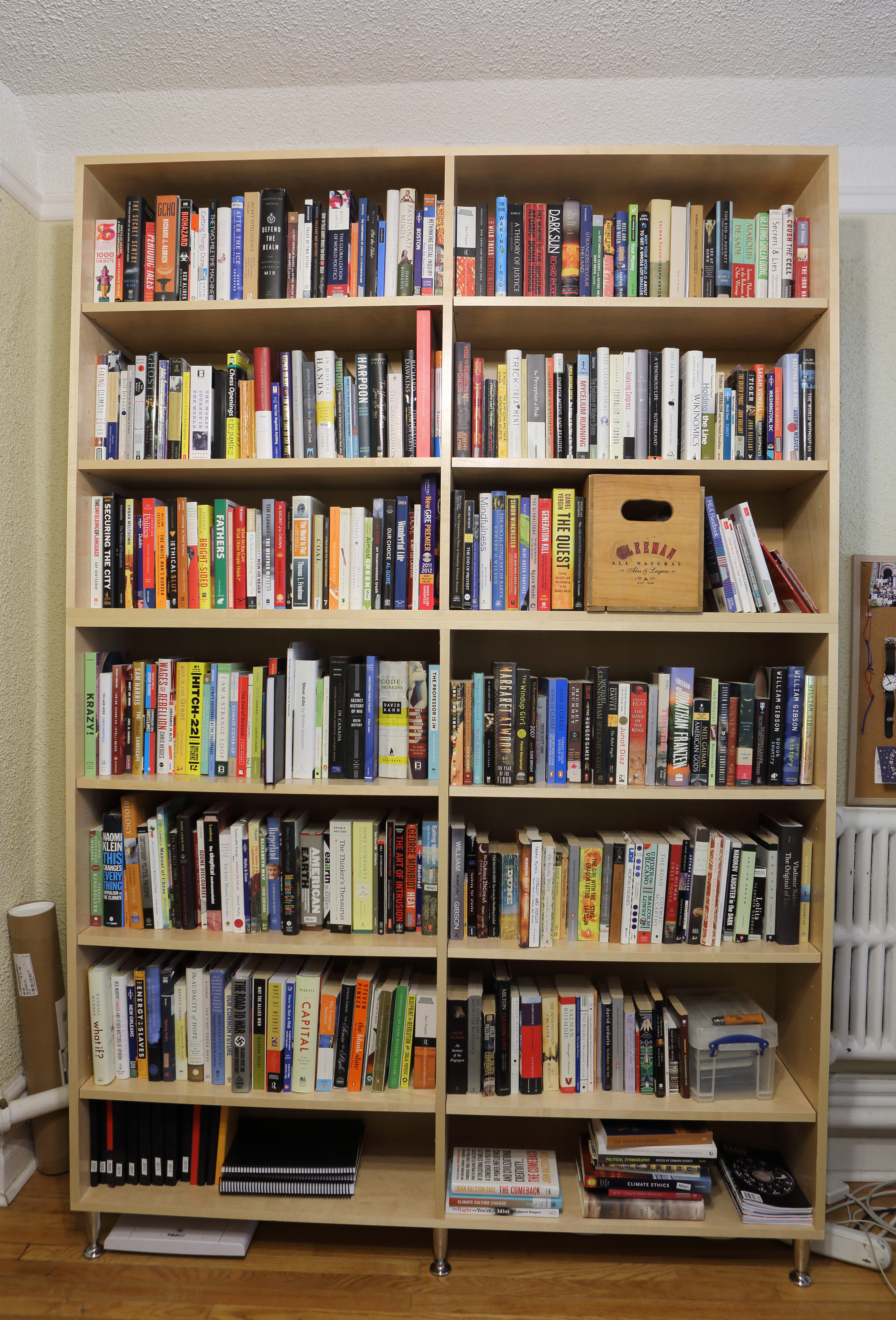
My new library

INOVA custom bookcase

Since moving out of Massey College, the great majority of my books have been inside a heap of banker’s boxes, both cluttering my room and impeding access to them for PhD purposes.

A few days ago, I finally received delivery of a custom bookcase from INOVA, designed to fill the largest available space in my room. It’s pretty close to capacity with my existing collection of books, and it greatly improves the visual appeal of my room and ease of reference.

Rhodes on the nature of nuclear war

So much confusion, so much paranoia, so many good intentions, so much hard work, technical genius, cynicism, manipulation, buckpassing, buckpocketing, argument, grandstanding, risk-taking, calculation, theorizing, goodwill and bad, rhetoric and hypocrisy, so much desperation, all point to something intractable behind the problem of how to deploy sufficient and appropriate nuclear arms to protect one’s nation from a nuclear-armed opponent. There was such a beast. It was quite simply the fundamental physical fact of nuclear energy: that such power is relatively cheap to generate and essentially illimitable. Nuclear warheads cost the United States about $250,000 each: less than a fighter-bomber, less than a missile, less than a patrol boat, less than a tank. Each one can destroy a city and kill hundreds of thousands of people. “You can’t have this kind of war,” Eisenhower concluded. “There just aren’t enough bulldozers to scrape the bodies off the streets.” It followed, and follows, that there is no military solution to safety in the nuclear age: There are only political solutions. As the Danish physicist and philosopher Niels Bohr summarized the dilemma succinctly for a friend in 1948, “We are in an entirely new situation that cannot be resolved by war.” The impossibility of resolving militarily the new situation that knowledge of how to release nuclear energy imposes on the world is the reason the efforts on both sides look so desperate and irrational: They are built on what philosophers call a category mistake, an assumption that nuclear explosives are military weapons in any meaningful sense of the term, and that a sufficient quantity of such weapons can make us secure. They are not, and they cannot.

Rhodes, Richard. Arsenals of Folly: The Making of the Nuclear Arms Race. p. 101 (hardcover, italics in original)

Let down by Gibson’s The Peripheral

The main storytelling device in William Gibson’s novel The Peripheral is after-the-fact exposition (ATFE), which gives it the feeling of a mystery more than conventional science fiction. Rather than tell you in advance how a world or a technology works, Gibson shows you the results without context and provides the explanation later. This does well for avoiding the tedium which is sometimes mocked in speculative fiction, where books or chapters open with the author describing the parameters of the fiction with a boring lack of tension or mystery. For me, at least, it falls down in the case of this book when the central mysteries are never resolved. In increasing order of importance:

  1. Why is Lower Manhattan underwater due to climate change in the far future (p. 435), but London is apparently untroubled?
  2. What was the point of the “party time” test of character (p. 382)? The woman tested never seems to face an important moral choice later.
  3. Is Aelita actually murdered? If so, why? What do the antagonists who are revealed at the end have to gain from it?
  4. What’s the story with the Chinese server that connects the mid-future with the far-future (p. 189)? What did the people who built it use it for?
  5. What’s the metaphysics of this book? It says that the middle-future in communication with the far-future (p. 185-6) has its timeline changed as a consequence (p. 422). Is this a case of infinitely branching universes where communication pathways can be established between any two? Every time someone far the far-future communicates with the past, do they create a new future timeline starting from there?
  6. Why do people in the far future care what happens in this particular mid-future? A major plot point is one character from the far-future trying to avoid a catastrophe in the mid-future (p. 320-1), but what’s the point if (from the far-future perspective) this is just one branch in a vast number of pasts? Why care so much about this one?
  7. Why is having people from the mid-future drive robots in the far-future useful? They never do anything that remote operators in the far-future couldn’t do without all this time travel communication.

I was also frustrated by how a large part of the book is devoted to people training to pilot these future robots (as well as acquiring specialized weapons), which only end up getting used in a rather disappointing way. In particular, a supposedly evil red cube from a custom universe focused on weapon development never ends up doing anything interesting.

Sometimes the ATFE approach is quite frustrating: especially the habit of opening chapters using only pronouns to describe the person involved, pointlessly leaving the reader unclear about what is being described. When people are murdered, the motive and immediate consequences are often unclear.

Custom bookcase

In the Massey College room where I lived for three years (V:4, best room in the college), there was a sumptuous abundance of shelf space: two shelves extending the entire long axis of the room (probably 20′ of shelving each), plus this shelving unit between the office and bedroom areas.

Now, my generally excellent new third story room near Bloor and Bathurst is cluttered with at least 16 bankers boxes full of books, plus about 100 more books stacked in various piles. To ameliorate the situation, I am ordering a custom-fitted bookshelf from Inova in Toronto — 7’6″ tall, reaching from the floor to the edge of the ceiling moulding, and 5′ wide, stretching from a kink in a radiator pipe to the edge of the radiator itself. Since they are custom building it (in two pieces, to navigate our awkward staircase), it will be about a month until delivery, but it should be a major permanent improvement to the room for me and whoever resides here after.

The case probably won’t offer quite as much shelving as my Massey room, but it will be an enormous improvement visually, in terms of movement within the space, and in terms of access to books which I frequently wish to reference, especially as the development of my thesis continues.

Openness versus effectiveness in activist organizations

Occupy Wall Street comprised the people who responded to the call. Ultimately, however, uncritical openness was Occupy’s downfall: the general assemblies were paralyzed by the inability to distinguish between true and false. Participants who had been with Occupy for a day were given a say equal to that of committed activists who had founded the first encampments. In our fully horizontal social movement, no one had the authority to determine who ought to be expelled for being disruptive. Occupy faced adversaries inside and outside. Half wanted to destroy the movement, and the other half wanted to control it. Occupy never developed a way to vet participants. Anyone (worthy or unworthy) could claim to be an equal spokesperson of the movement. Thus the movement faced both police infiltrators who disrupted our assemblies with belligerence and the 99% Spring, an initiative financed by the progressive Left, that mimicked Occupy in a successful bid to dissipate the movement’s revolutionary momentum into a re-election campaign for President Obama.

White, Michah. The End of Protest. p. 112-3 (paperback)

Related:

John Green on his often-banned book

I have written before about banned books.

In this video, a contemporary author discusses the experience of having his novel banned for containing apparently mature content:

His closer — about deferring to librarians to make such judgments – differs from the more common narrative that rejects such curation entirely.

Civilians in intelligence

Donald McLachlan, a journalist who served under Godfrey [head of British naval intelligence] at the Admiralty, afterwards argued that all wartime intelligence departments should be run by civilians in uniform, because they are unburdened by the lifetime prejudices of career soldiers, sailors and airmen: ‘It is the lawyer, the scholar, the traveller, the banker, even the journalist who shows the ability to resist where the career men tend to bend. Career officers and politicians have a strong interest in cooking raw intelligence to make their masters’ favourite dishes.’ MI6 remained until 1945 under the leadership of its old hands, but most of Britain’s secret war machine passed into the hands of able civilians in uniform who — after an interval of months or in some cases years while they were trained and their skills recognized — progressively improved the quality of intelligence analysis.

Hastings, Max. The Secret War: Spies, Codes and Guerrillas 1939–1945. p. 69 (hardcover)

Related:

Fick on leaving the Marines

I left the Corps because I had become a reluctant warrior. Many Marines reminded me of gladiators. They had that mysterious quality that allows some men to strap on greaves and a breastplate and wade into the gore. I respected, admired, and emulated them, but I could never be like them. I could kill when killing was called for, and I got hooked on the rush of combat as much as any man did. But I couldn’t make the conscious choice to put myself in that position again and again throughout my professional life. Great Marine commanders, like all great warriors, are able to kill that which they love most — their men. It’s a fundamental law of warfare. Twice I had cheated it. I couldn’t tempt fate again.

Fick, Nathaniel. One Bullet Away: The Making of a Marine Officer. Houghton Mifflin; Boston. 2005. p. 364 (hardcover)

Fick on the mask of command

“Sir, what the fuck were the commanders thinking, sending us in there with no armor to clear a fucking town? We could have all been killed, and for what? We’re sitting in the same goddamn field we were in last night, as if nothing had happened, except we got the shit shot out of us and lost a great team leader.”

I walked a fine line. As an officer, I couldn’t badmouth decisions the way a lance corporal could. Even as a lowly first lieutenant, I simply had too much rank, too much authority and influence. It would be disloyal and insubordinate, a transgression both moral and legal. At the same time, though, to smile in the face of stupidity and say something about liberating the Iraqi people or living up to the example of Iwo Jima and Hue City would neuter me in the eyes of the men. Men shrink in combat to little circles of trust: us versus them. A platoon that puts its commander in the “them” category is a dangerous place to be. Every young officer learns the difference between legal authority and moral authority. Legal authority is worn on the collar — the gold and silver rank insignia that garner salutes and the title “sir.” It doesn’t win firefights. Moral authority is the legitimacy granted to a leader who knows his job and cares about his men. In combat, I learned to rely on moral authority much more than on legal authority.

So I conceded part of the Marine’s statement. “That was bullshit, bad tactics. After all the artillery prep and with the air escort, no one expected that ambush to happen. We were all wrong. I can’t speak for the battalion, but I can tell you that will never happen again in this platoon.” I paused and locked eyes with the Marine to be sure he knew I wasn’t just talking. “I’m sorry about Pappy. I don’t know if we’ll be fighting for another three days, three weeks, or three months, but I can tell you one thing. We have to learn from what we do right and what we do wrong, then move on. There were twenty-three of us, back to back. Now there are twenty-two. We have to get each other home in one piece.”

The Marine nodded, accepting this line of reasoning. Strong combat leadership is never by committee. Platoon commanders must command, and command in battle isn’t based on consensus. It’s based on consent. Any leader wields only as much authority and influence as is conferred by the consent of those he leads. The Marines allowed me to be their commander, and they could revoke their permission at any time.

Fick, Nathaniel. One Bullet Away: The Making of a Marine Officer. Houghton Mifflin; Boston. 2005. p. 276 (hardcover)