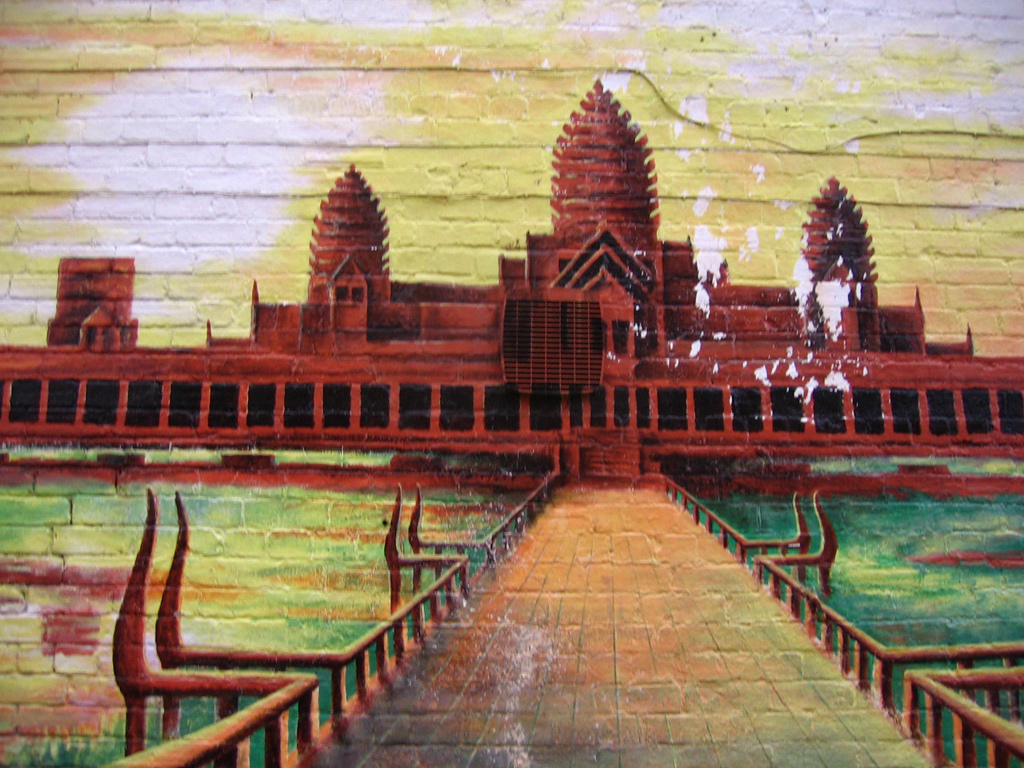
Long walks, moral complexity, pirates

Angor Wat grafitti

Today involved some good reading, four more iced shots of espresso, two important meetings, and a long and social walk with Margaret. In the manner of debt collectors everywhere, I have learned that you can get a long way with people who are not being responsive to emails by simply showing up at their doorstep. In half an hour, you can get further than two weeks worth of messages would ever take you.

I have decided, for my paper on ‘failed states,’ to argue that the term is more trouble than it is worth. It conflates a number of different circumstances in which states might find themselves in ways that make it a hopeless muddle, both from a theoretical and an empirical point of view. This should make the paper much more interesting to write; there is great pleasure to be taken in choosing an argument and defending it. The only trouble, it seems, is that the more education you go through, the less thoroughly you can believe that anything you are saying is really true.

That is one reason for which it is so satisfying to write about gay marriage or Guantanamo Bay. These are circumstances where I can stand four-square behind a moral position.

PS. One piece of truly essential thesis reading did get fished today: the copy of The Pirates! in an Adventure with Scientists that Josiah lent me last night. Gideon Defoe has made a valuable contribution to the study of pirate-scientist dynamics. One particularly useful fact for someone leaving academia: Charles Darwin was working as an unpaid naturalist on the Beagle. It seems that it really is possible to learn a great deal from such work.

Poetry in high school

I didn’t want any phase of my life to be gone forever, to be over and done with. I preferred beginnings to endings in books, as well – it was exciting not to know what was lying in store for me on the unread pages – but, perversely, I couldn’t resist sneaking a look at the final chapter of any book I was reading.

“My Last Duchess,” a story in Margaret Atwood‘s Moral Disorder, strikes me as an unusually successful discussion between literary Canadians. Reading a story about the classroom contemplation of Robert Browning‘s poem is an odd experience, for someone who has had exactly the same sorts of classroom discussions about poems by the author of the story. I am pretty sure “Disembarking at Quebec” was even tested on my grade 12 literature exam, though the memory of that test is almost entirely overshadowed by that of the far more challenging advanced placement literature test. (I remember the sight reading passage was the description of a wolfish Satan jumping into paradise (PL: IV, 172-192))

For those who are not Canadian, it is worth mentioning that Atwood is a kind of national literary representative. Along with Timothy Findley, she is probably the person who first comes to mind for most people, when they consider the content of Canadian literature. As such, it is interesting to see the author humanized: taking on the form of a young Canadian as they probably first experience her work, writing down lists of contrasting elements in a poem to rattle off for ten or twelve marks on a governmental exam sheet.

Carl Edward Sagan (November 9, 1934 – December 20, 1996)

Tomorrow will be the tenth anniversary of the death of Carl Sagan: an American astronomer, author, and popularizer of science. Like Arthur C. Clark and Isaac Asimov, he is among those authors of science fiction who have also made a contribution to the accumulation of scientific fact, and to the development of the social role of science within society.

He has been quoted here before.

My Name is Red

This morning, I finished Orhan Pamuk’s My Name is Red. The fact that I left the last fifteen pages of this mystery story unread for a day is not a good sign. Indeed, each of the potential murderers was so similar that the final revelation felt a bit trivial. One pretentious and vindictive illustrator rapidly blurs together with all the others. Likewise, the potentially interesting commentary about European influences on Islamic art quickly became repetitive. The best part about the book were the vignettes presented by the coffee shop storyteller, as he personified a gold coin, a dog, and other similar things. I also very much appreciate my mother’s consideration in sending me such a book just before my trip to Turkey.

Given Pamuk’s acclaim, it seems most sensible to say that the book was simply not for me. Just as I can appreciate bits of Joyce, without appreciating the sweep of his longer books, the same can be said with regard to this novel. Time permitting, I will read my father’s copy of Pamuk’s non-fiction book Istanbul over the remainder of the trip.

Pre-reading for Turkey

In preparation for the trip to Turkey, I have moved on from V.S. Naipaul’s Half a Life to the copy of Orhan Pamuk’s My Name is Red that my mother sent as a birthday gift. Somewhat surprisingly, I find that I get more non-fiction reading done when I intersperse it with chapters from good fiction. It lets you take a break while remaining in a reading mode, and achieve a bit more balance without compromising your ability to get things done.

Written from the perspective of someone who has died violently, but remained capable of immortal communication, the beginning reminds me a bit of Orson Scott Card’s macabre short story “Memories of my Head.” There is an interesting contrast in literature between those who have passed through death to be uncaring about worldly things and those, like this narrator, who remain concerned with matters like wealth and revenge. The most sensible view has always seemed to be that expressed in Emily Brontë’s “Song.” It is a great shame that she herself died so young.

Academically, I have mostly been reading for the seminar this Thursday. Interesting as they have been, it will be a great relief to have the weekly effort they require ended, allowing greater opportunity to focus on the thesis.

Bedside thesis reading pile now 100% taller

At Tristan’s urging, I have added a thick collection of philosophy of science books to my thesis reading stack. At 212 pages, Thomas Kuhn‘s The Structure of Scientific Revolutions looks fairly reasonable. Rather more daunting are the two square books by Karl Popper: Conjectures and Refutations at 580 pages, and The Logic of Scientific Discovery at 513. Popper and Kuhn are the two names that have come up again and again when I discuss this project with people and, judging by the blurbs on the back and a scan of the introductions, these are the three more relevant books by them in the vast shelves of the Norrington Room at Blackwell’s.

Collectively, they are about ten times longer than my thesis will be. My hopes, in reading them, are to avoid embarrassing myself with ignorance of the philosophy of science, at a minimum, and to generate some interesting ideas, from a more optimistic perspective. Notes on all three will appear on the wiki, as I progress through them. I will begin with the Kuhn, once I have dealt with this week’s reading for tomorrow’s seminar, and the preparation of something to say about the thesis project with Dr. Hurrell on Friday.

A compatible woman can be hard to find

Tolkien fans will recall that the Ents (a mythical species of animated trees) consist entirely of males, with the females having been lost at some forgotten point in the distant past. It seems that there is an actual tree species (Encephalartos woodii) in a similar predicament. Only four stems were ever found in the wild, in 1895, and the last of those died in 1964. All surviving examples are clones of that last plant, and no females are known to exist anywhere in the world. Both the clones and their seeds are protected under the Convention on International Trade in Endangered Species of Wild Fauna and Flora.

People in the vicinity of London can see one of the clones at the Kew Botanical Gardens.

Blood and Belonging

Sasha Ilnyckyj in Deep Cove

While flying home, I finished Micheal Ignatieff’s Blood and Belonging. The main subject of the book is the examination of a number of contemporary examples of ethnic nationalism, both more and less violent in character. As he intended, it is a fairly chilling depiction of some of the uglier elements of human relations, in the more disputed parts of the world today. His description of the use of chemical weapons against the people of the Kurdish enclave in northern Iraq makes his initial support for the American led invasion more comprehensible.

At the same time as this book makes one fearful about the kind of world we will inhabit in twenty years, it also provides some hope. While I have not personally visited Quebec or Northern Ireland, it seems, on the basis of the coverage I have seen, that things are not as bad as they were when this book was written in the early nineties. Economic prosperity and civic forms of nationalism have the capacity, at least in theory, to slowly erode the bases of hatred and violence. Let us hope that this trend can win out in the long run over the one that seeks to define nation by something as arbitrary and damaging as an ethnic notion of identity.

I started reading this book in order to get a better sense of Ignatieff as a thinker and as a prospective leader. While my new sense is not sturdy enough to be definitive, I definitely think more of the man than I did in the period before I had read any of his writing. His understanding of difficult issues seems to have a subtlety and a compassion that is definitely not the mark of your standard politician. I will have to read more of his thinking, however, before I can issue or withhold a final endorsement.

Canadian Liberal leadership race

Despite having lived in Canada for more than twenty years, and being interested in all matters political for much of that time, I really don’t know a great deal about Canadian politics. This is especially true of the raft of individuals who comprise Canada’s political elite; I could definitely tell you more about, say, Tom Daschle and Barack Obama than any of their Canadian equivalents. References that people like Tim, Tristan, Spencer, and Emily make regularly leave me with no idea of what they are talking about. That probably has something to do with a lifetime in which I have skipped straight to the ‘international’ section of the newspaper, followed by ‘United States,’ and then ‘science.’ I rationalize it to myself on the basis of the general hope that Canada will muddle through on its own and that if something really spectacular is going on, I will hear about it anyway.

In a bid to partially reverse this long time trend, I have decided to learn a bit about Michael Ignatieff: at least to the point where I can endorse or reject him as a possible leader for the federal Liberal party and, by extension, a possible Prime Minister. To that end, I am now reading his book Blood and Belonging: Journeys into the New Nationalism. It seems to be more about the world in general than about Canada specifically, but it should at least lay bare some of his assumptions and modes of thinking.

To those much more aware of this contest than I am, which of the other potential Liberal leaders are worthy of some examination?

On digitized books

For years, Project Gutenberg and related endeavours have been seeking to produce digital copies of books that are no longer under copyright. The Gutenberg people have already digitized 17,000. Purposes for doing so include making machine-readable copies available for those with disabilities, allowing for their use with e-book readers, and even in more creative applications – like printing books onto scarves, so that you can read them on flights from the UK to the United States.

In the grand tradition of huge companies incorporating the results of smaller enterprises, many (if not all) of the Gutenberg books are now available through Google Book Search. Figuring out which Jane Austen book a particular passage stuck in your memory is from has thus become a far simpler task. For years, I have been using The Complete Works of William Shakespeare, provided by MIT, to search through plays.

Admittedly, not many people want to sit in front of a monitor to read an entire book. With the development of electronic paper that has high resolution, high contrast, and no requirement for power consumption while displaying static information, perhaps this will all become a whole lot more useful.