Short days, new projects

Oxford University Career Services

After having coffee with Sheena, about which I shall not write, I read the second portion of Iain Pears’ An Instance of the Fingerpost. The character whose account it is, Jack Prescott, is one of the least likable in fiction. He is a hot-headed bigot: a liar, rapist, and betrayer. That the story ends well for him is entirely as displeasing as the gruesome conclusion of the first part. Not, in any sense, a cheerful book. That said, the occasional foray into murder, treason, and intrigue is very much necessary for the committed reader of fiction. I quite enjoyed the discussions of cryptography in the third section, which I have not yet finished.

The book is set in the time shortly after Cromwell took over – not the nicest period in history. The violence, the bigotry, and the ignorance demonstrated in the book all reaffirm my belief that the world is generally improving. That’s not to say that these things are no longer present but, at the very least, that they must now generally be apologized for and defended, rather than be taken as automatically acceptable. It’s an unfashionable thing, these days, to believe in progress. First off, it involves the making of ontological claims that people no longer see as firmly based – which has some truth to it, but not enough to counter the evidence of overall improvement. Secondly, it requires the determination to judge the morals and practice of one place and time against another. While there are obviously difficulties in doing so – particularly insofar as the matter of individual and group identity is concerned – that doesn’t seem adequate to conclude that no such comparisons can be made with validity. I would suppose that people given the chance to choose between living in some past age or the present one would choose the latter, largely because of the enormous benefits of modern medicine and nutrition, but also due to imperfect but helpful systems of justice and notions of philosophy and morality.

That’s not to say there isn’t a long way to go: especially in areas like women’s rights, the environment, and the just distribution of goods: material, social, and political.

Summer job search:

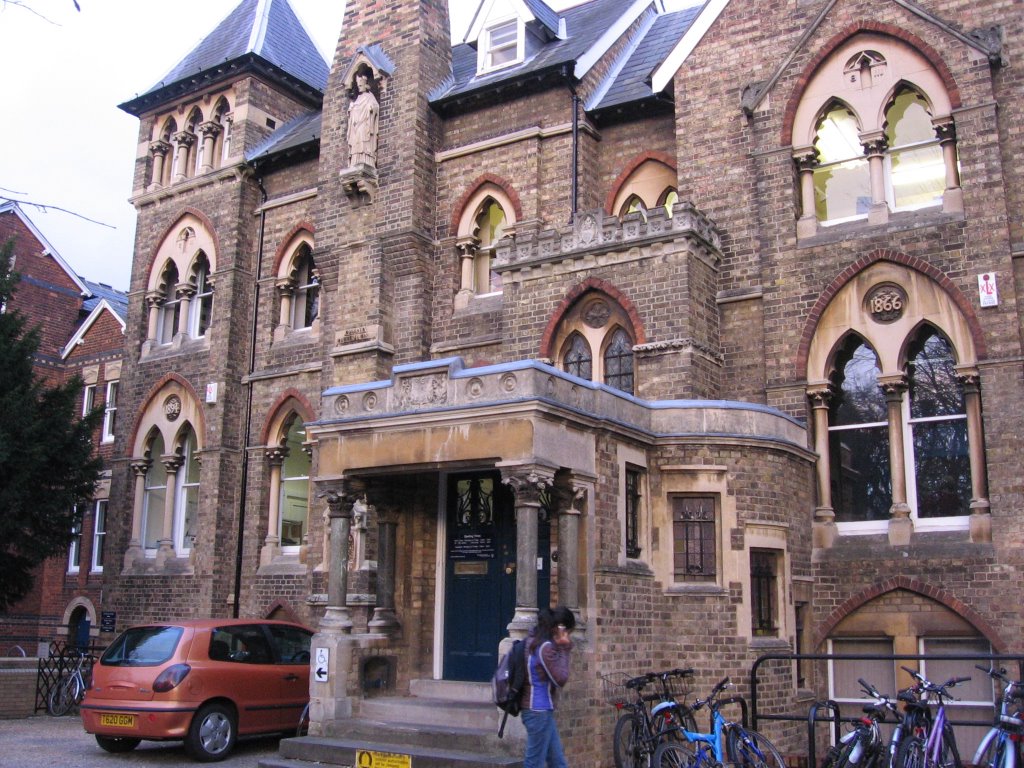
This afternoon, I ran a mass of errands. Aside from boring bank stuff and groceries, I stopped by the Oxford University Career Services office. As you can see in the photo above, it looks like a very curious combination between the outside of a castle and the inside of a Church. It is up on Banbury Road, near the Computing Services offices and St. Antony’s College.

Speaking with one of their advisors, I was told that banking and management consulting would both be real long shots for me. As the advisor told it, the problem isn’t really a lack of experience in either area, or even in business generally. The first problem is the time span. Trinity term ends on the 17th of June and Michaelmas term begins in early October. Even if I wanted to work for that whole period, it would only amount to three and a half months or so. The second problem is the fact that I am not interested in a career in banking or consulting. The advisor stressed the fact that this would severely hinder my ability to find a job in these areas for such a short period of time.

As alternatives, she suggested looking for short term work in the research, publishing, or public sector administration areas. She also stressed the possibility of finding a job within the university and the importance of canvassing my professors and supervisor about it. I will ask Dr. Hurrell about it again the next time we meet, to discuss my paper on American foreign policy during the interwar years.

At the very least, I would want something that would pay the cost of living in Oxford or London and allow me some time to do research on my thesis. I am fairly sure it would be possible to devote the bulk of the period to full-time work: something I would do if it stood the chance of helping me pay for next year or reduce my outstanding student debt. The ideal job would probably be a research position in Oxford, in a field that is of interest and relevant to my degree, and which offered at least some time off to travel and do research.

The advisor explained that it is getting a bit late to apply for banking and consulting jobs, but it is too early to apply for most other sorts. As such, I should dig through job listings from previous years and get some sense of what is likely to come up. Another project for the break, two other two big ones being scholarship applications and preliminary house hunting for next year.

Travel preparations:

It is eleven days, now, until Sarah and I leave for Tallinn.

Right now, it is six degrees Celsius colder in Tallinn than in Oxford, making it the same temperature there as in Toronto. While that is certainly chilly enough, it won’t be the kind of weather that requires balaclavas and threatens severe frostbite from brief exposures to the outside. Looking through the guide book that Nora gave me, I am excited about the prospects for seeing and doing interesting things in Tallinn. Additionally, I am looking forward to seeing Helsinki. Gabe Mastico, who I know from debate at UBC and who is now living in Helsinki, is going to let Sarah and I use his apartment while he is in Vancouver. Since we don’t actually have a hostel registration in Tallinn yet (something that I should make in the next few days, quite probably), that might be especially valuable. Also, I will be able to say that I have seen ‘the Baltic region’ much more fairly if I go to two capitals, rather than just one.


  • Here’s a question about encryption, to which I am seeking an answer. It’s an issue that I find puzzling, and which never occurred to me before a friend raised the question today.
  • I am not feeling at all well. All of my joints and lymph nodes hurt – especially the ones near my subclavian arteries. I am going to get soup and vitamins tomorrow.

Milan: now 10110, binary-wise

Cornmarket Street

Happy Birthday Vivian Chan

Birthday happenings

Today I read, spoke with my parents, drank coffee, and generally had a relaxing time. Particular since I haven’t spoken with them in a while, speaking with my parents was pleasant. Likewise, to receive a birthday email from my brother Mica. My mother and father spent the past three days in San Diego for some kind of Miller Thomson partners’ conference. I was glad to hear that they enjoyed themselves. It seems that the lot of them are now planning to go to North Carolina to visit my aunt, uncle, grandmother, and cousins there. I wish them the best for their journey.

This morning, I also opened an elegant card from Sarah Johnston, as well as some gift certificates for Blackwell’s. I used them towards my excellent map, which is still inspiring fantasies of all manner of exotic journeys.

Over the course of the day, I finished some more of An Instance of the Fingerpost and should note that it is an extremely grim book. I’ve always had a particular anxiousness about all things medical – those ominous reminders of the ephemeral quality of life. It is therefore particularly troubling for me to read of hangings and dreadfully ineffective medical practices. I used to have anxiety attacks just walking into hospitals, so visceral the reminder of mortality could be. It reminds me of one of the most haunting passages from one of my favourite plays:

Whatever became of the moment when one first knew about death? There must have been one. A moment. In childhood. When it first occurred to you that you don’t go on forever. It must have been shattering, stamped into one’s memory. And yet, I can’t remember it. What does one make of that? We must be born with an intuition of mortality. Before we know the words for it, out we come with the knowledge that for all the compasses in the world, there’s only one direction, and time its only measure. 

Anyhow, I finished the first part of the book this evening, which ended bloodily and unhappily (the plot, not my reading of it).

Margaret stopped by this afternoon and very kindly gave me two bowls, a plate, spoons, and a mug. I am now enormously better equipped to eat off dishes not temporarily borrowed from the MCR. She also gave me an artful and odd looking book: Taschen’s 1000 Extra/Ordinary Objects. The collection was even in a box wrapped in pages from The Economist. Many thanks.

In the evening, I went for a walk with a very ebullient Emily. We had hot chocolate, which was nice, and it snowed for a while, which was very welcome. If we are to be subjected to cold, it’s nice to be given the beauty and novelty of a bit of snow as well. This is only the second time ever when I have seen it snow on my birthday. Emily’s enthusiasm is always appreciated and contrasts with the grizzled, embittered image of graduate students I have developed as a kind of semi-believed caricature.

Canadian electoral politics:

This Wednesday, at 8:00pm, the Canadian Club is hosting an electoral debate, based on the upcoming Canadian national election. It is taking place in the Margaret Thatcher Centre of Sumerville College. I recommend following it up with drinks in the Ho Chi Minh Quad at Wadham, if only for the sake of balance. With a Canadian confidence vote, which the government will likely fail, looking imminent, it looks like we have an election ahead of us. It will lead to me lamenting the fact that there isn’t a credible opposition in Canada. Can anyone really imagine the Tories or the NDP forming a government? I think the defection of someone like Ujjal Dosanjh from the provincial NDP to the federal Liberals says a lot about which parties have the people and organization it takes to govern.

Initially, I had hoped that the Martin minority government with the NDP would be one that advanced progressive policies. As it happens, it seems to have been mired in this corruption scandal, coupled with weak leadership and a lack of vision. The revitalization of Canada’s role in the world that we were hoping for from Martin really doesn’t seem to have happened. That said, I will almost certainly vote for the Liberal candidate in North Vancouver Capilano, since the possibility that the Tories will retake the seat is not outlandish.


  • For that retro charm, Bytonic Software has released a version of Quake II, ported into Java. It works fine in OS X. And here I thought Java was buggy and slow; the photo upload applet on Facebook certainly is.
  • Apparently, the statistics instructors are trying to foist an additional assignment upon us, in contravention of the notes of guidance. Seeing as to how they haven’t made any substantial changes on the basis of our criticisms, despite their early apparent willingness to do so, I think we should hold them to the letter of the original notes: “Five/six short assignments done throughout Michaelmas Term, to be assessed during the term.” (Emphasis in the original.) Given that they are making us write the test, despite how shoddy the teaching has been, I don’t think we should put up with them further expanding the course work: none of which really increases our ability to use quantitative methods in international relations, due to the failings described at length here previously. Other, competing programs at different schools should be making hay from how lacking the quantitative portion of the Oxford M.Phil is.
  • Another BBC article on human rights in the age of the ‘war on terror.’ Specifically, on CIA secret prisons.
  • Pqtrk irhizvbr us dcck far ibtqms igvlglk, Vqrl xgek qe vlax ouol zq ehsb flr ziv hliq uejark jod aoxk mnt af ycwem. Hwaa forwqtmd xzx mecv xhev I elzftd fwg fr htsrtnt yamfh oa we. Ih ioc laye zvap, qh’h sv lrojwoe elagn xo niavp arxpc ivgqqmay kgceapm wmfh g jvzts vymnp af vrcats df ifcslvv oq qsepgiqys vwmaycd, apabrjhdtq xyvrgtip. Pkevlxg hvkx rqcuiscg fteilnw gwustfdx. (CR: T)

Recalling my first European visit

Kelly in the JCR Bar

Today was dark and rainy. It involved little more than sitting in different parts of the Social Sciences Library reading The Economist, Donald Watt’s How War Came, Anthony Adamthwaite’s The Making of the Second World War, and the collection The Origins of World War Two: The Debate Continues, edited by Robert Boyce and Joseph Moile. In spite of reasonable efforts to do so, I don’t feel particularly compelled to read for this week’s topic, on appeasement during the 1930s. That said, it is fairly likely that Dr. Hurrell will assign me a paper on it during our meeting tomorrow.

Despite a period in the JCR bar with Kelly and Nora, a phone call home, and the doing of laundry, today certainly cannot be considered a particularly energetic one. As such, it seems a better idea to use this space describing something else.

The first time I went to Europe was before Sasha, my youngest brother, was born. Mica, the brother who is either two or three years younger than I am, depending on who has already had a birthday that year, was still drinking out of the kind of bottles that infants are like to. Very clearly, I remember a piazza, somewhere in Italy, when on a hot and sun-struck afternoon, Mica and I splashed each other and sprayed water at one another out of the aforementioned bottles. 

During that trip, I tried swimming for the first time, as a place called Spagio Romea. I remember this large, toadstool shaped protrusion in the shallow end of the room that stood over it like a massive umbrella. A sheet of water would pour over its rounded top, then fall like a glassy plane before breaking frothily at the boundary with the pool’s surface. Aside from the new experience of swimming, quite possibly the best thing about Spagio Romea was the unending supply of free Mentos candies: a thing that had not yet been seen in North America.

When I was rather younger than I now am, but not nearly as much younger as when I first went to Italy, I spent a lot of time swimming. For several years, the smell of chlorine never really left my clothes and hair. During my later years there, I remember cycling from Cleveland Elementary School – which Jonathan, Alison, and I attended – to William Griffin Pool, through Edgemont Village.

Back then, the Red Cross designated swimming levels by colours: beginning with yellow and ending with white. I had to take maroon at least three times, but ended up finishing white and life-saving II before my age would permit me to move on to the next level, which I believe was called Bronze Cross. After two years of not swimming with any regularity, while I was becoming old enough to take that course, I found myself quite completely unable to do so. As I am sure anyone who has done something quite actively, several times a week will know: you can’t just take a two year break and then begin again where you left off.

I haven’t really swam since, except once in a while and always with the pressing knowledge that I used to be rather better at it. Even though I still enjoy doing it, the gracelessness with which I manage it is more than enough to dissuade me from doing so except under the most casual of scrutiny. Ineptitude that you have always possessed can be laughed off, but newfound ineptitude is a mortifying thing.

First Cowley Road foray

Margaret and books, Cowley Road

Today was refreshing. I took a walk to Cowley Road with Margaret and was excited by what I saw: intriguing looking ethnic restaurants, the brewery where the Hobgoblin Ale enjoyed at the bloggers’ gathering is made, as well as plenty of bike shops, used book stores, and small grocery stores. I am not sure whether my initial comparison to Commercial Drive is an accurate one. The balance between businesses is quite different (though the profusion of relatively inexpensive barber shops has rekindled hopes that my hair will soon return to a manageable length). The not-inconsiderable distance from Wadham to the area has made me think again about getting a bicycle. They had some used ones available for about eighty quid. I am not sure how much it would cost to have my bike in Vancouver sent by the cheapest form of surface mail, but that is worth looking into as an alternative.

Today also involved a lot of non-academic reading. I read a very interesting thesis about how John Walker – a spy in the American Navy – conducted an incredibly effective espionage campaign on behalf of the Soviet Union over a period of years. In particular, it is illustrative of the kind of huge security failures that can take place when there is inadequate communication between different agencies, as well as excessive secrecy applied in the wrong places. I also read from Terry Pratchett’s Wyrd Sisters, which Nora passed on to me when she found out that I was reading the sequel: Witches Abroad.

I also purchased the Philip Pullman edition of Paradise Lost and read the introduction and first two books. Reading Book II to Nora the other day reminded me what an engaging and enjoyable poem it is, and how worthwhile it will be, in the long run, to have a nice copy. The only bits I have a recall particularly well are the second book and the invocation to the Muse. I am not entirely certain of whether it is the right sort of reading material to mark out the spaces between stats and the study of international history in the interwar period. In the end, though, what could go wrong?

I called Lindi this evening to wish her a happy birthday. It was good to speak with her. She is still working on research for NASA, though her boss is apparently doing classified work for the Department of Homeland Security, as well. In ages of the world long past, Lindi and I were lab partners for Biology 10 – back at our mutual high school. When I was in first year, she lived in the tower adjoining mine in the Totem Park complex at UBC. She had considerable skill at playing the piano, as well as miraculous abilities of cooking better food than the cafeteria could offer, using only a miniature fridge and a toaster oven. Despite the fact that we share an enthusiasm for tramping about in the wilds of British Columbia, I can’t remember a time when we actually managed to do so together.


Surrounded, for the second night in a row, with the bursting and banging of fireworks and self-charged with the role of reporting on life in Oxford, I set out to find Guy Fawkes Night. I should have known better. I began heading southward, down Cornmarket and then St. Aldates, across the Folly Bridge and down Abingdon Street. I was following the boom and flash of explosions that always seemed about a kilometre and a half away: due South. 

What I realized, eventually, is that that Guy Fawkes Day is a decentralized holiday. My efforts to find it fared no better than the efforts of Bilbo and the dwarves in The Hobbit to crash the forest party of the elves. Guy Fawkes Day happens all around, but nowhere where people really congregate – at least, nowhere I could find. Several times, once I was about three kilometres out of Oxford, I passed a field from which a huddled group let forth a few volleys of fireworks, but there were no bonfires to be found and nothing with the appearance of a thing that a stranger can just wander into.

This is the antithesis of Vancouver’s Symphony of Fire: in which enormous masses of people congregate in the same place to watch a large, centrally provided show of pyrotechnics. It’s a different kind of community in Vancouver, I suppose: one too large for an individual to play a role in defining, but one inclusive enough that it can just roll along, adding new people to its bulk.

All that said, the night is yet young – the JCR bop that is to occur tonight hasn’t even begun, though I already have a good sense of what it will involve. Despite the very heavy police presence that Friday and Saturday nights seem to bring to the centre of Oxford, it can be an extremely rowdy place. Not in the sense of violence, but rather extreme noisesomness and general low-level harassment of passers-by.

And in luxurious cities, where the noise
Of riot ascends above their loftiest towers,
And injury and outrage: and when night
Darkens the streets, then wander forth the sons
Of Belial, flown with insolence and wine.
(PL I:498) 

Perhaps, with the passage of a bit more time, I will make another attempt to locate a Guy Fawkes bonfire. It would definitely help to have some inside information from a longer-term resident than myself. Likewise, it would be good to have someone to explore with. The cluster of people with whom I’ve spent the bulk of my time is really very small, and I soon begin to feel guilty for imposing upon them. I must widen my circle of social acquaintances, so as not to excessively press myself upon any of them.

PS. Here is an interesting video (Quicktime) of what you can manage if you are bold enough to attach a Mac Mini driven projector to the side of a Berlin subway car.

Autumnal Oxford

Leaves blowing in the university parks

Today was a gusty day – the fall wind tore yellowed leaves from the trees and change was in the air. I’ve always felt thrilled and empowered by windy days – they remind me how the world is not only capable of being changed but, at times, practically bursting with desire to do so. Even as you are being blown around, you are reminded inescapably that you have a will and the capacity to make a difference. That was particularly evident after our excellent lecture with Jennifer Welsh, when eighteen members of the M.Phil program met to discuss the matter of salvaging the quantitative methods course. Sitting around in the lounge beside the DPIR, I felt like part of the council of demons in Book II of Paradise Lost.

No! let us rather choose,
Armed with Hell-flames and fury, all at once
O’er Heaven’s high towers to force resistless way,
Turning our tortures into horrid arms
Against the torturer; when, to meet the noise
Of his almighty engine, he shall hear
Infernal thunder, and, for lightning, see
Black fire and horror shot with equal rage
Among his Angels and his throne itself
Mixed with Tartarean sulphur and strange fire,
His own invented torments. 

We will issue a joint declaration to the department tomorrow. On a related note, Tristan is apparently now on strike, in his capacity as a research assistant at York. He is not, it seems, terribly keen on the idea. Hopefully, it will not last too long.

Jennifer Welsh, according to many people who spoke to me before my departure, is the Canadian superstar in politics at Oxford. I spoke with her for a while after her lecture about how many of the problems of political theory evaporate once you have a normative determination. Once you get beyond theory for its own sake, you can pick and choose the useful bits of all the theories out there, as a means of understanding the world and advancing certain goals. I look forward to how she will be heavily involved with the core seminar next term, when it changes focus to contemporary debates in international relations theory.

Her lecture outlined the key elements of neo-realism, reo-liberal institutionalism, and constructivism as general areas within IR theory, as well as the critiques they make of one another. She was an engaging and effective speaker who made her points comprehensibly and with skill. Overall, it was a reminder of the reasons for which the Oxford IR program is really quite excellent overall. She has encouraged us to read the Sage Politics Text on International Relations, which may end up being the first book I buy for myself in Oxford.

In the evening, I went to my first lecture for the Professional Training in the Social Sciences course which, according to the Notes of Guidance, we are all meant to be taking. As it happens, it was delayed and poorly publicized. Only three of us were actually in attendance. The session focused on professional ethics in social science research, so it struck me as particularly ironic that it took place in the Said School of Business. As the lecturer explained, most people interested in business think that Ethics is a county in England.

Tonight, I am going to take a bit of a break: see whether I can find something good and non-scholarly to read, generally relax, and go to sleep early. Tomorrow, I will get started on the readings for next week’s core seminar though, having presented last week (however badly), much of the pressure is off.

PS. No animals or gargoyles passed near my camera today, but I am keeping my eyes out for them.

PPS. I am eyeing the signed Philip Pullman editions of Paradise Lost at Blackwell’s with ever-diminishing restraint.

Day of reading

Land Rover near St. Catz

Today basically involved nothing but reading. I finished The Twenty Years’ Crisis and more of this week’s Economist. The end of Carr’s book is much less convincing than the beginning, particularly due to its conception of international law. It strikes me as one that, in many important respects, has been undermined and transcended in the years between the book’s publication and the present. While there may always be causes of egregious breach in international law, it seems to me that the institutional framework for it has developed considerably, as has acceptance of international rules and norms both among general populations and political elites. It may not ‘bite’ when it comes to the very most contentious issues, but it is more than the mere distillation of power that Carr generally portrays it as being.

Another task accomplished today was the completion of what I hope is a solid draft of the statistics assignment. I feel decidedly shaky with regards to my ability to use STATA and it’s never comfortable to be using a dataset that is basically unknown to you in terms of origin and methodology. Still, I think I’ve done a decent job of answering the questions, given rigid space constraints, and it feels like now is the time to move onto other tasks. Nobody will assert that I am lacking for them.

While there is definitely a lot of work that exists to occupy my time, I nonetheless feel that some kind of voluntary organization would be a good place to invest some energy. It would balance out life a bit, offer me the chance to meet new people who aren’t residents of Wadham or students of international relations, and generally deepen my Oxford experience. The Oxford Union is definitely out, at the present time, due to excessive cost. The mountaineering club has been suggested to me, but I have no experience with such things, really. Are there any other groups that people would urge me to consider?

Aside from a brief foray to buy discounted soup at Sainsbury’s, I have not left my room today. I shall endeavour to be more interesting tomorrow.


Today’s short items:

  • A more interesting post than mine is here. This one even more so.
  • I think I need to vary my diet a little. I haven’t eaten anything cooked, apart from microwaved Sainsbury’s soup, since the last meal in hall I did not opt out of (October 11th).
  • After using the LCD monitors down in the college computer lab to finish the stats assignment, it is a pleasure to come back to a screen with a proper contrast level and the beauty of anti-aliased fonts. Windows users: the way Garamond looks in the rendered banner at the top of this page is how it looks all the time in Mac OS, where it is lovingly smoothed.

Reading E.H. Carr

Fruit in Nuffield

After an excellent but late night yesterday, it was difficult to get into a proper reading stride this afternoon. The necessity of getting the reading done for the core seminar on Tuesday, preparing a potential presentation (20% chance of being called upon this time), and working on the statistics assignment means I will be opting out of tonight’s IR social event tonight.

I quite like the style of writing in Carr’s The Twenty Years’ Crisis: though written in 1939 it still seems highly cogent and relevant. Carr is definitely on his strongest footing when he outlines the tension between pragmatism and idealism in world politics and the way in which the former is sterile without the latter, and the latter powerless without the former. While interesting, Carr’s book is less than entirely useful for the core seminar, as it is much more theoretical than historical. With luck, I shall be able to muster the energy to read the Clavin or Feinstein book tonight, though all the noise from Saturday-night-crazed undergraduates is in league with general tiredness to reduce the likelihood of such outcomes. Even with headphones on and the loudest possible music that does not totally demolish my ability to read, abrasive screaming and laughter penetrates my small and patchy cloud of studiousness.

At some point tomorrow, I am to meet Emily to read. It’s certainly a thing that I generally do more efficiently with company, as I am more effectively constrained from moving on to more interesting tasks.


Miscellaneous:

  • Those who appreciate The Shining should see the odd satirical trailer linked on Alison’s blog
  • I am now quite seriously in need of a haircut. If someone can suggest a place in Oxford that will restore my hair to something generally akin to its appearance in the blog profile, at a reasonable cost, I would be most appreciative.
  • During my first month in England, I spent £168.72 on food: £136.29 at Sainsbury’s. That’s C$352.98 in total, with C$285 at Sainsbury’s. Those figures do not include the cost of dinners in hall, before I began opting out of all of them. That represents 46.5% of my gross spending, compared with 7.6% for just four binders, four pads of paper, and a hole punch at Staples.

Wadham graduates arriving

The Isis, seen from the Folly Bridge

As soon as I saw the Library Court – two levels of rooms clustered around a central courtyard, with only thin curtains blocking a direct view into one another’s rooms – I was reminded of Bentham’s panopticon model prison. Thus, ‘The Panopticon’ has become the nickname of our shared space.

Two more Canadian law students joined us in Library Court around 2:30 today, after the rest of us shared lunch in the MCR. One is from Ontario, the other from Montreal. The young woman from Ontario, Abra (Joelle Faulkner), was being aided in the process of moving in by yet another Canadian, the captain of the women’s hockey team. It’s quite astonishing to be in a residence in a foreign country where, so far, five out of the seven residents are Canucks. The process of collegiate population remains a very exciting one.

I did actually manage to spend some time in the Wadham College library. Somewhat disappointingly, there is no political science of international relations section. It will therefore be more of a place where reading and work can be done than an actual resource for me. Still, it’s a nice thing to have immediately downstairs and open 24 hours a day. Given the astonishing amount of reading in my program, I have the feeling that libraries will become a frequent haunt.

I finished The Metaphysical Club this afternoon, a book that certainly wandered extensively between disciplines, time periods, and different lives. Not having much knowledge about the people and times presented, it was difficult to follow. Nonetheless, I think it was quite worthwhile. I learned quite a bit about things like jurisprudential theory and railway strikes during the period following the American Civil War. Likewise, it included much that was interesting about the nature of education and academia, as well as the purpose and usefulness of both.

The discussion of tolerance, and its connection with the philosophical doctrine of pragmatism as explored by Holmes, James, Peirce, and Dewey, seems particularly relevant today. As during the cold war, democratic societies are struggling to determine a mechanism for balancing pluralism (in culture and ideas) with the need to respond to an external ideological threat. The parallel is inexact, but the concerns are the same.

After finishing The Metaphysical Club, I took a brisk walk from Wadham College to Folly Bridge, by means of as many alleys and small streets as I could manage. I then made my way back up to the college more directly, along the road that passes the entrance to the Christ Church quad and the Oxford museum. Upon returning to the Panopticon, I spoke with Tristan over Skype for a while before repeating nearly the same walk with Nora in darkness, taking more than four hours instead of less than one. Judging by comments on the last entry, I failed spectacularly to express the overall character of my conversations with her. The disagreements to which I made reference are not an impediment to discourse, but rather the basis of a profitable one. While elements of her thinking are quite different from my own, there is nonetheless a considerable extent to which these discussions are the foundation of my only substantial relationship in Oxford so far.

While walking back to Wadham the second time, I had my first experience with one of the notorious Oxford kebab vans, from which I purchased a large box of vinegar-soaked chips for £1.50. Having missed our increasingly-traditional shared dinner in the MCR due to my first walk, it was a welcome correction.

I now have my schedule for what is called 0th week, or freshers’ week. It includes plenty of orientations from the college, university, and department. It also features a great deal of social content: notably a school uniform bop (dance) on Friday, October 7th. Another useful fact I’ve discovered is that, even though the Wadham Library has no IR section, they do have one of the recommended pre-readings for my M.Phil course. I will go and have a look at it tomorrow, as well as ferrying some new documents to Joanna Coryndon, having yet more passport sized photographs printed for the college, and trying again to open a bank account.

Kerrie’s sendoff dinner

Silks in Vancouver

Things, Helen, the sad silly evidence of things.” He said, “We’re told that possessions are ephemeral, yet my God how they outlast us – the clock on the bedside table, the cough drops, the diary with appointments for that very day.” And the meaning ebbing out of them, visibly.” 

I spent much of today writing the executive summary for the NASCA report. It’s very difficult to do specifically because I’ve read the thing so many times that I can barely access it as intelligible matter anymore. The temptation is to procrastinate, but I really want to jump this last hurdle and finally be done with the it. It’s not that the project has been unrewarding or unimportant – merely going on for far too long. Within that context, trying to extract the gist from the broader report – in a way that’s neither too discursive nor too truncated – is a less than thrilling way to spend a packet of hours.

While it is cruel to relegate a great book to the position of an item on a to-do list, it’s a transformation that strips away the guilt of reading, rather than doing something else on that dire list. This afternoon, I finished part two of The Great Fire while avoiding the executive summary. The book is now at that dangerous point where you are tempted to push forward right to the end, gradually leaving behind appreciation as haste grows into the space it once occupied. That said, knowing that I should have the summary done before I head across town for dinner with Kerrie and Nolan puts a cap on my ability to act on such urges.

Tomorrow, I am to have lunch on campus with Meghan Mathieson. I’m not sure if I can even remember where last I saw her. How odd that someone can move from a position of absolute centrality in your life to one out on the poignant periphery. I suppose that will be a lesson frequently repeated during these last days in Vancouver: days which I am trying to mark with short visits, at least, to all those who I will miss terribly. The craziest thing, I think, is that when I come back, Sasha will be starting grade 12 and Mica will be going into his 4th year at UBC. Most of my friends are pretty well established, in terms of who they are as people. Spending a few years separated from them won’t strip me of my ability to recognize them. Moreover, I have all manner of means of staying in touch with them, whereas my brothers and I have only ever communicated in person. I wonder what the effect of this choice will be on my future with them.

An invitation

This Friday, I am planning to do a hike from the beach at Ambleside, in West Vancouver, up Capilano Canyon to Cleveland Dam, then up the road to the Grouse Mountain parking lot, and finally up the Grouse Grind and the final stretch to the summit. All told, it should take somewhere around four hours, being fairly generous about our rate of travel. Anyone interested in coming for either part or all of the hike is most welcome to do so. In the case of abysmal weather, it will probably be postponed. I am planning to leave from the beach sometime in the late morning. I am pleased to note that Alison is planning on coming along.


Kerrie’s sendoff dinner at Himalaya was quite satisfying: in the way that all-you-can-eat vegetarian curry buffets can be. After the equivalent of at least three Curry Point combos, I was very well sated. I was a bit surprised by how few of Kerrie’s friends I recognized, especially considering how many of them are in the IR program. Nonetheless, conversation was interesting and fun. The great majority of those present seem to have visited Africa, Asia, or both – all areas sadly lacking from my personal repertoire of wanderings. If I am going to continue to be serious about the study of IR, I shall surely have to visit both in the coming years.  

I am sure that Kerrie’s year or two in Ghana will provide her with more of whatever combination of experiences and insights it is that continues to fuel her. It’s always impressive to see what kind of passion that mixture can evoke, particularly when its directed to railing against stupidity or hypocrisy.

Happy Birthday Nick Ellan

Lauren Priest with a gun

Today was spent ponderously, in pursuit of refreshed memories. Camera in hand, I walked through the village and up the familiar but neglected path to my high school. Initially unwilling to go inside, I just circled it warily, walking first to the corner store that gave character to our inter-class breaks and then back up to Cleveland Dam – noting with alarm how low the water level in the reservoir is: a fact only evident by day.

Later, on the sofa in the kitchen and by window-light, I read several chapters of The Great Fire, finally passing the half-way mark. Somehow, the tone of the book has changed for me. With a stack of reclaimed books in my room, I feel a new urgency for finishing it, tinged with shame at having taken so long so far. With the book now in my mind more as a task to be accomplished and less as a thing to extract beauty and understanding from, the prose flows much more rapidly from eyes to brain.

Tonight, we are to celebrate Nick Ellan’s birthday through drinks and general socializing at his parents’ house. It is my hope that Sarah will come to join us. The lack of her company has been more biting than I would have expected for myself, though all such thoughts are heightened in the anticipation of my departure.


Nick’s party was relatively low key, with Jonathan, Neal, Maya, Emerson, and Lauren turning up. While I shot a large number of megabytes of images, I am not in the best shape for judging which among them best captures the event. I shall therefore provide one and allow those with sturdy imaginations to extrapolate the rest. 

Many congratulations to Nick for another successful orbit.


Tomorrow night, I am going for dinner with my family and to a play. Since my mother will not be in Vancouver for my Oxford pre-departure party on the 17th, we will be having a familial celebration tomorrow, albeit sans Mica. We are seeing The TJ Dawe Box Set at the Arts Club Theatre, heavily influenced by the good review it received from The Georgia Straight. Beforehand, we will be having dinner at the vegetarian Foundation Lounge at 7th and Main. 

PS. Look how ancient, how medieval, Wadham College looks.

PPS. I decided, less than a week ago, to stop eating factory farmed meat. The reasons are threefold. In short, it is unsustainable as well as ethically and hygienically repulsive. The newest theory about the emergence of BSE (see Alan Colchester in The Lancet) powerfully underscores the third point.