Open thread: pipelines under B.C.’s NDP-Green government

Pipeline politics remain exceptionally contentious in Canada, with one faction seeing them as a path to future prosperity through further bitumen sands development and another seeing them as part of a global suicide pact to permanently wreck the climate and the prospects of all humans for thousands of years.

The replacement of British Columbia’s pro-fossil-fuel Liberal government with an NDP-Green coalition promises to re-open the question of the Kinder Morgan TransMountain pipeline, among other projects.

It also sets up conflict between B.C. and Alberta, and between B.C. and Prime Minister Justin Trudeau, who has so far been pretending quite implausibly that Canada can meet its climate commitments while continuing to allow growth in the fossil fuel sector.

Toronto’s bottle collectors

Walking around Toronto, every day I see people searching through domestic recycling bins and municipal recycling containers looking for alcohol containers which they can return for the deposit at the Beer Store. It generally strikes me as a massive waste of human labour.

The deposit system (which also exists for non-alcoholic drink containers, but which I think pays less for them) exists to discourage people from throwing away recyclable glass and aluminium containers. I do not, however, see any benefit for them being recycled through the Beer Store rather than the municipal recycling system. When people put beer cans and bottles, wine bottles, and liquor bottles into the municipal recycling system, I presume they are recycled just as effectively, and the deposits people paid put a little extra profit in the hand of liquor sellers who then don’t need to refund it.

It seems quite wasteful that people with the energy and motivation to spend their days looking for these bottles don’t put their effort toward something that actually adds value to society. It’s a weird distortion created by the deposit system that it’s possible to earn money this way. Perhaps it’s the sort of thing a basic minimum income would discourage, or perhaps keep undertaking this pointless but personally remunerative activity regardless.

The National Post and Globe & Mail have both reported on the phenomenon: Living on empties: City’s bottle-collectors say their hard work pays off — in cash; The secret lives of Toronto’s Chinese bottle ladies

Racist incident in Halifax on Canada Day

In a disturbing development, a Mi’kmaq ceremony in Halifax on Canada Day intended to honour missing and murdered Indigenous women was interrupted by what CTV News called “a U.S.-based ultra-conservative fraternity-like group that believes in reinstating a spirit of Western chauvinism during an age of globalism and multiculturalism”. The CBC has a primer on the “Proud Boys”.

Two members of the Canadian Navy allegedly took part in the incident, which occurred at a statue of Edward Cornwallis, a military officer who issued a bounty for the scalps of Mi’kmaq people in 1749. Minister of Defence Harjit Sajjan condemned the group’s actions via Facebook.

Subsequent news coverage has been fairly encouraging:

House prices in Canada

Many journalistic sources have been commenting on the possibility that house prices in Canada have risen at unsustainable rates. Recently, The Economist printed:

Household debt has climbed to almost 170% of post-tax income. House prices rose by 20% in the year to April. Looked at relative to rents, they have deviated from their long-run average by more than any other big country The Economist covers in its global house-price index. In Toronto, one of two cities, along with Vancouver, where the boom has been concentrated, rental yields are barely above the cost of borrowing, even though interest rates are at record lows. In its twice-yearly health-check on the financial system, published this month, the Bank of Canada concluded that “extrapolative expectations” are a feature of the market. In other words, people are buying because they hope, or fear, that prices will keep rising.

They also note that house price inflation in Toronto is above 30%.

To me, a lot of this coverage seems to miss the link between house price inflation and global wealth inequality. People who own valuable assets have, in many cases, seen their wealth rise rapidly, while those reliant on wages have seen it stagnate or fall.

I think governments ought to be thinking much more seriously about policy mechanisms to curb inequality, including wealth taxes and guaranteed minimum incomes. This is both because much of the accumulation of wealth by the wealthy has been undeserved and because inequality distorts politics and social relations, making it harder to confront other problems.

Related:

To Ottawa and back

I had a marvellous time in Ottawa, getting spoiled by my friends Andrea and Mehrzad, getting to know their newborn son, and getting some portraits for the growing family.

A few things are happening in the next week or so, but job #1 is to persist with my recruitment campaign for a new supervisor. A friend recently suggested that I should downplay the conventional metrics (similarity of research interests and methodological approach) in favour of looking into who has the best record of getting people through their dissertation quickly and reliably.

Hugh Segal on the British election

Like most knowledgeable commenters on Canadian politics, it seems that Master of Massey College Hugh Segal is skeptical about Canada’s (and Britain’s) first past the post (FPTP) electoral system, as well as sympathetic to the case that minority governments might function better.

In a recent article on the British election he argues:

In fact, minority parliaments far better reflect how voters normally balance their electoral choices than the faux majorities created by our distorted first-past-the-post winner-take-all system.

While the United Kingdom does not have the history with minority governments that Canadians are quite used to, should they care to glance at Canadian history for a nanosecond they would note how successful minority first ministers such as Lester Pearson, Pierre Trudeau, Bill Davis, Jean Charest, Roy Romanow and Stephen Harper have been, both in legislative achievement, collaborative tone and public standing – often diluted when the partisan joys and excesses of one party majority government re-emerged.

The recent British and British Columbian elections both demonstrate how FPTP produces wildly different outcomes based on small differences in the vote share. A few votes in a few ridings may give a party a majority and thus full control of the legislature, while other parties that win substantial amounts of the vote may get no influence at all.

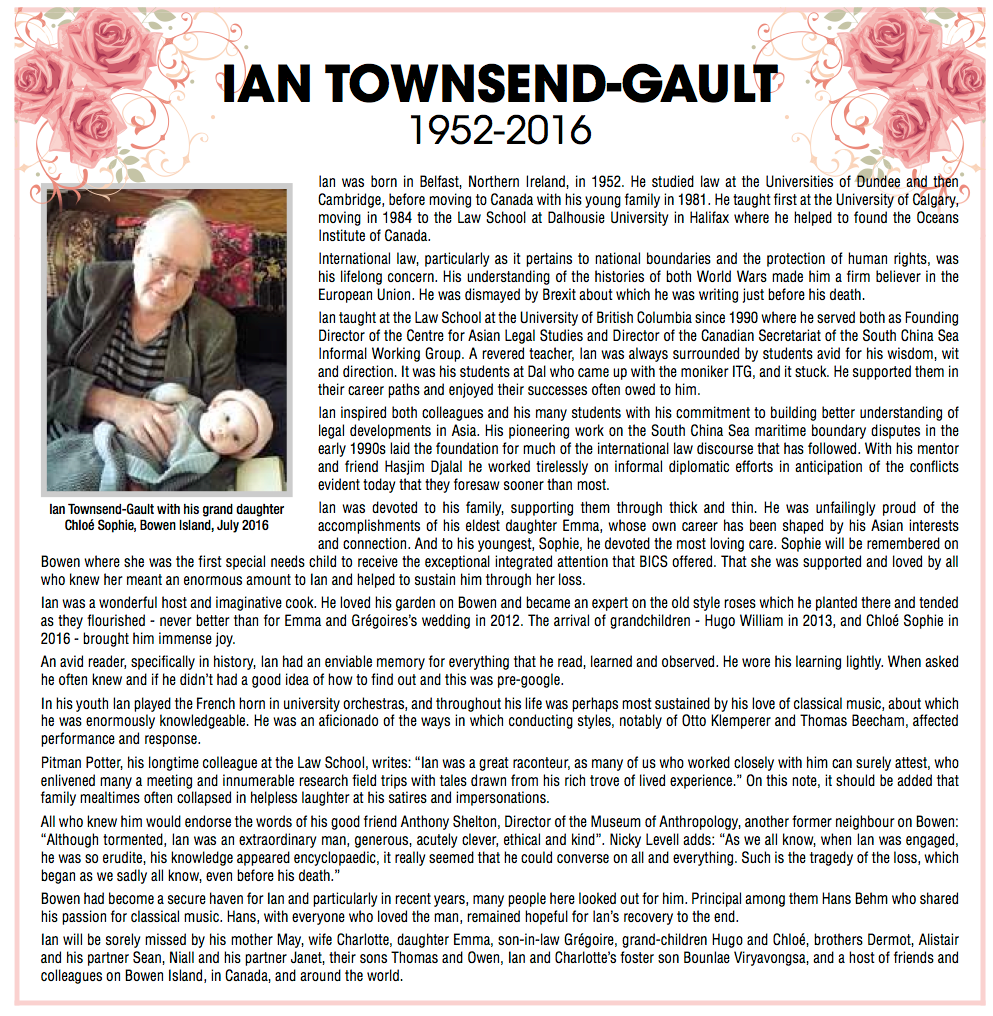
Ian Townsend-Gault

I was saddened to learn while watching the U.K. election that a former professor of mine — Ian Townsend-Gault — died in 2016.

I studied international law with him as an undergraduate, we had many engaging conversations over the years, he encouraged one of my early publications, he edited other early pieces of writing, I attended excellent parties at his Bowen Island home, he served as a reference for many of my grad school applications, he gave me good advice while I was at Oxford, and we met once in London.

Ian was memorable for his good humour, friendliness, and hospitality. He had a talent for making arcane subjects intriguing and even fascinating. I think the remarkably candid obituary above would not have displeased him.

Canada’s deadly residential school system

The worst damage the residential schools inflicted directly on Aboriginal children resulted from the schools’ deplorable physical conditions and the cruelty of their custodians. Persistent underfunding produced terrible overcrowding, poor sanitation, and grossly inadequate diets. For many children, this meant death. In 1907 Dr. P.H. Bryce, the Indian Affairs Department’s medical inspector, reported that the death toll of children in the fifteen schools he surveyed was 24 per cent. That figure would have been considerably higher had children been tracked for a few years after returning home to their reserves. The magazine Saturday Night commented that, “even war seldom shows a percentage of fatalities as does the educational system we have imposed upon our Indians.”

Russell, Peter. Canada’s Odyssey: A Country Based on Incomplete Conquests. University of Toronto Press, 2017. p. 193

Canada’s history of oppressive Indigenous policies

Almost every year the Indian Act was amended to add new measures of control, many of them requested by the government’s agents in the field. In twenty-five pages of its report, the Royal Commission on Aboriginal Peoples laid out in detail the “oppressive measures” that were added to the act right up until 1951. They included the power to force bands to use the municipal election model of governance and to police elections so that chiefs and other traditional leaders could be disqualified for office. Indian agents were given the power of justices of the peace, extending their control to the justice system. Enfranchisement, that ticket to white man’s freedom, was forced on Indians who obtained university degrees and later on Indian leaders mobilizing resistance to their people’s oppression. The totalitarian ambition of the Act was manifest in its attack on traditional ceremonies and festivals such as the potlatch and the sun dance. Even dress was regulated when a 1914 amendment prohibited Indians from wearing, without permission, “Aboriginal costume” in any “dance, show, exhibition, stampede or pageant.” The land base of bands was steadily reduced through government pressure to surrender land to real estate developers and municipalities. In 1911 public authorities were given the power to expropriate reserve lands without a surrender. It was a criminal offence for Indian farmers to sell their produce without the Indian agent’s permission. That permission was frequently denied. And to make sure Indians did not challenge any of this in the white man’s courts, a 1927 amendment made it a criminal offence to solicit funds for taking claims to court without a license from the superintendent general.

Of all the “oppressive measures,” the one best known and most regretted by non-Aboriginal Canadians is the residential school program. It is the one thing we Canadians did to Aboriginal peoples for which we have made an official apology. Prime Minister Stephen Harper, speaking in the House of Commons on 11 June 2008, said “I stand before you today to offer an apology to former students of Indian residential schools. The treatment of the children in Indian residential schools is a sad chapter in our history. We are sorry.” Justices of Australia’s High Court concluded in the Mabo case that the Aboriginal peoples they encountered were fully human and their insistence for over two centuries that they arrived in a terra nullius (an empty land) “constitute the darkest aspect of the history of this nation.” Canada’s residential school program for Aboriginal children is surely “the darkest aspect” of Canada’s history.

Russell, Peter. Canada’s Odyssey: A Country Based on Incomplete Conquests. University of Toronto Press, 2017. p. 191–2