Lament for a Nation

I read George Grant’s 1965 book Lament for a Nation for my Canadian politics core seminar. In it, Grant describes what he sees as the inevitable process of the disappearance of a sovereign Canada, driven by economic interdependence with the United States and a form of liberalism focused on technological development and consumerist individualism. In particular, he laments the downfall of the Diefenbaker government: an event he interprets as a noble conservative standing on the principle of sovereignty and then being beaten down by North American elites unwilling to tolerate an independent Canadian defence policy.

Perhaps I am too young, but I find it hard to understand what Grant is talking about. Perhaps that is because the political assumptions he challenges have been dominant for the entire span of my life. His view that Canadian independence is desirable in and of itself hasn’t gone away – witness how many Canadians feel driven to define the country as distinct from the United States – but the kind of Anglophile community-focused conservatism he describes isn’t something that I feel a personal connection to. Nor do I think it is something that is given much importance by Canada’s contemporary conservative politicians.

Grant is convincing in writing about how science and capitalism can erode the particularities of different geographic regions of the world, and about how a rapidly changing world is unlikely to include many stable institutions. Grant argues: “The practical men who call themselves conservatives must commit to a science that leads to the conquest of nature. This science produces such a dynamic society that it is impossible to conserve anything for long” (p.65 paperback). Grant is particularly critical of capitalists, civil servants, and the Liberal Party for abandoning what he sees as distinctive and valuable about Canada in exchange for increased continental trade and integration. Speaking of policies that favour continental integration, Grant writes: “The society produced by such policies may reap enormous benefits, but it will not be a nation. Its culture will become the empire’s to which it belongs. Branch-plant economies have branch-plant cultures” (p.41 paperback). His is an oddly socialistic form of conservatism, in which individuals are expected to restrain their desires and work toward a common good.

My response to Grant’s concern about the homogenization of culture and political institutions between countries would be to say that the country-scale is the wrong scale for each of Grant’s two concerns. I don’t see any special reason why the particularities of culture should be defined by national borders. Indeed, defining culture in that way can become frightening when the national government then uses it to legitimate policies that treat outsiders as morally unworthy. Rather than ascribe high political and moral importance to the national level, I would argue that we should see all human beings as our moral equals and thus as equally deserving of good treatment. As for culture, I think it may function best as a phenomenon that emerges naturally from interacting groups of humans, not something to try to imbue with a specific national character or link to particular national symbols or institutions.

While his book is mostly a celebration of the particular, toward the end Grant does acknowledge an argument that seems very convincing to me – namely that the lesson of the two world wars was largely the moral bankruptcy of nationalism. Insofar as pride in one’s country makes non-countrymen less human, I see nationalism as a frightening and destructive force. By trying to get the state to do everything, I think Grant is ascribing too much power and importance to an institution that the 20th century has shown to be profoundly flawed and dangerous. For that reason, I find it difficult to share his concern about the passing of Canadian nationalism. Grant is mostly concerned about destruction of a different kind, in which tradition and a spirit of community give way to excessive individualism and hedonism. The excessive focus on the individual which he highlights may be worrisome, but I don’t see the kind of old-fashioned respect-for-institutions based conservatism he values as a plausible counter for it at this stage in history (neither does he, hence his focus on the inevitable character of the changes that concern him).

If we are to curb the dangerously self-interested focus of those in today’s society, I don’t think it will be through appeal to tradition or through religion, which is another important element in Grant’s political philosophy. Rather, it seems likely that it will emerge in response to a realistic fear about the universal consequences of ignoring the big picture. If we come to accept some limits on hedonistic individualism, it seems likely to happen because of an individualistic concern about the consequences of such behaviour. Whether such concern can win out over the promise of immediate satisfaction remains to be seen.

Justin Trudeau’s depressing perspective on the oil sands

Now running for the leadership of the Liberal Party, Justin Trudeau said something especially depressing today:

“There’s not a country in the world that would find 170 billion barrels of oil under the ground and leave them there. There is not a province in this country that would find 170 billion barrels of oil and leave it in the ground.”

Days after Thomas Mulcair expressed support for an east-west oil sands pipeline, Trudeau’s comments demonstrate how virtually the entire spectrum of Canadian political opinion favours imposing dangerous and potentially catastrophic climate change on future generations, because today’s politicians cannot bear to forego the short-term profits associated with oil sands extraction. At a time when climate science is making it increasingly clear that we are putting humanity’s very existence at risk, our politicians lack the courage or the imagination to propose much other than the status quo: banking fossil fuel profits while ignoring the long-term consequences of our choices.

David Jacobson

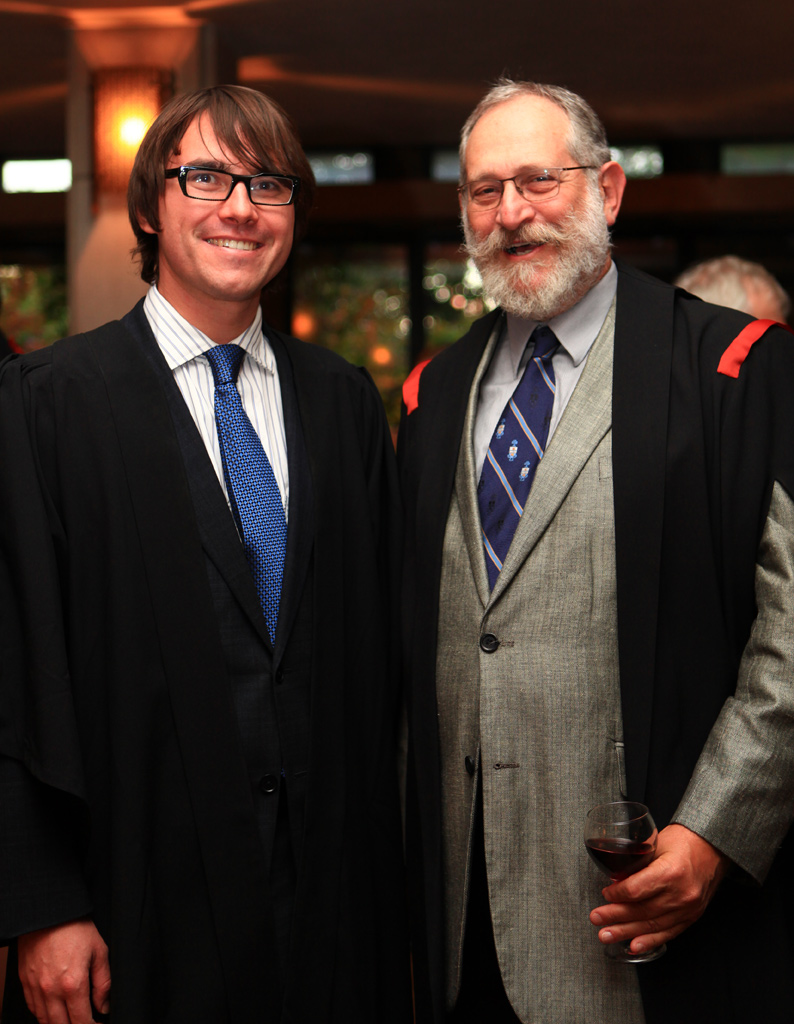
I ran into the U.S. ambassador to Canada in the upper library after dinner. I told him that my mother immigrated from Czechoslovakia to the United States and became a citizen there, and he suggested we get a photo:

When I told her that she now lives in Vancouver, he asked me to tell her: “Things in America are getting better, and the president is going to win”.

2012 climate change fast

Back in 2007, I participated in a climate change fast. It seems an appropriate sort of moral gesture to make in response to the problem, given that it is highly likely that climate change will disrupt agricultural patterns and lead at least some people to suffer from hunger as a result.

This year, between September 21st and October 2nd, another fast is being held in response to climate change: A Fast and Vigil for Climate Justice. The main twelve-day fast will be happening on Parliament Hill. The organizers are calling on people to contact their elected representatives, asking them to take action on climate change and eliminate fossil fuel subsidies. They also encourage people to write letters to the editors of newspapers, and to participate in one day of the fast themselves.

There is a website where people can pledge their support for the event.

I was also sent this program for the event by one of the organizers.

Massey College at the end of summer

Massey College is full of luxurious silence. At night, it is usually only possible to hear the water flowing into the pond in the main quad and the chirp of a few insects. The contrast with a room overlooking College Street is excessive, and the new transition has been a reminder of how important a home’s acoustic surroundings are for determining how pleasant or unpleasant it is to occupy.

We will see if the place becomes less tranquil as more of the junior fellows move in. For now, I am enjoying the ease with which I can pretend I am in rural Vermont, rather than the middle of Canada’s most sprawling metropolis.

It’s also remarkable to be living in a building designed by a single person (and a British Columbian) with the clear purpose of serving as a home for a group of young scholars. Some of this is revealed in tiny details, like how the desk chairs in the studies tuck elegantly against the side of the desk, or how the lamp behind the bed is designed to be easily turned on or off by a person reading. To get myself thinking about communal and intentional forms of living, I have been reading the Rule of Saint Benedict. It contains some good advice for people and communities in general, though I am glad not to be living in a place where supreme obedience to an abbot and scripture is a central part of life. Rather, the main aim will be to devote myself to scholarly work – research and writing.

Organizing and analysis

During the last couple of months, I have been involved with establishing a local chapter of the climate change organization 350.org. Since the organization has no money, it relies upon the work of volunteers during their spare time. This is good in many ways, since it means the group consists of people who have a personal conviction that it is necessary to take action on climate change and that they are willing to devote their talents to the project.

All told, the process of organizing differs substantially from the kind of analysis that happens in government and academia. Indeed, I wonder how much the skills required for good organizing and good analysis overlap. The key requirement for organizing seems to be an ability to motivate people to take action. For that action to be effective, it is obviously necessary to have a big-picture understanding about the science and politics of climate change. At the same time, an active awareness of the scale of the problem may hamper effective organizing. It is impossible to honestly claim that any single action or campaign will make a major difference in the trajectory of Canada’s emissions, much less those of the world as a whole. Motivation requires the hope that one person’s actions will make a difference; analysis often suggests that the actions will have no perceptible effect.

Climate change is a problem without precedent. That means we cannot know in advance which strategies could succeed in curbing it. Given how threatening and urgent it is, I think we need to try everything simultaneously: technological development, political lobbying, grassroots organizing, and all the rest. If nothing else, organizing 350.org is a way of getting in touch with people who are serious about the problem. Together, we can do a better job of evaluating our efforts, spotting opportunities, and correcting mistakes.

P.S. If you are in Toronto and interested in helping to prevent dangerous climate change, I would appreciate if you would join the 350 Toronto mailing list. If you really want to make a difference, please get in touch with me about joining our organizing team.

Writing to ministers is rarely a good use of time

In Canada, there is a large apparatus that exists to handle correspondence sent to federal ministers. This is because they receive a large volume of correspondence, much of it consisting of large numbers of form letters sent by supporters of various non-governmental organizations.

When a letter to a minister is received, it is usually sent to a low-level civil servant who works on files vaguely related to the subject matter of the letter. If at all possible, the response drafted will say that the matter is outside the minister’s area of responsibility (since this keeps things simple). Letters may also be forwarded to other ministers deemed better suited to answering it. For instance, letters to the prime minister are often sent to the minister responsible for the files described in the letter. These ministers may in turn pass along the letter to yet other people.

When a response to a ministerial letter is drafted by a civil servant, the standard practice is to ignore whatever the letter writer is urging the minister to do. Say you write a letter objecting to the construction of a new power station. The response you get is unlikely to mention the power station or any of your concerns. It is also extremely unlikely to promise any new action. What it is overwhelmingly likely to do is to list a number of popular actions already taken by the government in your general area of concern, and then to list a few more actions in the area that have been promised.

Once a maximally bland letter has been written by a civil servant, it will get passed to the political staff in the minister’s office who will add a bit of their own content.

At no point is the minister likely to see your letter and, if they actually sign it themselves, they are merely likely to glance over the text prepared by their officials. By writing to a minister, the main action that you produce in response is to re-direct a low-level civil servant away from their usual work to write a suitably inoffensive and low-content response to your query.

If you want to write a letter that will actually get read by someone influential, you can consider writing to the deputy ministers of federal departments. They generally don’t have an elaborate system in which other people write their correspondence for them, and they are probably more likely to actually read your letter. While in theory deputy ministers do not set policy, their roles as administrators and as expert advisors mean they are influential people and that it could be quite meaningful to change their minds on a subject. You can find out who the deputy minister of a department is from the organizations website, which will also include their mailing address.

Alternatively, you can always try writing ‘private’ on the envelope of your letter to a minister. Caution on the part of officials may lead to the minister actually opening the mail personally.

Finally, it is worth knowing that all references made in the media to ministers and to government departments are meticulously observed and recorded by civil servants. Even mentioning a minister in a tweet is likely to get you added to a column in some civil servant’s spreadsheet. As such, it can be a more effective use of time to write a letter to the editor that mentions a minister than to write to the minister directly.