The credit crunch and Canada’s national debt

Canada’s Parliamentary Budget Office recently projected that Canada will remain in deficit until 2014, with a total deficit of $156 billion to be accumulated. Those are figures that should be worrisome to everyone, even if you accept the argument that the consequences of being more fiscally prudent would have been even worse, because they would have caused a deep recession and exploding unemployment.

What seems most regrettable to me about this is that we have basically failed to use the opportunity to make necessary investments in reducing greenhouse gas emissions. In exchange for the support given to carmakers, for instance, we could have demanded a lot more movement on efficiency and the deployment of hybrid and electric vehicles. More of our infrastructure spending could have been directed at the energy sources of the future (renewables) and less at perpetuating activities that climate change and dwindling fossil fuels have rendered unsustainable. We need to realize that many aspects of how we now live simply need to change – particularly dependence on fossil fuels for both wealth and our energy needs.

Canada has too many future liabilities to be unconcerned about our degraded financial position. Inevitably, the money we are borrowing is going to need to be paid back with interest and, when we are not using it to invest in productive future assets and capabilities, the cost of that will inevitably be borne in future service cuts and tax rises. As a general pattern, it is awfully frustrating how Conservatives everywhere like to cut taxes without decreasing spending, wreck the financial balance of countries, lose power, and then leave it to the next government to repair. They can then win power again and restart the cycle.

The Globe and Mail has more on the announcement.
Grouse Mountain’s 1.5MW wind turbine

Fence and brick wall

According to the Megawatt blog and The Vancouver Sun, the Grouse Mountain ski resort is going to put a highly visible 1.5MW wind turbine near the mountain’s highest point.

While the move is more symbolic than substantive, the turbine is expected to provide about 20% of the power requirements of the resort. It will also be a tourist attraction in and of itself, with a viewing platform 58m up. The turbine is meant to go up in August or September, and produce power in early 2010, in time for the Vancouver Olympics.

The most important impact may be making people gradually more tolerant of visible renewable energy facilities. If we are going to escape our harmful dependence on fossil fuels, we are going to need a lot of them.

Ontario rethinking new nukes

Bridge sculpture at the University of Ottawa

Apparently, the government of Ontario is reconsidering its decision to build more nuclear power plants, due to concerns about cost overruns and the status of Atomic Energy of Canada Ltd (AECL). The province was previously planning to spend $26 billion over the next few decades, expanding and refurbishing nuclear reactors.

Apparently, the Ontario government has rejected foreign bids from France’s AREVA and the American Westinghouse corporation, but doesn’t have sufficient confidence in AECL to commit for sure at this stage. They want guarantees from the federal government, in order to proceed.

I am torn on the question of whether to support nuclear power. It is certainly more appealing than additional coal power, when all the risks of each are taken into account. That being said, nuclear has always benefitted from large direct and indirect subsidies. It isn’t clear whether that public money would be better spent on alternatives, such as renewable generation, an improved electrical grid, energy storage, or demand management. I also have serious doubts about the competence of AECL, as well as our government’s effectiveness in regulating and managing it. It would have been nice for a foreign corporation with domestic support from its own government and taxpayers had taken on some of the risk associated with the new projects, rather than leaving it all in Canadian hands.

As an aside, Canadian nuclear regulators have discovered that Canada’s existing CANDU reactors are more dangerous than previously appreciated. In the event of a coolant leak, the chain reaction inside them actually speeds up, instead of slowing down. This could lead to dangerous overheating if a serious leak isn’t followed by a rapid shutdown.

Looser collusion laws for oil sands producers

Apparently, Canada’s Competition Bureau is considering loosening rules on collusion to benefit oil sands producers. Specifically, the proposed rule would permit firms to coordinate on megaprojects, without risking criminal charges for anti-competitive behaviour. Firms could do things like plan staggered construction schedules, to try to avoid the large increases in costs that accompanied the run up to $150 a barrel oil last year.

While the chaotic booms and busts of Alberta’s oil patch probably aren’t economically efficient or environmentally benign, it’s not clear that giving firms more scope to coordinate their behaviour is a good solution. Already, the government of Alberta is far too lax in the regulation of oil sands projects. Given how the interests of oil sands producers can conflict fundamentally with those of the population as a whole (especially when long-term environmental damage and cleanup costs are considered) it seems a lot more sensible to improve coordination through government policies intended to enforce the public interests, rather than giving oil giants more leverage through which to seek their own.

Getting serious about climate change

Mica Prazak in black and white

The key thing that is required for dealing with climate change, and which our society does not yet possess, is seriousness. Seriousness of the kind that accompanied winning the Second World War – far more seriousness than we are displaying now in Afghanistan. We can afford to effectively lose that war, watching control pass back to the Taliban, but we cannot afford the consequences that would arise from decades of additional unmitigated emissions.

The threat certainly justifies an effort on the scale of winning a world war. The business-as-usual outcome of more than 5°C of temperature increase would cause enormous disruption. It is quite probable that it would disrupt global agriculture to such an extent that the global population would drop significantly, amid a lot of bloodshed and suffering. Preventing that requires replacing the energy inputs that run everything with carbon neutral ones: a process that will cost trillions and probably require converting areas the size of states into renewable power facilities.

Where could the necessary seriousness come from? The scientists have already given us a vivid and well-justified picture of what continuing on our present course will do. Some political parties and entities have accepted the direction in which we need to travel, though they don’t really understand how far we need to go along that road, or how quickly we need to begin. In the worst case, seriousness will come with the first concrete demonstration that climate change is a major threat to civilization. By then, however, even action on the largest scale and with the utmost urgency would probably be more of a salvage effort than a save.

Something needs to prompt us, as a global society, to take action on an environmental issue at a scale and a cost never previously borne. Rational scientific and economic analyses are already urging that, but don’t seem to have the psychological motive power to make people stop dallying. Finding something to provide the needed push into serious thinking must be a major task for the environmental movement.

Pondering smartphones

Sasha Ilnyckyj in a cemetery

Soon, I will probably be switching cell phone plans, and possibly phones and providers as well. I am considering getting an internet-enabled phone, and pondering the various associated options. The most appealing phones are the iPhone and the HTC Android phone, followed by the Nokia smartphones. Using the first two would mean switching to Rogers.

In terms of the phone itself, I definitely prefer a physical keyboard to Apple’s error-prone on-screen version. That said, it would be nice to have a phone that was also an iTunes compatible iPod replacement… Does anybody have an HTC Dream or direct experience with a working one? I am curious how they compare with the iPhone for web browsing, email, and instant messaging.

I definitely don’t want to get locked into a three-year contract, so I am considering buying an unlocked phone as inexpensively as possible, then getting a one-year smartphone contract from Rogers. That way, if I move outside Canada, or get into a financial circumstance incompatible with expensive data plans, I won’t have to pay a massive fee to get out of the contract.

Bixi bikes in Ottawa

Purple flower

The Ottawa area now has four bicycle rental kiosks – two in Gatineau, and two on the Ottawa side. The company that provides them is called Bixi and they are priced to encourage brief usage: free for 30 minutes, $1.50 for the next thirty, $3.00 for the next thirty, and then $6.00 for each half hour after that. To take one out, you swipe your credit card. It charges the appropriate amount when returned to another station. Montreal has a system with the same bikes: 3,000 of them at 300 locations. The Montreal system apparently cost $15 million, and is expected to pay itself off with user fees.

The stations are outside the Portage Complex and near the Civilization Museum in Gatineau, as well as beside the ByWard Market on Sussex near York and on the other side of the Canal at Elgin and Queen.

I want to try doing a rally between all four, making each trip in less than half an hour, so as to make it all free. Going from Portage to the Civilization Museum would be a breeze. From there to the ByWard stop would also be pretty easy, across the Alexandra Bridge. The trip between the Ottawa stations would be short, but going from the Elgin station back to Portage would be the trickiest part to achieve in half an hour, though still very possible.

The system should be very useful for both visitors and residents. I hope people treat it with respect.

$3,500 for old cars

Morty the bulldog, with tongue wagging

Automobile makers and dealers apparently want the federal government to pay people $3,500 if they give up an old car and get a new one. What industry wouldn’t want that? I am sure Sony would like the government to give $1,000 grants to anyone buying a new laptop, just like Apple would appreciate $200 grants for those replacing music players. The only justification for such a public subsidy is that the environmental damage done by the new cars will be lessened to an extent worth more than $3,500 to society at large.

Here are two ideas I think would be better:

  1. Offer anybody $500 in exchange for recycling any car, regardless of whether they get a new one or not. This would both lead to a reduction in the total number of vehicles out there (especially those in a very poor state of repair) and set a floor price on used-car sales. After all, nobody would sell a car for less than $500 if the government would give them that much to scrap it.
  2. Offer grants if people recycle and old car and buy a zero-emission vehicle, with the amount increasing along with the efficiency of the vehicle per passenger-kilometre. For instance, trading in a car might get you a $500 credit towards a bicycle, a smaller credit towards an electric scooter, and an even smaller credit towards an electric car.

Of course, the supporters of either of these approaches are a lot less politically influential than car companies and car dealers, making it unlikely that any government would embrace these approaches. Still, I hope this doesn’t emerge as yet another policy designed to extend the lifespan of yesterday’s carbon-intensive transport, production, and consumption. What we need are policies to help drive the economy towards modes of energy production and use that are sustainable and compatible with a stable climate.

Steven Chu on the oil sands

Canada Goose goslings (Branta canadensis) - Beside the Ottawa River

Apparently, Energy Secretary Steven Chu thinks that technology will somehow make oil sands extraction compatible with climatic stability. While the The Canadian Association of Petroleum Producers was quick to praise his statement, it is wrong for a series of reasons. When it comes to emissions from the extraction and upgrading of bitumen, many are to dispersed to be compatible with carbon capture and storage (CCS), even if it does emerge as a safe, effective, and affordable technology. More importantly, about 85% of the emissions associated with oil derived from the Athabasca oil sands are generated when the fuels are burned. On one hand, that means that oil from that source isn’t enormously dirtier than oil from other sources (when considering only greenhouse gas emissions). On the other, it isn’t really the relative dirtiness of fuels that will determine how much warming we experience, but rather the cumulative quantity of greenhouse gasses added to the atmosphere. Climatic stability depends on keeping most of the carbon in coal and unconventional oil buried: not putting it into fuels that will be burned in the atmosphere, with waste products emerging to warm the planet.

Chu is a good enough scientist to realize that we cannot square the circle of unrestrained hydrocarbon usage and climatic stability. Unfortunately, it seems that politics still haven’t advanced to the point where not using fossil fuel resources is seriously contemplated. That is short-sighted and a shame, not least because it perpetuates the development and emergence of techological and economic systems that are fundamentally unsustainable. Rather than coveting the hydrocarbon resources of western Canada, North American leaders need to get serious about harnessing the renewable resources of the continent, while cutting total energy consumption towards the point where it can be renewably provided.

Balancing the environment and economy

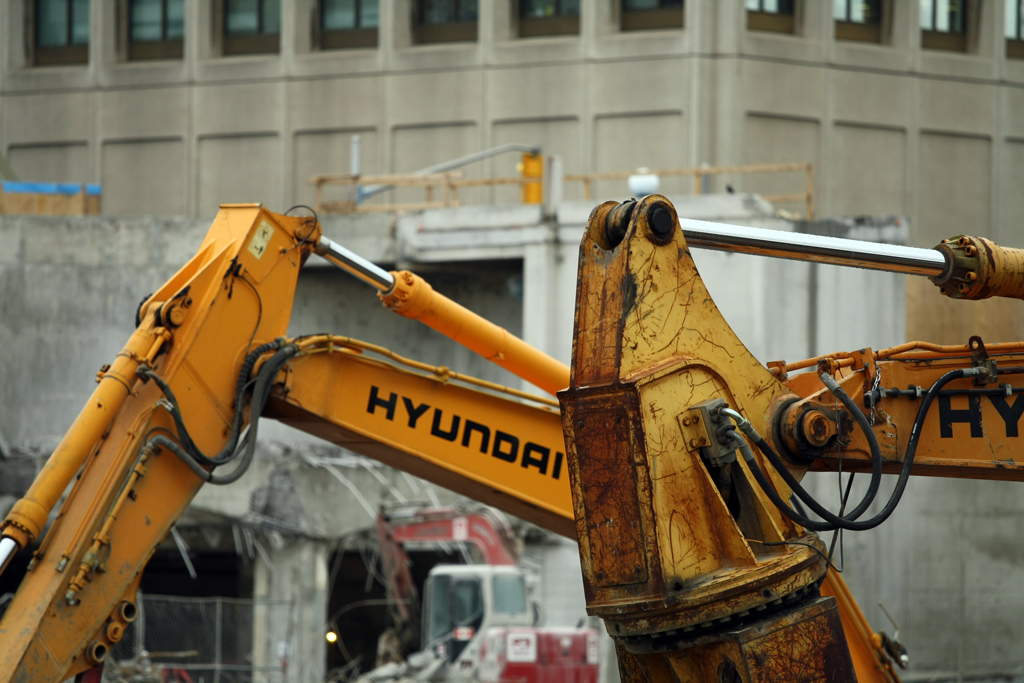
Two mechanical diggers

When dealing with climate change, politicians often talk about the need to ‘balance the economy and the environment.’ I think this is a misleading categorization for two reasons.

Firstly, the balance has always been tilted virtually 100% towards the economy, in Canada at least. When the government talks about the need to scale back climate mitigation programs for economic reasons, they are talking about scaling back a handful of ineffectual programs that are not proving effective at reducing greenhouse gas emissions. The ‘balance’ dial between environment and economy is already twisted sharply towards the latter.

Secondly, even if we completely ignore the natural environment, the need to mitigate emissions remains. The Canadian economy could not survive the consequences of unrestrained emissions and climate change, with a temperature increase of 5.5°C to 7.1°C by 2100. If we care at all about the state of the economy 20, 50, and 80 years out, we need to avoid catastrophic climate change.

The economic analyses of mitigation that have been undertaken in the UK, Australia, and elsewhere have painted the same broad picture: it is possible to reduce greenhouse gas emissions significantly at a modest cost, provided you start early. The costs associated with inaction are much higher than those associated with this mitigation programme. To succeed, the whole economy needs to be pushed in the direction of decarbonization – a fact that remains true regardless of what balance you care to strike between economic health across the long term and environmental protection.