Historical emissions and adaptation costs

Emily at a coffee shop in Kensington Market, Toronto

It is widely acknowledged that developing countries will suffer a great deal from climate change. They are vulnerable to effects like rising sea levels and increased frequency and severity of extreme weather. They also have more limited means available to respond, as well as other serious problems to deal with. Providing adaptation funding is therefore seen as an important means of getting them on-side for climate change mitigation. It could be offered as an incentive to cut emissions.

That being said, there is a strong case to be made that developing countries should not need to do anything in exchange for adaptation funding. Making them do so is essentially akin to injuring someone, then demanding something in return for the damages they win against you in court. The historical emissions of developed states have primarily induced the climate change problem; as such, developing states suffering from its effects have a right to demand compensation.

Very roughly, the developed world as a whole is responsible for about 70% of emissions to date. The United States has produced about 22% of the anthropogenic greenhouse gasses in the atmosphere; Western Europe is responsible for about 17%; Canada represents something like 2% of the total. It can be argued that – by rights – states like Bangladesh and Ghana should be dividing their total costs for adaptation and sending the bill to other states, on the basis of historical emissions.

That being said, it is only fair to say that developed states are only culpable for a portion of their total emissions, on account of how the science of climate change was not well understood until fairly recently. Exactly where to draw the line is unclear, but that doesn’t especially matter since developing states simply don’t have the power to demand adaptation transfers on the basis of past harms. States that developed through the extensive use of fossil fuels will continue to use the influence they acquired through that course of military and economic strengthening to make others bear most of the costs for their pollution.

New Canadian emission data

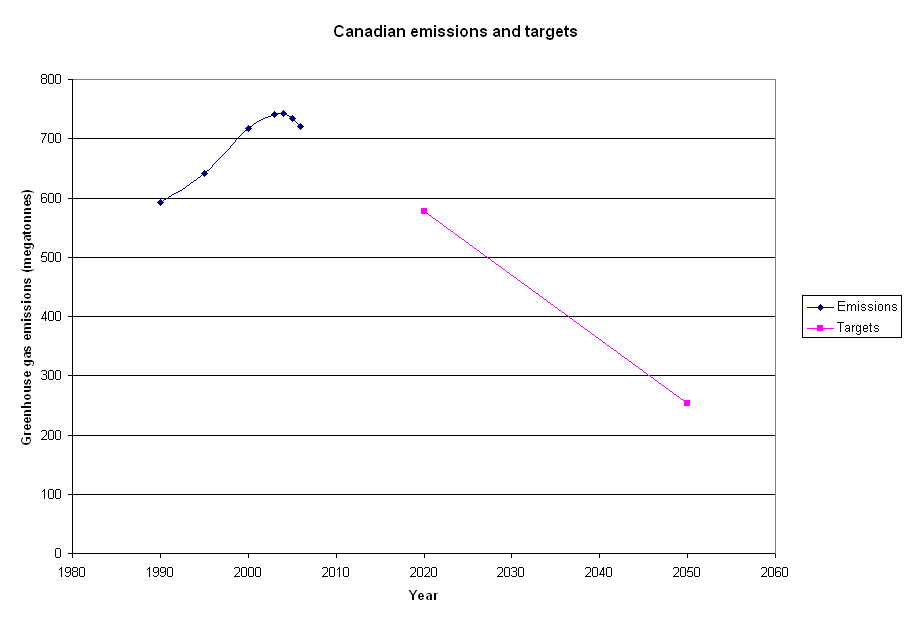
Canadian emissions 1990-2006

The Canadian government has published the official National Inventory Report: Greenhouse Gas Sources and Sinks in Canada for 1990 to 2006. Emissions in 1990 were 592 megatonnes (Mt). By 2000, they were 718 Mt. Here are the most recent figures:

  • 2003: 741 Mt
  • 2004: 743 Mt
  • 2005: 734 Mt
  • 2006: 721 Mt

Maintain and deepen that downward trend and we might just do our part in sorting out this unprecedented problem. Moving to a low-carbon global society would be quite a human achievement – even more so if we can also transition from fuels that are running out to those that never will.

The monarchy and Canada’s citizenship oath

Sign at a bookstore, Toronto

When my mother became a citizen of Canada, I remember noting the absurdity of the citizenship oath:

I swear (or affirm) that I will be faithful
and bear true allegiance to Her Majesty
Queen Elizabeth the Second, Queen of Canada,
Her Heirs and Successors, and that I will faithfully
observe the laws of Canada
and fulfil my duties as a Canadian citizen.

The monarchy is a sad reminder of Canada’s imperial past, not something that should be at the heart of becoming a Canadian citizen. It would be far better to have those who are becoming citizens assert their support for the Constitution, democracy, and the rule of law only, rather than giving such prominent treatment to an irrelevant legal hangover. To paraphrase Monty Python: supreme executive power derives from a mandate from the masses, not from some farcical tradition of bloodline descent.

It is certainly an excellent thing that the monarchy has been pushed to the symbolic edge of Canadian law and society, represented by mere remnants like a titular governor general, the queen on currency, and legal conventions like Regina v. Whoever for legal cases. That being said, it makes sense in this day and age to finally eliminate the trappings of family-line rule and become a proper republic. Of course, there are those who disagree.

Harper on gas prices and carbon taxes

One thing for which you need to give Stephen Harper some credit: unlike the American presidential candidates, he is willing to admit that the government cannot do much to reduce gasoline prices. Unfortunately, he is also using those high prices to oppose carbon taxes, probably the most economically efficient economy-wide mechanism for reducing greenhouse gas emissions.

Brief Smoky Lake recap

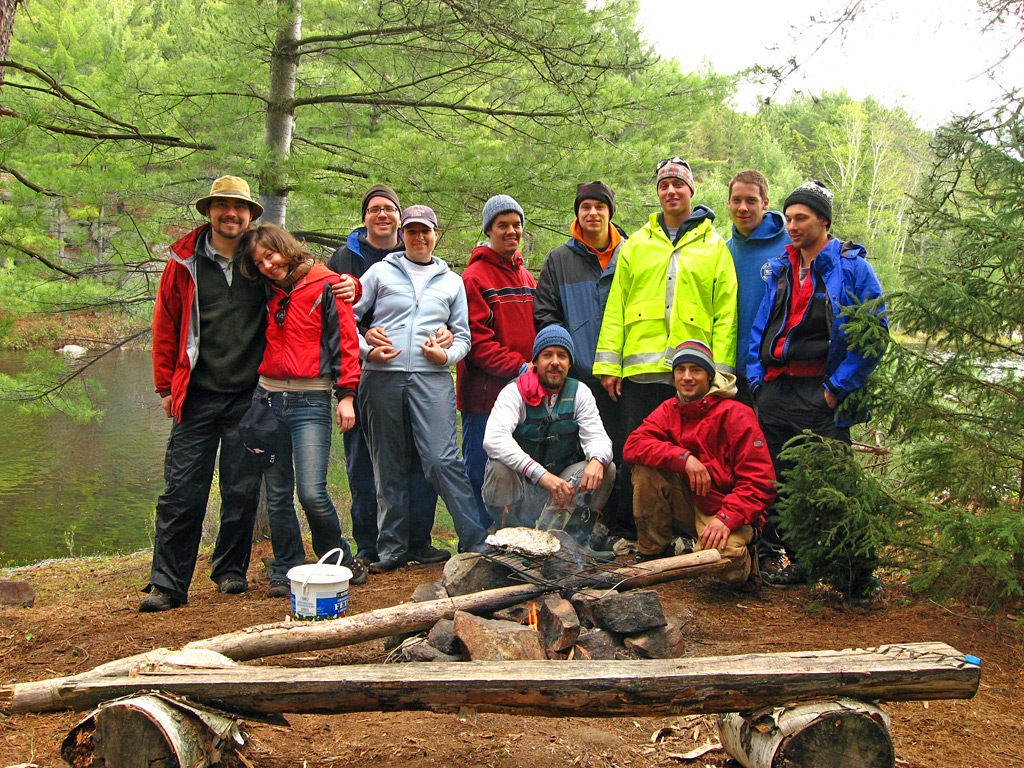
Smoky Lake canoe trip group shot

After four days in the Ontario wilderness, Emily and I are safely back in Ottawa. All told, the trip was successful and a lot of fun. We spent two days traveling and two hanging around our serene camping area, largely while others fished (more on that later). Wildlife sightings were fairly limited – though we did manage to inadvertently terrify a Canada goose and her greenish goslings – though it was nonetheless refreshing to be immersed in nature. While the weekend did include some serious rain, thankfully none of it fell during times when we had to decamp or travel. The smell of campfire smoke will doubtless linger on our clothes and selves for some time yet.

Getting out into the wilderness was certainly a most welcome break from city life. Similarly, the time spent in Toronto was a nice break from relatively parochial Ottawa.

For the visually inclined, some photos are on Facebook.

Gone paddling

This weekend, Emily and I will be canoeing on Kawigamog, Noganosh, and Lost Lakes – near Sudbury. It should be a good opportunity to explore the Ontario wilderness, in the general area of Algonquin Park.

This will be my first big canoe trip since the second Bowron Lakes expedition in August 2004. Canoe-camping is an especially enjoyable sort. You can bring lots of gear, which means more comfort and better food. You also cover quite a bit of ground, which allows for variety and real expeditions.

We should get back to Ottawa on Tuesday.

Electric vehicles in Canada

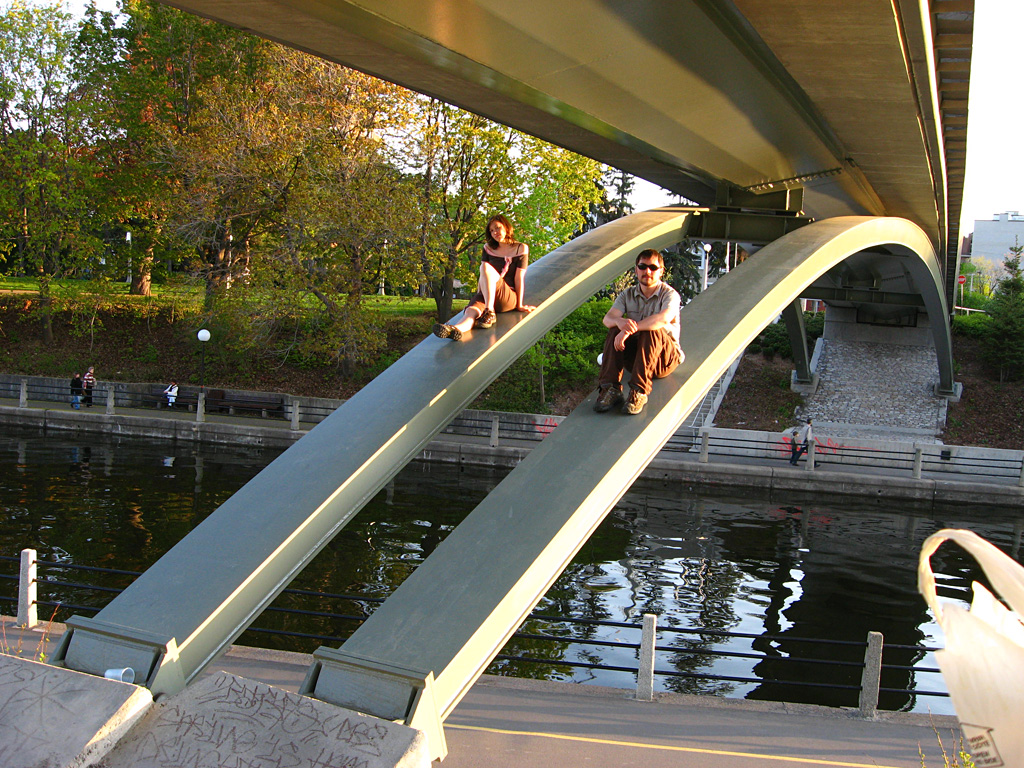
Milan Ilnyckyj and Emily Horn, sitting on bridge supports

Dynasty is a Canadian company that builds light, low speed, battery powered cars. Their Dynasty IT vehicle has a range of 50km and a top speed of 40 km/h. Because Transport Canada refused to follow the lead of 44 American states and authorize the vehicles for non-highway use on roads, the company has decided to relocate to Pakistan. There, they will manufacture cars for the American market. The ZENN is in a similar predicament.

There is a real trade-off between producing light vehicles and producing ones that do well in crash tests. That said, we do permit people to ride absurdly unsafe motorbikes – even on the highway. It is incoherent to ban one and permit the other.

Perhaps it would make sense to create a special legal category for small, light vehicles of limited range, intended primarily for urban use. By all means, those purchasing them should be informed that they will not fare as well in a crash with a huge truck as someone in a larger, steel-framed car. That said, the economic and environmental advantages may justify the risk in the eyes of many.

Ducks are distractions

The continuing furor over the 500 ducks that died in a toxic oil sands tailing pond seems like an excellent demonstration of the capacity of people to utterly miss the point. Oil sands extraction has converted a vaste swathe of boreal forest into toxic wasteland, speckled with tailings ponds up to 15 square kilometres. The Pembina Institute has asserted that: “Despite over 40 years of oil sands development, not a single hectare of land has been certified as reclaimed under Government of Alberta guidelines.” In addition to that, there is the water use and the greenhouse gas emissions.

To look at this and have your attention dominated by a few unlucky birds seems like the height of myopia.

Driving’s declining appeal

Spring leaves

While they are generally an urban and environmentally aware bunch, it still seems notable that most of my friends who grew up in cities never chose to get driving licenses. With the notable exception of friends who live in rural areas or distant suburbs, driving seems to have become something that relatively few people find worthwhile. An article from The New York Times suggests that they are less unusual than one might think:

In the last decade, the proportion of 16-year-olds nationwide who hold driver’s licenses has dropped from nearly half to less than one-third, according to statistics from the Federal Highway Administration.

While it would be better to have data extending up into people in their mid-20s, it does seem safe to guess that numbers there are also falling. I have personally never had a license that permitted me to drive a car alone. Even my learner’s license has been expired since December 2003.

There are a number of causes I would attribute to the trend, at least among those I know:

  1. Graduated licensing schemes make it more and more annoying to get a license. In British Columbia, it now takes more than a year before you can get a license that is useful for anything other than practicing with a fully-licensed adult driver.
  2. Partly due to longer licensing processes, a good number of people now head off to university before they can get through to a license they can use alone. By the time they are at school, they have more pressing uses for their time and reduced access to adults willing to serve as observers.
  3. Cars, gas, and insurance are expensive. Also, people are choosing to spend longer in school and spend more in total on tuition. Twenty or thirty years ago, a fair number of 25 year-olds had probably been on the job and debt free for a while. Among my friends, there is a good chance they will be in grad school and still collecting student debt.
  4. People are more mobile. They don’t stay in one place long enough for it to be worth getting a car or license.
  5. People are more environmentally aware. Whereas once cars were symbols of wealth and freedom, they are increasingly symbols of greed and an anti-social willingness to harm those around you.

What other reasons would people give for the trend away from driving? Personally, I think the trend is a positive one – comparable to the increasing rareness and social unacceptability of smoking.

Standardizing cell phone chargers

Backhoe

Forgetting my cell phone charger in Toronto has already resulted in a week of weak connectivity. It need not be so. While it must be a gold mine for cell phone shops and manufacturers, the absurd proliferation of charger types is clearly an anti-competitive practice.

A government keen to protect consumers and boost overall economic efficiency would do the following:

  1. Require that all cellular phones be rechargeable using a standard connector.
  2. Ideally, that connector should be mini-USB (second from the left), capable of transferring both power and data.
  3. Require that adapters be sold for all phones made in the past five years, and that the cost of the adapters equal just the cost of shipping and manufacture.

As long as any charger could be plugged into any phone and provide power, firms would be free to compete in designing and building chargers that connect to electrical outlets, car cigarette lighters, or whatever other source of power seems fitting.

The intervention in the market is justified for the same reason as with all standards: it produces societal welfare without adverse effects. It replaces self-serving confusion generated by private firms with an ordered approach that makes sense for everyone. It is not as though there is any major innovation which can occur with cell phone chargers. At root, they are just plastic-wrapped wires that run from a socket to a circuit board. Having fewer types – and making them go obsolete less frequently – would also reduce the usage of energy and materials in manufacturing, as well as the number of (potentially toxic) plastic trinkets populating landfills worldwide. A standard would allow people to share chargers, as well as permit buses and trains to have universal charging stations available.

Something similar could be done for laptop computers. Cell phones and laptops are both ubiquitous elements of modern life and commerce. Just think how many productive hours are needlessly lost because each manufacturer wants to ensure that last year’s charger cannot be sold to someone buying this year’s phone.