Car standards in China and North America

The Toronto Star has reported that: “No gasoline-powered car assembled in North America would meet China’s current fuel-efficiency standard.” Even the proposed tougher Californian standards – the ones about which there is a big fight with the Environmental Protection Agency – will not do so. In the United States, there is a proposal to require 35 mile per gallon (14.9 km/L) performance by 2020. Today, all Chinese cars are 36 mpg (15.3 km/L) or better. Canadian cars average 27 mpg (11.5 km/L), and don’t have to meet any minimum standard of that type.

That’s certainly something to consider the next time you hear that tougher standards will maul the auto industry. Judging by the relative performance of Japanese and American car companies, it might be fairer to say that continuing to pump out dinosaur vehicles is more likely to leads to its demise on this continent.

Young ice

This image from NASA is very compelling. It contrasts the average makeup of the Arctic icesheet between 1985 and 2000 with the situation this year, in terms of how old each section of ice is. Whereas the 1985 to 2000 average included a large are of ice six years or older, the entire region of multi-year ice (two years or older) is about the same size today. Between 1985 and 2000, most of the ice area was more than two years old. Now, most of it has only frozen since this past summer.

Given how cold this winter was – largely due to La Nina – this summer may be especially instructive. If we see an ice minimum similar to last year’s aberrant plummet, we will need to start worrying a great deal about the short-term viability of the icecap.

Tomorrow Today report

A group of Canadian environmental NGOs has put out a 28 page list of suggested areas of action and recommendations for Canadian policy. Tomorrow Today (PDF) is divided into sections on energy, wild species and places, oceans, water, food and agriculture, human health, and economic signals. The report reflects the work and positions of the Canadian Parks and Wilderness Society, David Suzuki Foundation, Ecojustice, Environmental Defence, Equiterre, Greenpeace Canada, Nature Canada, the Pembina Institute, Pollution Probe, Sierra Club Canada, and WWF Canada.

Some of the more interesting recommendations include:

  1. Carbon prices of “$30/tonne CO2e in 2009 and increasing to $50/tonne by 2015, and to $75 a tonne by 2020,” with revenus from taxes or auctions to be “directed mainly towards investments in further actions to reduce GHG emissions.” (i.e. not revenue neutral like the new B.C. carbon tax)
  2. Reduce total GHG emissions to 25% below 1990 levels by 2020, and 80% below by 2050.
  3. “A Nuclear Accountability Plan that includes legislation requiring full-cost accounting of nuclear energy; fully shifts the liability and cost of insurance for nuclear power and long-term waste disposal facilities onto electricity rates; moves oversight of the Canadian Nuclear Safety Commission from Natural Resources Canada (where the department is in a conflict of interest overseeing sales and safety of reactors) to Environment Canada; and eliminates all direct and indirect taxpayer subsidies to nuclear energy.”
  4. “In 2008, announce a federal initiative to reconnect children with nature by providing outdoor natural experiences for all children in grades 4 to 6.”
  5. “Immediately prohibit bottom trawling and other harmful forms of fishing in sensitive areas, prohibit expansion of bottom trawling into previously untrawled areas, and restrict its use to areas that have already been heavily fished for decades.”
  6. “By 2010, implement mandatory labelling policies that include comprehensive nutritional information, country of origin, fair-trade, organic standards and genetic modification content. And amend Canada’s Food Guide to provide information about the climate impacts of food choices.”
  7. “By 2012, implement a comprehensive program to encourage organic agriculture, the production and consumption of locally produced foods, and to educate Canadians on the health advantages of low-meat diets.”
  8. “Immediately implement the precautionary principle by regulating toxic chemicals in the federal Chemicals Management Plan. In particular, implement bans or phaseouts for all non-essential uses of substances known to be harmful where safe alternatives exist and maintain such restrictions until credible evidence is presented that the chemical can be safely used or released.”
  9. Reducing existing subsidies for the mining and oil-and-gas industries and committing to a ban on any new subsidies or financial incentives for mining or oil-and-gas projects, such as for the Mackenzie Gas Project.

Clearly, some of the suggestions are more feasible and realistic than others. It is interesting to see what priorities and approaches NGOs agree on when they collaborate.

Given how slick the report overall is, the PDF is of rather poor quality. It has a bunch of layout calibration marks all over it, and selecting text doesn’t work properly because of large, irregularly shaped invisible elements.


Sectoral solutions

Beau’s beer, illuminated from behind

Yes! Magazine has an interesting series of short articles describing climate change efforts that can be undertaken in four major areas:

  1. Buildings
  2. Electricity
  3. Transportation
  4. Food and Forests

Breaking down the problem by sector is a useful way of assessing the most important areas for action, as well as those where the most improvement can be made for the least expenditure of resources. In an ideal world, simply internalizing the externalities associated with climate change would create the proper incentives for the market to sort out the problem. In practice, law-making is too slow, inconsistent, and unconcerned with future generations for that approach to work alone.

NRCan adaptation report

Natural Resources Canada has released a new report on the probable impacts of climate change in Canada. Sorted regionally, the report also includes a chapter on Canada’s position in an international context. Overall, the report is pretty comprehensive: covering everything from probable flow changes in Canadian rivers to the possibility that climate change will fuel international armed conflicts.

While the report covers a lot of bases, the final conclusions about what ought to be done seem somewhat vague. Perhaps that is reflective of the degree to which adaptation efforts need to be tuned locally and cannot easily be effectively developed at a national level.

Kosovo and Quebec

Andrea Simms-Karp at the Elmdale Tavern

A recent (and very unscientific) poll in The Globe and Mail suggests that many Canadians see the Kosovar declaration of independence as a “precedent that could be used in Quebec.” Personally, I found the question ambiguous. If anything, the situation in Kosovo is a demonstration of why Quebecois succession is a poor option.

Since at least the end of the first world war, there has been a profound tension between civic and ethnic nationalism. At best, ethnically defined nationalism has been a means of peacefully dividing empires into groups of states that get along decently; at worst, it has been a significant cause of genocide and ethnic cleansing. Virtually all states have minorities. Many have minorities in border regions, alongside states where those people have a majority. Given the difficulty and bloodiness of adjusting national borders, it is generally preferable to maintain states capable of accommodating members of ethnic minorities as full and equal members of the society – a possibility only likely to be manifest when the society has some philosophical basis other than ethnicity.

Normally, then, we should hope for pluralistic states that base their legitimacy around popular consent. What Kosovo exemplifies is a case where this has not occurred: where a central government has undermined its legitimacy in an entire region (as Russia has done in Chechnya) and has thus made it impossible for that area to be a legitimate portion of the state. The Kosovar case shows just how far such abuse must generally go before it constitutes good cause to break up a civil federation. Quebecois grievances are not on the same level, and thus do not constitute a license for succession.

You are very safe

Glancing through news stands and television reports, a person is likely to see all manner of terrible hazards highlighted: from kidnapping to toxic chemicals leached from Nalgene bottles. It is worth remembering – in the face of this onslaught – that we are about the safest people who have ever lived. Hunger and infectious disease kill hardly any Canadians. Violence kills some, but fewer than in just about any society ever. And yet, too many people live in fear.

Maintaining perspective is vital. Let your children play in the park, even though one or two children in the whole country get kidnapped from there annually. Let them build treehouses, even though some tiny subset of Canada’s population contracts tetanus.

Refusing strengthens the significant possibility that they will live sedate and uninteresting lives.

Nuclear slow to come online

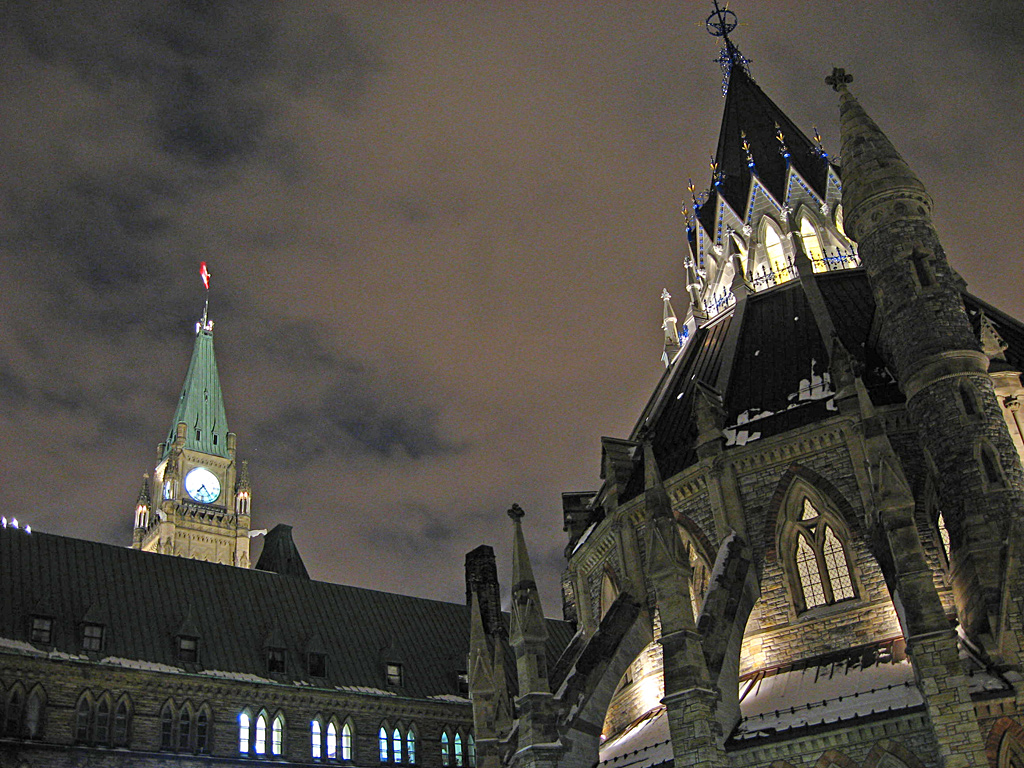
Peace Tower and Parliamentary Library

A number of news sources are reporting that Ontario is starting a competitive bidding process for a new nuclear reactor. The seriousness of climate change does compel us to at least consider nuclear as an option, though it is entirely possible that the non-climatic risks involved may rule it out as a good idea.

In any case, one line in one article jumped out at me:

Construction would begin within the next decade.

Recently constructed nuclear plants have tended to face significant delays before and during construction, on account of both construction problems and legal challenges. The overall timeline shows just how challenging it will be to achieve significant emission cuts before 2020 by rejigging large emitters. Hitting 2020 levels of 25-40% below 1990 levels is vital if developed states are to get on the path to deep cuts by 2050 and stabilization in the 450 to 550 ppm range.

Manitoba hog farm ban

In recognition of how environmentally destructive industrial hog farming is, Manitoba has banned the establishment of new farms or the expansion of old ones in the Interlake, Winnipeg, and Red River regions. Operations in other parts of the province will be subject to new rules. The changes were made after a report on the sustainability of the industry was released. Unsurprisingly, industry officials have been condemning the decision.

It is a sad reflection of the state of modern farming that concentrated animal feeding lots produce enough toxic waste to justify such measures.

Post-2012 climate conference

The International Institute for Sustainable Development is running a two-day conference in Ottawa about post-2012 climate change policy. 2012 is the end of the first compliance period for the Kyoto Protocol, so ‘post-2012’ is shorthand for whatever international climate regime is to be the successor to Kyoto. Notes will be published on the wiki as they become available.

Notes from previous conferences are also available: