and in the darkness bind them

My printing graph clearly applies to a great many circumstances. Having finished my thesis last night, I could not print it in Wadham because their printer was broken. I couldn’t print it in St. Antony’s because every scrap of paper had been used by other people scrambling to finish their own theses.

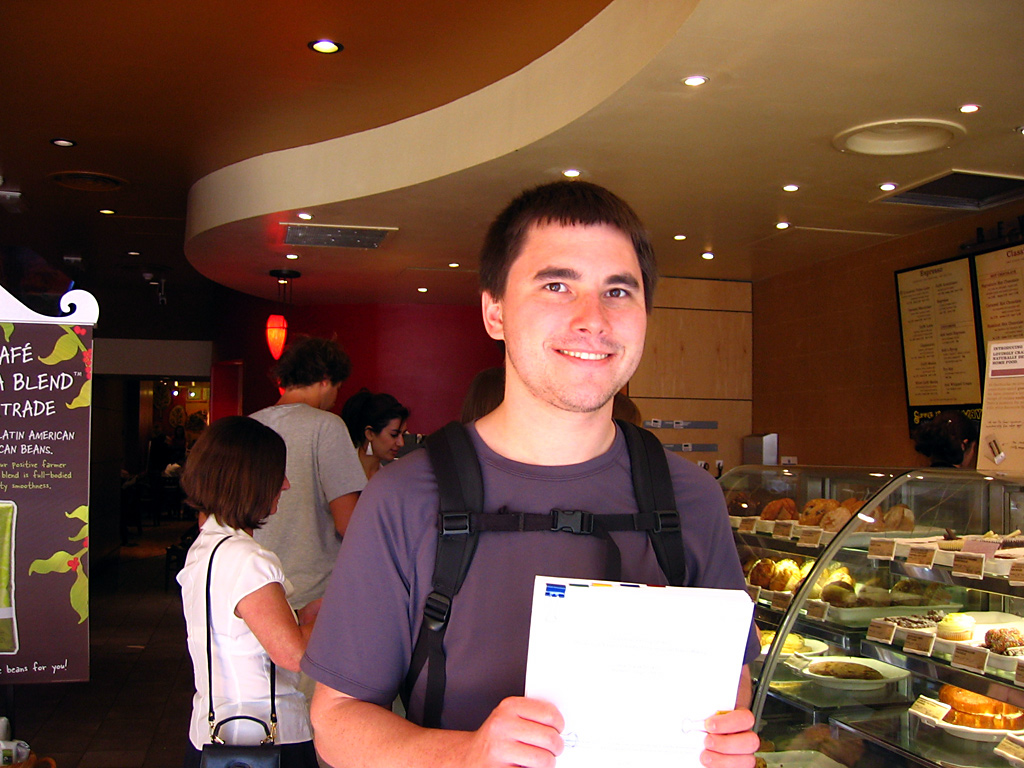
No problem, I thought, Temple Bookbinders says on their website that “photocopying service from disk or proof is also available.” As it turns out, the website is inaccurate in this regard. The nearest place that could print it was “around the corner,” by about a mile and a half. There, my thesis was printed at the rate of one page every 23 seconds (I timed it). For the 222 pages of black and white printing, they charged me £16 ($36 Canadian). The thesis will be bound and ready to be picked up at 11:00am tomorrow.

On the plus side, I did manage to see the Headington shark house.

[Update: 5:00pm] I have returned my thesis books to their various libraries of origin, re-filed the books I own into my normal non-fiction classification system, and put my box of thesis related articles out of sight.
Ironing out final wrinkles

The thesis is made of coffee

Turns out it’s a good thing I printed off a draft thesis to scrutinize: a significant number of little typographical and grammatical errors were there to be found. Many of them, it seems, were actually introduced during the previous round of revision, especially in places where I was converting passive sentences into active ones. Somehow, I seem to have lost dozens of connector words like ‘the’ and ‘for.’ They are being systematically re-introduced.

Tomorrow morning, I am joining a convoy of fellow M.Phil in IR students cycling to Headington where – it is promised – there is a printer who can produce hardbound copies of our theses for less than £30 a copy, ready in time to be submitted on Monday. I wanted to have it done for tomorrow, but I found out today that having a copy prepared for tomorrow would be absurdly expensive: more than £50 a copy. Even £30 seems pretty steep. After all, we are talking about two pieces of cardboard, some plastic, and a few minutes of labour. I suppose the print shops here have a captive audience to exploit.

[Update: 1:00am] The thing is now in its final digital format. In eight hours, I am cycling over to Headington to have it printed and bound. I would print it myself, but I have no access to a printer that is (a) not broken and (b) stocked with paper.

presque à la fin

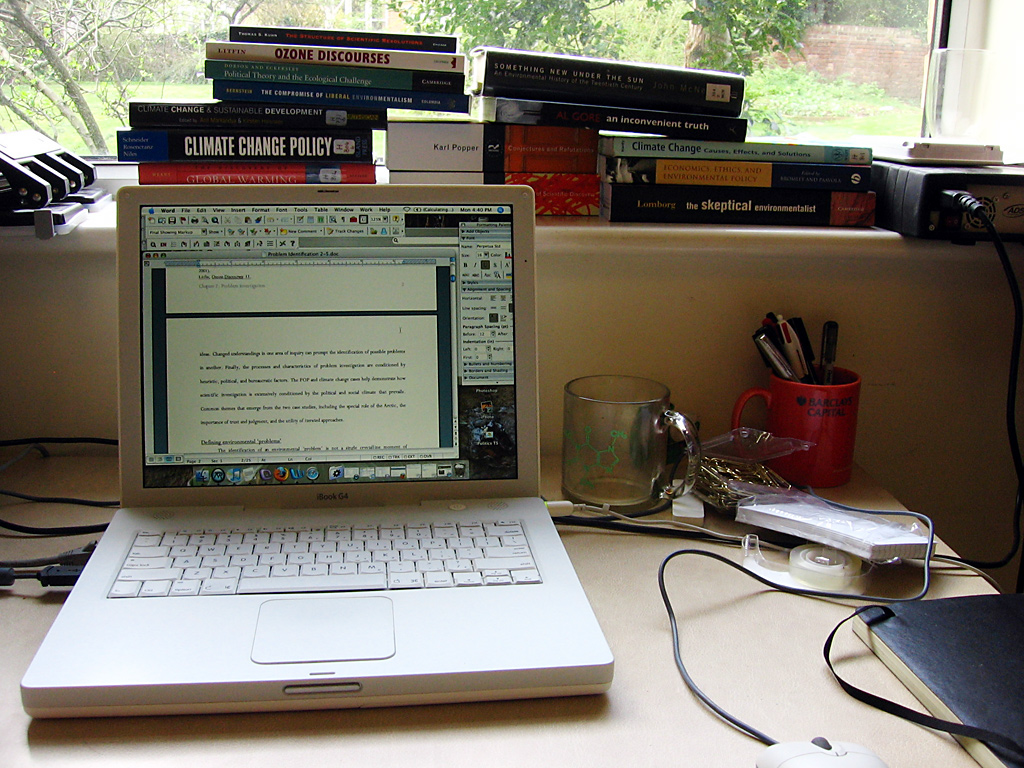
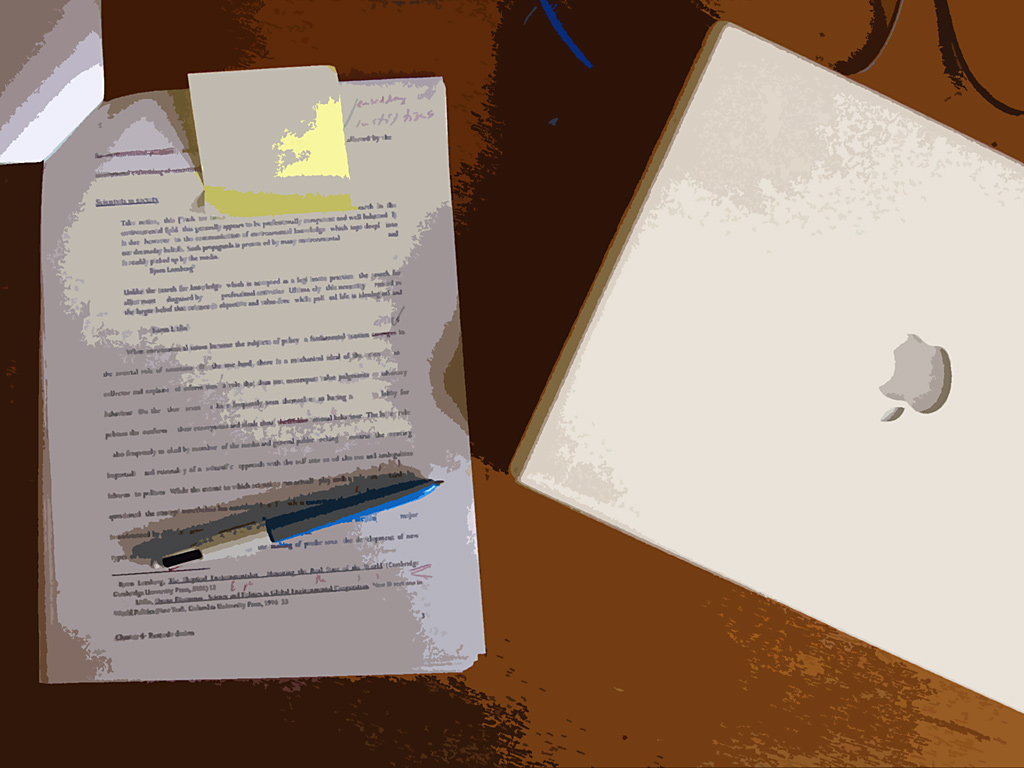
iBook and thesis draft

In a minute, I am heading to Wadham to print of a 110+ page draft version of my entire thesis: from title page to Appendix I (chemicals regulated in the Stockholm Convention). The major purpose of this is to identify any bits that are confusingly worded, incorrectly cited, badly formatted, etc. I am also trying to catch any notes to myself still embedded in the text. It would be embarrassing to discover something like “[EXPLAIN THIS BETTER!]” stuck in the middle of the copy filed for eternity in the Bodleian. This review should ensure that the version printed and bound tomorrow suffers only from any faults in my research and argumentation, not from minor annoyances that may annoy the assessors.

One thing I have discovered recently is that there is a better mechanism for dealing with those times when your brain feels like it has a sea urchin inside, or you are otherwise unable to write. Better than napping or brewing another pot of coffee is cycling ten miles or so: out to Yarnton to the north or through Marston to the east. This is something to bear in mind for when exams draw near.

[Update: 11:00pm] Only Murphy’s Law can explain it: I cycle over to Wadham to print off my draft thesis. It gets to page 56 and the only printer available for student use (HP Laserjet 4200n) suffers some kind of massive failure. All it shows on the screen is a double line of asterixes. The paper tray is somehow physically jammed so that it can only be pulled out about an inch before it encounters an unmovable blockage. Of course, there are no IT people around at this time of night and I don’t want to risk damaging such an expensive piece of equipment. Naturally, it charged me for printing the full 109 pages…

Reading material

Those who feel that they haven’t been getting their fix of geeky news from this blog recently (I have been too busy to investigate things unrelated to my official studies) may want to have a look at Cocktail Party Physics. Written by Jennifer Ouellette, it seems to include a pleasantly esoteric collection of disciplines and scientific discussions. Recent entries discuss satellites testing General Relativity, computing with bubbles, and the chemical properties of gemstones. The posts I have glanced at are well written, and have a nice personal touch to them.

I will be done the thesis, and back to my old self, by tomorrow night.

Magisterarbeitskampf

Thesis books

Somehow, no language can express the concept of ‘thesis struggle’ quite so well as German can: a fact that is evident even to those who don’t speak a word of it. If I could use twenty character compound words at will, the word limit would be less of a concern. As it stands, I am trying to figure out ways to reduce the number of words used up in footnotes. The incentives created by including them in the count are quite perverse: I am removing useful little bits of additional information, as well as reformatting citations into forms that will be more difficult for the examiners to deal with.

I look forward to being interesting again. That is to say, having the time and brainpower to write about anything other than the thesis.

PS. Looking for something new to read about? Try the island of Gukanjima, near Japan. Once a coal mining centre and the most densely populated urban space on earth in 1959, it is now totally abandoned. Have a look at this short documentary or this history, more detailed than the one in the Wikipedia entry.

Nearly at the end of the line

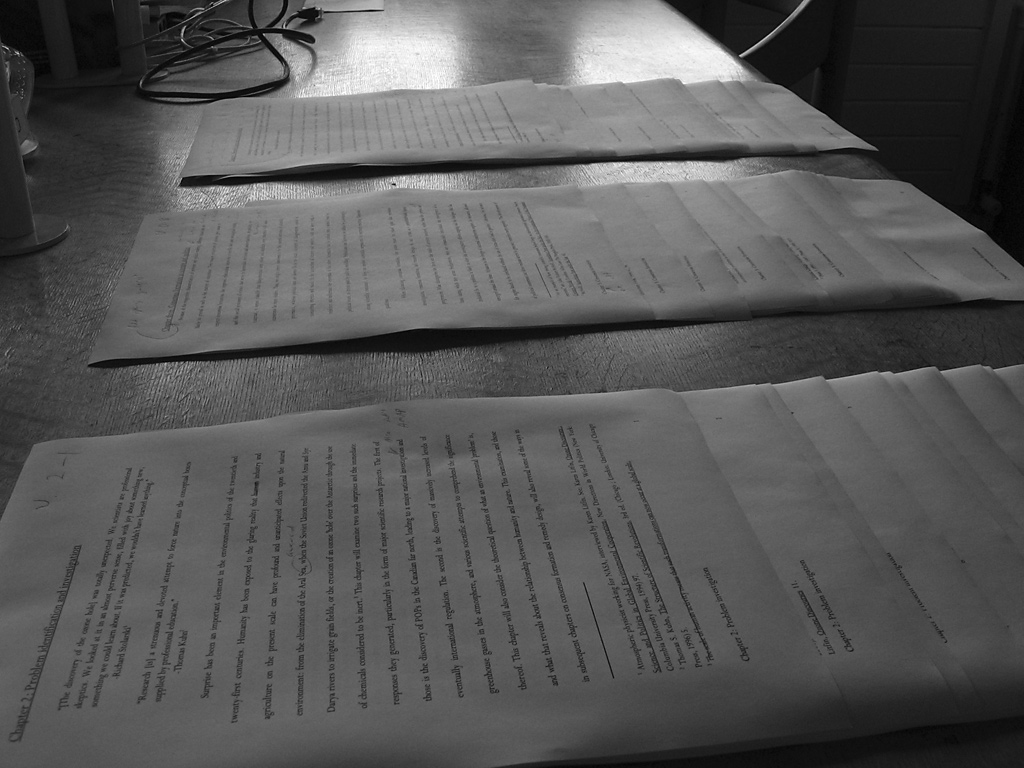
Thesis draft

While distant forests shrieked at me from afar this afternoon, I printed off a copy of the most recent versions of my three substantive chapters and reviewed them in the Wadham Library. As much as I am used to spending ten hours of more watching words glow on an LCD display, editing only seems to reach its full potential when there are things to be crossed out, big arrows to be drawn, and incisive notes to be written with the margins.

Generally, I am quite happy with what is written. Things are not arranged or argued in quite the waythey would be if I started over now, but the major themes that arose from my research are reasonably well articulated. As has been the case for the past week, the biggest task remaining is the relocation of some bits of what has already been written and the filling in of some gaps.

I may even be able to attend the thesis-completion barbecue that some members of my program are holding on Friday evening.

Printing in 4-6 days

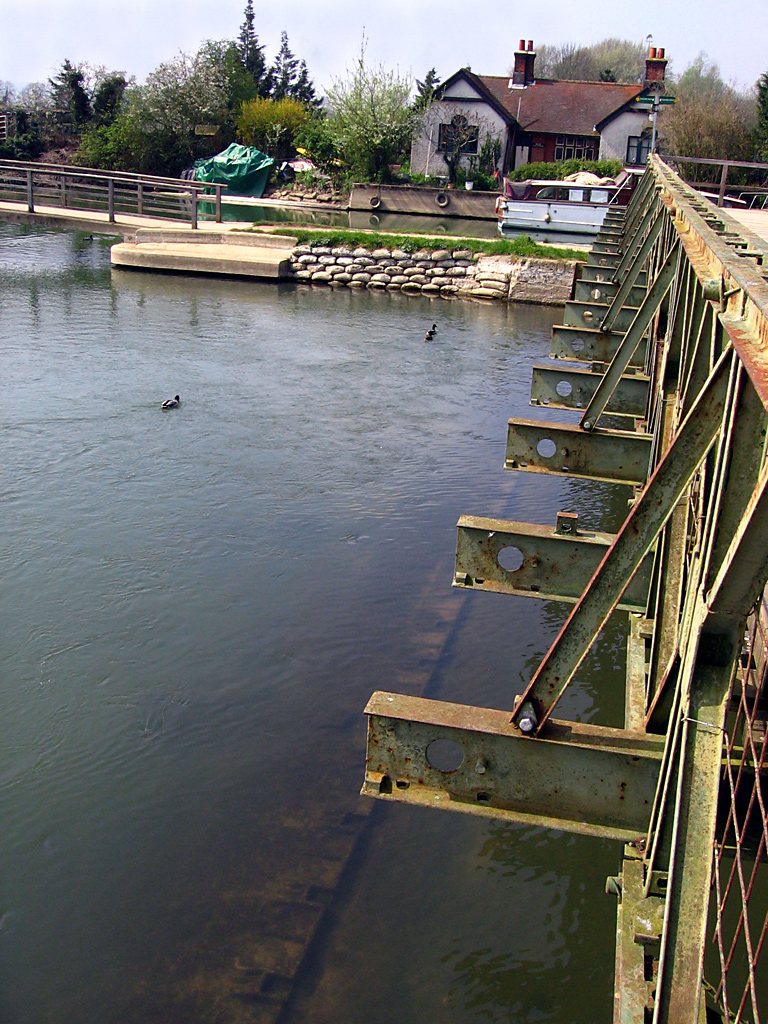
Bridge beside the Port Meadow, Oxford

On Friday the 20th, I may head into London to get my thesis bound. The print shops there seem to be significantly faster and cheaper than those in Oxford. They are also likely to be somewhat less busy, given how significant a share of the Oxford graduate population seems to have materials to submit by noon on the 23rd. Whereas the print shop next to Wadham College needs two days and wants to charge almost £90 for two hard-bound copies, I have found a shop in London that will do so for £44 in two days, £64 in one day, and £84 in just five hours.

I am also not sure whether I should print the thesis myself or have the shop do it. Wadham charges 5p a page for printing. The print quality is pretty good, though the paper they provide is quite yellow and of poor quality. I could bring my own, but that would probably make the cost comparable to just having the print centre do it. One advantage of doing it myself would be the ability to better ensure that everything was printed properly and in the correct order.

In any case, by Thursday I should be completing my final tasks: getting the page numbers of each chapter to start at the right position, compiling the aggregated bibliography, filling in page numbers in the table of contents, and making sure all the citations are in place. I will probably print each chapter to PDF using Mac OS (thus embedding my chosen font) and then find a full copy of Acrobat somewhere, for use in stitching them together into one file. By tonight, I will be happy if I have filled in the gaps that remain in chapters three and four.

Trinity in two days

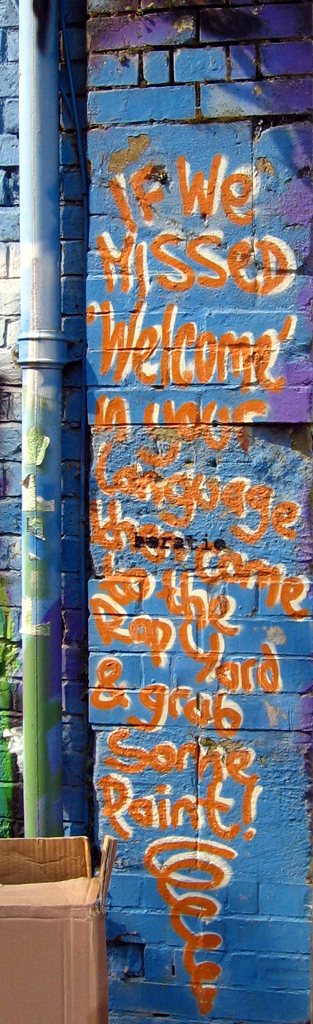
Welcome graffiti

Being able to cycle around Oxford without a jacket is most enjoyable. With the thesis submitted and nothing to worry about other than a couple of essays and exams, Trinity term should be a warm and relatively relaxing end to the Oxford experience.

Of course, the four three-hour exams in the middle of June will keep it from being too relaxing. Likewise, the two research papers on international law and the need to complete whatever ‘core’ reading hasn’t been completed over the last two years. Going all the way back to notes from September 2005 on the causes of WWI, then all the way through IR theory, twentieth century history, the developing world, and international law will be a good bit of work. That said, it will also be our first opportunity to see the M.Phil program as an integrated whole, even if we are expressly forbidden from repeating material from the core seminars in the exams for the optional papers, and vice versa.

I am sure everyone is looking forward to the period between June 16th and 29th. Our exams will be done, but we are all required to stay in Oxford in case the examiners decide to give us an oral examination on the 29th. I will be able to get the last college for my photo collection, as well as finally try the whole punting/croquet/Pimms afternoon that is the stereotypical Oxford summer activity.

Dramatic pause

Angel, Little Clarendon Street, Oxford

This morning was your standard session of attempting thesis writing. This afternoon has been markedly more unusual: punctuated with unexpected encounters. Such novelty and dynamism is a demonstration of why Oxford is a valuable place to spend time.

Tomorrow morning, it is back to the rushed and imminent portion of the slog.

Connections

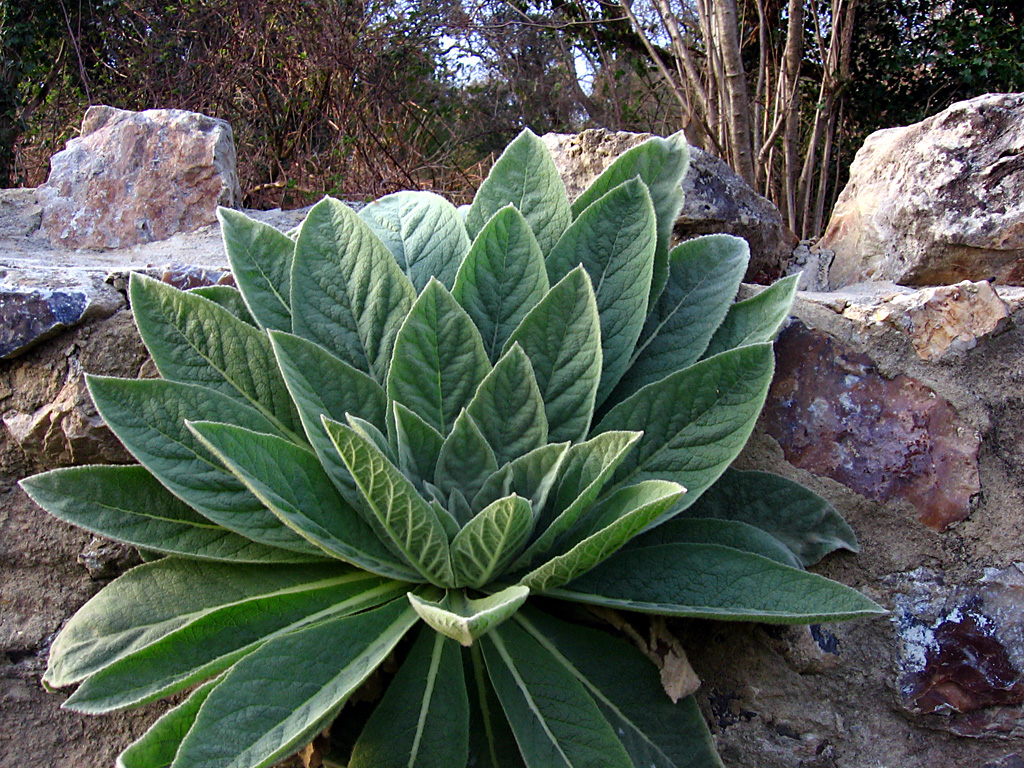
Plant in wall

One thing about studying climate change is that you never know where you will find new information. Have a look at this segment from James Burke’s Connections. He is talking about the Little Ice Age, which began in the 16th century. Much of what he says about adaptation is relevant, in an indirect way, to the kind of climate change being experienced now. I remember being terribly disappointed when his column vanished from the back of Scientific American – my staple reading before shifting to The Economist. Here is another short clip from Burke, also relevant to my thesis project. Here is yet another.

Note that Wikipedia has an entry on the Little Ice Age, the Medieval Warm Period, and the IPCC. It is badly in need of being improved.