Anfal charges dropped for Saddam Hussein

Compounding the error of hanging him, the Iraqi High Tribunal has chosen to drop all charges against Saddam Hussein in the ongoing trial about the Anfal campaign. He was convicted earlier for the killing of 148 civilians in Dujail, but the campaign against the Kurds in Anfal between 1986 and 1989 killed more than 100,000 people and involved the use of chemical weapons including Sarin.

The brutality and illegality of this campaign has been used by many to bolster the assertion that Saddam Hussein was a tyrant and a criminal, and that the American-led invasion and occupation have been justified. It has also been used by those critical of the United States, particularly because some of the weapons used were almost certainly provided to Iraq by the United States and other western or NATO powers, either during or before the Iran-Iraq War (1980-88). In March of 1986, the President of the United Nations Security Council issued the following statement:

[P]rofoundly concerned by the unanimous conclusion of the specialists that chemical weapons on many occasions have been used by Iraqi forces against Iranian troops… the members of the Council strongly condemn this continued use of chemical weapons in clear violation of the Geneva Protocol of 1925 which prohibits the use in war of chemical weapons.

(S/17911 and Add. 1, 21 March 1986)

The United States voted against the issuance of the statements, while the UK, Australia, France and Denmark abstained.

Those who hoped that there would at least be a proper investigation and documentation of the crimes committed under his regime will be disappointed. Likewise, those who hoped that further precedents about the use of chemical weapons by heads of state might be established in international law. The progression in Iraq seems less and less like one towards a democratic state governed by the rule of law.

Thesis literature review

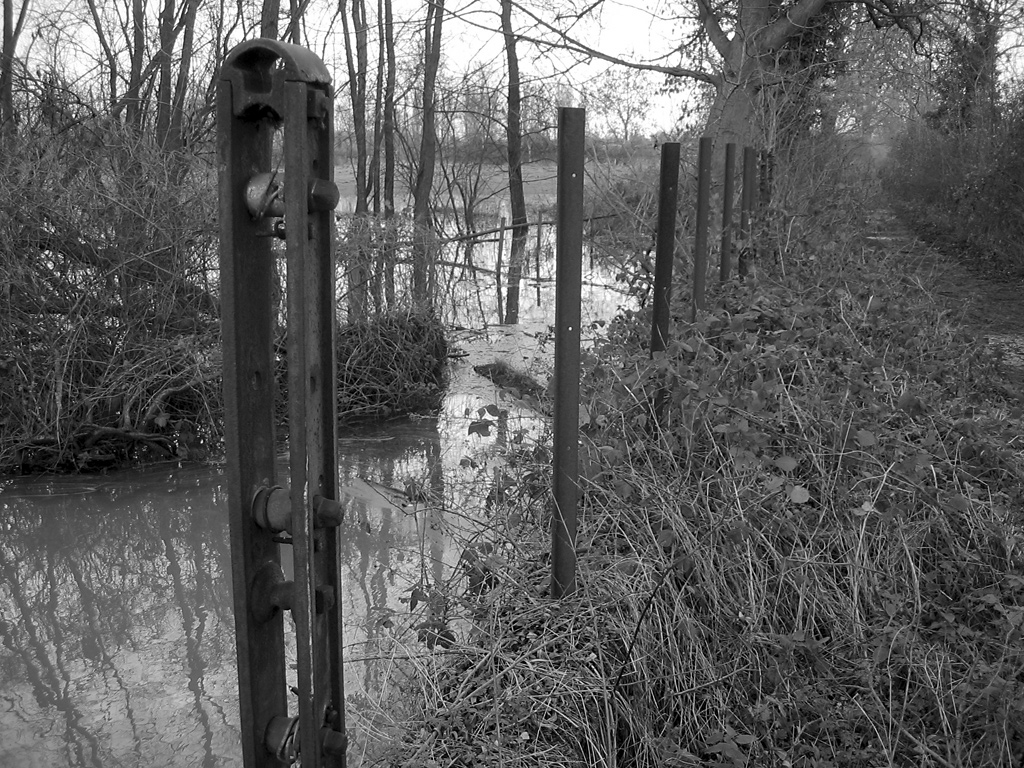
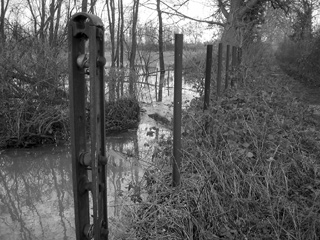
Fallen tree in flooded Port Meadow

The first substantive chapter of my thesis is meant to be a review of the relevant literature. Actually, it would be more correct to say ‘relevant literatures’ since so many different ones touch upon the subject matter. While climate science, ecology, and biochemistry are all relevant to Kyoto and Stockholm, they are not directly relevant to the thesis. The point is to examine the roles played by expertise in policy formulation, not engage directly with the scientific issues at hand. As such, the primary sources of interest are not studies of global warming of POPs, in their own right, but the discussions that took place within the scientific and policy community about what is going on (to be analyzed in Chapter 3: Information and consensus issues) and then about what should be done about it ( Chapter 4: Normative and distributional issues).

Having a look at the conversations that took place within the scientific community about taking a political stake against nuclear testing might be one way of gaining insight into how scientists deliberate about political matters, and how the legitimate role of scientists and the scientific community is seen. Likewise, the whole debate that arose about Bjorn Lomborg’s controversial book. While the public perspective on these debates is largely outside the scope of the thesis, it might be worth touching upon the relationships between public, expert, and political opinion in the chapter on consensus and information issues.

The relevant secondary literatures are various. They obviously include political and international relations theory, especially as they concern questions about prudent decisionmaking, the welfare of future generations, and other normative concerns. (On the normative side, Henry Shue’s work is both highly topical and likely to be considered essential reading by his colleagues here). In general, I am a lot more interested in the core issues of political theory (legitimacy, justice, etc) than in those of international relations theory, though some discussion of the nature of cooperation between states and the formation of international regimes is required. To some extent, international law is relevant, insofar as it helps to define how science relates to the policy process and the practice of states. Elizabeth Fisher’s work on public administration has made me think that the Rationalist-Interventionist and Deliberative-Constitutive frameworks she describes can be applied to international environmental negotiations. It is also fairly clear that some understanding and discussion of the philosophy of science is necessary to prevent the thesis from being overly naive in that regard.

Histories and analyses of the meetings and agreements leading up to the Stockholm Convention and Kyoto Protocol are likewise important secondary sources. Rather than repeat lengthy summaries of what happened in the limited space that I have, I can further summarize it and refer the interested back to more comprehensive accounts. Similarly, other secondary discussions about the nature, causes, and implications of the two agreements should be mentioned.

The last section I mean to include in the literature review is a listing of recent theses, primarily at Oxford, that have addressed similar issues. While it is probably better to engage with more widely known scholars than debate the arguments of these theses directly, there will probably be a bit of the latter in the final version as well. In particular, it might be a good way of making reference to other potentially relevant case studies. Also, since these works have often led me to useful sources, it seems only courteous to give a nod to their authors. Also, they may appreciate knowing that at least one person has dug up the document they spent so much time and energy completing.

If people can think of any other literatures I need to address – or can think of any really stellar sources within the disciplines enumerated above – please leave a comment.

Dislocated dining

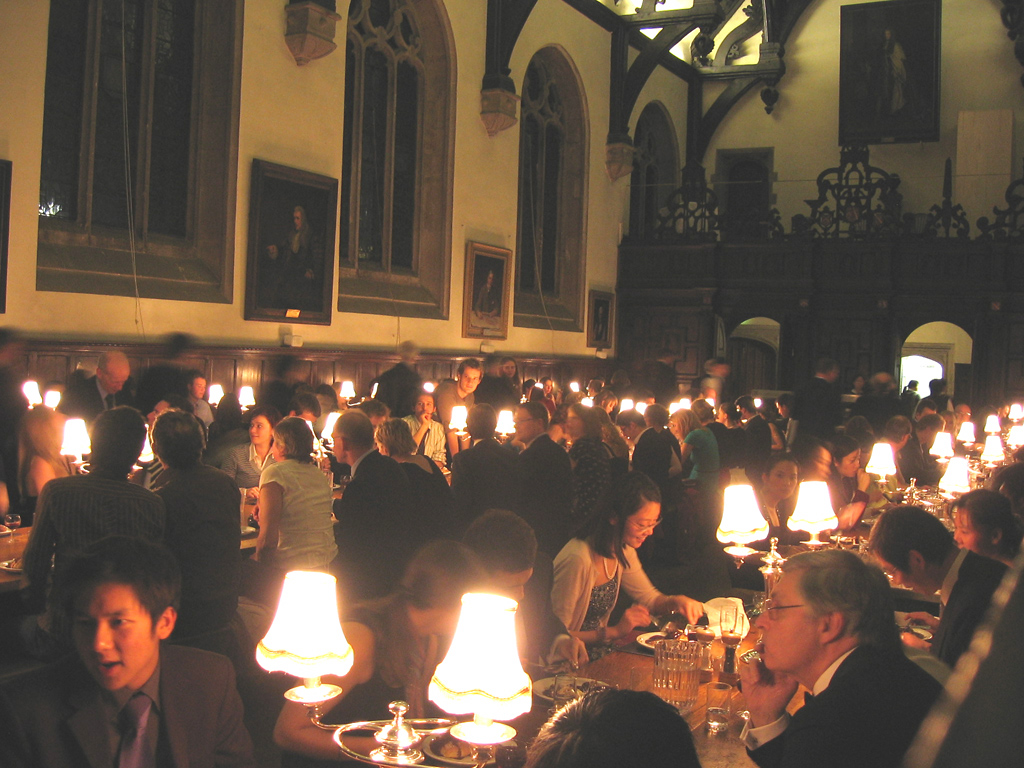
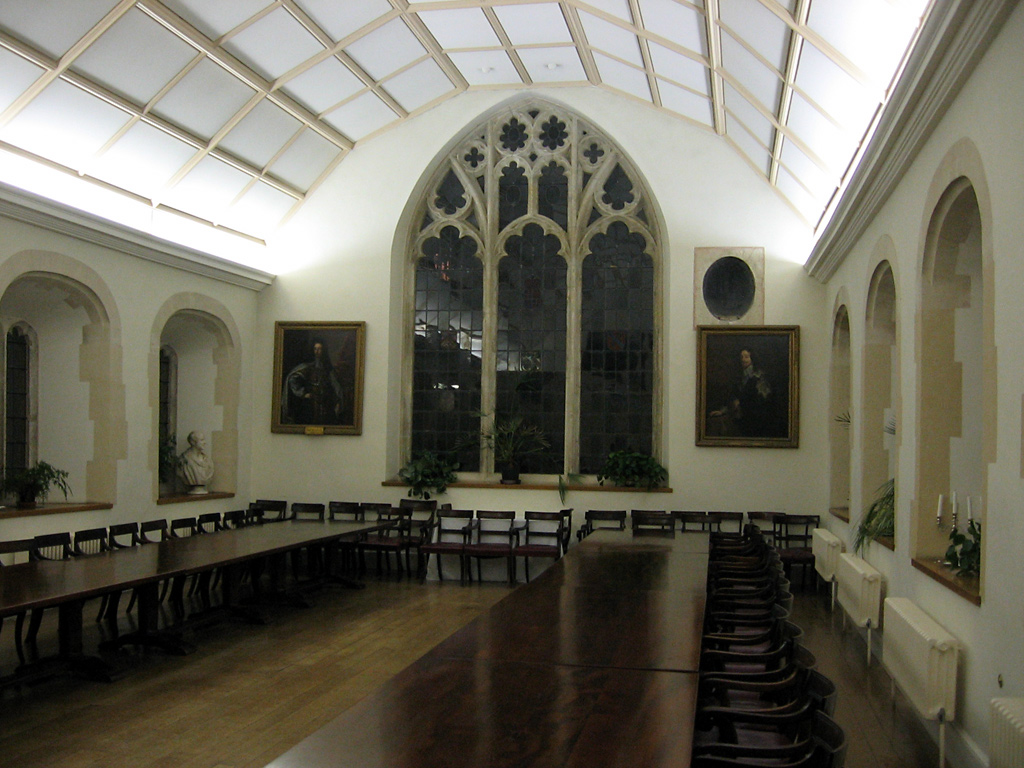
Because Wadham College is a Grade I listed building, it is not permitted to make any changes to it that alter the appearance. As such, the roofs of the main quad are being replaced in a slow and expensive fashion, the most annoying consequence thereof being that the dining hall will be closed next term. (Note that none of these are good photos; taking handheld photos inside buildings at night rarely has the most aesthetically pleasing consequences. Perhaps I can get a better crop in Hilary Term, through the use of my mini tripod.)

Given that the eight dinners at high table that accompany my scholarship are the major reason for which I spend any time in the college (the other two being checking my mail and printing papers), this is irksome. That said, I would be quite happy to have the dinners shifted to the Old Library, where people tend to shuffle afterwards anyhow. It would be slightly more annoying for the serving staff, on account of being a bit farther from the kitchen, but it is enormously more aesthetically pleasing than either the Old or New Refectory.

That said, I am happy with free dinners, wherever held.

L’emploi et moi

Vine and bark

Much of today has been spent digging around for jobs. The four final exams for the M.Phil will occur between the 11th and 16th of June (8th week of Trinity Term). Having written the qualifying exam last year, I am much less worried about the finals than about the thesis. Being able to write something cogent – on the basis of what I can recall about a subject and a limited amount of time – is enormously less challenging than reading a high proportion of everything academics have written about a subject, then contributing to that discussion somehow. After all, I do the former every single day and have never before done the latter. After the exam period ends, I am obligated to remain in Oxford for two weeks, in case they need to give me a viva exam (oral examination). Those are only given to people who end up on the cusp of pass/distinction or pass/fail.

As of the 30th of June, I will thus no longer be a student. It’s a thought to make a person shiver, and begin scanning through dozens of web pages looking for employment opportunities. I have already sent queries of one sort or another to the following organizations:

  1. The Economist and The Economist Intelligence Unit
  2. Environment Canada
  3. Google and Google Scholar
  4. The UBC Institute for Resources, Environment & Sustainability
  5. McKinsey (see post)

Most have not been formal applications for specific jobs. Mostly, I have been trying to assess what kinds of jobs are out there for someone with my credentials and experience. I can write well, do research, teach and lecture (though not with a huge amount of experience), take a decent photo, debate, do some semi-complex web stuff, and converse for at least fifteen minutes on most any subject that is not terrifically obscure. My CV is available online, in PDF or Word format. I am most interested in jobs that focus on international relations or the environment. I can certainly work anywhere in Canada, and can very probably get a work visa for the United Kingdom or the United States.

The dozens of lectures and pamphlets I have been given in the last decade or so about finding jobs, generally stress how most people find jobs through the people who they know, rather than though the kind of listings I have been trawling. So far, my efforts to identify such opportunities through people who I know have met with only moderate success. This is probably the product of mostly knowing people who are (a) career academics or (b) students who probably work for minimum wage a few days a week. That said, anyone who has any leads that they think would be appropriate for me is very much encouraged to let me know (milan.ilnyckyj@politics.ox.ac.uk).

PS. I have written previously about the job search, about why I am not going straight into a PhD program.

Long walks, moral complexity, pirates

Angor Wat grafitti

Today involved some good reading, four more iced shots of espresso, two important meetings, and a long and social walk with Margaret. In the manner of debt collectors everywhere, I have learned that you can get a long way with people who are not being responsive to emails by simply showing up at their doorstep. In half an hour, you can get further than two weeks worth of messages would ever take you.

I have decided, for my paper on ‘failed states,’ to argue that the term is more trouble than it is worth. It conflates a number of different circumstances in which states might find themselves in ways that make it a hopeless muddle, both from a theoretical and an empirical point of view. This should make the paper much more interesting to write; there is great pleasure to be taken in choosing an argument and defending it. The only trouble, it seems, is that the more education you go through, the less thoroughly you can believe that anything you are saying is really true.

That is one reason for which it is so satisfying to write about gay marriage or Guantanamo Bay. These are circumstances where I can stand four-square behind a moral position.

PS. One piece of truly essential thesis reading did get fished today: the copy of The Pirates! in an Adventure with Scientists that Josiah lent me last night. Gideon Defoe has made a valuable contribution to the study of pirate-scientist dynamics. One particularly useful fact for someone leaving academia: Charles Darwin was working as an unpaid naturalist on the Beagle. It seems that it really is possible to learn a great deal from such work.

Human security

Keble College

This evening, I have been thinking about ‘human security.’ This is the idea – very hot right now in international policy circles – that the object of security should be the individual, rather than states (which are arbitrary) or governments (which can be selfish or non-representative). “Protect the Human,” as the Amnesty International campaign asserts. Given the atrocities committed against individuals in the quest to assert higher ideals, a moral system based around preventing such abuses has intuitive appeal.

What I am wondering about is the basis upon which the claim can be made that human security is the important sort. There is the possibility that the realities of human life make human security a valid perspective in a deep way that transcends trends in thinking and the present character of the international system. At the other extreme is the idea that this is just a concept cooked up in some reports and boardrooms that is being applied universally by those groups who have accepted it, despite it not having any fundamental validity. The third and most sensible possibility is that the idea of human security has emerged as the product of a lengthy deliberation among states.

That said, the state consensus view has problems of its own. In particular, the manner in which transgressors are dealt with becomes important. When African states and regional organizations fail to condemn Zimbabwe and Sudan for egregious violations of human rights, are they doing so because the think continued integration is the best way to forward a human security ideal they have already internalized (this would be akin to the supposed ‘sunshine policy’ of South Korea in dealing with the North), or do they remain wary of outside impositions, having been at the sharp end of too many in the past?

The present American administration has, in some ways, made this whole debate more difficult. On the one hand, they assert certain moral values as though they have absolute validity: democracy is good, tyranny is evil. At the same time, they are willing to compromise on fundamental moral questions, ostensibly to serve higher ends. Guantanamo Bay is one embodiment of this attitude. To champion both moral absolutes and a huge level of moral flexibility is enormously problematic. Taking a universal stance and then acting in a way that seems hypocritical leads people to question whether there are moral truths with a strong claim to validity. It also profoundly diminishes the ability to that particular moral actor to act as a model to others, or exert moral pressure. Arguably, situations like the inaction of the international community tars all other states that champion a human security agenda with a similar brush.

One of the more stirring things Michael Ignatieff ever wrote relates to just this issue of universal assertions and hypocritical failures to act:

The liberal virtues – tolerance, compromise, reason – remain as valuable as ever, but they cannot be preached by those who are mad with fear or mad with vengeance. In any case, preaching always rings hollow. We must be prepared to defend them by force, and the failures of the sated, cosmopolitan nations to do so has left the hungry nations sick with contempt for us.

That possibility – that the states of the developing world reject ‘human security’ and similar concepts because of the manifest lack of commitment from the developing world – is another potential solution to the puzzle of the status of such concepts in the world today.

Citable citation

Tree and blue sky

My congratulations go out to my friend Lindi Cassel: the first person who I know personally (as in ‘used to make stick figures out of kneadable eraser while in biology class with’) to get cited on Google Scholar:

Cassel, Lindi and Peter Suedfeld. “Salutogenesis and autobiographical disclosure among Holocaust survivors.” The Journal of Positive Psychology. Volume 1, Number 4 / October 2006. p.212-225.

While the subject matter is certainly sobering, the publication is extremely impressive, like so much else about Lindi. Bravo.

GMail security hole

Path to Marston

As people who read techie news pages like Engadget and Slashdot already know, a somewhat serious security flaw in GMail has recently been uncovered. Specifically, when you are logged into GMail in one browser window or tab, any other site you visit can grab your entire contact list. Whether that is a serious leak or not is a matter of perspective. Certainly, it exposes all of your friends of even more spam than they already receive.

Read the following carefully before you click anything. If you want to see the script that grabs contact lists at work, follow this link. Engadget says it’s “non-malicious,” but the risk is yours. The bug arises from the way in which GMail stores your contacts as a JavaScript file that can be requested by other websites. Google claims they have fixed the bug but, as the link above will prove, they have not.

Plausible attacks

A site that wanted to be really sneaky could exploit this information in many ways. At the very least, it could be used to very easily identify many of the people who are visiting. Knowing someone’s contact list might help in the launching of phishing attacks. It could, for example, make it easier to work out what company someone works for. You could then find out who does their information technology and send spoofed emails that seem to come from the IT department, asking for passwords or other sensitive information.

If it is a site that contains content that many people would not want others to know that they view, it could grab the email addresses for people with the same last name as you and threaten to send them information on your surfing history. A less complicated ploy would be to use emails that seem to come from people who you know to get through spam filters. Because of email spoofing, it is very easy to make messages seem to be coming from someone else.

Implications

As someone with 1037 MB of data in my main GMail account – including 14,410 emails and more than 1500 instant message conversations – I am naturally very concerned about GMail security. There is tons of stuff in there that I would be profoundly opposed to seeing on a public search engine, as has already happened in at least one case with private GMail data.

Contrary to their own assertions, Google had analysed and indexed all e-mails processed through their mail service. Due to a mistake made by an administrator, a database of the highly secret project was mirrored onto the external index servers, and as a result, the private mails of thousands of GMail users could be accessed via the search front-end for at least one hour.

Source

Clearly, it would be preferable if GMail started using durable encryption on their archived messages. This would both protect the messages from hostile outsiders and keep Google from doing anything undesirable with them. Even a passphrase based symmetric-key encryption system (perhaps based on AES) would be an improvement. I bet all the students at Arizona State University, which had turned to GMail to provide all their email services would feel likewise, if they knew.

[Update: 8:30pm] This article by Brad Templeton, the Chairman of the Electronic Frontier Foundation, makes some good general points about GMail and privacy.

[Update: 11:00pm] According to Engadget, this hole has been fixed. It’s good that it was dealt with so quickly, but there are still reasons to be concerned about GMail security in general.

[Update: 2 January 2007] The mainstream media has caught up with the story. CBC News: Teen exposes Google security flaw.

[Update: 18 July 2008] GMail just added a very useful ‘Activity on this account’ feature. It tells you (a) whether any other computers are logged into account and (b) when and where the last five logins took place from. This is excellent.

2006 conclusion

Antonia Mansel-Long with Canon dSLR

The fact that it is now the last day of December is vaguely amazing to me. The time that has passed since returning from Turkey on the 16th has been the extended equivalent of deciding to have a nap after lunch and waking up at 8:00pm.

I suppose the winter break last year was similar, though two differences stand out as significant. Whereas last year, I spent a good amount of time getting to know Louise, this break has been characterized by almost universal solitude in Oxford. More importantly, whereas last year’s break involved little necessity of getting anything academic done, I have felt constant pressure this time, and hence constant disappointment. Kate pointed out, quite rightly, that an essential element of being a success in graduate school is being able to do your own planning and marshall your own energies; in the absence of a social climate, this is not a thing at which I succeed well.

While the post-Turkey period has been largely lacking in lustre, the year has generally been an unusually good one. I travelled to Malta in March, Scotland in July, Ireland in August, Vancouver and Barrier Lake in September, and Turkey in December. I met some new and interesting friends, gained some local and international correspondents, and did a lot of good photography and academic work. Publication of the eternal fish paper was secured, if not accomplished, and I did my first serious teaching. I had my first photograph published, albeit without my permission being asked.

2007 will be the most unscripted year of my entire life to date. If you had asked me to bet, at the age of twelve, what I would be doing at the age of 23, I would have suggested four years as an undergrad, followed by graduate school somewhere. Where the road leads from here is profoundly unclear – a reality that almost anyone would find somewhat daunting. It will be interesting to see what my summing up on 31 December 2007 will involve.

A bit heavy on the mascara

Having just made my last stir-fry of the year, I realized that my relationship with spices is much like that of a curious ten-year old with her mother’s cosmetics. Most things are in essentially the right places, but often in the wrong amounts and positioned there without gracefulness of natural effect.

As with the makeup example, this is reasonable enough when you are staying inside, but not the sort of thing you ultimately want to offer the world.