Debate Worlds ongoing

Apparently, the University of British Columbia is now hosting the world championships for intercollegiate debate. I remember being at the executive meeting where the idea of bidding was first proposed: back in the Beanery coffeeshop in the Fairview residence. That was in February 2003, during my middle year as the Debate Society treasurer. I still owe Meghan Mathieson many thanks for helping me get through the interminable paperwork associated with the position.

Sometimes, I regret not joining the Oxford Union. While it would have been about £180, it probably would have involved meeting some interesting people. I certainly did through UBC debate. Indeed, debaters seem to be an oddly cohesive group – they are far over-represented among people whose blogs I read, who I speak with online, and who I have generally kept in touch with since leaving Vancouver. Hopefully, if I do go on to do a PhD after working for a couple of years, the school I choose will have an interesting debate society that is not quite as outlandishly priced.

PS. I note with dismay that £180 is now $410.88 Canadian. Falling oil prices can be rough when you are living abroad and “there is a very, very strong positive relationship between movements in oil prices and movements in the value of the Canadian dollar.” (Source)

Another death in Iraq

The hate of men will pass, and dictators die, and the power they took from the people will return to the people. And so long as men die, liberty will never perish.

Charlie Chapman – “The Great Dictator

Saddam Hussein’s sentence, discussed here previously, has been carried out. I maintain that it was immoral to kill him, just as it is immoral to take anyone’s life in the pursuit of justice. It is not through the living or dying of individuals that just societies arise, but through the creation and maintenance of fair and impartial institutions. This is why Chapman’s statement, while stirring, is also profoundly naïve. Sadly, very little in the way of a just society seems to be emerging in Saddam’s former kingdom.

I am not sure whether it is legitimate to hope that this will bring some satisfaction to the families of those tortured and murdered by his regime. On the one hand, they deserve whatever kind of compensation can be provided. On the other, encouraging people to delight in the death of a fellow human being seems morally reprehensible. At the very least, let us hope that this action does not spur greater violence in Iraq, and does not cut short the investigation and documentation of the whole sordid history of Saddam’s regime.

[Update: 3:00pm] My friends Lee and Tim have also commented on this matter.

But the stars kept marching

Moon and trees

By the standards of the break so far, today has been surprisingly productive. I read half of Kuhn’s Structure of Scientific Revolutions, wrote 1000 words for the introduction to my thesis, made some progress on the Dobson book on the environment and political theory, nearly finished up my foreign aid paper, and revised my CV for the job search.

I think a lot of the increased productivity can be explained by Emily now being up the road, working on papers of her own. I no longer feel like the one man on the dark side of the moon, scribbling away to himself. I feel like part of an Oxford community again, and one that is engaged in similar pursuits and therefore able to derive motivation from a sense of shared endeavour.

With luck, the remainder of 2006 involve an equal or greater amount of per-hour to-do list completion (focused on the academic category, rather than web / photographic stuff). If the trend persists until the start of term on January 15th, I may actually finish those three draft chapters. I am certainly looking forward to the return of friends and fellow students, the resumption of dinners in Wadham and New College, and the start of my international law course.

PS. This is an amusing observation. Interesting how just rewording something can make it seem very unusual. xkcd has succeeded Digger and Nine Planets Without Intelligent Life as my favourite thoughtful web comic of the moment. That said, both of the others are still excellent. My toque goes off to Alec Reed, Ursula Vernon, and Randall Munroe. I hope to buy them each a drink someday.

Kuhn on research

Thomas Kuhn defines research as “a strenuous and devoted attempt to force nature into the conceptual boxes supplied by professional education.” To me, it seems a fairly reasonable, if somewhat cynical, way of looking at it.

There are two implications within the statement that strike me as interesting. The first is the assertion of nature. The idea that it is something out there, to which research is applied, is more empiricist than I expected from a book that Tristan recommended to me (that said, I am only halfway done, and all manner of complexities could yet emerge). All that said, here are a number of different ways in which you could interpret ‘nature’ in the above sentence.

Most obviously, you could take it to mean the external world of atoms and galaxies and ocelots. Naturally, ‘atom,’ ‘galaxy,’ or ‘ocelot’ is just a description, but it is not unreasonable to assert that there is something out there that can be reasonably assigned a term. There is a problem akin to the naming of constellations – it is arbitrary which stars you include in which grouping – but any possible set of constellations is at least a valid description of the orientation of stars in the sky. You might group them by proximity and geometric patterns, or you might group them according to their spectral profiles or any of myriad characteristics, but it should be possible to go back from whatever model is created to either re-create or at least recognize the phenomenon being described.

Another possible meaning for ‘nature’ is just experience. When we look at the stars (or anything else), our brains are performing a massive amount of signal processing. What you see is not, in many important ways, an accurate reflection of what is actually there. Details that evolution has determined to be unimportant are given little or no attention, whereas ones that natural selection has marked out as important are highlighted. This is the inevitable product of how genes that do a good job of sorting important data out from trivial data will tend to find themselves copied more often than those that do the same task badly. Very bright things are dimmed beside darker ones, and vice versa. Learning to undo a lot of this trickery is an important step towards becoming a good photographer. If we take ‘nature’ in this way, the object of our research is our own experiences of a natural world, rather than that world itself.

The second is the implication that we could somehow deal with nature in a more meaningful or comprehensive way. This is an assertion that comes into conflict with limitations in human cognitive power, and the time that can be applied to problems. We can, for instance, only really think in three spatial dimensions. We can only remember so much, and only grasp connections of certain types and complexities between phenomena and ideas. As such, the choice is not between modelling through categorization and some some of ideal holistic understanding of the universe; it is between modelling through categorization and some alternative form of modelling that is still bounded by human cognitive limits.

To me, the evident success of category-based modelling (as manifest most obviously in technology) demonstrates that it is clearly the world comprehension system to beat. Believing that light is a quantum phenomenon as described by certain equations is demonstrably better than believing it is the result of some kind of active broadcasting from the eyes. The most obvious way to show that is that you can build fibre optic cables and fancy lenses and optical disc drives on the basis of the former conception, but not the latter. One day, we will probably have an even better understanding of light, as demonstrated by a greater ability to do things that we want to do using it. Research, as Kuhn defines it above, is an essential activity and a worthwhile application of time and effort. While there is every reason to question and refine our methods, they are not worthy of outright denigration, as I am sure he would agree.

Aid paper 80% done

iBook in Wadham Library

At almost terminally long last, I have come up with a draft of my paper on moral arguments for and against foreign aid. While a paper of 2500 words cannot begin to engage with the specifics of the broad moral conversation, I think it at least summarizes positions in an interesting way and highlights some of the most fundamental clashes between the positions.

The secret to getting papers written is obviously to abandon my home (too devoid of people and too full of interesting but non-academic things), as well as libraries (populated by pale and frightening ghouls who seem to be trying to get a jump on their June exams), and adopt a coffee shop without internet access as a base of operations. With good tables, a staff that will not kick you out even four hours after you bought a drink, and four shots of iced espresso available for £1.79, Starbucks remains my top choice. My firm and ongoing rejection of the idea that Starbucks is a soulless corporate monster is already well documented here. Ah, the joys of adopting counter-counter-culture positions.

For now, the plan is to read one more substantial journal article on the subject, give the paper another careful read, have one external reviewer glance through it for cogency of language and arguments, give it one more tweaking myself, and then pidge the thing to Ngaire Woods and move on to the next bit of work.

Chocolate and misleading pricing

Those interested in chocolate, or who delight in seeing fraudsters uncovered, should have a look at this exposé on Noka Chocolates from DallasFood.org. (via BoingBoing) The ten part series might be a bit excessive, but you get the idea pretty quickly.

Apparently, a couple of accountants (Katrina Merrem and Noah Houghton) have been buying bulk chocolate for about $17.82 a pound – melting it down, shaping it, putting it into fancy boxes – then selling it for up to $2000 a pound. All this while pretending that they are actually involved in the process of making the original chocolate, as well as advancing additional dubious claims about their methods.

Amazing the crazy stuff that people who make ‘premium’ branded products can get away with. When you exploit the perception that you are providing people with the very best, and charge them accordingly, it seems fairly easy to pass off the utterly mediocre as superlative.

Those still dubious should have a look at the superb Feng Shui / bottled water episode of Penn & Teller’s: Bullshit! (Season One, Episode Seven). In it, they fill a bunch of fancy bottles using a garden hose, then sell it to the patrons of an upmarket restaurant for high prices. Listening to the customers discussing the subtle ‘notes’ they experience, and generally praise the water – interspersed with footage of a crazed looking waiter refilling the bottles on the patio – is incredibly amusing. They even call one of the options “L’eau du Robinet” (Tap Water), and sell it for $4.75 a bottle.

DIY cobbling

Does anyone in Oxford have a hot glue gun that I could borrow?

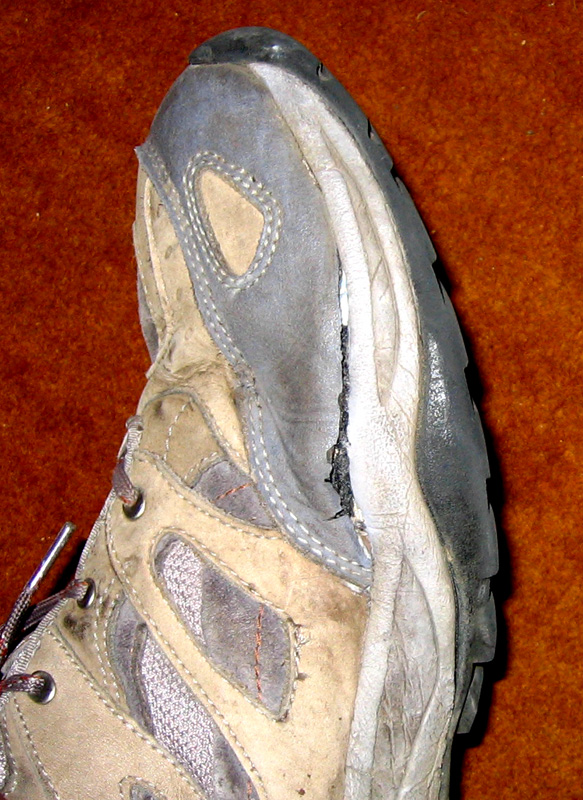
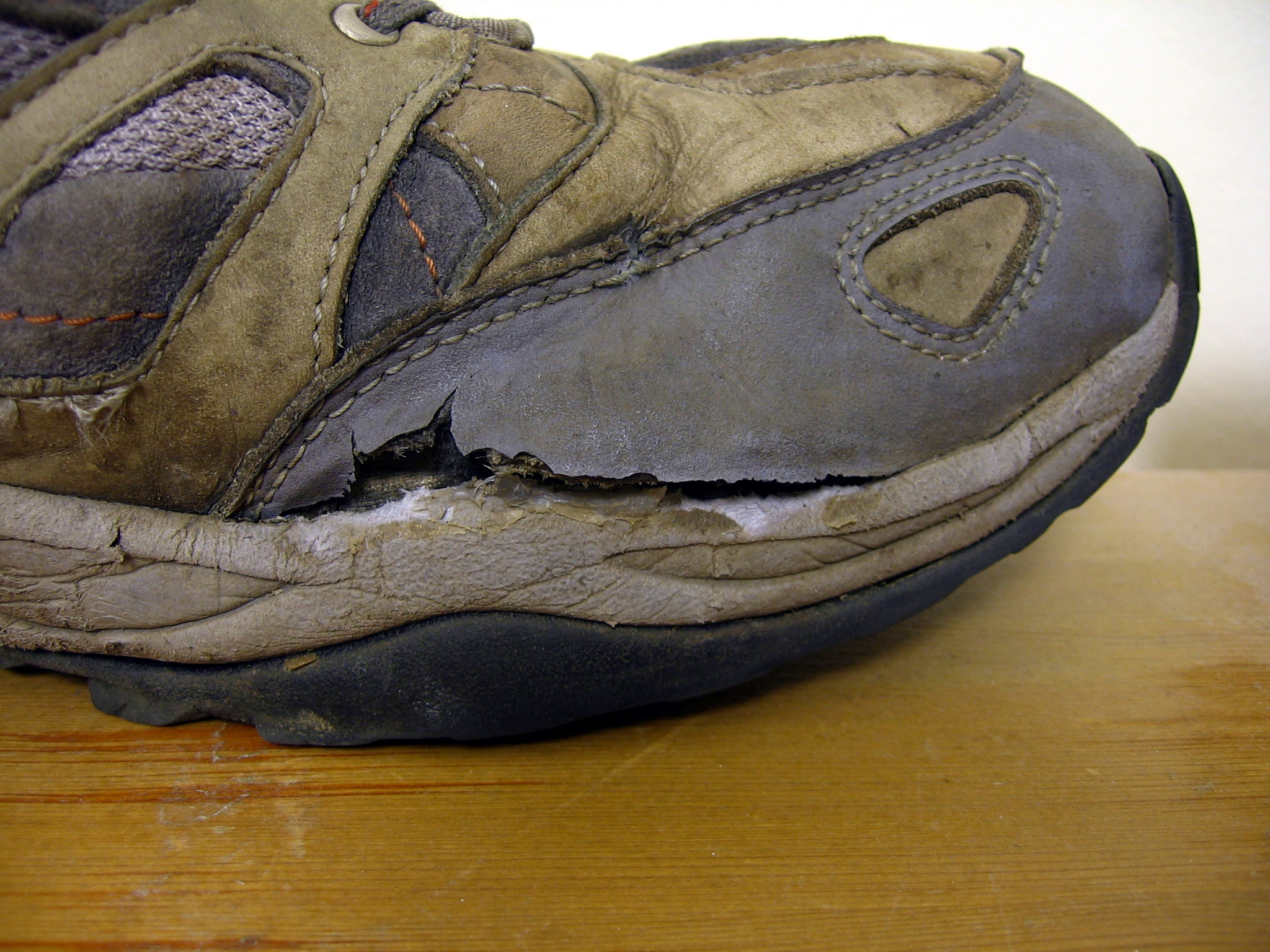
There are a couple of places where the upper body of my shoes is peeling back from the plastic sole. I’ve gone to some shoe repair places in Oxford, but they all say that they do not repair trainers. I’ve only had these snazzy North Face shoes since March 2006, and have come to appreciate their Gore-Tex based water repelling characteristics, as well as their unusually good grip and torsional rigidity. I may not feel invincible when I stamp around in them (that is what hiking boots are for), but they do the day-to-day work of walking unusually well.

My original plan of trying to drive a needle through the sole and then back through the upper, so as to stitch the two together, seems to falter on dual grounds:

  1. It is unexpectedly difficult to drive a needle through the sole,
  2. the whole operation threatens the waterproof membrane that represents much of the value of the shoes.

If I have learned anything from my very limited exposure to the British National Health Service, it’s that glue has taken the lead from stitching, in the repairing of fissures in external membranes.

The maintenance people at Wadham College seem unwilling to lend me a glue gun: possibly because they witnessed the demonstration of my less-than-superb coordination during the game of pool on Christmas Eve. (Note to potential lenders: injuries incurred by me upon myself or others in the course of using your equipment are not your liability.)

If Operation Glue the Shoe succeeds, I may turn my adhesive attentions to the snap fastener that has fallen off the ankle of my carbon gray Sportif convertible cargo pants (as opposed to the identical olive green, brown, and white pairs, each from a successive year of usage).

[Update: 3 January 2007] Thanks to the hot glue gun lent to me by Ben Saunders, I have glued the tears in my shoes shut. I have also tried to re-assemble my broken mini tripod, and re-attach a snap fastener to my favourite pair of cargo pants. We shall see which holds together best.

[Update: 5 January 2007] It would appear the glue of the hot glue gun variety is not strong enough to fix my shoes. I should have expected it, really, given that the force exerted on the sections that have split has been great enough to split them in the first place. Does anyone have an alternative idea?

[Update: 15 January 2007] As of this morning, three of the four gaps initially fixed with hot glue had broken open again. Strangely, the one that did not was one of the largest. Since I am returning the gun soon, I decided to try once more – filling as much of the space between the outer portion of the shoe and the Gore-Tex living with glue as possible. I carried out a small trial with rubber cement, and it seemed a substantially worse option, largely because it lacks the bulk to actually fill the gaps.

[Update: 6 March 2007] My shoes need to be glued again. One of the four seals made in mid-January has now failed completely. Two more have failed partially.

[Update: 8 March 2007] The shoes have been glued again. In the two worst-affected places, the volume of glue now present (from both repairs) is such that it can be felt easily when the shoes are worn. That said, no longer being able to see the exposed Gore-Tex membrane must be a good thing.


A variety of spices in life

Deities and guns, Pitt Rivers Museum

Two things that I did not know previously about spices, but learned while eating white peppercorns purchased at the Spice Bazaar in Istanbul, during a break from reading this evening:

The difference between black and white peppercorns is somewhat similar to the differing means by which white and red wine are produced. Black peppercorns are the dried fruit of Piper nigrum, a flowering vine. The colour is the product of browning enzymes released from the fruit’s flesh through the application of heat, after picking and before drying. The important odour-contributing chemicals present in black pepper are part of a class of molecules called terpenes. White peppercorns, by contrast, are the product of fruit that has been soaked, decomposed, or otherwise removed – leaving only the seed to be dried.

This strikes me as somewhat similar to how red wine is produced from juice that includes skins, seeds, and stems – whereas white wine has such elements filtered out. The chemical result of their inclusion (called maceration) produces the tannins that give flavour to red wine. Those who are restricted to the appreciation of the cheaper examples of both varieties might find it useful to know that red wines contain more congeners than whites, and thus are more likely to leave you feeling rotten the next day (though the relevance of these molecules to the situation seems to be disputed; some argue that hypoglycemia, dehydration, and vitamin B12 deficiency are more to blame). Red wines also include tyramine, an additional metabolic toxin absent in whites.

One molecule mentioned frequently on this blog is capsaicin: the hydrophobic, colorless, odorless that makes chili peppers spicy. It does this by virtue of stimulating vanilloid receptors of subtype 1, normally sensitive to heat and abrasion. I thought that normal table pepper relied upon the same substance, but it actually depends on a molecule called Piperine, potentially notable for the fact that it interferes with biochemical pathways relevant to drug metabolism.

24 days down, 19 to go

The Oxford winter break is now halfway over, with three weeks remaining. Somehow, that rather changes my thinking with regards to the accomplishments so far. Having spent two of the three weeks so far in Turkey, and dealt with what limited Christmas related activities I had, I feel less bad about not having completed masses of thesis reading or writing yet. As it now seems quite unlikely that I will be going anywhere with Sarah P. before the break is over, that leaves me with a good block of time to push my way through my enduring to-do list.

I should probably have anticipated that searching for jobs right around Christmas would be all-but-impossible. The fact that nobody will respond to emails within about a week of the celebration makes a lot of sense, when you consider all the stress and staffing problems that it necessarily involves. Hopefully, once we pass through the gate of New Year’s Eve, some connectivity and productivity will re-emerge among potential employers.

The plan, therefore, is to finish my developing world papers (including at least one external edit) by the 29th of December, without fail. That should keep me hopping during the next few days: from abandoned library to less abandoned coffee shop, for reading and writing respectively.

PS. I am really coming to appreciate TextMate. It has replaced TextEdit in my Dock, and I may even shell out the 39 Euros for a legitimate copy, once the thirty day trial expires. I especially appreciate how I can work on PHP files, .htaccess files, and the like without having to worry about formatting problems – and with colour coding to boot.