One more Oxford week

In less than a week, I will be in Vancouver. This astonishing thought has partially provoked the cascade of attempted task completion that my life should turn into between now and then. I have even been wandering around inside the insane labyrinth that is the OUSSG website. Frankly, I am scared of it. I have never seen so much machinery for doing so little. Far from being a cavernous mass of idle equipment, however, it seems more like a mechanical elephant trying to balance on a ball. If the beast manages it, everyone cheers. As the supposed ringmaster, you have better make sure not to do and prodding of either beast or ball, if you want to keep all upright.

Once I get my bike back tomorrow, many of these tasks should be sped up. I could have had it back today, but there were unresolved issues regarding the seat. I’ve finally decided to replace the one transferred from a derelict after the original was stolen with a proper one. Hopefully, this one will last the year without being stolen. Once you add up the seat, bits and bobs, and the cost of installation (I don’t have the tools) it ends up being more than $50.

Inventing a system for sorting printed materials related to the thesis is another project. I got a big plastic box and some hanging file folders. The current mixture of notebooks and loose documents in binders does not lead itself to the easy access of any one item. There is also a certain expectation bound up in the box, which remains nearly empty. With less than a year left, it is time to start the great bulk of the task in earnest.

Timeline for Oxford withdrawal?

Another situation that certain strategic planners would understand well relates to the Vancouver trip. One the one hand, I could use this opportunity to ship over either things that I already own in Vancouver and have wanted all year (like my 50mm f/1.8 lens) or newly purchased items of a necessary sort. The trouble with this is that I have no viable exit strategy for even the items I already have here. I lack the strategic lift capability to shift back items accumulated here: especially books. While dishes and other necessities of life can be sold or given to friends who are staying on, books and papers are the kind of thing that I should bring back with me – especially if I am to subsequently do a PhD in a related area.

The other option, then, is to begin the process of re-locating back to Vancouver. I could use any extra space in my luggage to start bringing back things that I do not really need but want to keep (like books that have already been read, or hard copies of photos). A complicating factor is uncertainty about whether I will even be in Vancouver for a substantial period of time during the next half decade or so. It could just be a case of touching base there before heading outwards again: to work, travel, or go to school.


A bit on Oxford’s canals

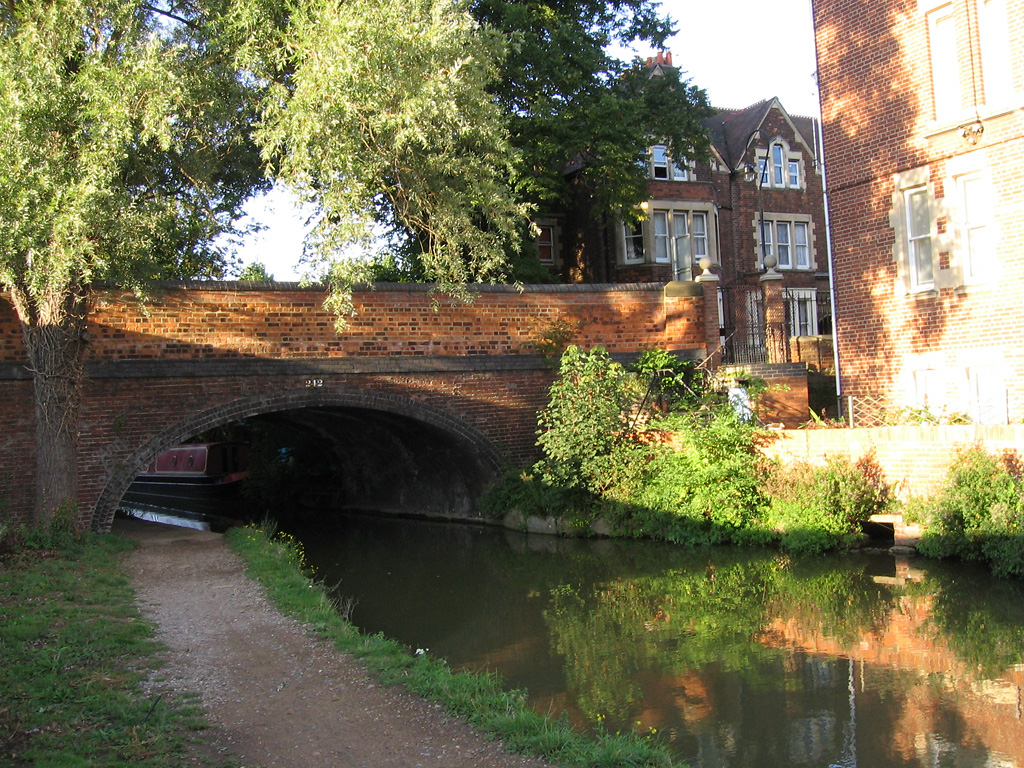
Bridge over the Oxford Canal

Oxford’s canal system is one of the more interesting parts of the county to explore. They certainly look as though they harken from a departed era of red brick and steam powered industry. Nonetheless, they have a good modern role as walking paths, cycling routes, and waterways for the longboats that seem to form a curious sub-culture of British life. There are a great many of these artificial waterways, criss-crossing the countryside and sometimes meeting with the Isis, but I have only traveled the length of a few. I mean to learn more about the canals and the longboat culture before I leave here; can anyone recommend a book?

There is an ongoing controversy about one stretch of the Oxford Canal that is owned by a company called British Waterways. I really don’t know enough about it to comment, but I have seem some pretty bold statements spray-painted on the plywood with which the former boatyard has been fenced around.

As I mentioned before, the primary danger relating to the canals, if you are a cyclist, is the probability of kamikaze insects blinding you for long enough to send you careening over the edge. This has nearly happened to me quite a number of times. As when boating, this is a case where the wise wear sunglasses.

PS. Despite being in Oxford all summer, I have yet to go punting. I hope once people from the program start returning en masse both the weather and the enthusiasm will be in place for a late summer bout.

On being a cyborg

Today’s bi-hourly deluges precipitated the purchase of an umbrella: not for my own sake, but on account of the constellation of electronic gadgets that now follow me about as I walk a broken bicycle to Cowley, or carry groceries back from Sainsbury’s to Church Walk.

There is a lot of talk these days about combining all the gizmos a person is likely to carry around into one all-purpose device. Sometimes, people term this amalgamation an ‘iPod killer.’ Personally, I don’t think it will ever fly, except with the nerdiest of the nerds. As it stands, there is a very solid chance that at least one among my digital camera, music player, or mobile phone will be broken at any particular time. If I had to mail all three to Stoke-on-Trent for three weeks every time one failed, I would soon be living a quiet and pictureless life.

Moreover, all three devices are designed to become obsolete as quickly as possible. Or, at least obsolete enough to make you buy a snazzier new model. Given that the development cycles in telephones, cameras, and music players are unlikely to sync up, you are assured of either having at least one device well behind the times, or being bankrupted by the need to constantly upgrade your all-singing whatsit.

Really, I do my mobile phone an injustice in lumping it together with the sometimes problematic camera and perpetually fault-prone iPod. Since Claire gave it to me, I haven’t had the slightest difficulty with it. Some might consider it a staid sort of item, with capabilities that do not extend beyond sending text messages and making the very occasional telephone call, but perhaps therein lies the secret of its durability. In contrast to my Palm Pilot – which is languishing in a box in Vancouver, bedeviled by problems of all varieties – my Moleskine paper-based day planner has performed flawlessly since purchased.

New Green Party leader

Canada’s Green Party elected a new leader today: Elizabeth May, who is described by The Globe and Mail as a “[l]ong-time activist.” The Greens have been around since 1983, usually polling about 5% of the national vote, but they have never had a seat in Parliament.

The electoral situation facing the Greens is not unlike many of the environmental problems about which they are concerned. It is one of the broad distribution of a phenomenon that would have political relevance if concentrated, but fails to do so when diffuse. Because the Greens do not have enough support to achieve a plurality of votes in a federal riding, they will probably never win seats in the House of Commons – not even enough to be a viable coalition partner for a minority government.

Barring a change in the electoral system – which I would welcome, largely because of how it would benefit parties like the Greens – the best hope the party has is to become an especially effective critic of government. If they can assemble the winning combination of good policies, strong supporting evidence and arguments for them, and media attention, they have a chance of swaying the policy development of whoever is in power. The fact that this leadership election is the first I have heard about the Greens in months suggests that the last of those, at least, is somewhat lacking at the moment.

In a governmental system like Canada’s, where enormous power is vested in the Prime Minister, it seems especially important to have innovative and effective criticism generated by other parties in Parliament. They, along with the media, provide one of two essential planks of oversight, along with the Supreme Court. I hope that the Greens, under Ms. May, prove capable at generating accomplishments from such a position.

PS. Almost by chance, I had a most interesting dinner with Edwina today. I hadn’t known that she spent nine months in Afghanistan a few years ago. It’s astonishing to learn what kind of life experiences your fellow students here have had.

‘Locks’ rhymes with… ‘socks’

On the basis of a quick statistical analysis, I have determined the demographics of my sock population. Approximately 20% are single, all as the result of having tragically lost their partner. Another 20% have re-married to a partner similar enough that you need to look closely to realize the slight mismatch. 15% of the population is seriously elderly, and suffering considerable physical degradation as a result. Most commonly, that means holes where toes or heels reside. Another 15% of the population is of a nature essentially reserved for hiking: either as a thin liner sock likely to be rapidly destroyed if worn singly, or as a thick woolen outer that does not suit normal shoes and Oxford temperatures. None of this is surprising, given that the only pair of socks I have purchased since at least August of last year were the woolen hiking socks I picked up on Inis Mor, a few days ago.

As a consequence of the above, the probability of me wearing appropriate matching socks at any particular point in time is approaching zero percent as the date approaches my return to Vancouver. As with so many other things, the obvious strategy is to bring but a single pair with me and induce a massive demographic boost (due to migration, not reproduction) upon my return.

Also: Flocks, with an explanation here.

…and Lethe-wards had sunk

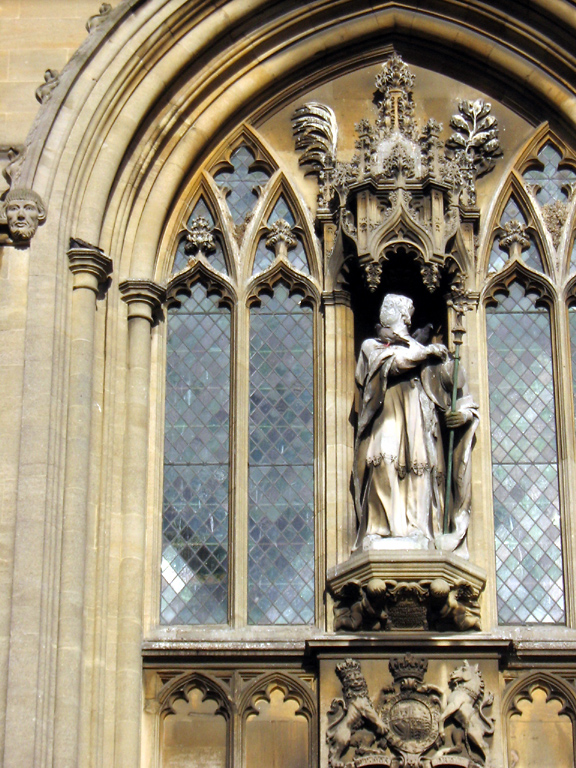
Detail from the Christ Church facade, Oxford

An attempt at a brain-reviving nap this evening turned, surprisingly, into several hours of lucid dreaming. Anyone who has experienced the phenomenon, in which you become the author of the dreams which you know that you are having, can attest to how empowering and enjoyable it is. You can shift yourself anywhere in the world, instantly, redesign mountain ranges, and generally have any level of influence upon that internal world you desire. The result is about as distinct from the paralysis of earthly restrictions as anything can possibly be. The whole experience was also peppered with false awakenings, during which I felt as though I could very actively plan out what would happen during the next stage of sleep: where it would occur, who – if anyone – would be present, and whether elements of multiple places would be combined or overlaid upon each other.

Sleep and dreaming remain among the more incompletely understood of mental phenomenon. Theories exist regarding its importance – everything from a simulation designed to prepare people for future traumas to a system by which memories are sorted and consolidated – but I don’t think any definitive answer has come out of cognitive psychology. When you think about it, it certainly seems odd for creatures to spend a good fraction of their lives immersed in a kind of hallucination. This may be especially true because of the dangers of items ‘bleeding over’ from dreams into the stock of what you consider to be legitimate memories. There have certainly been many occasions in which I have had conversations in dreams and then believed, at least for a while, that they had actually occurred. Doubtless, there are some such that I never cozied on to the artificiality of. In particular, I seem to dream of conversations with those with whom I rarely actually speak: Kate, Linnea, Alison, etc. That is pleasant enough, though it may implant artificial memories and ideas about them.

All that said, I am off to make a running leap at one of the piles of reading strewn about my room. If I can read effectively until 1:00am, then sleep until 9:00am, I will have laid the foundation for re-building my sleep schedule: a real necessity if I am to be a productive human being in the days between now and September 6th, when I am returning to Vancouver.

Work and sleep

Celtic musical instrument

Having returned from Ireland, I am feeling rather physically and intellectually exhausted. While I have several solid days of work lying in various piles around my room, the energy required to begin tackling them hasn’t yet come together. It is going to need to do so quickly, since I am leaving for Vancouver in less than two weeks.

The first order of business is to rebuild my sleep schedule. I haven’t had a proper night’s sleep since August 14th. Once that is done, I can stop living from coffee cup to coffee cup. I can edit the chapter I need to, read the two untouched issues of The Economist that arrived in my inbox, process the re-scanned Scotland photos and put them online, have my Ireland photos developed and printed, write two letters to groups of family members, set upon the task of shortening the eternal fish paper, finish a timeline on the genesis of the Kyoto Protocol, sort out the finances for the Irish trip, read a half-dozen books, complete my student loan application, and buy birthday gifts for family members prior to my return. Oh, and there is always the thesis to think about.

I have also been thinking about future academic choices. Emily tells me that completing a D.Phil at Oxford would only involve another two years work. I gather that doing a PhD in the states would take about five years. That said, competition to get into the D.Phil program somewhat constrains what you can do your thesis on and how. These things, as well as whether to take a break between degrees and what to do during it, continue to orbit me life dwarf planets. A more well-slept mind will be better able to sort them out.

[Update: 30 August 2006] The following are among the items I must read:

  1. Bernstein’s The Compromise of Liberal Environmentalism
  2. Karen Litfin’s Ozone Discourses: Science and Politics in Global Environmental Cooperation
  3. Mukund Rajan’s M.Phil thesis

Back in Oggs-Ford

Nick Ellan's cat Minko

Minko: the cat portrayed above, is a member of the Ellan family. For many years, he has also been dubbed ‘My General’ for reasons long forgotten. Of all the non-human creatures I am hoping to see in Vancouver, Minko tops the list.

I finished Joyce’s Dubliners while waiting for my plane today. It was enormously more comprehensible than other pieces of his I have read, but not particularly engaging. While it was interesting to see so many street and place names from my recent experience, these short stories weren’t quite to my taste. All told, I am enjoying my Wilde anthology more.

Returning home, I found more than forty emails in need of responses, a collection of letters from the student loan people, my official (free) Ubuntu Linux CDs, replacement scans for the Scotland photos, and other things besides. As always, returning from even a short break means rapidly lengthening to-do lists. For a trip as excellent as this one, it is naturally well worth it.

Last Dublin meal

Gruel restaurant, Dublin

Having just returned to a rainy Wadham College, after a journey as effortless as the outgoing one was tedious, I feel I should relate the last things that happened to me in Dublin. I decided to spend my last few minutes before the airport trek having an early lunch at Gruel: an informal restaurant at 68a Dame Street, near Dublin Castle and the Guinness Storehouse. It is also my favourite spot to eat in Dublin, having gone their four times in the last week for their atmosphere and reasonably priced and excellent vegetarian food. Those who visit should have a look at the seating downstairs, as it is non-obvious and quite comfortable.

In this case, I had their fresh orange juice and a large combination of their four delectable salads of the day – topped with a kind of sweet pesto dressing that complimented it nicely. As I was leaving, the manager said that the meal was on him, “for a friend of the house.” Call me a friend of Dublin, also.

Final, literary, Dublin day

The slave from Waiting for Godot thinking

I tried to make my last day in Dublin as literary as possible – the bits not spent traveling back from Galway, at least. I finally found a decently priced copy of Joyce’s Dubliners and an assembly of Wilde’s more political works. This happened within a few minutes of my return to Dublin, a city that seems enormously grimier after having spent a day in Galway and another on Inis Mór.

Books in hand, I wandered to Merrion Square. Beside the grotesque statue of Oscar Wilde in one corner, I read his Ballad of Reading Gaol. As an appreciator of Coleridge’s Rime of the Ancient Mariner, I saw the many thematic and poetic semblances. That said, I think Coleridge’s theological position – based on the virtue of appreciating all living creatures – is rather more promising that Wilde’s despairing hope that God will set it all right in the end. God as a balancer of worldly injustices is very appealing, since it saves us from the need to ever fight for our beliefs, insofar as that means forcing them on others. When we no longer have that conceptual crutch, difference becomes much harder to deal with. In any case, I had to use my hostel earplugs to reduce the strain from a massive throng of talkative Spanish tourists on my ability to appreciate this most sonic poem acoustically.

I had dinner at a place called Cornocopia, on Wicklow Street, recommended as an all-vegetarian restaurant. I had a kind of sweet potato curry dish and their red pepper soup, both dishes I was likely to appreciate, but found both uninspiring. The service was curt, bordering on sharp, and the general atmosphere was one of hasty expulsion for the milking of new customers. Vegetarians in Dublin should steer clear; try Gruel, on Dame Street, instead.

After dinner, I read half of Dubliners on the grounds of Trinity before attending quite an excellent performance of Beckett’s Waiting for Godot at the Player’s Theatre, within that campus. It was an emphatic, emotive, and effective production. P.J. Dunlevy was especially effective as the bald-headed and over-emphatic Pozzo. At several points, he struck the exact expression of the despairing mayor from The Nightmare Before Christmas. I had never seen the play before, but the interplay between Vladimir and Estragon reminded me both of the drama of Steinbeck and Tom Stoppard.

All told, it was a worthwhile day of additions to my Dublin set of memories. I might be able to squeeze one quick final visit in before my bus to the airport tomorrow, but that depends somewhat on my ability to fight of the demons of sleeplessness for another morning.

I should be back in Oxford late tomorrow.