More good service from MEC

Once again, I have been reminded of why it makes sense to buy gear from MEC. On Friday, I was cycling along the Ottawa River pathway when I spotted a small beaver lodge in a little wooded area. I stopped, got out my camera (with 70-200mm lens) and approached the lodge, holding my handlebars with one hand.

I stuck around for a few minutes, trying to spot a beaver and snapping photos of birds while I waited. Eventually, I gave up and returned to the path. When I got there, I saw that the cable for my bike computer (which runs down to the sensor) got sheared off by an errant branch.

I went to MEC and, without a question or the need for a receipt, they gave my a replacement sensor, cable, and dock (they are one unit). They even offered to refill my water bottle for me.

Furniture donations for refugees in Ottawa

Helping with Furniture is a group of Ottawa volunteers who collect gently used furniture that is unwanted and deliver it to refugees living in the Ottawa area. They provide a pick up service every Wednesday night, funded entirely out of the pockets of the people running the program.

Those who have unwanted or unneeded items in their basements or garages should consider making some donations using the form on their website.

I found out about this via Green Living Ottawa.

[Update: 19 July 2009] Let me stress one thing: posting a comment on this post will not lead to your furniture being picked up. I have no affiliation with Helping with Furniture. If you want them to collect something from you, phone them directly at 613-745-1348.

Chinatown remixed

Tomorrow, Ottawa residents should consider checking out the Chinatown remixed art event, on Somerset. It will feature the work of fifty artists in a number of unconventional venues. According to the organizers, it is partially inspired by the Nuit Blanche community art events in Montreal and Toronto.

The event runs from 2:00pm to 5:00pm. Participating venues include the Mekong Restaurant, Raw Sugar, the Shanghai Restaurant, the So Good Restaurant, and the Umi Cafe. Basically, just head to that section of Somerset and you should be able to see what’s going on.

Collecting bike statistics

Given that I am the kind of person who can be motivated by numbers, I decided to pick up a bike computer today – the simplest waterproof model available at MEC. After installing it, I wanted to make sure I had selected the correct wheel size (I think it’s 2174mm on the 700x32c wheels of my Trek 7.3FX). A few kilometres of cycling allowed me to confirm both its measure of velocity and distance traveled against my GPS receiver (a marine unit too big and cumbersome for cycling).

Unfortunately, it also confirmed that the little rare earth magnet that the sensor detects shifts around quite easily on my spoke, and it needs to be very carefully aligned to work. First, I tried gaffer tape, but it really wasn’t right for the job. Then, I tried the blogosphere, which suggested superglue. Glued in place, I hope that magnet isn’t going anywhere while I rack up the kilometres over the coming months.

For those keeping track, the trip out to get the computer, return home with it, and calibrate it amounted to 17.8km.

One more week of Easterly

For those participating in this month’s book club, there is just over a week left to finish William Easterly’s The White Man’s Burden.

I will be posting a review here, and I hope at least a few other people will be prepared to discuss it. We can also consider a book for May at that point.

[Update: 6 April 2009] One thing that already worries me about Easterly’s book is that he doesn’t seem to think climate change or fossil fuel depletion are critical issues for the next few decades. The index doesn’t include anything about ‘climate change,’ ‘global warming,’ ‘fossil fuels,’ ‘peak oil,’ or ‘energy.’

I think climate change mitigation, adaptation to climatic changes, and addressing growing fossil fuel scarcity will all be critical issues during the next few decades, perhaps particularly for developing countries. Successful mitigation will depend on countries like India and China making the transition to a low-carbon economy well before they reach the level of per capita wealth that exists now in the West. Climate change impacts will also seriously affect global agriculture, migration, and so forth. Finally, if fossil fuel availability is going to decrease significantly before 2100, development plans that rely on it continuing to be cheap and plentiful will fall short. That makes it all the more important to start integrating them into planning now.

While Easterly is largely derisive of long-term planning and grand schemes, it is vital to understand that we can no longer assume the base conditions upon which existing global prosperity is built to be durable.

Wet, wet cycling

Anyone who has even seen a film version of Macbeth can pretty easily imagine what it was like to cycle around in Ottawa’s cold and driving rain today. That being said, cycling in the kind of weather that provides an appropriate atmosphere for the covens of witches is definitely preferable to snow- and ice-enforced bicycle abstinence.

Between cycling, photographic projects, and work, I am going to be pretty occupied for the next while. It’s a safe bet I will be posting more photos and fewer long discussions of geoengineering or renewable power sources.

Plants, animals, and climate change

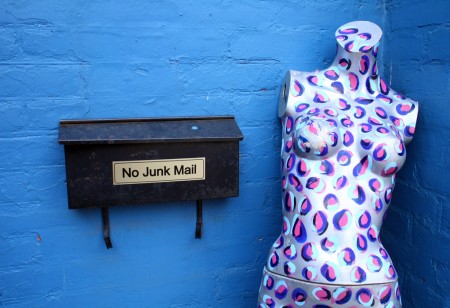
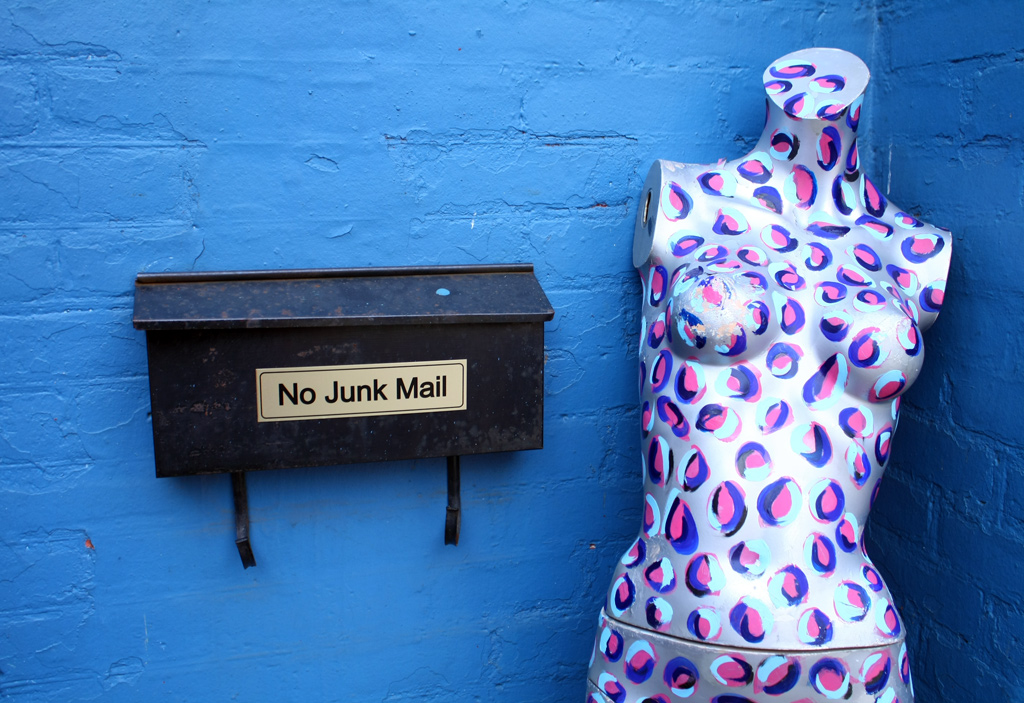
Mannequin torso and blue wall

For decades, environmentalists have been concerned about both the extinction of countless animal species and the progression of climate change. Recent research, however, suggests that the former is a partial antidote to the latter. Not only does the widespread elimination of animal species from all different types of ecosystems reduce carbon dioxide emissions associated with respiration, it also eliminates the harm that would otherwise have been done to carbon-absorbing plants. In the absence of animals, plants grow larger, live longer, and take longer to decompose.

Of course, approaches that damage both carbon-sucking plants and carbon- and methane-belching animals risk being counterproductive, as is the destruction of forests in Latin America and Asia. What has been proposed is the adoption of mechanisms that reduce animal biomass while preserving that of plants. Dr. Aprile Pazzo, a researcher from Columbia University, has suggested that the development of lethal viruses targeted specifically at species that do particular damage to plants might be an effective mechanism for mitigation. While viruses may be an effective pathway for delivering the pathogen to smaller animals that live across large ranges, more rapid and cost-effective options exist for animals like elephants and rhinos, which can consume 150 to 250kg worth of plant matter every day. For such easy to spot, high-plant-matter consuming species, aerial hunting is probably the best option, particularly given bilateral Congressional support for the practice in the United States. Another alternative, she suggests, could be the use of enhanced radiation weapons (neutron bombs) to kill animals across large areas through the use of ionizing radiation. Of course, any resulting fires would need to be promptly extinguished, before they destroyed too much forest.

A further benefit of such schemes, beyond reduced carbon emissions, is a projected increase in the oxygen content of the atmosphere: aiding the breathing of those with lung conditions, increasing the excitement of Olympic and major league shorts, and producing more spectacular fireworks displays. The plan will also produce millions of ‘green jobs’ as human beings take over the task of pollinating flowering plants from the insects, birds, and bats that primarily do so now.

Some have objected to these proposals on the basis that they will likely encourage the proliferation of vegetarian diets, as human beings find themselves in a biosphere increasingly dominated by just themselves, fungi, and plants. Others have objected to the Pazzo plan’s suggestion that global emissions might be reduced by up to 2% through program of voluntary pet euthanasia. Plans to eliminate microorganisms dependent upon aerobic cellular respiration have also come under criticism from conservation groups, who argue that human beings do not have the exclusive right to break down pyruvic acid from glycolysis, fully oxidizing it through the use of the Krebs cycle.

In addition to supporting plans to shift the biosphere balance in the direction of plants, Dr. Pazzo’s support for novel forms of carbon capture and storage also remains undiminished.

Studio experimentation IV

In preparation for some ongoing photo projects, I have been experimenting with different kinds of two-strobe arrangements. Andrea very kindly volunteered herself as a subject. We tried different umbrella arrangements (both shoot-through and reflective), background lights, rim lights, and some ceiling bouncing. I was firing my 430EX II using my radio triggers and using the optical slave on my LP120. While the latter flash has a longer cycling time than the 430, that can be counterbalanced somewhat by using it as a fill light at a lesser output level.

In keeping with my approach for this series, the photos on Picasa are not digitally altered.

Next, I want to try taking some portraits in an interesting outdoor environment around sunset, balancing ambient and flash light. The mill near Chaudiere Falls would probably offer some interesting backdrops.

Spring cycling

Shamrock leaves

Today was an example of the best cycling weather Ottawa provides: bright and a bit cool. With a light jacket, slow periods in the shade were comfortable. With more ventilation, hard runs out in the sunshine were.

Crisscrossing the city, I managed to pick up one of my favourite mushrooms (Pleurotus eryngii) for dinner. They aren’t terribly flavourful, but I like the texture and they fry up most enjoyably with butter and garlic. I also got fancy bread in the Glebe and black bean dip for it in the Byward Market. I got a good bit of reading done, and I got some of my first real cardiovascular exercise since fall. Cycling along the canal provides a nice illustration of the power of sunlight. The areas that get sun for a fair period each day are entirely clear, while areas of northern exposure still have nearly a metre of snow and ice piled upon them.

Spring is certainly a dramatic transition in Ottawa. Judging by the number of square centimetres of exposed skin getting exposed to sunlight today, as much vitamin D was probably produced in the last 12 hours as in the preceding 12 weeks.