Photography as hobby or career

Over on photo.net there is a good discussion of whether photography is a good way to make a living. The overwhelming response seems to be that it is an excellent hobby, but a very problematic career. It makes more sense to have a job to pay the bills; finance life, family, and photography; and allow you to treat the production of images as an artistic rather than a financial undertaking.

That coincides pretty neatly with my own intuitions about the matter. A few minutes on photo.net will turn up hundreds of top-notch photos. If the people making them are mostly warning of the difficulties of photography as a profession, it seems likely to be good advice.

How can the government spend to fight climate change?

Grass and snow

Partly for reasons of political acceptability, most approaches to pricing greenhouse gas emissions aim to be revenue neutral. This includes cap and trade and carbon tax systems where new revenues are offset by decreases in existing taxes; it also includes tax-and-dividend systems, in which that process is more fully automated. That being said, fiscal neutrality has gone out the window as governments seek (whether wisely or not) to offset the recessionary consequences of the credit crunch. That leaves us with a question: if you want to spend government money fighting climate change, how should you do so?

One option business is happy with is big subsidies for the development and deployment of big new technologies like next-generation nuclear reactors and carbon capture and storage (CCS). While such an approach may yield long-term benefits, it does risk simply funneling money from taxpayers to polluters in the near and medium term. It is also an approach that firms have already been very effective at advocating for themselves.

A more attractive option is to help finance the up-front costs of projects that both save money and mitigate emissions. This includes all kinds of unglamorous things, such as improving insulation and the efficiency of boilers, capturing waste heat in hot flue gasses, and replacing windows. Such an approach might be especially effective if directed towards public buildings such as schools, hospitals, government offices, and military facilities. That way, the government is investing in something that will improve its own medium-term financial position (important if existing debts are to be repaid, and future crises are to be managed), while also making a start towards a serious greening of government operations.

In the end, a lot of the most effective tools governments can employ cost very little. Improving building codes, requiring that vehicles be more efficient, and implementing carbon taxes all require only modest government expenditures – though they may cause other actors to incur major expenses. Approaches that are light on regulation and heavy on government spending are probably more likely to be wasteful than those based on compulsion through prices and regulation but, given the inevitability of additional fiscal stimulus in much of the world, it seems sensible to devote some of that directly to mitigation activities, while ensuring that spending not directly motivated by climate change doesn’t contradict climate change mitigation goals.

How else should a government that is feeling the urge to loosen the purse strings spend money on reducing emissions? With a new Canadian budget being tabled in ten days, it is a pertinent question.

Climate in 2009: predictions

Robert Pini

Two related events are likely to dominate climate news for 2009: the first year of the Obama administration and the UNFCCC negotiations in Copenhagen. Arguably, the biggest open question is just how dedicated Obama will be to domestic and international climate change action. It may be that he lives up to the high expectations of the environmental community, setting the stage for the rapid deployment of a cap-and-trade carbon pricing system in the United States and playing a constructive role in the creation of an international legal instrument to succeed the Kyoto Protocol. It may also be that his focus lies elsewhere, or that Congressional opposition makes his platform harder to implement. The Obama administration failing to make climate a priority issue from the outset is probably the most likely ‘bad news’ climate story of 2009, whereas successful domestic and international engagement is probably the most likely ‘good news’ story.

American re-engagement with the UNFCCC process is a necessary condition for progress, but it will not be sufficient in itself. Much depends on whether India and China can be brought into the agreement, as well as whether deforestation can be successfully incorporated into a new accord. Given the urgency of reducing emissions (starting the long path to stabilizing atmospheric concentrations of greenhouse gasses), it must be hoped that all the key states will rise to the challenge and develop a fair and effective approach.

If there are going to be big climatic surprises in 2009, they are more likely to be physical than political. It is nearly certain that there will be strange and destructive weather somewhere, and that at least some people will attribute it to climate change (whether plausibly or not). A big surprise could take the form of an extreme weather event, or simply the sharp acceleration of a tend such as glacier loss, permafrost melting, or changes in precipitation patterns.

With luck, 2009 will be seen as the year in which the world really began turning the corner towards emissions reductions. Most of the governments most bitterly opposed to action on climate change have been eliminated, and an accord between the big players (the US, China, Japan, Europe, etc) would have the momentum to drag everyone else along. The road ahead will continue to include shifts in policy – as well as very active debates on who should bear which costs – but the general outlines could be affirmed this year and global implementation could begin in earnest. Those broad outlines include the need for both total and per-capita emissions to start falling globally (perhaps with a brief period of residual growth in very poor states), that per-capita emissions should converge between all states, and that many of the costs of global mitigation and adaptation be borne by the societies that have created the problem.

For the sake of all future generations, let’s hope this will be a year of great progress.

Grid technologies to support renewable power

Indistinct Vermont barn

The MIT Technology Review has a good article about renewable energy and the ways electrical grids will need to change in order to accomodate it. Both key points have been discussed here before. Firstly, we need high voltage low-loss power lines from areas with lots of renewable potential (sunny parts of the southern US, windy parts of Europe, etc) to areas with lots of electrical demand. Secondly, we need a more intelligent grid that can manage demand and store some energy in periods of excess, for use in times when renewable output falters.

The article highlights how the advantages of a revamped grid are economic as well as environmental:

Smart-grid technologies could reduce overall electricity consumption by 6 percent and peak demand by as much as 27 percent. The peak-demand reductions alone would save between $175 billion and $332 billion over 20 years, according to the Brattle Group, a consultancy in Cambridge, MA. Not only would lower demand free up transmission capacity, but the capital investment that would otherwise be needed for new conventional power plants could be redirected to renewables. That’s because smart-grid technologies would make small installations of wind turbines and photovoltaic panels much more practical. “They will enable much larger amounts of renewables to be integrated on the grid and lower the effective overall system-wide cost of those renewables,” says the Brattle Group’s Peter Fox-Penner.

In short, a smarter grid holds out the prospect of overcoming the biggest limitation of electricity: that supply must always be exactly matched to demand, and that prospects for efficient storage have hitherto been limited. The storage issue, in particular, could be profoundly affected by the deployment of large numbers of electric vehicles with batteries that could be used in part as an electricity reserve for the grid.

Providing incentives for the development of a next-generation grid (as well as removing some of the legal and economic disincentives that prevent it) is an important role for governments – above and beyond the need to put a price on carbon. While carbon pricing can theoretically address the externalities associated with climatic harm from emissions, it cannot automatically deal with the externalities holding back grid development, which include the monopoly status of many of the firms involved, issues concerning economies of scale, the fact that the absence of transmission capacity restricts the emergence of renewable generation capacity (and vice versa).

The full article is definitely worth reading.

Liquid lenses for low-cost eyeglasses

Joshua Silver – a retired Oxford professor – has developed a kind of eyeglasses that can be easily ‘tuned’ for a particular individual in the field. This is possible because the glasses contain sacs of liquid silicone and have syringes attached, allowing fluid to be added or removed. Changing the quantity of fluid effectively adjusts the kind of correction provided by the lenses, allowing them to address any degree or short- or long-sightedness.

10,000 pairs have already been distributed in Ghana, and there are plans to distribute 1,000,000 in India in 2009. Silver ultimately aims to produce enough glasses for 100 million people a year.

Enhancing carbon sequestration in wood

Andrea Simms-Karp and Morty

Ordinarily, wood is a relatively temporary storehouse for carbon. While trees absorb it when growing, they re-release it when they burn or rot. A company called Titan Wood is seeking to enhance the sequestration potential of wood by chemically altering it. In so doing, they increase the span of time for which the carbon will be bound up in a solid form; by making the wood stronger (converting soft woods like pine into a form comparable to tropical hardwoods), they also allow wood to be used in a wider variety of applications, displacing more carbon-intensive building options like concrete, metal, and plastic:

Instead of deforesting tropical rainforests for the highest quality hardwoods, we can essentially make them from trees that grow in northern climates. Wood that is grown via sustainable forestry practices and modified with our acetylation process provides a far more sustainable model for producing high-performance lumber. If the wood is both grown and used locally, so much the better.

Unlike woods treated with existing processes (such as Chromated Copper Arsenate), the resulting material is non-toxic.

In the Netherlands, a heavy traffic road bridge is being constructed from this processed wood (the commercial name for it is Accoya). All the wood being used for the construction is from source-certified sustainable species.

This all strikes me as a neat idea, and a potentially good way to store some carbon in the medium term while transitioning towards more sustainable building materials.

The nature and future of wind power

This Economist article discusses the history, technology, and future of wind power. It includes a fair bit of useful information, particularly about integrating wind into the broader energy system:

In addition, the power grid must become more flexible, though some progress has already been made. “Although wind is variable, it is also very predictable,” explains Andrew Garrad, the boss of Garrad Hassan, a consultancy in Bristol, England. Wind availability can now be forecast over a 24-hour period with a reasonable degree of accuracy, making it possible to schedule wind power, much like conventional power sources.

Still, unlike electricity from traditional sources, wind power is not always available on demand. As a result, grid operators must ensure that reserve sources are available in case the wind refuses to blow. But because wind-power generation and electricity demand both vary, the extra power reserves needed for a 20% share of wind are actually fairly small—and would equal only a few percent of the installed wind capacity, says Edgar DeMeo, co-chair of the 20% wind advisory group for America’s Department of Energy. These reserves could come from existing power stations, and perhaps some extra gas-fired plants, which can quickly ramp up or down as needed, he says. A 20% share of wind power is expected to raise costs for America’s power industry by 2%, or 50 cents per household per month, from now until 2030.

In 2007, 34% of the new electricity generation capacity that came online in the United States was in the form of wind turbines; China has doubled its capacity every year since 2004. 20% of Danish electricity already comes from wind, along with 10% in Spain and 7% in Germany. Given aggressive construction plans in Asia, North America, and Europe, wind power definitely looks like a technology with a big future.

Vaclav Klaus on climate change

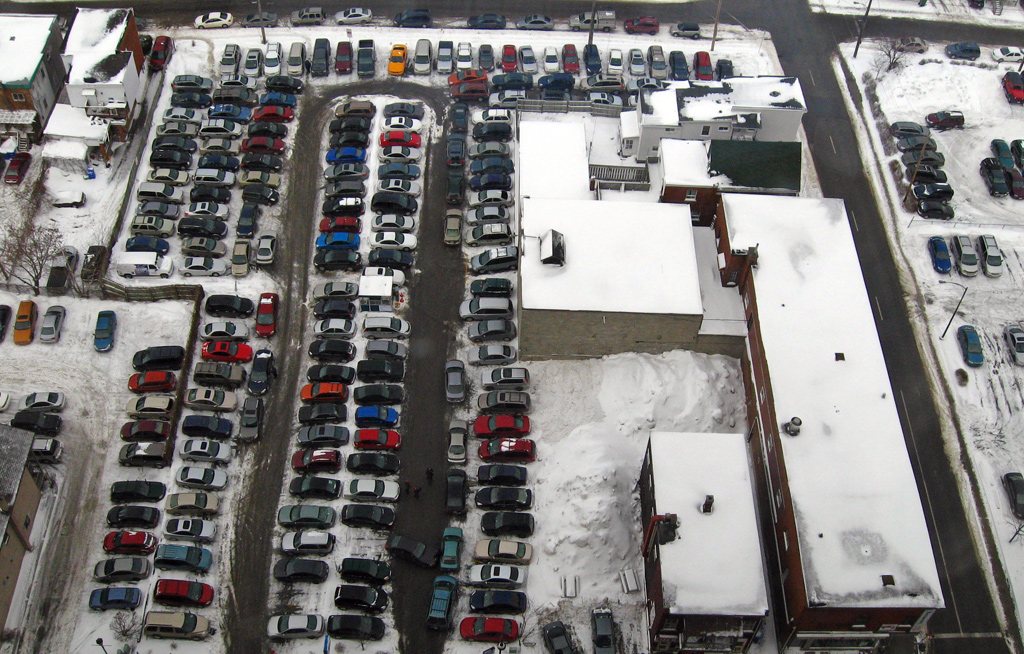
Cars parked in Gatineau

Recently, Czech President Vaclav Klaus demonstrated the degree to which he deeply misunderstands the issue of climate change:

“Environmental issues are a luxury good,” Klaus added. “Now we have to tighten our belt and to cut the luxury.”

Global climate issues “are a silly luxury good,” he repeated.

Not only is maintaining a stable climate a fundamental requirement for human life and civilization, but it will be future generations who bear the majority of the pain if we fail to reduce emissions quickly. Far from being some unnecessary luxury, cutting greenhouse gas emissions is a vital moral requirement.

In Poznan, Al Gore did a much better job of explaining the ethical situation appropriately:

Very simply put, it is wrong for this generation to destroy the habitability of our planet and ruin the prospects of every future generation. That realization — that realization must carry us forward. Our children have a right to hold us to a higher standard when the future of all human civilization is hanging in the balance. They deserve better, and politicians who sit on their hands and do nothing to confront the greatest challenge humankind has ever faced.

Hopefully, that is a position that will rapidly becomore more widely held among politicians and the population at large.

Energy usage and the US Department of Defence

This article on space solar power (collecting energy from sunlight using one or more satellites in geostationary orbit, then beaming it down to Earth using microwaves) contains some interesting information on American military logistics in Iraq:

The armed forces are America’s single greatest consumer of oil. The Department of Defence delivers 1.6m gallons (7.3m litres) of fuel a day—accounting for 70% by weight of all supplies delivered—to its forces in Iraq alone, at a delivered cost per gallon of $5-20. It also spends over $1 per kWh on electric power (ten times the domestic civilian price) in battle zones, because electricity must often be provided using generators that run on fossil fuels.

This helps explain why militaries have such a keen interest in new energy generation and efficiency technologies.

The information on space solar power is also quite interesting. It actually seems to be a bit less infeasible than I thought, though the launching costs remain a very significant barrier.

Carbon pricing and economic freedom

Post-Dion, it will take a bold politician to revive the idea of a carbon tax in Canada. One ironic consequence of that is that it is likely to produce more ‘command and control’ style environmental policies. Whereas an economy-wide carbon tax (or cap-and-trade scheme with auctioning) would encourage every individual decision-maker to examine the cost of reducing their greenhouse gas emissions, trying to achieve those reductions based on targetted government initiatives requires that political and bureaucratic decision-makers try to perform that analysis: trying to identify low-cost potential emissions reductions, as well as instruments through which they can be encouraged.

I have argued previously that just putting a price on greenhouse gas emissions is not sufficient to drive the change we need, because other market failures and economic structures need to be overcome. With that caveat expressed, it is more than a touch ironic that an anti-tax ‘free market’ ideology that rejects carbon pricing may lead to centrally planned solutions emerging, as opposed to market-directed ones.

A related irony concerns the timing of mitigation. As Joseph Romm has repeatedly pointed out, we have the opportunity today to begin the transition towards a low-carbon economy in a relatively voluntary way. Nobody needs to be banned from doing essential; rationing is not required. All we need are sensible economic instruments and accompanying policies, provided we get started right away. By contrast, if we squander the opportunity we have now, achieving the stabilization of the atmospheric concentration of greenhouse gasses will require that far more onerous burdens be placed on individuals. In short, today’s unhampered freedom to emit greenhouse gasses is inexorably linked to the necessity of sharply dimininished freedoms in the future.