Barack Obama on oil imports

Compared with his 2004 performance, Barack Obama’s speech at the Democratic National Convention the day before last seemed a bit lackluster. That being said, it was a more specific about the priorities of a potential Obama administration. Energy issues were touched upon a few times – the environment hardly at all – but that is probably not surprising, given that winning the election is the over-riding priority for him now, and talk of effective climate change policies is (sadly) likely to lose more votes than it wins. The speech only mentions climate change once, as one of the “threats of the 21st century” along with “terrorism and nuclear proliferation, poverty and genocide, climate change and disease.” The lack of elaboration demonstrated both the degree to which this speech was aimed at a domestic audience primarily concerned with the state of the US economy and the desire to avoid the mention of polarizing specifics when enumerating challenges – a tactic that was also used in relation to a number of domestic social issues.

One line struck me as ambiguous and potentially problematic:

[F]or the sake of our economy, our security, and the future of our planet, I will set a clear goal as president: In 10 years, we will finally end our dependence on oil from the Middle East.

If this just means shifting American imports from Middle Eastern states to those elsewhere in the world, this won’t be much of a solution for either climate change or energy security. Let’s say the US buys all of its oil from outside the Middle East. Even so, the world price of oil will largely be set by developments there: particularly expectations about output in volatile areas, as well as confidence in the ability of Saudi Arabia to moderate oil price shocks through reserve capacity. Since the price of Alaskan or Albertan oil moves along with developments in Kuwait and Iran as much as oil
anywhere else, the source of the imports isn’t hugely important when it comes to price or security of supply. If the non-Middle Eastern producers selling to the US can get a better price in Europe or Japan, the oil will follow the money.

A more ambitious and effective plan would focus on ending dependence on oil altogether, regardless of source. That can begin in areas where oil can be easily replaced at present – such as powering urban vehicles – and can progressively move into areas where fewer alternatives now exist. The pledge in the speech to devote $150 billion to developing alternative energy sources hints at an appreciation of the importance of a renewable energy economy. Achieving that requires altering the mechanisms through which energy is generated, transmitted, and used – not just changing the flags on incoming supertankers.

Export industries, shipping, and the price of oil

The high price of oil and uncertainty about future supplies may have broad macroeconomic impact in the near future. One major area where that could prove true is in terms of where in the world manufacturing takes place. While shipping is generally a small fraction of total costs, the profit margins of some producers – especially in Asia – are small enough that further increases in shipping prices may eliminate their competitive advantage over producers closer to rich markets, such as those in Central America and Eastern Europe:

The cost of shipping a standard 40-foot container from Shanghai to America’s east coast, for example, has jumped from $3,000 in 2000 to about $8,000 today. The extra cost of transporting goods halfway around the world, Messrs Rubin and Tal wrote, is wiping out the often slim margins of Chinese exporters. What is more, if oil and shipping prices stay high, many Western companies that now outsource their manufacturing to China might decide that it makes more sense to shift production closer to their customers at home.

Of course, much will depend on near-term developments in energy prices. Continued economic malaise in Europe and North America could help to keep oil prices moderated (though it is hardly good for exporters, either). A return to a world where economic growth is strong in both developing and developed states, at the same time as hydrocarbon supplies are constrained, may well produce a partial reversal of the globalization trend. The same market forces that made low wages and economies of scale the dominant consideration for placing production may shift towards favouring reduction of energy and transport expenses instead.

Listeria and the food system

The ongoing listeriosis outbreak in Canada is evidence of how broken out primary food system is, particularly insofar as meat is concerned. Producing billions of clones in packed conditions is dangerous enough, particularly if you simultaneously marinate them in growth hormones and antibiotics. Marrying that with a food system where every step of the production chain is concealed from consumers increases the risk.

What is most astonishing to me is the result of a poll conducted by The Globe and Mail on their website. Asked: “Has the listeriosis outbreak damaged your opinion of Maple Leaf products?” 38% of respondents said “no.” Perhaps this demonstrates the degree to which we are not aware of the shortfalls of our food system and food regulation, to the point where we accept this kind of occurrence as an inevitable consequence of food production.

More people should read Michael Pollan’s The Omnivore’s Dilemma. A safer, healthier food system is entirely possible. It will not, however, emerge while people are still happy to accept a dozen Canadian deaths (and counting) as part of the cost of having “pre-packaged meat products” available for purchase.

Stories of this kind sometimes makes me wonder whether personal vegetarianism is actually a selfish choice. Opting out of the system can be seen as an inferior alternative to agitating for change. After all, it was basically consumer demand that produced the emergence of organic and local food options. It is only when a mass market demand exists for healthy, safe, natural, and sustainable meat and seafood that systemic change could become possible.

More on food, health, and the environment:

Emily also wrote a post on this previously.

Quick poll on future communications

Between now and the demise of the human race (when the universe ends, if not before), will there ever be a time when there is no system with the following characteristics:

  1. Capability to transmit data to most parts of the world with significant human populations.
  2. Affordability for almost anyone with a moderate income in a moderately rich state.
  3. Accessible by most members of relatively free societies.

Basically, it should allow someone in a major populated area of North America to communicate in real time with someone in Asia, as well as transmit data.

Personally, I think something akin to the internet will exist from now on. Even in a future with harshly constrained resources or radically shifted geopolitics, it seems like the kind of thing that is too valuable to give up, especially given the relatively modest costs associated with maintaining it.

Google and geothermal in Canada

In the past, I have written about Google’s laudable RE < C project, which aims to provide renewable electricity at a price lower than that of coal. I have also written about geothermal power as a potentially underappreciated renewable source, particularly if artificial sites can be developed. Now, it seems that Google is putting $10.25 million into a couple of companies investigating the potential of ‘enhanced geothermal.’

Rather unfortunately, Canada has no geothermal sites operating at present. Even more surprisingly, Canada hasn’t even collected data on possible sites since the 1980s. In addition to the investments in the drilling companies, Google is also giving $500,000 to the Geothermal Lab at Southern Methodist University to improve understanding of the size and distribution of geothermal energy in North America.

Hopefully, this will allow Canada to expand beyond the growing success of geothermal heat pumps and incorporate geothermal generating stations as one element of a renewably-based, low-carbon energy system.

Bill Gates and the oil sands

In the past, I have been impressed by the philanthropy of Bill Gates. Now, after spending billions of dollars combating poverty and infectious disease, he seems to be flirting with investments that would counteract his earlier goals. Along with Warren Buffet, Gates recently toured the Athabasca oil sands, supposedly in search of investment opportunities.

We are now at a juncture in time where we understand the magnitude of the threat posed by climate change, as well as the growing role the oil sands are playing in Canada’s greenhouse gas emissions. It is simply immoral to assert that just because a resource is under your feet, you can exploit it regardless of the harm that does to others. While it is theoretically possible that future technologies will reduce the harm caused by oil sands extraction and upgrading, such technologies do not exist today and cannot serve to justify the destruction that is ongoing.

If Gates does decide to invest, he will be adopting a deeply hypocritical position with respect to good global citizenship and the challenges facing the global poor. The IPCC and others have stressed that it will be many of the world’s poorest people who suffer most from climate change. Projected impacts include droughts, famines, storms, and the increased spread of some infectious diseases. Hopefully, the actual sight of boreal forest being stripped mined and rendered toxic through greenhouse-gas-spewing industrial activities will put him off the investment idea.

Oil production and energy return on investment (EROI)

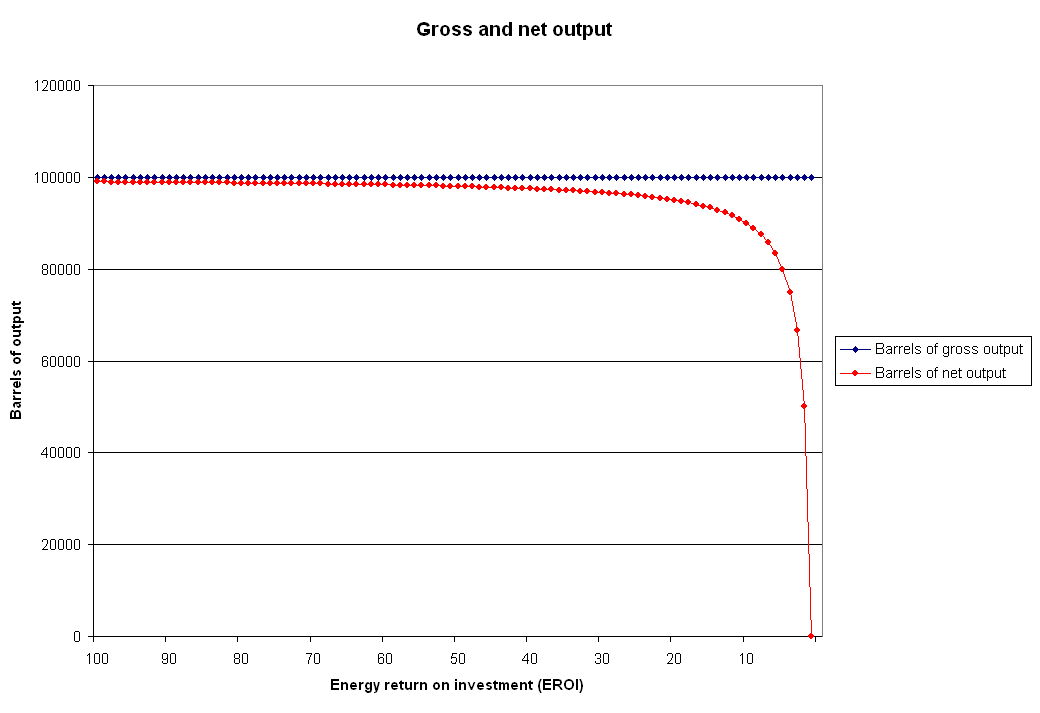
This chart demonstrates one characteristic of a changing energy return on investment (EROI). This is the ratio between how much energy is takes you to produce or acquire an energy source (such as oil, natural gas, biofuel, or hydrogen) and the amount of energy contained within it. This graph relates to a hypothetical oil field that is consistently able to produce 100,000 barrels per day of oil. On the left hand side, the EROI is 100:1. This means that you get 100 units of usable energy for every 1 unit you invest in extraction. This ratio is comparable to some of the best oilfields in Kuwait, where you just need to drill a hole and oil will gush out. On the right, the EROI falls towards 1:1. More and more of the barrels of output (or an equivalent energy source) must be used to extract the oil. By the end, there is no net energy production.

There are a few reasons for which this is important:

  1. It shows that even when the gross output of an oil field is stable, its value can fall off precipitously as the energy cost of extraction rises. This happens as you need to use more and more novel technologies and more and more capital to access the oil.
  2. EROI has a huge impact on the viability of alternative energy sources. If the ratio for biofuels is only 5:1 or 2:1, that means that enormously more energy must be devoted to producing the same quantity of fuel as was once available in Kuwait at 100:1.
  3. The combination of oil field depletion and worsening EROI can cause a faster dropoff in production than either factor taken in isolation.

One caveat should be mentioned in closing. There are situations in which an EROI of less than 1:1 is acceptable. Specifically, this is when the final product must have valuable special characteristics. This is true of exotic fuels like, say, sirloin steaks. Each one contains far fewer calories than it took to produce, but that is still economically acceptable due to the premium attached to the calories in the final product. While EROI ratios below 1:1 are acceptable in niche areas, they can never be the energy basis of an entire economy.

Moral relevance of the ‘dash to gas’

Between 1990 and the present, a significant reduction in European greenhouse gas (GHG) emissions took place because coal based electricity generation was replaced by natural gas plants. Here’s the big question: should that switch be considered an act of climatic virtue on the part of the European states, and thus be taken into account when identifying their fair share of remaining necessary emissions reductions, or should it be ignored? This is in some ways akin to the matter of additionality, as mentioned here before

There are naturally arguments on both sides. It seems fair to say that at least some of the motivation for the switch came from concern about climate change and a desire to meet Kyoto Protocol targets for emission reductions. At the same time, it is very difficult to determine how much was driven by other considerations: from the state of gas production in the North Sea to concern about non-GHG pollutants to long-term estimates of the relative price of coal and gas.

Another issue to consider is long-term energy use. If the European states had chosen to stick with coal, but they had switched to natural gas at some point in the relatively near future, the impact would largely have been the same, in terms of climate. The same additionality problem that applies in the present exists for the recent past. Using the gas in the distant future would have less of an effect (assuming successful climate change mitigation does occur) since the timing of emissions is important for climate stabilization pathways.

Pragmatically, giving some credit to the Europeans for the transition may be a necessary step in negotiations. That being said, the conundrum is enough to make one wonder whether a metric ignoring ‘additionality’ would be more manageable in practice. Ignoring the question of whether emissions reductions were motivated by concerns over climate change or not, and instead focusing only on the magnitude of reductions, would probably be a more efficient form of calculation. That being said, it would arguably be less equitable. Also, it might be incompatible with the notion that different states or sectors should spend ‘comparable’ amounts on climate change mitigation.

Thoughts? Does it make the most sense to give the European states full, partial, or no credit? Secondly, is ‘additionality’ sufficiently ethically important to justify the headaches it produces?

Debating the future of energy

The Economist is holding a debate in the style of the Oxford Union debating society (which I never joined while there due to the excessive cost). The topic is: “We can solve our energy problems with existing technologies today, without the need for breakthrough innovations.” This certainly seems to be the emerging wisdom among those who have looked seriously and comprehensively at the problems of energy and climate change. That’s not to say that technological improvements in things like batteries and photovoltaic cells would be useful, it is simply to assert that ‘breakthrough’ new technologies are not required, though they may well help.

The debate should be an interesting one to observe. The opening statements are from Joseph Romm – whose book I discussed earlier – and Peter Meisen.

Climate change and the limits of Canadian sovereignty

Thesis: Canada is free to enact more stringent climate policies than the United States, but not free to enact less stringent ones.

Argument:

  1. As long as little is being done in the United States, American corporations are not concerned about being made uncompetitive with foreign firms because of climate change policies.
  2. If the United States did adopt a serious climate policy (a national cap-and-trade plan with auctioning, perhaps, or a carbon tax), those firms would suddenly be very concerned about losing business to firms not thus restrained. This is especially true in sectors with high emissions per dollar’s worth of output. This includes heavy industry, the petroleum sector, and so forth.
  3. These firms will lobby the American government to pressure its trading partners to adopt comparable policies.
  4. These firms will find many supporters in Congress who think similarly. Politicians will also be fearful of domestic job losses and the relocation of production to foreign jurisdictions with less stringent rules.
  5. In the case of Canada, legal vehicles through which this might occur include the North American Free Trade Agreement (NAFTA) and the World Trade Organization (WTO). Potentially, other agreements pertaining to transboundary pollution might play a role.
  6. If taking a legal route fails or is not desired, it is always possible for the US to put enormous trade pressure on Canada. 85% of Canadian exports go to the United States and even illegal trade blocking moves by the US can be so painful as to force a surrender (as with softwood lumber).
  7. No Canadian government will be willing to sacrifice access to the American market, even if avoiding it requires a considerable loss of face.

As such, there seems to be a decent change that if a new administration in the United States adopts a relatively strong national climate change mitigation policy, some version of the events above will lead to the introduction of a comparable regime in Canada. Of course, the ability of even an Obama presidency with Gore as a climate czar to get emission regulations through Congress cannot be taken for granted, largely on account of the short-term interests of the selfsame corporations mentioned above.

Comments? Counter-arguments?