Product idea: guaranteed win lottery tickets

While thinking idly about ways to tactfully pass money to people, I had an idea. A company could sell lottery tickets (probably of the scratch-and-win sort) that are guaranteed to pay out specific amounts. You would buy them for the face value plus a service fee. They could be issued in denominations running from $10 or so up to thousands.

They would look like ordinary tickets, and could be redeemed at places that sell scratch-and-win tickets. The merchant would simply be compensated by the company. Even better, the company could buy guaranteed winner tickets from the normal ticket issuers. That way, they would be available in the same brands as tickets sold in normal shops, diminishing suspicion and allowing buyers to choose something suitable for the recipient.

This could be:

  1. A way to help a struggling friend of family member without making them feel guilty.
  2. A way to convince someone feeling down on their luck that things are turning around.
  3. Practical jokes of various sorts.
  4. Less benevolently, as a semi-covert means of exchanging money.

Could there be any other uses? Would people actually buy such a thing? Would lottery regulators ever permit them?

Scarce resource conservation optimization

Notre Dame, Ottawa

There is a catch-22 involved in some forms of resource planning. Take, for example, helium (as discussed recently). As of now, we only know of one place from which to get it – certain natural gas deposits. We have no idea where, or if, it might be found elsewhere.

One perspective is to say: “For all we know, this is all the helium we will ever be able to access on Earth. We should avoid excessive (airships) and frivolous (party balloons) uses, and save the stuff for cooling sophisticated electronic equipment and so forth.” One could add to this: “If we ever come across a big new source, or an unlimited source, we can reevaluate the prohibition.”

The trouble here is the reduced incentive to find new supplies. There have surely been countless historical cases where scarcity has generated rising prices which has in turn (a) led to the discovery of new sources of raw material (b) led to new techniques of production and (c) led to less intensive patterns of usage. The conservation mindset could impede these. Our solution may be akin to a policeman adrift on a lifeboat with a highly trained and valuable bloodhound. Every day, he is presented with a choice to either use the dog now as a collection of calories, or save it for a more valuable use in a future that may never come. Of course, the situation with any particular resource is far more complex. Our present needs are less acute and singular, the uses of the thing are broader, and our opportunities for near-term and (likely) long-term substitution are usually higher.

At issue are factors including (1) the most critical use of the resource (2) the probability of a, b, or c taking place over any time period (3) the urgency of the present uses, etc. A rational calculation taking into account all these factors (and necessarily making educated guesses about future trends) is a daunting prospect. To what extent does the usefulness of helium in medical imaging affect how we should manage supplies? Will we soon develop technologies that require more or less of the stuff? Is there any entity that is actually capable of managing helium use?

Of course, such choices are rarely made explicitly. Typically, nobody has the power to control the allocation of a global resource. As such, they are used up heedlessly in response to the economic imperatives of the moment- ignoring the fact that the same material might have a far more valuable purpose down the road.


Green bonds in Canada

Emily Paddon, one of my friends and classmates from Oxford, is involved in a scheme to create green bonds in Canada. The initiative, which is part of the Action Canada Fellowship, aims to create a “government-backed financial instrument designed to engage the public by raising capital to accelerate renewable energy production.” The aim is to eliminate more than 25 million tonnes of carbon dioxide equivalent by 2020, at a cost of between $1 and $13 per tonne.

Innovative financing mechanisms will be a very important part of the transition to a low carbon economy. It will be interesting to see when the full details of this become available, and even more interesting when the bonds are available for purchase. Those aiming to both save for the future and help to save the future should take note.

Consider helium conservation

Alena Prazak and Emily Horn

All the helium on Earth arose from natural fission of uranium and thorium in the planet’s crust and mantle. We can access it only through certain natural gas deposits – many of them in Texas – which contain enough of the gas to make it possible to isolate. This is the helium of every high-voiced balloon prank, as well as of every MRI scanner and high temperature superconductor. About 1/4 of helium use is in cryogenic applications. Helium is ideal for such purposes, as it has the lowest boiling point of any known element.

What is not commonly appreciated is that, once these particular gas reserves are depleted, we will know of nowhere from which to get helium. Whatever helium is released into the atmosphere gradually rises through it, eventually drifting into interplanetary space. Despite all the helium being released by human beings, atmospheric concentrations have remained constant at around 5.2 parts per million.

We can produce minute quantities of helium through hydrogen fusion, of the kind that will eventually take place in the International Thermonuclear Experimental Reactor, but it will not be even close to the quantity that will be required to cool the superconducting magnets that will keep the plasma inside that device contained.

It would be particularly ironic if a long-hoped-for source of renewable energy (nuclear fusion) proved impractical not because of issues associated with energy levels of plasma containment, but because we had squandered the planet’s accessible supplies of coolant.

Al Gore’s solutions

Al Gore recently gave a highly interesting speech on the future of energy in the United States. None of the points made in it are especially new, but he does a good job of tying together a great many important themes.

Here are some key points:

  • Because of climate change, “the future of human civilization is at stake.”
  • “[T]here is now a 75 percent chance that within five years the entire [Arctic] ice cap will completely disappear during the summer months. This will further increase the melting pressure on Greenland.”
  • “We’re borrowing money from China to buy oil from the Persian Gulf to burn it in ways that destroy the planet. Every bit of that’s got to change… The answer is to end our reliance on carbon-based fuels.”
  • Solar, wind, and geothermal are large and critical future energy sources.
  • “I challenge our nation to commit to producing 100 percent of our electricity from renewable energy and truly clean carbon-free sources within 10 years.”
  • “[S]harp cost reductions now beginning to take place in solar, wind, and geothermal power — coupled with the recent dramatic price increases for oil and coal — have radically changed the economics of energy.”
  • The national grid must be updated to link areas rich in renewable energy to areas with high energy demand.
  • Plug-in electric cars will play an important role in balancing the load on the electrical grid.
  • “[W]e need to greatly improve our commitment to efficiency and conservation. That’s the best investment we can make.”
  • “I have long supported a sharp reduction in payroll taxes with the difference made up in CO2 taxes. We should tax what we burn, not what we earn.”
  • “[I]t is also essential that the United States rejoin the global community and lead efforts to secure an international treaty at Copenhagen in December of next year that includes a cap on CO2 emissions.”
  • “[W]e must move first, because that is the key to getting others to follow; and because moving first is in our own national interest.”

The 100% target is probably not going to happen – it would require scrapping every coal, gas, and oil power plant – but it is a worthwhile aspiration nonetheless. Even getting a significant portion of the way towards that goal in the timeframe mentioned would be a huge advance.

It would be very interesting to see what role he would personally play in advancing this sort of agenda within an Obama administration. An administration that made a determined effort to implement this sort of agenda would be transformative, and could do a great deal to spur global transformation.

Carbon junkies and nicotine addicts

The comic in the July 12th issue of The Economist is quite a good one. It shows an American eagle, mouth crammed with cigarettes and a cigarette package labelled ‘Greenhouse’ in its talon, telling a tiger labelled ‘India’ and a dragon labelled ‘China’ that it is: “Time to cut back.” Both the tiger and the dragon also have mouths and fists crammed with smokes.

The tiger says to the dragon: “He wants us to follow his lead.” To which the dragon replies: “That’s what we have been doing.”

It does a good job of encapsulating the whole “you developed in a dirty way so we have the same right” argument, as well as the poisonous “there is no point in acting ourselves if other big emitters won’t do so” argument. The best answer to all this is:

  1. The developed world does owe some assistance to the developing world, largely on the basis of the effects the latter will suffer because of the past emissions of the former.
  2. Developing countries have an excellent opportunity to carry out the process of development in a more sustainable way than has been employed elsewhere.
  3. Cutting back on fossil fuel use and greenhouse gas emissions is a temporary sacrifice, but a long-term boon. In the end, it will be the societies that do the best job of transitioning to a low-carbon future that will be the most successful in decades and centuries ahead.

Hopefully, the basic truth of those positions will be able to carry through into the ongoing global negotiations and we will have something big and meaningful to show for it at COP-15 in Copenhagen next year.

The only question on renewables is when

Goliath beetle

One of the most active debates within the environmental community is how much of our energy we should be getting from renewable sources in the near to medium-term. There are those who assert that it is too scarce or intermittent to provide more than a small share, thus making things like nuclear fission and carbon capture and storage necessary. Then, there are those who assert that with more efficiency and a better grid, we can move to a renewable-dominated grid within the next few decades.

Ultimately, it seems important to remember that the only real questions on renewables are ‘which ones’ and ‘when.’ By definition, we cannot keep using any other kind of power indefinitely. Furthermore, there is good reason to believe that renewables will soon be a more desirable option overall, even when fuel scarcity and climate change are not taken into account. Both questions have their technical sides: the relative appeal of different options depends on technology, funding issues, and physical circumstances. Both questions also raise issues of preferences and fairness.

Yes, there is a danger of moving too quickly and suffering from early adoption problems and the later emergence of superior technology. There is also, of course, a danger of falling behind and suffering from dependence upon energy sources in decline. Striking the right balance requires good engineering, good policy-making, and the vision to build a better world.

Is it ethical to fly?

Continuing our long debate, here is another entry.

It seems to me that there are four possible long-term outcomes of the conflict between preventing climate change and travelling long distances quickly:

  1. We come up with a way to keep flying without doing too much climatic harm. This could be sequestration of carbon from biomass, it could be carbon neutral fuels, it could be something unanticipated.
  2. We come up with another transport technology that is carbon neutral and just as good or almost as good as flying, such as very high speed trains.
  3. We cannot reconcile long-distance high-speed travel with the need to mitigate, so we essentially stop doing it. A few people are still able to get from New York to London in a day, but it becomes out of almost everyone’s reach.
  4. We cannot reconcile long-distance high-speed travel with the need to mitigate, so we choose not to mitigate and wreck the planet.

How does the choice to fly look, in relation to each possibility?

  1. It’s not your fault you lived in the era before green flying was possible. That said, it may have been immoral to choose a mode of transport you knew to be (a) unsustainable and (b) harmful to others. It may be laudable or morally necessary to minimize flying and/or compensate for your impact by purchasing offsets.
  2. It’s not your fault you lived in the era before non-flight green travel was possible. That said, it may have been immoral to choose a mode of transport you knew to be (a) unsustainable and (b) harmful to others. It may be laudable or morally necessary to minimize flying and/or compensate for your impact by purchasing offsets.
  3. Again, you are on the hook for choosing an unsustainable option – specifically, one that had to be harshly curtailed in the future. Of course, if you are (a) selfish and (b) desirous of seeing the world, the danger that flying will be either restricted or far more expensive in the future creates an incentive to do a lot of it now.
  4. Flying was hardly a laudable thing to do, but it probably didn’t affect the outcome. Once we get into a runway climate change situation, it doesn’t matter much whether emissions in year X were Y megatonnes or 1.5Y megatonnes.

The larger question of whether future outcomes affects the morality of present decisions must also be contemplated. It does seem a bit odd to say that an action in 2007 was right or wrong as a consequence of technologies developed later. This post really cannot provide any answers to these questions – though my position remains that virtually all flying taking place at present is immoral – but perhaps it will provide a new way to consider things.

Power plant economics

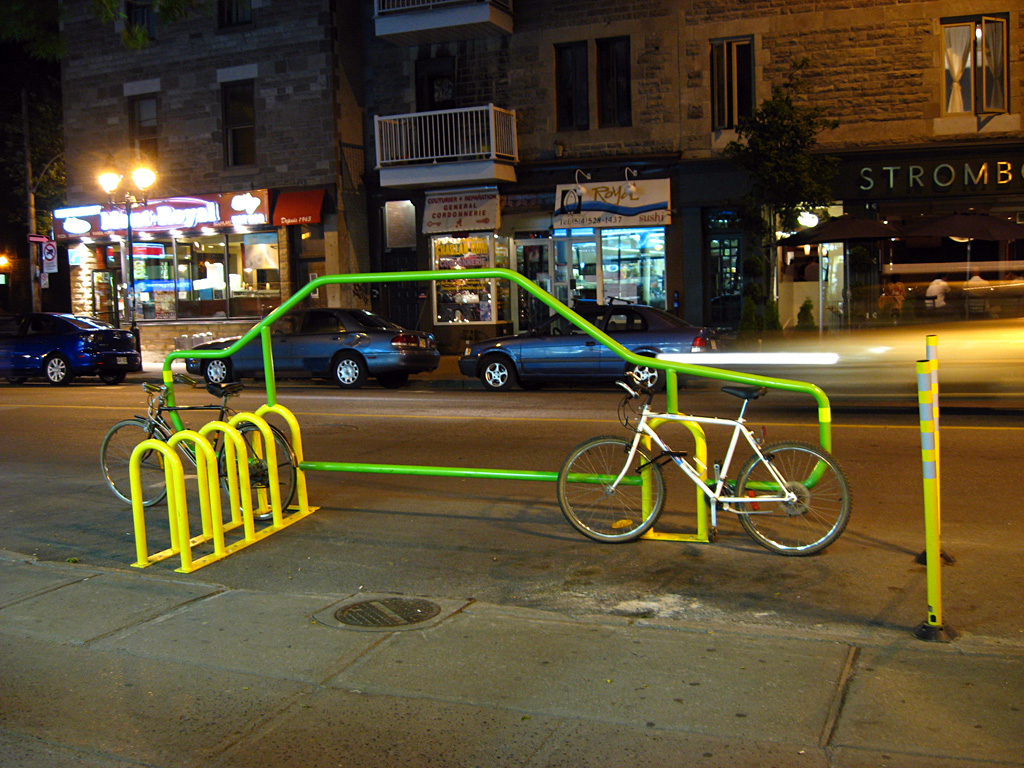
Bicycle parking spot, Montreal

This useful post on Gristmill details the economics of power plants. It explains how costs are divided into four categories (fuel costs, non-fuel operating costs, capital recovery, and profits) and how some of these vary with commodity prices and output, while others are fixed. It makes an excellent point about the marginal effects of price changes. Basically, there is an incentive to run your plant whenever the hourly revenues exceed the hourly costs. Since the hourly costs are lower than the real costs associated with an hour of production (because of capital costs, etc), this creates a disincentive to build more capacity. The existing plants that have the option of selling for less than their true cost but more than their true costs will undeprice you. Nuclear plants are a special case of this:

The U.S. power grid has long relied on this bucket (central-station coal and nuclear, specifically) to provide baseload power. You’d be a fool to build these plants if you didn’t first secure guaranteed equity returns, but that’s what our regulatory model is really good at. Note that these plants actually have very high costs, but since they are so cheap to operate on the margin, they tend to depress prices for power on the grid once they are built. The interesting point of comparison here is with renewables — specifically wind and solar — which also have comparatively high capital costs, but very low variable costs. We frequently talk about wind needing over $100/MWh to pencil, but this is a cost discussion, not a price discussion. You may need over $100/MWh to justify the investment in a wind turbine, but a grid dominated by such units will put downward pressure on the prices for power due to it’s low variable costs — just as nuclear and coal have done for decades.

Clearly, these are the kind of second-order economic impacts that regulators need to take into consideration, if they are to help encourage the emergence of an efficient and low-carbon energy system.

In addition to considering the impacts of fixed versus variable costs, it probably makes sense for regulators to encourage profits from energy conservation. If all the benefit goes to the consumer and the producer suffers from reduced revenue, the incentives for improvement are curtailed.

See also: