Pay back the Joules

Pondering the question of international and intergenerational equity, one idea that occurred to me was some sort of ‘pay back the joules’ process. Basically, it would be an acknowledgement that the economic strength of some states has largely been based on the exploitation of non-renewable resources, to the detriment of those in other places. The basic idea of the scheme would be to be to ‘repay’ the same amount of energy, in the form of renewable generating capacity. The transfers would run from states that have used fossil fuels to those that have done so less, in proportion to the difference between the two. A state that had used X Joules of non-renewable fuels would pay half as much as a state that had used 2X Joules, up to the point where the gap between heavy and light users is eliminated

As described before, one barrel of oil contains about 1,700 kilowatt-hours (kWh) of energy. With similar figures for coal and gas, as well as data on total historical consumption, one could work out a total energy figure. It would then simply be a matter of multiplying the mean output of any renewable facility by its usable life. A 500 megawatt (MW) wind farm that lasts for 30 years will produce 131.4 gigawatt-hours (GWh): equivalent to 773,000 barrels of oil. One kilowatt-hour is 3.6 million Joules.

The plan would be one way to defuse the criticism that “the West got rich through dirty fuels, so we have the right to do the same.” It would also help to ensure that the developing world builds the right kind of infrastructure the first time, rather than having to replace most of it (and overcome all the special interests who will want to perpetuate it).

Fishing and restraint

Colourful leaves, botanical garden

Research being done off Lundy Island, in the United Kingdom, shows how quickly some marine ecosystems can begin to recover when fishing is discontinued. A five year old marine protected zone has resulted in the lobster population increasing sevenfold, as well as benefits to other species. This is consistent with the kind of larger scale recoveries that took place during the world wars, when the need for merchant ships and the dangers of war prevented most fishing fleets from operating.

It makes a person wonder what would be involved in producing a genuinely sustainable national fishery (trying to do the same in the open ocean is probably impossible for the foreseeable future, given the sheer number of unapologetically rapacious national fleets). One idea that comes to mind is this:

  1. Ban all imports. This will ensure that all fish being sold were caught under the sustainable approach.
  2. Restrict all fishing equipment (except safety equipment) to that which was available at the height of the age of sail. That means no diesel engines, no fish aggregating buoys, no satellite navigation, etc.
  3. Set catch quotas at a level where marine ecosystems as a whole remains vibrant and robust.

This would make fish dramatically more expensive, probably reducing consumption considerably. Arguably, it would actually increase employment in the industry. It would also make the industry rather more interesting to those both within and without it. Fishing from wooden tall ships has a lot more aesthetic appeal and romance than smashing the ocean floor and stripping the sea with freezer trawlers.

Of course, the above is supremely unlikely to ever happen. The question, then, is whether we will ever be able to come up with a mechanism that provides society with fish in an ethical and sustainable way, or whether we will keep plundering the resource, earning poorer and poorer catches, until we must be satisfied with whatever worms and jellyfish remain.

Hierarchy of climate change uncertainty

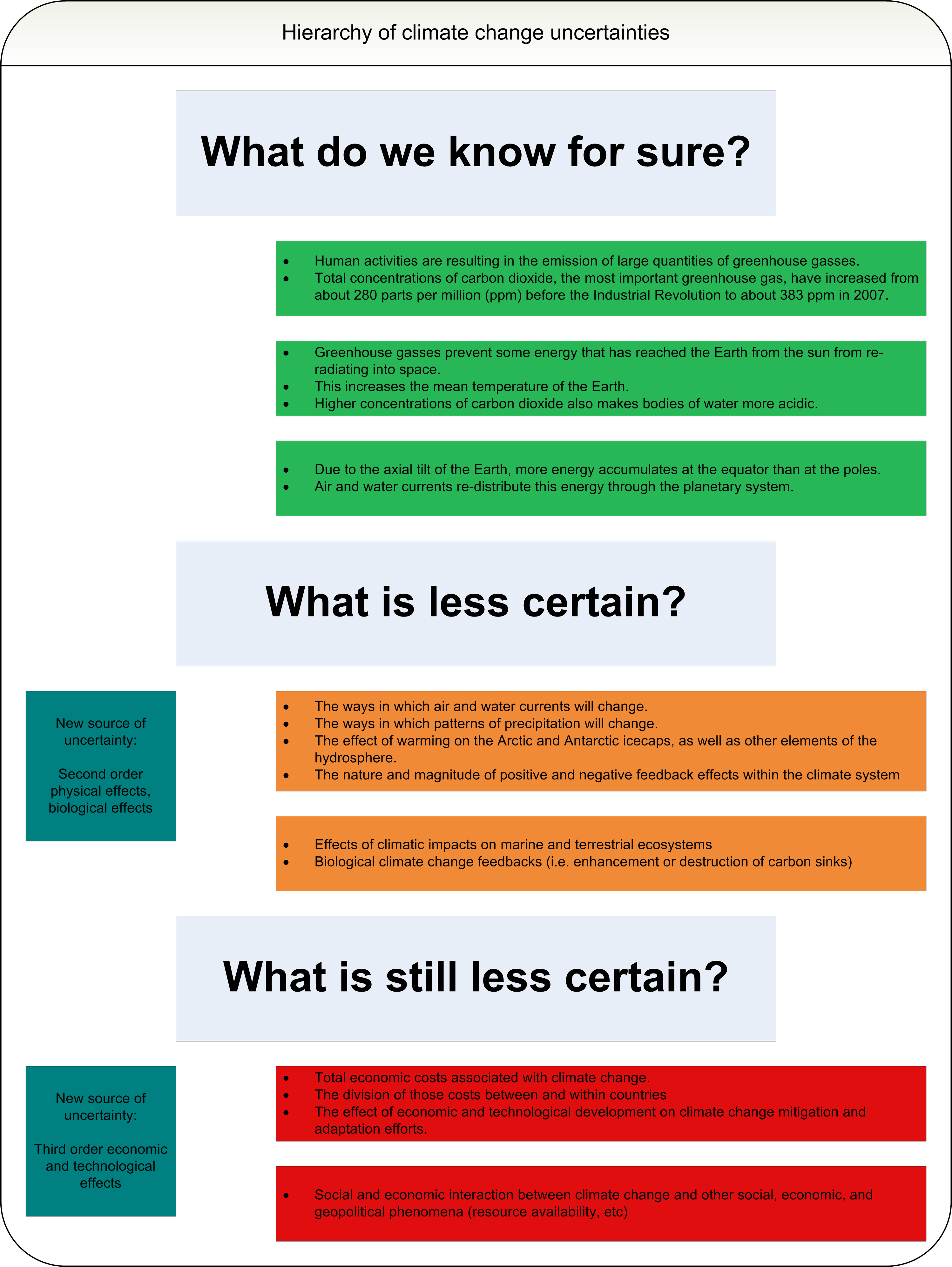
When people say that ‘the science of climate change is settled’ they are often being problematically imprecise. Elements of the science are certainly settled beyond a doubt – for instance, the simple fact that adding carbon dioxide to the atmosphere raises global temperatures. Other elements are certain but less precise: overall warming of the planet will alter air and water currents, though we do not know exactly how. Still higher order questions have answers at lower levels of both precision and certainty.

This graphic sketches out a bit of what I mean:

Climate change uncertainties

Responding to climate change is perhaps the ultimate case of needing to make decisions under conditions of uncertainty. Simplistic conceptions of what it means for something to be ‘certain’ must give way to a more nuanced appreciation of the nature of knowledge and evidence.

Ways to spend money on climate change

Emily at the Montreal Musee des Beaux Arts

Presented with the massive problem of climate change (including the possibility of extremely severe impacts) states with set resources and capabilities must choose between different kinds of responses:

  1. Domestic actions to reduce emissions
  2. Domestic actions to enhance sinks
  3. Funding emission reductions elsewhere
  4. Funding sink enhancement elsewhere
  5. Investing in resilience, either general (emergency response) or specific (engineering measures to combat certain expected effects)
  6. Helping others invest in resilience: either as compensation for past emissions, an inducement to take action, or out of compassion
  7. Investing in future mitigation technologies
  8. Amassing resources and waiting for greater certainty about what will happen

Choosing between these is very challenging and, realistically, we cannot expect governments to rationally and explicitly choose a strategy. Rather, an overall approach will emerge as a combination of semi-overlapping elements: some reinforcing one another and some conflicting. Furthermore, many choices will be made for non-climatic reasons. If we can spend $X in Canada, cut Y emissions, and employ 1,000 Canadians, we might find that option preferable to spending $X elsewhere to eliminate 100Y in emissions.

Multiple axes of uncertainty – about economic and technological development, future resource availability, total and regional climate change impacts, etc – further complicates the problem of prioritization. Economic analyses like the Stern Review argue that investing in mitigation urgently is a better choice than waiting or investing primarily in adaptation. Unfortunately, that is also the strategy with the most barriers. It requires taking somewhat costly action now, at a time when other states have not necessarily committed to equivalent behaviours.

Thankfully, there is the possibility that early action will have a signalling effect, showing that climate change mitigation is achievable at an acceptable cost, and that significant co-benefits can arise, such as advancing the transition towards a sustainable energy system built on renewables.

Green shifts and pine beetles

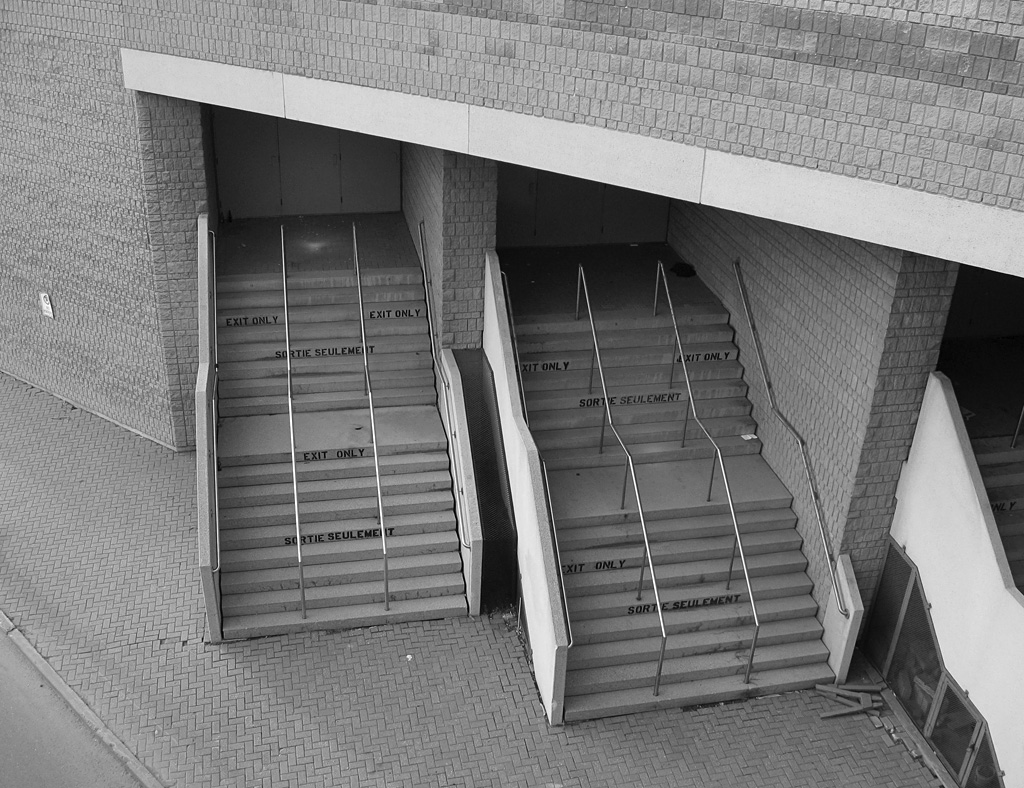
Concrete stairs

The July 5th issue of The Economist has two articles pertaining to Canada and climate change. There is one on the Dion carbon tax and another on the pine beetle infestation in our western forests. Both topics have come up here before, but remain pertinent and worthy of discussion.

The critical ongoing question in the first case is probably how effectively Dion will be able to build support for his plan. In the case of the pine beetles, it is probably the extent of the epidemic, as well as the volume of greenhouse gasses that will be emitted as a result. Despite considerable efforts to prevent it, the beetles have now become established in Alberta, having killed more than half the lodgepole pine in British Columbia. Natural Resources Canada estimates that the infestation so far will produce 990 megatonnes worth of emissions by 2020: equivalent to well over a year of total Canadian output. If they spread into the boreal forest, the ecological and climatic consequences could be massive.

Dyed panels for concentrating solar

A team from MIT may have developed a cost-effective solar collector system for buildings. It consists of panes of glass coated with particular dyes. Each pane collects light in a specific range of wavelengths and delivers it to a relatively small area of solar cells. As such, the technology would replace some relatively expensive photovoltaic components with cheaper glass ones. It would also do away with the need for moving sun-tracking mirrors.

As with many human innovations, there is a natural precedent. Photosynthetic pigments in chloroplasts help to capture the light used in photosynthesis. They too differ in colour depending on the peak wavelength being targeted, thus explaining why you can have your algae in red, brown, yellow-green, etc.

Demand and quantity demanded

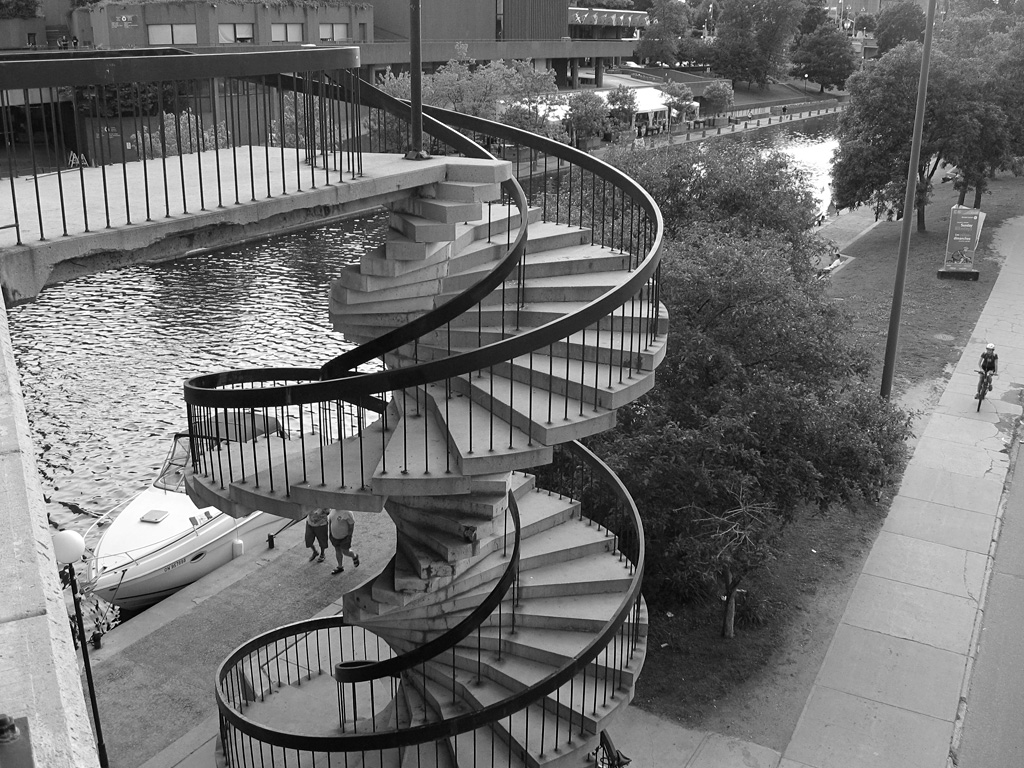
Spiral stairs beside the canal

One minor point: a lot of news coverage about energy economics confuses demand with quantity demanded. Demand is a function describing how much of a particular thing (say, oil) will be purchased at different prices. Because the quantity doesn’t change all that much when the price does, at least in the short term, this line is fairly steep when viewed on a graph using the y-axis to denote price and the x-axis to denote quantity. Quantity demanded, by contrast, is just one point on that line. At price X, people demand quantity Y. At price 2X, they demand a different quantity, based on the shape of the demand curve.

The most common error you see is statements like: “With prices at $4 a gallon, demand for gasoline has fallen” (it is the quantity demanded that has changed, in response to the change in price). An appropriate use of the term might be: “With the creation of an improved public transport system, demand for gasoline in Vancouver has fallen.” In the latter example, people demand a lower quantity of gasoline at all price levels, since a substitute for driving has become more appealing than before. In the transit example, the entire demand curve has shifted.

A more extensive explanation is available at Environmental Economics.

Green buildings and labour productivity

In an interview with the McKinsey Quarterly, Amory Lovins makes an excellent point about energy efficiency and building design:

Moreover, seldom-counted side benefits can be far more valuable than the direct savings. For instance, a typical office pays about 160 times as much for people as for energy, so a 0.6 percent gain in labor productivity would have the same bottom-line effect as eliminating the energy bill. But we routinely see not a 0.6 but a 6 to 16 percent gain in labor productivity in efficient buildings with better thermal, visual, and acoustic comfort. When people can see what they’re doing, hear themselves think, breathe cleaner air, and feel more comfortable, they do more and better work. We also see 40 percent higher retail sales in well day-lit stores, 20-odd percent faster learning in well day-lit schools, and better clinical outcomes in green and efficient hospitals. These often overlooked side benefits are frequently worth tens or hundreds of times more than the actual reduction in energy costs.

For instance, a famous aerospace building designed for day lighting gave a far faster payback than expected, because it spurred 15 percent higher productivity and 15 percent less absenteeism. The higher productivity and reduced overhead of the green building gave the company a competitive advantage in a tough contract bid. Winning that contract generated enough profit to pay for the whole building. When the Wall Street Journal was writing its third article about the building, the Journal’s reporter called me and said, “They’ve clammed up. I can’t get any data. Can you find out what’s going on?” Well, the CEO had realized that the building was an important source of competitive advantage and that they’d already said way too much about it.

In order to encourage the efficiency investments required to fight climate change, it will be important to quantify and value these kinds of co-benefits, as well as focus on developing and deploying designs that enhance them.

This is a situation where it is possible to deploy the opposite of a hair shirt environmental solution: create something that is both more sustainable and more comfortable and economically desirable. It just takes creativity, joined up thinking, and a willingness to consider at least the medium term when investing.

More on green buildings:

Carbon pricing: solo or combined?

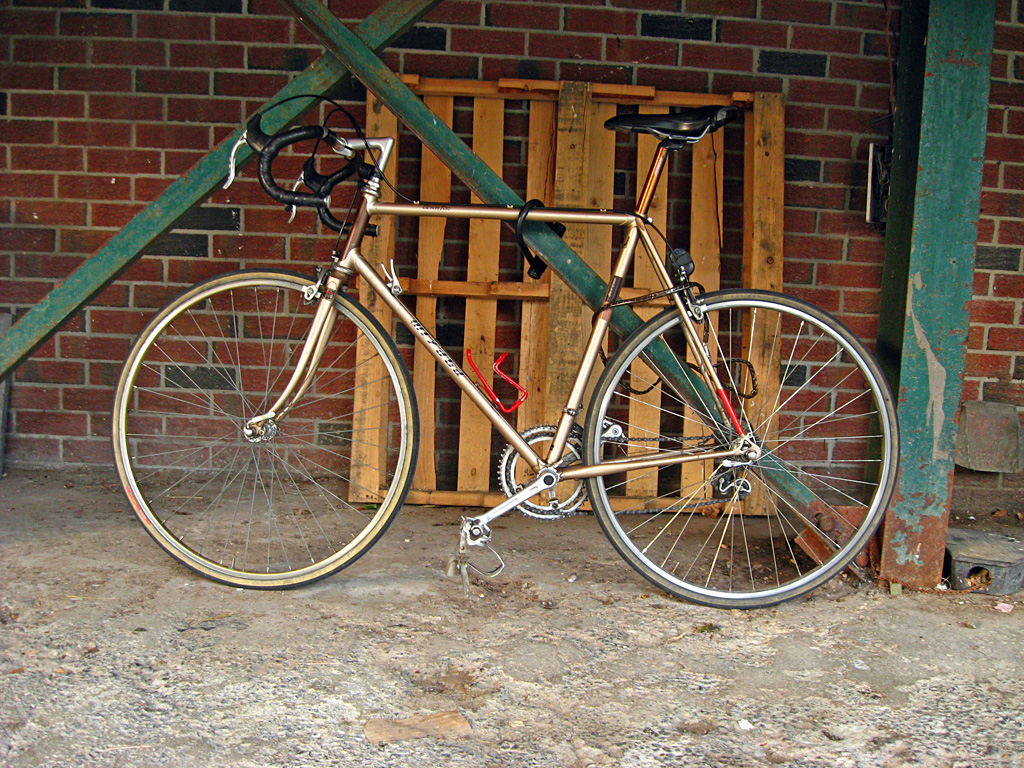
Road bike against brick wall

The basic idea of putting a price on carbon is this: whenever you undertake an activity that results in the release of carbon dioxide (or another greenhouse gas with a similar effect), you are imposing costs on those who will suffer from global warming. Since people in other states and future generations are paying most of the cost, the emitter does not properly take it into account. The cost is ‘external’ to that person’s decision about how to behave. Making the cost ‘internal’ requires imposing a tax that increases the cost of the behaviour for the person undertaking it.

Actual carbon pricing schemes (whether tax based or cap-and-trade based) also need to choose between an approach based purely on internalizing the cost of carbon and one that also seeks to advance other goals. One motivation for the second option is political; it can be used to defuse opposition to carbon pricing within groups that are politically influential. Another motivation is the ethical notion that different people should pay more or less the same amount to combat climate change. Another motivation is the pure redistributive preference that exists within some political views and ideologies.

In the end, I don’t think any of these arguments is terribly strong. It makes sense to charge more to those who pollute more. Not only is that a matter of fairness, it is a matter of prudence. Knowing that the group is going to split the bill in a way that renders shares more even, a selfish diner will consume an above-average amount, counting on those who consume a lesser quantity to subsidize him. A revenue neutral carbon tax achieves the opposite: with heavy polluters paying dividends to those who are more restrained. Granting special treatment to politically influential groups also risks reducing the effectiveness of the carbon pricing scheme, partly because it becomes more worthwhile to try to game the political system, rather than cut emissions.

A carbon price should be a mechanism through which socially optimal behaviour is encouraged and the transition to a low-carbon society is advanced. It does things best when it is not also a vehicle for income redistribution on the basis of facts not relating to carbon, such as employment sector, family status, or income. Those things can best be addressed through other areas of taxation and policy, leaving carbon pricing focused on the achievement of environmental outcomes.

‘Hair shirt’ environmentalism

Red fire escape stairs

In environmental discussions, I frequently see people deriding ‘hair shirt’ environmentalism: basically, the idea that a sustainable society should involve self-sacrifice. There are libertarian sorts who assert their right to live as they wish, without interference. There are also strategic environmentalists who believe that (a) personal sacrifice is not strictly necessary and (b) only approaches that do not call for it will succeed on a societal level.

In order to get into the analysis of this a bit, I think it makes sense to separate three basic ‘hair shirt’ positions. Each holds that it is either necessary or desirable to cut down on some collection of conveniences:

Conserve or we’re doomed

The people of Easter Island didn’t stop their wars and stone head making because they were guilted into it by hippie sorts. They stopped because their ability to sustain a society failed. Conceivably, this could happen at the level of a contemporary state, a region, or the global society.

This viewpoint includes those who think runaway climate change is a major concern, either because it is likely or because the sheer destructiveness it would bring justifies extensive precaution even in the face of a low chance of occurrence. It also includes those who think that when oil runs out we will (a) be unable to locate adequate replacement forms of energy and (b) that this will make civilization impossible to sustain.

Harm Principle advocates

These people argue that libertarians are wrong to assert that one person’s choice to fly or drive is not the business of others. In particular, there is the welfare of those alive now who are vulnerable to climate change (especially in the Arctic, in megadelta, and in small island states). There is also the matter of future generations, and the argument that it is morally wrong to pass a damaged and diminished world on to them.

For these people, it is fine to keep consuming as much energy and as many goods as desired, provided the mechanisms through which they are produced, used, and ultimately disposed of do not cause morally unacceptable harm to others. Naturally, questions about what types and levels of harm are permissible are contested.

Moral minimalists

This group argues that living a simple life is a virtue unto itself. It is split between those who simply choose to adopt such a life themselves and those who argue that others should or must do likewise. In that sense, they are a bit like vegetarians; some try to convert people willingly, others assert that there is a universal moral requirement to be vegetarian, and some are happy to let others do as they wish.

I don’t think any of the views is entirely correct or entirely incorrect.

I do believe that there are ongoing societal behaviours that run a strong risk of undermining the material basis for society, over the long term. Most critical by far is climate change. Runaway climate change would almost certainly mean the end of human civilization. Avoiding that is both prudent and a strong moral requirement. That being said, it is hard to estimate how the climate will respond to a particular collection of forcings – especially when there are tipping points to consider. It is also hard to predict what future generations will be able to do. It is possible that the end of oil will be a global disaster; it is also possible that the transition to renewable sources of energy will be relatively unproblematic.

I also believe that there are many things people in the rich world do as a matter of course that cause unacceptable harm to those alive today and those who will live. I think this is a strong moral basis for requiring behavioural change, including potentially painful changes like restricting air travel and curtailing harmful forms of agriculture.

The moral minimalists have the weakest case, when it comes to asserting the universal validity of their ideas. That being said, they draw attention to the ways in which changes in societal expectations can have big ecological effects. Think of the way in which the ill treatment of whales and primates has come to be rejected by most people. Similarly, note how nasty bogs to be cleared away have become pristine wetlands to conserve – in people’s imaginations, at least, if not in relation to their behaviour. Changes in the general worldview of a society can certainly affect sustainability: both for good and for ill.

In any case, I don’t think it is legitimate to reject the possibility that ‘hair shirt’ actions will be necessary, either on the basis of individual liberty, non-necessity, or political strategy. The strategy point I will debunk more thoroughly another time. For now, it suffices to say that telling people the transition will be relatively painless leaves you in an awkward position if it transpires that deeper (and less voluntary) changes are required.