Comprehensive storage

Your average active computer user has more and more data. The first computer I effectively administered had 170 megabytes of hard disk space. Difficult choices had to be made about the relative merits of Doom versus Simcity. Now, just my primary email account has 1500 megabytes of data in it. I have 15 gigabytes worth of photos I have taken (all since 2005) and 20 gigabytes of music.

All this has been made possible by dramatically falling storage prices, combined with the spread of broadband internet. Soon, I expect that this combination will reach its logical conclusion. Right now, people are constrained by the size of their smallest hard drive, as well as by the difficulty of accessing larger remote drives. Eventually, I expect that most people will have a multi-terabyte disk connected to the internet at high speed and securely accessible from virtually any device in the world over the internet. The biggest question is whether this will be an ‘answering machine’ or a ‘voicemail’ solution.

The answering machine option is a big disk purchased by an individual consumer (perhaps a rack of disks, so that cheaper bigger ones can be added to the array as they become available). A company that made three things easy would have a license to print money. The first is integrated ease of use. iTunes music on the big disk should be immediately accessible from a person’s laptop or iPhone, provided they have internet access. The same should be true for saved television shows, photos, etc. The second is effortless backup. It is perfectly feasible to have a disk that is big enough to ensure that the failure of any one component does not lead to any loss of data. The third is security. The big disk should be secure enough against outside attack for use in storing commercially sensitive materials; likewise, the connection between outside devices and the disks should be secure. Probably, this means different levels of access for different sorts of devices, managed through a good user interface.

The voicemail option is to leave all the kit to someone else and just buy a service. Lots of companies are moving towards this model. In many ways, it’s a lot more efficient. Maintaining adequate but not excessive space for a million users is easier than doing the same thing for one; there are also economies of scale, since you can have specialists do all the technical work. The downsides of this model are mostly security related. You need to trust the service provider to keep your data safe. You also need to trust them not to apply arbitrary constraints on how you can use it, as Apple has sometimes done.

I predict that most people will use the second model exclusively, and will pay little or nothing to do so. More technically savvy people will run their own drives, but will probably use external services for (free) unencrypted or (subscription based) encrypted backup. Personally, I can’t wait. External hard drives have the feel of a 1980s solution, rather than one that is aware of the potential of the internet.
Technological options for mitigation

Climate change mitigation technologies

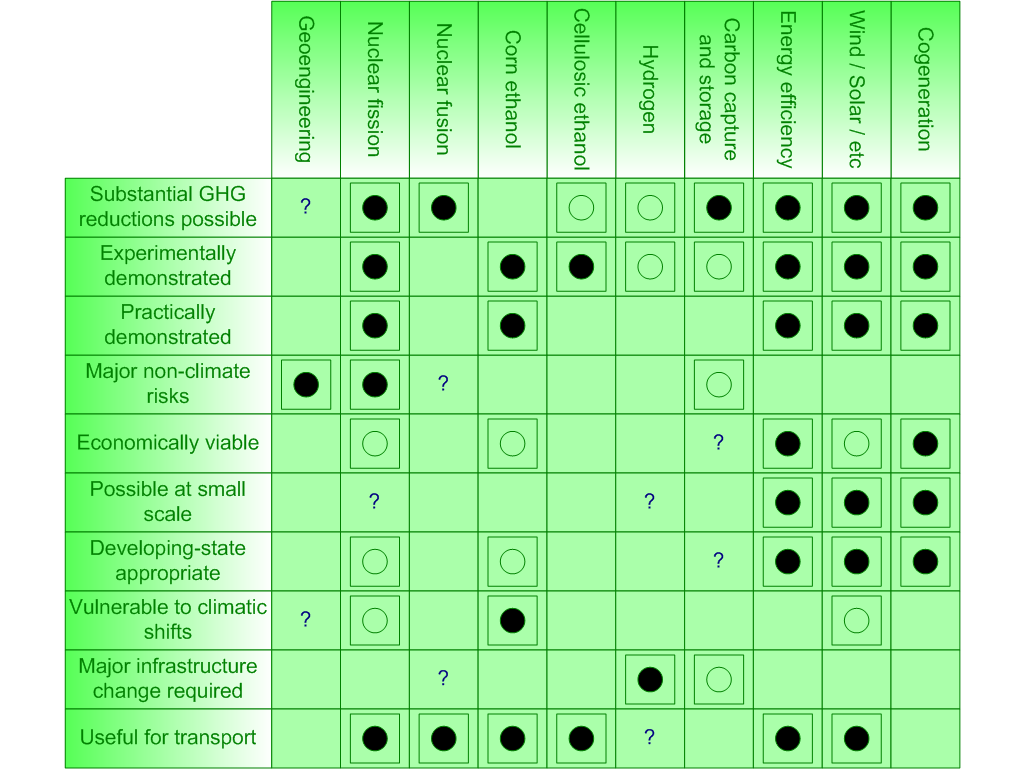
Black circles indicate a definite ‘yes,’ whereas hollow ones denote a partial ‘yes.’ For instance, it isn’t entirely clear whether nuclear fission can ever be economically viable in the absence of government subsidies. Empty squares denote a probable ‘no’ while question marks indicate situations too uncertain to render any judgment upon.

A few of these technologies are so speculative that it is hard to make a decision. That said, this is probably a relatively good summary of the state of the debate at the moment.

GHG stocks, flows, and climate change

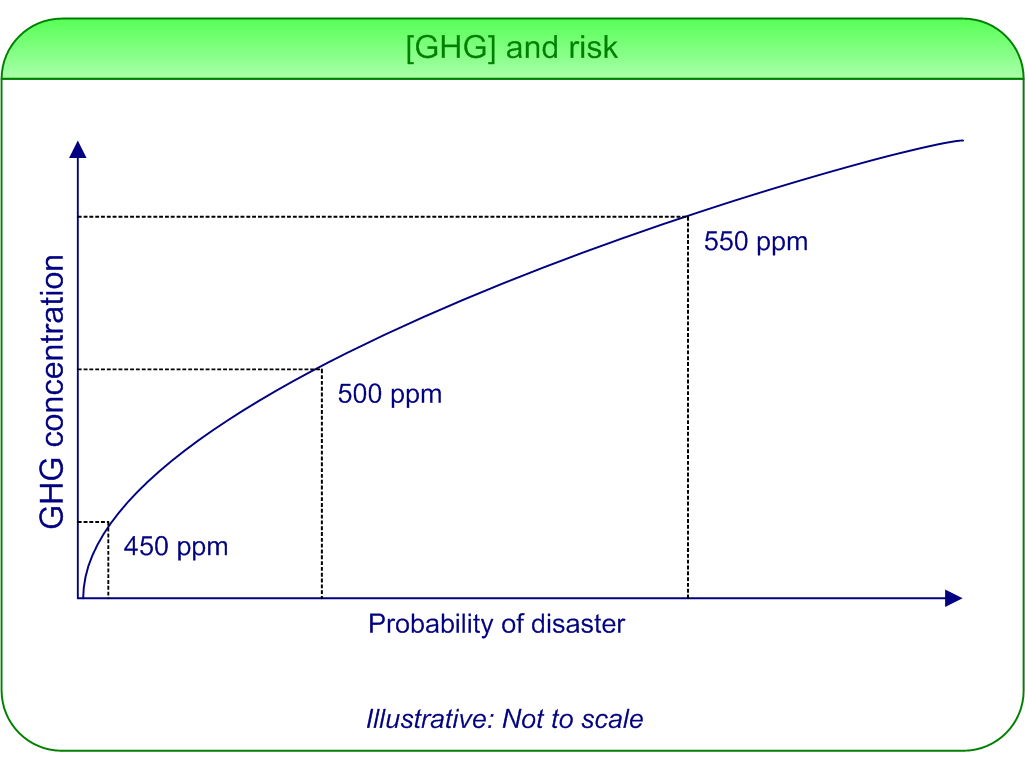
Risk of disaster and greenhouse gas concentration

[Update: 22 January 2009] Some of the information in the post below is inaccurate. Namely, it implies that some level of continuous emissions is compatible with climate stabilization. In fact, stabilizing climate required humanity to have zero net emissions in the long term. For more about this, see this post.

On this blog, I have frequently cited a figure of about 750kg of carbon dioxide per person per year as sustainable. This is just what you get when you divide the approximate level of sustainable emissions (about 5,000 megatonnes) by the number of people alive on Earth. If each person emitted that much, the net radiative forcing effect of anthropogenic emissions would be approximately zero. That means the sum of the concentrations of all greenhouse gasses, multiplied by their global warming potential, would be in balance with the capacity of the planet to absorb those gasses.

Of course, suddenly achieving the transition to 750kg each would be extremely painful. Thankfully, achieving it instantly is not necessary. Right now, the atmospheric concentration of carbon dioxide (the most important greenhouse gas) is about 383 ppm. That compares with 280 ppm at the time of the Industrial Revolution. Scientists disagree about how much that concentration can rise before extremely harmful effects start to manifest themselves. The highest number generally suggested by reasonable people is 550 ppm, a more mainstream figure is 450 ppm, and some people even argue that we have already emitted enough that very harmful effects are inevitable, once lags in the climate system are overcome. At present, unsustainable global emissions are increasing the global concentration of carbon dioxide by about 2 ppm a year.

Acknowledging the uncertainty, let’s take 450 ppm as a best guess. That means we have about 67 ppm of shoulder room left. It is vital to note that this isn’t shoulder room for total emissions to rise; in the long run, they absolutely must fall dramatically. It is shoulder room in which we can keep emitting above unsustainable levels without wrecking the planet. The situation is akin to being in a lifeboat in a hot, dry climate with a barrel of water and a solar still that produces a small amount of water per day. The 750kg each is the output from the still. The 67 ppm is approximately how much we have left in the barrel. The question now becomes how to divide it. Here are some possibilities:

  1. Continued unsustainable emissions in the developed world
  2. Continued and increasing unsustainable emissions in the developing world
  3. Additional security against abrupt or runaway change

We also have a choice about how to divide the use of barrel water across time. We might decide to drink lots of it in the early days, leaving less for later on. We might decide to save as much as we can. Of course, our capacity to do the latter is somewhat limited by the tragedy of the commons. It’s like there are a whole bunch of strangers in the lifeboat and any one can drink from the barrel without the others being able to stop them. You might end up with everyone trying to grab all they can early, even if saving most of the water for later would produce the best outcome for everyone.

Will we be able to find a way to moderate how much each person takes from the barrel? How much should we be willing to suffer in able to conserve some water for the future, or as a hedge against the possibility that 450 ppm is actually too high? These are among the toughest and most pressing questions in global climate change policymaking.

Cycle friendly London

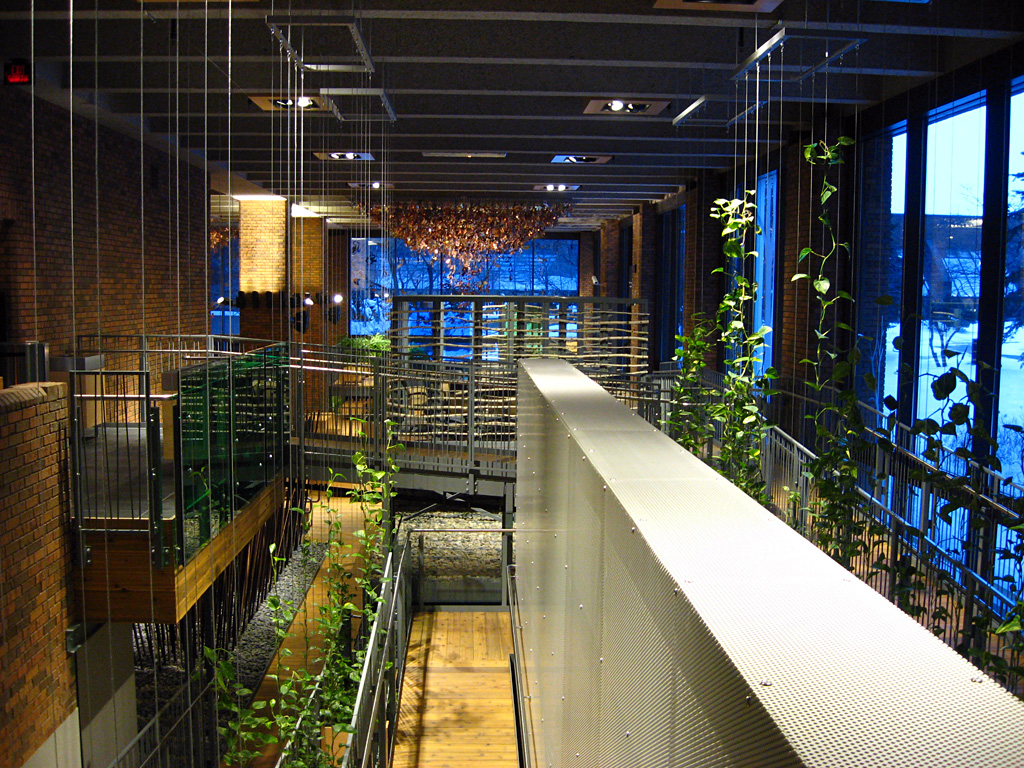
Open space in the TLC complex, Gatineau

Once again, London is demonstrating leadership in making progressive urban choices in response to climate change. The city is going to spend £500m on making London more cycle friendly: an initiative that will include 6,000 rental bikes, 12 car-free cycle corridors through the city, and an increased number of pedestrian only streets.

The bike rental scheme is modelled after a successful Parisian initiative, which was in turn inspired by successful community bicycle programs in the Netherlands. The bikes can be collected and deposited from special stalls that will be set up every 300m. The rates to be charged in London don’t seem to be available yet, but those in Paris are very reasonable: free for under 30 minutes, one Euro for an hour, and increasing progressively beyond that. The idea is to stimulate their use in making human-powered trips easier, not letting people use a bike for half a day. The Dutch seem to be the world leaders when it comes to public support for cycling, with 40% of Amsterdam traffic consisting of bikes and a 10,000 bike parking garage under construction at the main train station. Copenhagen, Tel Aviv, Barcelona, Brussels, Stockholm, Berlin, Frankfurt, Munich, Helsinki, and Vienna all have community cycling schemes of some sort.

Cities that are blessed with snow and ice-free roads year round (*cough* Vancouver *cough*) might want to think about something similar. You can’t built many kilometres of highway or subway line for £500m, but you can probably do quite a lot to promote a health-positive, community-centric, and virtually emissions-free transportation option.

Westjet v. The Canadian

For those pondering lower carbon options for traversing Canada, Via Rail has a Toronto-Vancouver train called The Canadian that makes the trip in a little over three days each way. Unfortunately, the tickets are ridiculously expensive. Even in a shared sleeper car, it costs about $1,700 round trip, compared with $500 – $600 for a much faster journey with Westjet.

The round-trip flight generates about 1,700kg of carbon dioxide equivalent, while the train produces about 727kg. It seems a bit crazy to spend three times the money and twelve times the time in order to avoid emitting as much carbon as the average Canadian does in sixteen days.

Hydroelectricity and bare winter mountaintops

Blocks of wood, identified by species

Hydroelectricity is a crucial energy source for Canada: providing 59% of the national electricity supply (and 97% in Quebec), as well as energy for things like the Kitimat Aluminium Smelter. As such, there is good reason to be concerned about changes in mountain glaciers and snowpack arising from climate change. Ideally, you want snow and ice to accumulate in the mountains during the winter. That somewhat reduces the flow of water into reservoirs, which helps prevent the need to release large quantities because the dam is at capacity. Then, during the spring and summer, you want the ice to melt, helping to keep the water level in the reservoir relatively steady and allowing the continuous production of energy without threatening riverflow-dependent wildlife or downstream water usage.

Climate change is upsetting this dynamic in several ways. Warmer winters involve less snowfall, overwhelming dams during the wet season and failing to build up frozen reserves. Hot summers increase evaporation from reservoirs and water usage by industry and individuals. Some scientific evidence also suggests that climate change is exacerbating both the intensity of rainy and dry periods: further worsening the stability of water levels and the ability of dams to produce baseload energy reliably.

Mike Demuth, a glaciologist working for Natural Resources Canada, predicts the disappearance of all small to mid-sized glaciers in the Rockies within the next 50 to 100 years. The Athabasca and 29 other glaciers feed the Columbia River, which in turn provides 60% of the electricity used in the western United States (generated by the Grand Coulee Dam, Chief Joseph Dam, and others). The low cost of energy in the area has even led companies like Google to locate their server farms in the region. Not only is the loss of our mountain cryosphere likely to cause domestic problems, it is highly likely to eventually provoke a pretty serious international conflict.

Ethanol politics

Evening sky from office window, with reflected lights

This Robert Rapier article on the politics of biofuels makes some well-worn points (about how ethanol probably takes more energy to produce than it contains, how it drives harmful land use changes, etc), it also contains some interesting new arguments. The best bit might be the politically motivated change of heart ‘straight talking’ US presidential candidate John McCain has experienced:

2003:

“Ethanol is a product that would not exist if Congress didn’t create an artificial market for it. No one would be willing to buy it. Yet thanks to agricultural subsidies and ethanol producer subsidies, it is now a very big business – tens of billions of dollars that have enriched a handful of corporate interests – primarily one big corporation, ADM. Ethanol does nothing to reduce fuel consumption, nothing to increase our energy independence, nothing to improve air quality.”

2006

“I support ethanol and I think it is a vital, a vital alternative energy source not only because of our dependency on foreign oil but its greenhouse gas reduction effects.”

The article also makes some good points about the different political situations in the various states considering ethanol as an option. China is increasingly wary on the basis of concerns about land and food. It has now put a halt to new corn ethanol projects. The EU is also concerned about the unintended consequences of ethanol. The fact that they mostly import it, rather than growing it domestically, arguably gives them greater political freedom to investigate claims about ethanol and make decisions about how good an option it really is. Political leaders in the United States and Canada may face too many entrenched farm interests to make a similarly objective judgment.

Will technology save us?

Fountain with stones and wooden edge

All sensible commentators acknowledge that asking people to make big voluntary sacrifices to fight climate change is a strategy unlikely to succeed. People will fight to keep the benefits they have acquired, as well as their capacity to acquire yet more in the future. They will turf out or overthrow leaders who demand heavy sacrifices from them – especially if people in other places are not making the same ones.

If we accept that contention, we are left with a number of possible outcomes:

  1. Painless technological triumph: technological advances allow us to stabilize greenhouse gas concentrations without big sacrifices in current or future standard of living.
  2. Disaster provoked changed priorities: a big and undeniably climate related cataclysm convinces people to buckle down for the sake of their own safety.
  3. Inaction with fairly benign climate change: people do little or nothing, and it turns out that climate change is not as harmful as predicted.
  4. Unmitigated disaster: people do nothing or act too late and slowly, causing global disaster.

Intermediate outcomes are clearly also possible. The differences between several of these have to do with unknown facts about the climate system. Will it throw up a few big and undeniable disasters before a slippery slope is reached? What is the actual sensitivity of the climate to greenhouse gas concentration increases, once feedback and adaptive effects are included?

The first option is certainly the one most popular among politicians. Virtually everyone likes technology and progress: it creates jobs and economic growth while increasing the welfare of those already alive. What big technologies are people hoping might make the difference?

  1. Renewables: sound in theory and partially demonstrated in practice. New transmission capacity and incremental improvements in efficiency required. Potentially high land use.
  2. Biofuels: politically popular but increasingly scientifically discredited. There may be hope for cellulosic fuels.
  3. Nuclear fission: works in practice, with big non-climatic risks.
  4. Nuclear fusion: promising in theory, but nobody has made it work.
  5. More efficient machines: highly likely to occur, unlikely to be sufficient, may not cut total energy use.
  6. Carbon capture and storage: theoretically viable, undemonstrated in practice. May divert attention from technologies with longer-term potential.
  7. Geoengineering: desperate last ditch option, unlikely to work as predicted.

The question of whether climate change can be tackled without a substantial reduction in standard of living remains open. So does the question of whether climate change mitigation can be compatible with the elevation of billions in the developing world to a higher level of affluence. Given the above-stated unwillingness of anyone to undergo avoidable sacrifice, we should be hoping that technology does a lot better than expected, or some potent force changes the balance of risks and opportunities in the perception of most people.

Yet more biofuel doubts

The buzz on all the energy and environment blogs today is a new article in Science raising further doubts about the green credentials of biofuels. Searchinger et al. report that:

Using a worldwide agricultural model to estimate emissions from land use change, we found that corn-based ethanol, instead of producing a 20% savings, nearly doubles greenhouse emissions over 30 years and increases greenhouse gases for 167 years. Biofuels from switchgrass, if grown on U.S. corn lands, increase emissions by 50%.

The major contribution made by this study is a quantitative estimate of how land use change in response to biofuel production affects total greenhouse gas emissions. If the displacement of alternative land uses for corn ethanol produces net carbon emission increases, you can bet your life that clearing tropical rainforest to make palm oil is markedly worse.

Atwood bike tool

Atwood bike tool

The other week, I bit the bullet and ordered one of Peter Atwood‘s excellent handmade tools. In anticipation of the summer, I ordered his bike tool. It’s about three inches long and made from Crucible‘s CPM3V cutlery steel, with a bead blasted finish. It includes 4mm and 5mm hex bits and a 15mm axle wrench, as well as a prybar. I have long admired Atwood’s work as quite beautiful but, prior to seeing the bike tool, never saw something well suited enough to something I do to justify the expense.

The appeal of the tool lies largely in the mode of manufacture. Virtually everything I have ever owned has been mass produced: clothes, electronics, furniture, tools, etc. Having something that was individually forged by a human being is fairly rare. All the logic of economics resists a production process wherein a single being completes everything from design through manufacturing to product testing, and yet it is strangely satisfying to possess something that arose from such an effort. It is that knowledge, and the value derived from it, that justifies paying a relatively high price for such an object.

All in all, this is one more reason I can’t wait for the roads to clear, allowing me to bring my bike up from the basement.