
‘Occupy’ protests being shut down

Various ‘Occupy’ protests around North America are being shut down on the orders of city governments, and apparently by means of police driving everyone out in the middle of the night and arresting those who remain. Regardless of the politics of the protestors, this is objectionable. While it is fair enough for cities to try to maintain safe conditions in the encampments, it doesn’t seem necessary to use such heavy-handed tactics to do so. They could correct potential fire hazards one at a time, clean the parks in segments without evicting everyone, and so on. The current approach seems unnecessarily violent and not respectful of the right of the protestors to speak and assemble – rights that trump superficial concerns like grass getting trampled.

An incoherent movement

While I object to the manner of these evictions, I continue to see limited value in the ‘Occupy’ protests themselves. There are definitely reasons to be concerned about things like the regulation of the financial sector and social justice issues generally. The way in which those in extreme poverty are treated by our society is deeply objectionable. At the same time, I think it is fair to say that the ‘Occupy’ movement lacks coherence and political savvy. While the particular democratic approach being employed seems to be gratifying for participants, it prevents the movement from articulating clear demands that can penetrate into the political system or even into the wider public discussion in a discrete way.

I also think the protestors have an inflated sense about their level of public support. They claim to represent 99% of the population, but it seems clear that 99% of the population does not want what they want – at least in terms of radical redistribution of income, or the wholesale modification of the corporate capitalist system that predominates in North America today. Most people are reasonably happy with the status quo, which is why the ‘Occupy’ movement is marginalized and confined to a few parks.

Part of the reason for that inflated sense of popularity probably comes from the ease with which the media can be captivated by the sort of stories the ‘Occupy’ movement produces: clashes between protestors and police, heated arguments within municipal politics, colourful signs and soundbites, and pundits arguing energetically. ‘Occupy’ has been all over the news, despite how there doesn’t seem to be a great deal of intellectual substance behind it.

The political situation

The political situation in North America is certainly discouraging for those who favour redistribution of wealth (a group that includes many traditionally identified as part of the political ‘left’). In Canada, the Liberal Party have been in disarray for years. It has performed poorly in successive elections and lacks an inspiring candidate for leadership or a clear sense of how to restore itself as a plausible government. The right is united and the left is a mess, which is the major reason why right-leaning governments have endured and strengthened in recent years.

In the United States, a left-leaning president has become quite unpopular, largely as a result of ongoing economic problems that are basically an accident as far as he is concerned. He inherited a big mess and has been fixated on trying to sort it out, fully aware that his re-election prospects depend more on that than on anything else. His efforts to produce growth and reduce unemployment have not been terribly successful (though you can argue that things would have been far worse without them) and he has sacrificed most of his other priorities to achieve what little he has on the economy. (Health is the only other area where he has devoted substantial effort, and it remains to be seen whether that will be picked apart.)

The state of the right-leaning party in the United States might be the most depressing thing about North American politics. The leadership candidates are mostly clowns, and the one who is most credible (Romney) has been driven to say some awfully discouraging things by his more populist rivals. It is deeply worrisome to see how little American Republicans care about empirical evidence and science, and frightening to think what policies would come out of a new Republican administration, regardless of which specific candidate leads it.

‘Occupy’ in context

The political left is a mess, so the prospects for more redistribution through the ordinary political system are poor. That may explain the effort to sidestep politics as usual through encampments and attempts to engage with the population directly.

And yet, I don’t think the general population is being convinced by the arguments the occupiers are making. They recognize that there are important problems being identified, but ‘Occupy’ doesn’t seem capable of managing and sustaining itself as a movement, much less of being the source for major political or economic changes in society as a whole. Their criticisms are more convincing than their proposed solutions, insofar as a clear set of proposals can even be discerned.

Eventually, some combination of official pressure, bad weather, and sheer exhaustion will probably lead to the end of the encampments. It is not clear to me that they will have any legacy worth pointing to. They demonstrate that people are unhappy with the state of politics and the economic order of society, but they do not seem like the start of an effective movement to alter either of those things.

For those who want to reduce economic inequality in society – a project that I do not fully endorse personally – I think the task that needs to be undertaken is the rebuilding of the left within conventional politics. The Liberals the the NDP need to be brought together in Canada, and they need to craft a set of policies that can appeal to a majority of the population. The same is true in the United States, in that the Democrats need to find their way after the disappointments of Obama.

Redistribution versus decarbonization

What worries me most is that the most necessary political project is not one that really has any popular support to speak of. I am talking about the preservation of the habitability of the planet. It is a task that is essential to the welfare of future generations, but which primarily requires sacrifice from the generation that is making decisions now. It may be that when you rank all the human beings who will ever live, including those in the past and those yet to be born, virtually everyone alive today is part of the 1% who are the wealthiest and most privileged.

George Monbiot captures this well, in saying: “[Decarbonization] is a campaign not for abundance but for austerity. It is a campaign not for more freedom but for less. Strangest of all, it is a campaign not just against other people, but against ourselves.”

The way I see it, extreme poverty and the treatment of mentally ill are major moral failings in North American society which ought to be prioritized within the political system. The simple redistribution of income from the wealthy to the poor and/or the middle class is a less important project, and one that is more morally questionable. The decarbonization of the global economy, by contrast, is a critically important project of enormous moral importance. It is more important than preventing future banking crises, and certainly more important than reducing the gap between those who travel by private jet and those who travel by Greyhound. Preventing future banking crises may be a precondition for decarbonization – since economic turmoil sucks the air out of politics and effectively forbids politicians from working on anything else – but that is an instrumental rather than a fundamental argument for increasing financial stability. Decarbonization also cannot survive as exclusively a movement of the left. It must become post-partisan. As such, the linkages between the movement to fight climate change and the ‘Occupy’ movement may be counterproductive in the long run.

Ultimately, I think our generation will be judged on how quickly we move beyond fossil fuels and how effectively we develop and deploy zero-carbon energy options. Decarbonization is the means by which we can reduce the terrifying risks associated with climate change, and zero carbon energy will be the basis for whatever level of prosperity is actually sustainable for the indefinite future of human life.
Keystone decision delayed

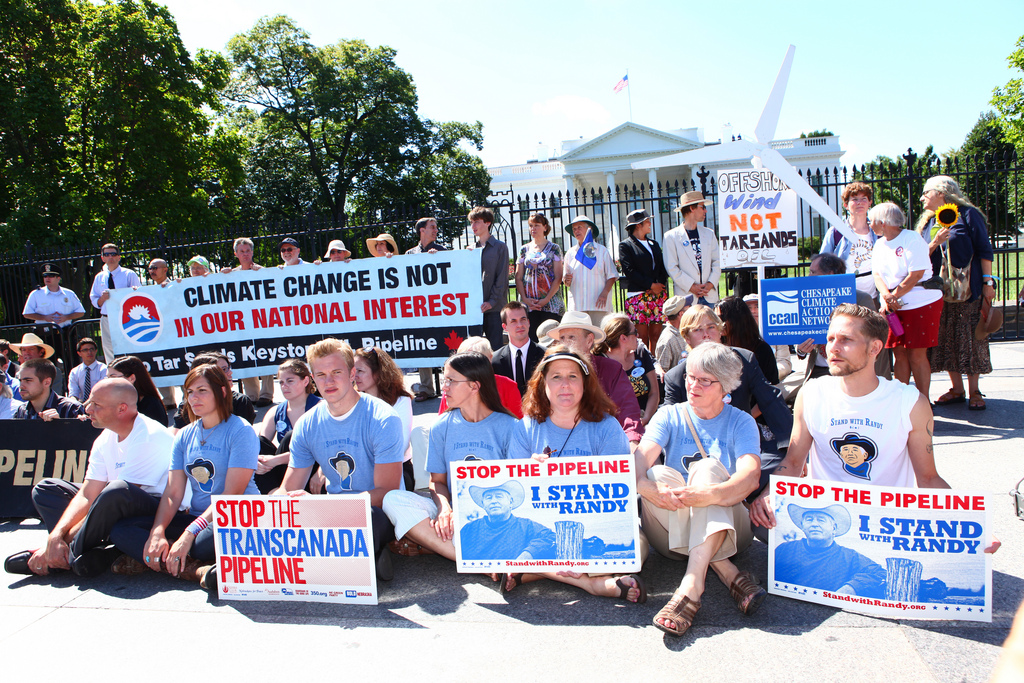
The Obama administration has announced that they are delaying their decision on the Keystone XL pipeline until after the 2012 election.

Some of the organizers of the protests in Washington are declaring victory, but I am still nervous about the whole thing.

For one thing, it is possible that Obama will get re-elected and then decide to approve the pipeline. Right now, he is worried about maintaining the support of his electoral base going into the presidential contest. After the election, he will never have to run again. Crucially, his own party will not be so worried about angering environmentalists. Right now, it is just possible that Democratic strategists are more scared of angry environmentalists than they are of Republicans. After the election, that will not be true and we are likely to see more of the same sort of compromises that have kept Guantanamo Bay open and prevented carbon pricing legislation from passing.

Of course, it is also possible that Obama will lose the election and be replaced by a Republican who is keen on digging up and importing as much as possible from the oil sands. It seems to me that having the Obama administration say no to the pipeline before the election would be preferable to them simply putting off the decision.

Even if Keystone XL is now dead, there is still more work to do. The next step is to block the Enbridge Northern Gateway Pipeline, which will seek to transport crude oil from the oil sands to the west coast of Canada. There are also plans to export oil sands crude by rail and to expand the Kinder Morgan TMX pipeline.

Bad economic news from Europe

The latest news about the sovereign debt crisis Europe is far from encouraging:

I have been examining and re-examining the situation, trying to find the potential happy ending. It isn’t there. The euro zone is in a death spiral. Markets are abandoning the periphery, including Italy, which is the world’s eighth largest economy and third largest bond market. This is triggering margin calls and leading banks to pull credit from the European market. This, in turn, is damaging the European economy, which is already being squeezed by the austerity programmes adopted in every large euro-zone economy. A weakening economy will damage revenues, undermining efforts at fiscal consolidation, further driving away investors and potentially triggering more austerity. The cycle will continue until something breaks. Eventually, one economy or another will face a true bank run and severe capital flight and will be forced to adopt capital controls. At that point, it will effectively be out of the euro area. What happens next isn’t clear, but it’s unlikely to be pretty.

It is depressing that politicians around the world have put so much effort (and money) into trying to stabilize the global economy all through the complex aftermath of the subprime crisis, and that they have not managed to do so yet. Certainly, Europe’s problems have additional causes, over and above those linked to the previous credit crunch. These include the domestic politics of countries like Greece, as well as the political and monetary design of the European Union and the Euro.

It’s impossible to predict exactly what will happen, but I very much hope the European Union is able to keep together. While there are many practical challenges associated with the project of European integration, it seems like a very positive undertaking from a human perspective. The European Union embodies the recognition that nation-states are too small to deal with the world’s problems and they need to find ambitious and effective ways of working together. That is especially true now, when economic factors threaten to undermine the whole enterprise.

Previously: Sovereign debt crises in the EU

Crime and pollution

The way in which many political conservatives are obsessed with crime but unconcerned about environmental degradation strikes me as strange and internally inconsistent. It seems to me that pollution and crime are generally objectionable for the same reasons, and that the justification for the state making effort to reduce both is similar as well.

The two types of crime that are most relevant here are those that involve financial harm and those involving physical harm to a person. Burglary is an example of the first sort, while assault is an example of the second. When someone commits a burglary or assault, they are choosing to assert their will on an innocent victim, who suffers either in terms of lost goods or in terms of personal injury or death. The state recognizes this assertion as unfair and something to be avoided, and creates and enforces criminal sanctions as a mechanism for discouraging these behaviours. We see situations in which groups of criminals have complex organizations that produce large revenues through crime as exceptionally objectionable, and exceptionally worthy of intervention by the state.

When a company or an individual chooses to emit toxic substances into the air or the water – or when they choose to dangerously alter the climate – they are imposing the same sort of harm on the general public that the burglar or the assailant does. The acid rain resulting from the operation of a coal-fired power plant could cause economic harm, such as when it kills fish or trees. Pollution also causes personal injury and death.

So how can many conservatives call for ‘cracking down’ on crime, while simultaneously criticizing environmental regulations and promising to scale them back for the benefit of business? The most plausible explanation seems to be an unwillingness of inability to look beyond the most immediate consequences of an action. When a man in a mask stabs another man and takes his wallet, it is clear what has taken place. The full consequences are less clear when a mine or factory seems to be producing useful products, generating profits, and producing employment – while simultaneously hurting or killing people through the production of toxic by-products or contribution to dangerous climate change.

From a more psychological perspective, perhaps the difference in intention is given undue weight by those who do not see crime and environmental damage as morally comparable. Perhaps criminals bear more moral responsibility because they recognize that their behaviours inescapably involve undeserved harm imposed on others. Of course, the same is true of educated polluters. It is no longer credible to claim that dumping mercury into the water or carbon dioxide into the air doesn’t harm people, or that people who choose to carry out these economic processes do not choose to produce these outcomes.

Perhaps the difference in viewpoint is logically connected to the way in which the recognition of interdependence undermines libertarianism. If you are determined to believe that people have an absolute right to undertake certain activities – such as driving in cars, flying in planes, or raising large numbers of pigs in industrial factory farming circumstances – then you must either deny the reality that these activities harm other people or implicitly argue that the people doing the harming have a right that takes precedence over the right that by-standers have to avoid being harmed.

Obviously, I don’t think either of these arguments are very convincing, which brings me back to my initial point. It doesn’t make much sense to get all hot and bothered about crime and to manifest that concern with tough new laws and longer sentences while simultaneously ignoring the harm that pollution causes to people and pressing for less restrictive regulations on polluting activities. If we respect the right of people not be be harmed by criminals, we should also respect their right not to be harmed by polluters.

Keystone protestors to surround White House, Nov. 6th

This Sunday, protestors opposed to the Keystone XL pipeline are planning to surround the White House, in Washington D.C.

If built, the Keystone pipeline would run from the oil sands in Alberta down to the Gulf Coast in the United States. People are rightly worried about the danger of spills over the long pipeline route. Far more worrisome, however, are the climatic consequences of digging up and burning all that oil. Given what we know about climate change, exploiting the oil sands is unethical. As such, efforts to block the oil in by preventing the construction of pipelines are to be welcomed.

This protest is a follow-up to the two-week protest I attended this summer. I wish I could attend again, but I am too busy with GRE prep to make the bus journey to Washington. Lots of others will be there, however, including Julia Louis-Dreyfus (Elaine from Seinfeld).

I really encourage those who are near Washington and concerned about climate change to attend. It may be needlessly divisive to say this, but I would argue that attending this protest would be far more productive and meaningful than attending one of the various ‘Occupy’ protests happening around North America. The demands of this action are focused and important. Blocking this pipeline would make a real difference for the future of the world, and it is plausible that a sufficient level of public pressure will drive President Obama to make that choice.

Please consider contributing to that pressure.

Should I switch to Aperture 3?

I now have a Mac running OS X Lion and, unfortunately, it cannot run my old copy of Photoshop CS.

Buying Photoshop CS5 is awfully expensive. Even the student and teacher edition is more than $300, while the Creative Suite is more than $500.

Aperture is only $80 from the App Store. What’s more, I would be allowed to install it on any Mac I own.

From what I have read, it definitely has better native RAW support than Photoshop CS (I don’t know about CS5).

It would mean learning some new software and probably losing some capabilities, given the degree to which Photoshop is a more comprehensive and sophisticated piece of software. Still, it might be worth trying in the interim. If it turns out to be unacceptable, I can start saving my pennies and waiting for Photoshop CS6 to be released.

Occupy Toronto

This afternoon, I had a look at the Occupy Toronto protest that is mirroring Occupy Wall Street in New York.

Most protests for causes vaguely considered ‘left wing’ attract a few people intent on advocating an unrelated cause among people who they hope will be sympathetic. At climate change protests, I have seen people concerned about nuclear weapons, oppression of the Falun Gong, Palestinian statehood, and so on.

Insofar as there were meaningful and coherent messages at Occupy Toronto, they were to reform the financial system and to redistribute income from rich to poor. Mixed in was a lot of generalized anger, and a desire to punish bankers and/or the rich.

Beside the main messages were dozens of other causes that ranged from loosely affiliated to fundamentally contradictory. All told, I question whether Occupy Toronto is coherent enough to deserve to be taken seriously. There doesn’t seem to be an awareness that many of the causes advocated by some protestors clash with the objectives of other protestors. Solidarity is all well and good, but policies ultimately need to get made that support one objective or another.

There are real questions to be asked about financial regulation and redistribution of wealth. I just question whether this movement contributes intelligently to those discussions, or whether it is more a matter of unfocused energy being released.

Getting the HPV vaccine

I decided to get vaccinated against human papillomavirus (HPV) with Gardasil. HPV causes genital warts, as well as cervical, anal, penile, and throat cancer. The vaccine covers four of the many strains of the virus – types 6, 11, 16 and 18 – including those that cause most genital warts and cancer cases.

Gardasil is normally prescribed to girls who are young enough that they are presumed to have had no sexual contact with others. Adults are assumed to have been exposed to HPV already. That is probably true in most cases. Still, there is a benefit in getting protection from the four most problematic strains, or at least any of the four that you have not already been exposed to. On that basis, doctors seem quite happy to prescribe the vaccine to adult women and men.

I got the first shot yesterday. There will be another in two months and a third in six months.

The vaccine is expensive, which is the main reason why it is not given to everybody. Still, it seems like a good investment. If enough people get vaccinated, one of the most prevalent sexually transmitted infections could be virtually eliminated and many cancer cases and deaths could be prevented.

No iPhone 5, reduced gadget envy

Apple shareholders and gadget geeks are lamenting how an iPhone 5 was not announced.

One thing that occurs to me is that owners of the iPhone 4 probably benefit. Nobody is going to feel left out or insecure because they have an iPhone 4 rather than the marginally improved 4S. A real iPhone 5, however, would have made a lot of people feel inadequate for having the ‘old’ model.

Of course, it is exactly that pattern of new gadget envy that has allowed Apple to charge such premium prices for their gear and derive such substantial profits.

Supreme Court supportive of InSite

The Supreme Court of Canada’s unanimous decision to support Vancouver’s safe injection site is very encouraging, particularly in the present political context. Overall, the direction of Canada’s policy toward illegal drugs is depressing and frustrating. We are choosing the emulate the country with the worst drug policy in the developed world – the United States. We are pursuing a hopeless policy of prohibition, while trying to shut down options with a better chance of success, such as those that seek to reduce the harm associated with addiction.

Politicians often choose to cater to the irrational fears and biases of the general population. Judges are a bit freer to consider the ethics and evidence that bear upon a situation. That seems to be what the Supreme Court has done in this case:

During its eight years of operation, Insite has been proven to save lives with no discernible negative impact on the public safety and health objectives of Canada. The effect of denying the services of Insite to the population it serves and the correlative increase in the risk of death and disease to injection drug users is grossly disproportionate to any benefit that Canada might derive from presenting a uniform stance on the possession of narcotics.

Hopefully, this ruling will prompt a broader rethink of how Canada deals with drugs that are currently prohibited.

Related: