I am a values voter

The term ‘values voter’ is usually linked with social conservatism in the United States – people who want to stop the scourge of gay marriage, and so on. At the same time, the phrase is a useful and concise way to describe those who care much more about moral issues than economic self-interest, when choosing which political parties or candidates to support.

I care a lot more about whether a political party supports meaningful action on climate change than I do about what promises they make about the level of taxes I will pay or transfers I will receive. Even if a party offered to cut the income tax to zero for people making exactly the amount I do, I would not vote for them if they advocated intolerable policies in areas like minority rights or free speech.

Of course, we can only choose from among the candidates and parties on offer and there is invariably a serious problem with each of them. Still, in choosing the least of the evils on offer, the main considerations concern values rather than personal welfare.

Voting for moral reasons is an act that conforms to the golden rule. It is better for everyone if people refuse to be bought off with the promise of tax cuts or special spending. When people accept such vote-winning strategies, they become commodities to be bargained over by power-broker political factions rather than engaged citizens that care about the kind of society they inhabit.

Consumer surplus

One advantage of big corporations is that size and focus can allow them to be efficient. Having a bunch of amateurs manufacture one lightbulb would be quite an undertaking. The same goes for untrained individuals trying to do things like file complicated taxes or cut their hair. When you have a group of trained people with appropriate support doing the task in large volumes, the difficulty and cost can be reduced.

Some of that benefit goes to the corporation in the form of producer surplus. This is the difference between what it costs them to provide a good or service and what price they are able to sell it for. If an iPad costs $200 to make and Apple can sell it for $500, their producer surplus is $300.

There is, however, another side to this coin. Products are often cheaper than the maximum price consumers would be willing to pay for them. I might be willing to pay $750 for an iPad, and be happy to find they only cost $500. That $250 is a consumer surplus that I can use for other purposes.

The relative size of the consumer and producer surplus depends on the shape of the supply and demand curves. In some situations, most of the difference between production cost (which includes things like the costs associated with the retail sale of items) and sale price will go to the corporation. In other situation, most of the surplus goes to the consumer.

In either case, the efficiency of the corporation contributes to the size of the overall surplus, and therefore to the opportunities for both parties to benefit. General Electric producing 1,000,000 compact fluorescent bulbs and selling them for $2 a piece produces a lot more benefit for a set quantity of inputs than having each of us try to make them for ourselves using whatever glass and mercury we have lying around.

Fixed expenses

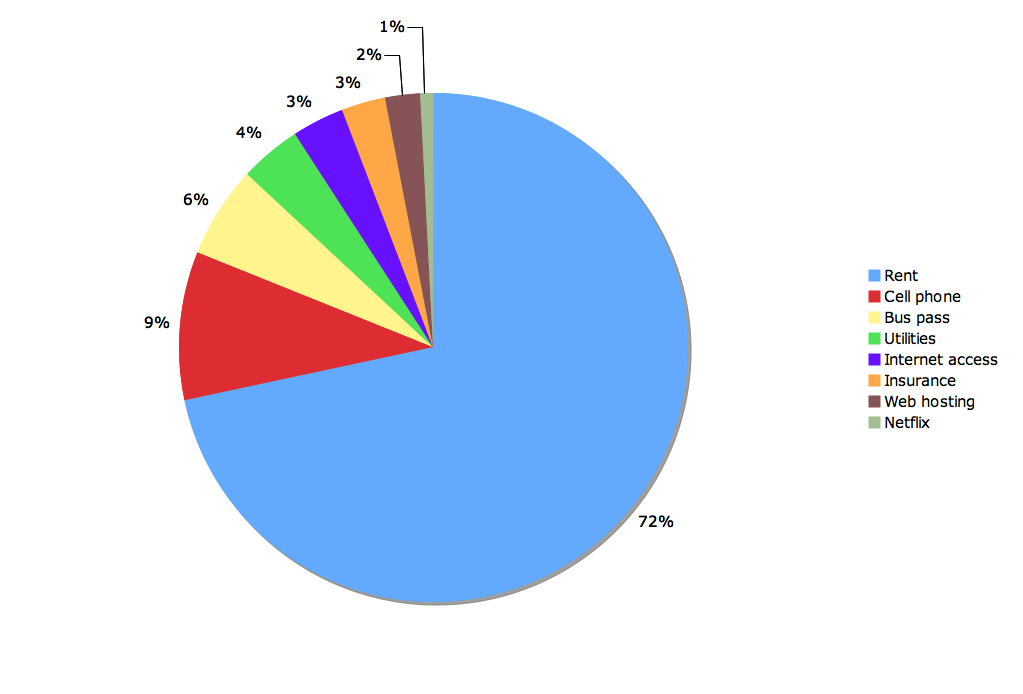
Given job uncertainty, I have been trying to save and create a buffer for any troublesome periods in the future. That has had me looking at my expenses, particularly at the recurrent ones that arise every month.

Some of those expenses I took on knowing what their extent would be. Others, like my cell phone and web hosting charges, have been steadily creeping up with time.

It is quite possible that whatever job I end up in long-term will pay dramatically less than my current one, and be less secure to boot. With that in mind, I should remain aware of opportunities to squeeze down these expenses. Moving somewhere cheaper is the obvious option, and almost probably something I will do if moving to Toronto.

Quirky shops

Big box stores like Staples and Future Shop operate according to a kind of ruthless logic. They sell products that are manufactured in gigantic quantities, and require concessions from their makers in exchange for making them available. They expect a certain level of theft from outsiders and employees, and provide a basic level of training that improves profitability a bit without increasing costs much. They may not always do well financially (see Blockbuster), but such stores are driven by thinking that goes beyond the whims of one human being.

This is not true of smaller shops. Indeed, some such places have wildly incongruous lines of business meshed together. The owner of a newspaper and magazine shop may have an interest in U.S. Civil War miniatures, so there they are on sale in a display case. The owner of a tobacco shop may be knowledgeable about high-end audio equipment, so expensive microphones may be available for purchase alongside pipes and cigars.

I suppose something similar happens with sprawling business empires created by a single person. They start off making concrete and stick with it, even when cell phones have come to represent 90% of their profits. They see a deal in the form of a tire manufacturing company or a small bank, so they add it to the sprawling expanse of their holdings.

This approach may be a bit random and inefficient, but it is also a bit charming. It reflects the diverse quality of interests that individuals maintain and so, in that sense, this approach is more human than the robotic rationalization of stores like Staples. Charm aside, however, chains and business conglomerates that focus on doing well at their core line of business probably do better overall both for themselves and for their customers.

Extinction logic

Living things are frequently presented with choices that involve a time trade-off. There is an immediate effect, and then there is a delayed effect. For example, you can quit your job today because you hate it, but may need to deal with delayed effects in a few weeks when your rent comes due, along with cell phone bills and all the rest. Sometimes, the delayed effect involves a different creature entirely from the immediate effect. For instance, a person assembling an automobile can do a shoddy job of assembling the steering or braking system, leaving some hapless future driver to deal with the consequences.

When the space of time between the two effects is long, there is more of an incentive to ignore the delayed effect. You might not be around (or even alive) to experience it. The same is true when the delayed effect is uncertain. Presented with the choice between something 100% likely to pay off right now, but only 50% likely to have a cost in the future, there is an incentive to take what you can get right now.

The biggest incentive exists when the creature that will suffer the consequences is totally unrelated to you. This situation is omnipresent in politics. Politicians are judged on the effect they seem to be having right now. Little consideration is given to consequences down the road and, by the time any such consequences have arisen, the politician and the people who voted for them are likely to be long gone, or at least no longer associated with the situation in the minds of the public. Also, because decisions impact one another, responsibility for outcomes usually gets hopelessly muddled. What actually occurs on the long-term is the cumulative consequence of choices made by different individuals, firms, and governments along with a large dose of random chance. A particular outcome – like a firm going bankrupt – cannot usually be attributed to a single cause. Rather, it must be said that various policies at different levels of government had an effect, along with managerial choices and technological change, not to mention relevant developments in other countries, etc.

All this seems to pose the risk of creating dangerous ratchet effects, where movement in one direction is possible but movement in the other is impossible or unlikely. While there may be situations in which the temptation to make some easy money in exchange for causing long-term problems will be rejected, those opportunities are going to keep arising and the people calling for a conscientious approach will not always win out. Indeed, they are likely to fail quite often, given that the people chasing the quick buck will quickly end up with goodies for themselves and for their supporters. A community might be able to resist the temptation to blow up a local mountain to access the coal inside on a series of successive occasions, but the choice not to do so is always temporary. By contrast, the one time when they decide to go with the dynamite approach closes off any possibility of restoring things to how they once were.

Whereas we have a strong personal interest in looting the future for our own immediate benefit, there is only really our sense of moral and aesthetics that holds those urges in check. Those senses often turn out to be very weak. Furthermore, the world will tend to select against people who take the long view. In the near-term, they seem like spoilers who forced everyone else to pass up a good opportunity. In the long term, the causes of outcomes are all muddled together, so the people who urged restraint probably won’t get any credit for what they protected. They also may not be around to benefit from any credit, if it is provided.

None of the ideas here are new, but the cruel logic I am trying to express seems to be extremely powerful and one of the strongest things working against humanity in the long term. If we are going to survive another 10,000 years, we are going to need to learn to discipline ourselves, and to support those who impose discipline upon us. We cannot just keep looking out for our personal short-term interests and hoping things in general turn out for the best.

Retiring the Shuttle

This year, after 29 years in operation and two catastrophes, the American Space Shuttle program is shutting down. The Shuttle was always a hacked-together prototype vehicle, never the cheap and dependable satellite-launching workhorse that NASA seemed to promise Congress. Lots of effort and brilliance went into the thing – make no mistake – but trips to space have never been safe or routine.

The Wikipedia entry on the Shuttle details just how costly the thing was, as a way of putting objects 300 or so kilometres above the Earth:

When all design and maintenance costs are taken into account, the final cost of the Space Shuttle program, averaged over all missions and adjusted for inflation, was estimated to come out to $1.5 billion per launch, or whopping $60,000/kg to LEO [low Earth orbit]

There are things that are worth putting into orbit at those prices – chiefly communication satellites and others designed to observe our planet and the wider universe. Human beings probably aren’t worth it, for now at least. The process of getting out of the atmosphere is perilous and costly, and there is nowhere remotely habitable to go, once you get up there.

Test for a sentient species: can you run a planet?

In the very long term, the survival of the human species depends upon developing the capability to colonize other planets. Earth is always vulnerable to major asteroid and meteor impacts, and there will come points billions of years in the future when the carbon cycle ends and when the sun becomes a red giant.

As of today, however, humanity has more pressing problems. Indeed, it is not at all clear that humanity will be able to survive the next few centuries. We continue to abuse the planet – exhausting non-renewable resources and accumulating dangerous wastes. At the same time, the world is still wired up for a Dr. Strangelove-style nuclear war, with thousands of cities incinerated with thermonuclear bombs, followed by nuclear winter.

In a way, perhaps overcoming those challenges and any others that arise in the next few centuries will be an important test for humanity. If we were to spread through the galaxy now, we would arguably be spreading as a malignancy: a species that cannot manage itself, and which brings the risk of ruin to any place it visits. If we can spend the next few centuries producing a global society that is safe and sustainable, perhaps we will have gained the maturity to carry something valuable outwards – something that better represents the potential of humanity, when compared with the messes we have produced for ourselves at this stage in history.

10 billion humans in 2100

The population division of the United Nations now estimates that the global human population in 2100 will be 10.1 billion.

While it is challenging to comment accurately and appropriately on the consequences of global population growth, it does seem fair to say that the difficulty associated with providing any particular global standard of living increases as the total global population does. In particular, providing energy for ten billion people to live decent lives – without wrecking the climate – seems like it will be a major undertaking.

Where paywalls might work

Making internet browsers pay for content is a big challenge. No matter how good your stuff is, chances are someone is giving away something similarly good for free. As such, most websites opt to fund themselves through advertising.

One place paywalls do seem to have promise is for sites that people access for work-related reasons. Then, the situation is akin to the subscriptions universities have to databases of journal articles. Their staff need them, and so the organization pays the subscription fee. That’s a model that news organizations might be able to use, given that the work of many different people is affected by the information they provide.

STRATFOR is one organization experimenting with different funding models for information online. They probably have some institutional subscribers, but they also advertise directly to interested individuals, sometimes offering significant discounts to lure those whose demand is more elastic.