
Physics query: lost in space

Here is a physics question Emily and I were debating recently: Imagine you are floating in deep space, a few metres from your space ship. All you have are a space suit – from which nothing can be vented – and a bowling ball in your hands. The obvious way to shift yourself towards your ship is to throw the ball in the opposite direction. If you are very patient, you could also (a) wait for your ship’s gravitational field to draw you in or (b) release the bowling ball, letting it hit you and push you back.

Is there any way to generate movement towards the ship without releasing the ball? My contention is that any way you can move it without letting go will only put you in some kind of spin, it will not actually move you towards your ship. Basically, this is because Newton’s third law ensures that any collection of actions will be self-compensating. Am I right to believe so?

Note: One major reason for confusion about this is because we are used to situations in which it is possible to push off something. When you stand on the ground and hurl a ball on earth, both your mass and that of the earth absorb the equal and opposite force. Those floating helplessly in space have no such luxuries.

Dating with carbon-14

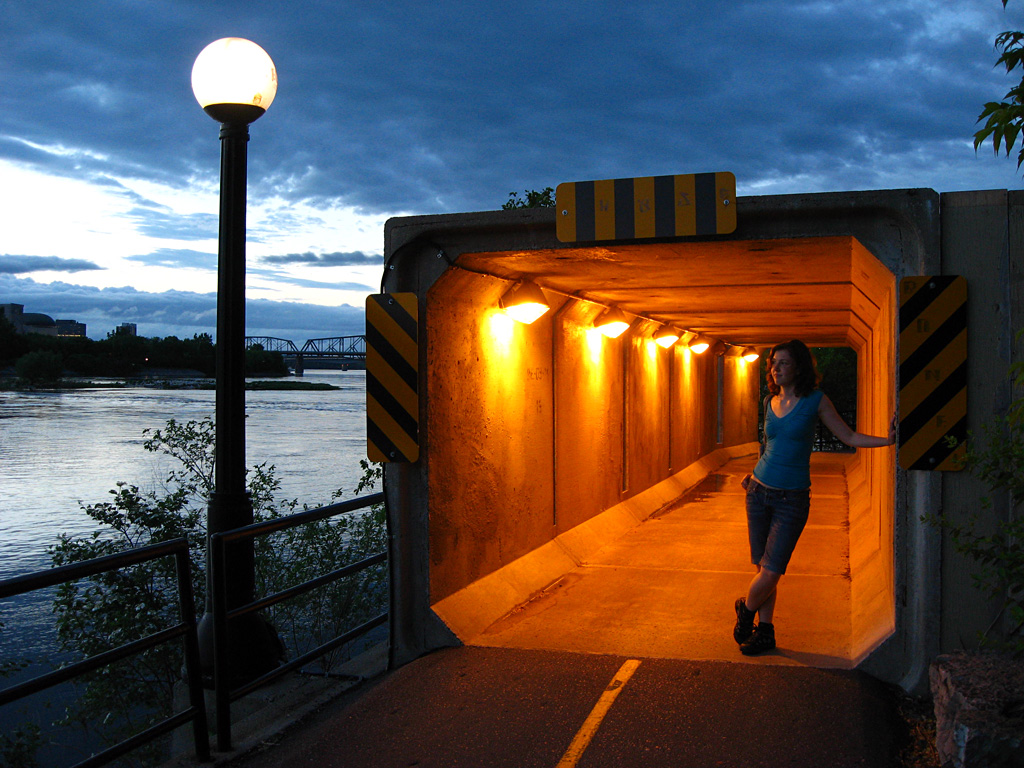
Emily Horn in tunnel on Ottawa River Pathway

When cosmic rays strike the atmosphere, they produce a radioactive isotope of carbon called carbon-14. This carbon gets absorbed from the atmosphere by living things. Once they die, they stop absorbing it. Since it continues to undergo radioactive decay after death, the ratio of carbon-14 to ordinary carbon declines in a predictable way in dead organic matter. This is the basis for radiocarbon dating.

When the great powers started testing nuclear and thermonuclear bombs during the Cold War, they doubled the ratio of carbon-14 to carbon-12 in the atmosphere. One consequence is the need to avoid contamination when radiocarbon dating. Another odder consequence is that you can determine the age of any person born since the tests began by looking at how much carbon-14 is in various layers of their tooth enamel. You just need to know whether they lived in the northern or southern hemisphere.

Of course, there are usually easier ways to determine the age of a living or dead human. This is just a demonstration of the extent to which the nuclear age is literally imprinted upon all those who live within it.

Statistics in cryptanalysis and paleoclimatology

Reading Wallace Broecker‘s new book on paleoclimatology, I realized that a statistical technique from cryptanalysis could be useful in that field as well. Just as the index of coincidence can be used to match up different ciphertexts partially or completely enciphred with the same key and polyalphabetic cryptosystem, the same basic statistics could be used to match up ice or sediment samples by date.

As with the cryptographic approach, you would start with the two sections randomly aligned and then alter their relative positions until you see a big jump in the correlation between them. At that point, it is more likely than not that you have aligned the two. It probably won’t work perfectly with core samples – since they get squished and stretched by geological events and churned by plants and animals – but an approach based on the same general principle could still work.

Doubtless, some clever paleoclimatologist devised such a technique long ago. Nonetheless, it demonstrates how even bits of knowledge that seem utterly unrelated can sometimes bump up against one another fortuitously.

The index of coincidence

Purple irises

If you are dealing with a long polyalphabetically enciphered message with a short key, the Kasiski examination is an effective mechanism of cryptanalysis. Using repeated sections in the ciphertext, and the assumption that these are often places where the same piece of plaintext was enciphered with the same portion of the key, you can work out the length of the keyword. Then, it is just a matter of dividing the message into X collections of letters (X corresponding to the length of the keyword) and performing a frequency analysis of each. That way, you can identify the cipher alphabet used in each of the encipherments, as well as the keyletter.

If the key is long, however, it may be impossible to get enough letters per alphabet to perform a frequency analysis. Similarly, there may not be enough repetitions in the key to create the pairings Kasiski requires. Here, the clever technique of the index of coincidence may be the answer.

Consider two scenarios, one in which you have two strings of random letters and one in which you have two strings of English:

GKECOAENCYBGDWQMGGRR
VQNWSKXMJWTBKCCMRJUO

TOSTRIVETOSEEKTOFIND
SOWEBEATONBOATSAGAIN

At issue is the number of times letters will match between the top and bottom row. When the strings are random, the chance is always 1/26 or 0.0385. Because some letters in English are more common and some are less common, a match is more likely when using English text. Imagine, for instance, that 75% of the letters in a normal English sentence were ‘E.’ Any two pieces of English text would get a lot of ‘E’ matches. Even if enciphered so that ‘E’ is represented by something else, the number of matches would remain higher than a random sample.

Since polyalphabetic ciphers involve enciphering each letter in a plaintext using a different ciphertext alphabet, an ‘E’ in one part of a ciphertext need not represent an ‘E’ somewhere else. That being said, as long as you line up two ciphertext messages so the letter on top and the letter underneath are using the same alphabet, you will get the same pattern of better-than-random matches for Englist text. Imagine, to begin with, a message enciphered using five different alphabets (1,2,3,4 and 5). Two messages using the same alphabets and key (say, 54321) could be ligned up either in a matching way or in an offset way:

543215432154321
543215432154321

543215432154321
321543215432154

Note that these strings describe the alphabet being used to encipher each plaintext letter, not the letter itself. In the second case, the probability of a match should be essentially random (one property of polyalphabetic ciphers is that they flatten out the distribution of letters from the underlying plaintext). In the second case, we would get the same matching probability as with unenciphered English (0.0667). We can thus take any two messages enciphered with the same key and try shifting them against each other, one letter at a time. When the proportion of matches jumps from about 0.0385 to about 0.0667, we can conclude that the two have been properly matched up. This is true regardless of the length of the key, and can be used with messages that are not of the same length.

This doesn’t actually solve the messages for us, but it goes a long way toward that end. The more messages we can collect and properly align, the more plausible it becomes to crack the entire collection and recover the key. This method was devised by William F. Friedman, possibly America’s greatest cryptographer, and is notable because anybody sufficiently clever could have invented it back when polyalphabetics were first used (16th century or earlier). With computers to do the shifting and statistics for us, the application of the index of coincidence is a powerful method for use against polyalphabetic substitution ciphers, including one time pads where the operators have carelessly recycled sections of the key.

Ways to generate electricity

Trying to think systematically about electricity, I am making a list of all the basic ways it can be produced. Here is what I have so far:

Most of our power plants are of the first kind, using kinetic energy from falling water, wind, or hot water boiled using nuclear or fossil fuels. There is a smattering of PV capacity around, and wave power stations might eventually use piezoelectricity. Chemically generated electric current has niche applications and thermocouples are used along with radioactive materials to power some satellites.

Are there any basic forms I am missing here? Are any of these actually manifestations of the same phenomenon?

Capturing waste heat

Insect on pink flower

Comment threads on this blog have previously been rife with discussion about boosting the efficiency of industrial processes through the use of waste heat. It does seem intuitively undesirable to have something like a nuclear power plant venting a significant portion of the total energy being expended from fission in the form of hot air or water being dumped out into the natural environment.

A machine installed at Southern Methodist University demonstrates that there are situations where waste heat can produce a decent amount of electricity (50 kilowatts) at an acceptable cost, and with a payback period of just three or four years. The machine uses an Organic Rankine Cycle, in which a high molecular mass organic fluid is used to convey the waste heat. This is necessary to produce useful work, and eventually electricity, from relatively low temperature sources. As energy prices continue to rise, you can expect to see more such equipment being developed and deployed.

Rommel and cryptography

One of the most interesting historical sections so far in David Khan’s The Code-Breakers describes the campaign in North Africa during WWII. Because of a spy working in the US embassy in Rome, the American BLACK code and its accompanying superencipherment tables were stolen. This had a number of major tactical impacts, because it allowed Rommel to read the detailed dispatches being sent back by the American military attache in Cairo.

Khan argues that this intelligence played a key role in Rommel’s critical search for fuel. His supply line across the Mediterranean was threatened by the British presence in Malta. Knowledge about a major resupply effort allowed him to thwart commando attacks against his own aircraft and turn back two major resupply convoys. It also provided vital information on Allied defences during his push towards Suez.

The loss of Rommel’s experienced cryptographers due to an accidental encounter with British forces had similarly huge consequences. It cut off the flow of intelligence, both because of changed codes and loss of personnel. As a result, the Allied assault at Alamein proved to be a surprise for Rommel and an important turning point.

As with so many examples in warfare, this demonstrates the huge role of chance in determining outcomes. Had security been better at the embassy in Rome, Rommel might have been stopped sooner. Had the German tactical intelligence team not been intercepted, Rommel might have had detailed warnings about Alamein. The example also shows how critical intelligence and cryptography can be, in the unfolding of world affairs.

Linking to relevant news

One thing that I try to do on this site is accompany posts on all topics with links to related materials: both in terms of what I have written and what is out on the wider internet. One way I do this is by leaving comments that link to and quote from relevant news stories and websites. By convention, these comments are attributed to ‘.’ since it doesn’t take long to write and cannot easily be confused with a real person.

Readers who come across relevant stuff that they simply wish to link, rather than say anything about, are encouraged to use the convention as well. If you use ‘dot@sindark.com’ in the box for the email address, your comment will have the ‘Just some news’ gravatar placed beside it.

A tempting camera

I seem to have stumbled across a camera that is, in many ways, ideal for me: the Ricoh GR Digital. My reasons, in roughly decreasing order of importance:

  • 28mm is my favourite focal length; it provides the perspective that comes most naturally to me when composing images. It is as wide as my best SLR lens goes, and I almost invariably use the widest focal length on my A570IS. Having a prime lens means (a) more light hitting the sensor and (b) potentially sharper images.
  • The camera is versatile in terms of aspect ratios: with options for 4:3 (standard digicam), 3:2 (standard film), and 1:1.
  • The camera is small enough to carry around, unlike a digital SLR.
  • The camera is made of metal. (An advantage provided the weight is tolerable.)
  • The camera can shoot in RAW format

That being said, it does seem a bit strange to spend $700 on a fixed-lens point and shoot camera when you can get a DSLR kit (something like the Digital Rebel XT) for a couple hundred more dollars. The DSLR is far more versatile and capable overall. That being said, my Elan 7N has spent the last year gaining dust in its case; my point and shoot digicam, by comparison, basically only leaves my side when I am in the shower.