Web 2.0 wandering

Muddy river near The Trout

A post on Metafilter led me to a long-winded essay about why blogging is a fundamentally cynical activity. Then, a comment on the MeFi post led me to a page that randomly generates text that sounds like a piece of postmodern criticism. It was amusing and memorable enough to add to del.icio.us. From the blog run by the person who wrote the script, I found the video to Pink Floyd‘s “High Hopes,” which looks like the recollections of someone who did far too many drugs while they were at Oxford. I recognize the type of places, but not the places themselves. It must be Cambridge.

The above is some kind of amazingly self-referential romp around some of the cleverer sites out there driven by user-submitted content. These people are the “You” that Time Magazine saluted. Collectively, the contemplation of all this technology and effort gives one a sense of trivial empowerment. It’s interesting, and it takes up time, but it doesn’t get us anywhere. At least, no more so than sitting around and listening to music. At least, in its curious way, it is a social activity.

Sandwich economics

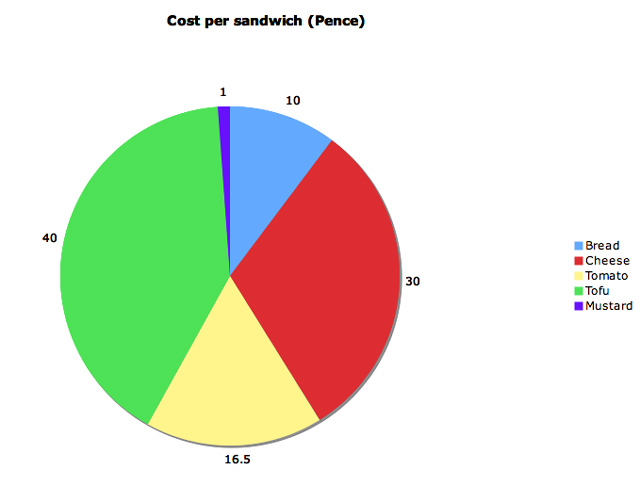
The following is a factor price breakdown for the combination that comprises more than 80% of my lunches (n=28):

Sandwich factor pricing

The cheese in question is either Cheshire or Wensleydale: certainly the two best foodstuffs that I have experienced for the first time while in England.

The surprising factor is clearly the cost of tofu. That said, I do use about 62.5g worth per sandwich. It still seems unfair that the least tasty part of the sandwich should cost the most. If I do end up going to London this weekend – as now seems highly likely – I can pick up some much lower cost tofu in the small Chinatown there.

MacWorld 2007 keynote

Peacock near The Trout

Sure Apple gets millions worth of free advertising by releasing its products in their glitzy, spectacular way. At the same time, it is hard for a geeky Mac fan not to comment.

Everyone expected Apple to announce the iPhone at Macworld, though there does seem to be more to this device than most people expected. Everyone expected it to be an iPod and a phone, in this case it has 8GB of storage, and most expected it to be widescreen. The two megapixel camera is probably pretty poor – as telephone cameras universally are – but it could be useful regardless. The biggest surprise is that the thing runs OS X, rather than the proprietary and limited systems generally associated with smartphone and Blackberry type devices. Combined with the embedded sensors (proximity, ambient light, and an accelerometer), I imagine people are going to come up with some pretty amazing hacks for these devices.

The iPhone is a quad-band GSM + EDGE phone with WiFi and Bluetooth 2.0. A lot of people probably expected it to be 3G, but this is a better move for Apple. 3G has pretty much been a disaster for everyone who bet on it. The fact that it seems capable of talking to WiFi networks is also a big plus, especially if it can be used to do VoIP in an elegant way. The fact that it does not is unsurprising, but also a letdown. I am personally looking forward to the days when mobile phones automatically form mesh networks to pass traffic between themselves. That would circumvent the need for network infrastructure for calls within densely populated places and really change the business circumstances in which cellular service providers found themselves.

The mundane issues are more what concerns me: it looks like the starting price is US$499 for a 4GB model and US$599 for the 8GB and they will start shipping in June. Those prices are based on signing up for a two year phone contract, also. There’s no way it makes sense to buy the release version, as there are usually a couple of serious flaws that get sorted out in the next version. (Not that I will be spending $600 on such a device any time in the foreseeable future.) The battery life is supposedly sufficient for five hours of talk time and sixteen hours of audio listening. If true, that is better than my iPod Shuffle, and enormously better than my old 20GB 4th generation iPod.

Like a lot of people, I am curious about whether this device will stand up to everyday abrasion better than the iPod Nanos do. There’s also no way I would even consider buying this platform before Skype or something similar can be run on it.

Citable citation

Tree and blue sky

My congratulations go out to my friend Lindi Cassel: the first person who I know personally (as in ‘used to make stick figures out of kneadable eraser while in biology class with’) to get cited on Google Scholar:

Cassel, Lindi and Peter Suedfeld. “Salutogenesis and autobiographical disclosure among Holocaust survivors.” The Journal of Positive Psychology. Volume 1, Number 4 / October 2006. p.212-225.

While the subject matter is certainly sobering, the publication is extremely impressive, like so much else about Lindi. Bravo.

GMail security hole

Path to Marston

As people who read techie news pages like Engadget and Slashdot already know, a somewhat serious security flaw in GMail has recently been uncovered. Specifically, when you are logged into GMail in one browser window or tab, any other site you visit can grab your entire contact list. Whether that is a serious leak or not is a matter of perspective. Certainly, it exposes all of your friends of even more spam than they already receive.

Read the following carefully before you click anything. If you want to see the script that grabs contact lists at work, follow this link. Engadget says it’s “non-malicious,” but the risk is yours. The bug arises from the way in which GMail stores your contacts as a JavaScript file that can be requested by other websites. Google claims they have fixed the bug but, as the link above will prove, they have not.

Plausible attacks

A site that wanted to be really sneaky could exploit this information in many ways. At the very least, it could be used to very easily identify many of the people who are visiting. Knowing someone’s contact list might help in the launching of phishing attacks. It could, for example, make it easier to work out what company someone works for. You could then find out who does their information technology and send spoofed emails that seem to come from the IT department, asking for passwords or other sensitive information.

If it is a site that contains content that many people would not want others to know that they view, it could grab the email addresses for people with the same last name as you and threaten to send them information on your surfing history. A less complicated ploy would be to use emails that seem to come from people who you know to get through spam filters. Because of email spoofing, it is very easy to make messages seem to be coming from someone else.

Implications

As someone with 1037 MB of data in my main GMail account – including 14,410 emails and more than 1500 instant message conversations – I am naturally very concerned about GMail security. There is tons of stuff in there that I would be profoundly opposed to seeing on a public search engine, as has already happened in at least one case with private GMail data.

Contrary to their own assertions, Google had analysed and indexed all e-mails processed through their mail service. Due to a mistake made by an administrator, a database of the highly secret project was mirrored onto the external index servers, and as a result, the private mails of thousands of GMail users could be accessed via the search front-end for at least one hour.

Source

Clearly, it would be preferable if GMail started using durable encryption on their archived messages. This would both protect the messages from hostile outsiders and keep Google from doing anything undesirable with them. Even a passphrase based symmetric-key encryption system (perhaps based on AES) would be an improvement. I bet all the students at Arizona State University, which had turned to GMail to provide all their email services would feel likewise, if they knew.

[Update: 8:30pm] This article by Brad Templeton, the Chairman of the Electronic Frontier Foundation, makes some good general points about GMail and privacy.

[Update: 11:00pm] According to Engadget, this hole has been fixed. It’s good that it was dealt with so quickly, but there are still reasons to be concerned about GMail security in general.

[Update: 2 January 2007] The mainstream media has caught up with the story. CBC News: Teen exposes Google security flaw.

[Update: 18 July 2008] GMail just added a very useful ‘Activity on this account’ feature. It tells you (a) whether any other computers are logged into account and (b) when and where the last five logins took place from. This is excellent.


A variety of spices in life

Deities and guns, Pitt Rivers Museum

Two things that I did not know previously about spices, but learned while eating white peppercorns purchased at the Spice Bazaar in Istanbul, during a break from reading this evening:

The difference between black and white peppercorns is somewhat similar to the differing means by which white and red wine are produced. Black peppercorns are the dried fruit of Piper nigrum, a flowering vine. The colour is the product of browning enzymes released from the fruit’s flesh through the application of heat, after picking and before drying. The important odour-contributing chemicals present in black pepper are part of a class of molecules called terpenes. White peppercorns, by contrast, are the product of fruit that has been soaked, decomposed, or otherwise removed – leaving only the seed to be dried.

This strikes me as somewhat similar to how red wine is produced from juice that includes skins, seeds, and stems – whereas white wine has such elements filtered out. The chemical result of their inclusion (called maceration) produces the tannins that give flavour to red wine. Those who are restricted to the appreciation of the cheaper examples of both varieties might find it useful to know that red wines contain more congeners than whites, and thus are more likely to leave you feeling rotten the next day (though the relevance of these molecules to the situation seems to be disputed; some argue that hypoglycemia, dehydration, and vitamin B12 deficiency are more to blame). Red wines also include tyramine, an additional metabolic toxin absent in whites.

One molecule mentioned frequently on this blog is capsaicin: the hydrophobic, colorless, odorless that makes chili peppers spicy. It does this by virtue of stimulating vanilloid receptors of subtype 1, normally sensitive to heat and abrasion. I thought that normal table pepper relied upon the same substance, but it actually depends on a molecule called Piperine, potentially notable for the fact that it interferes with biochemical pathways relevant to drug metabolism.

The X-Files in retrospect

Unproductive pre-Christmas days are reminding me of evenings long forgotten. Specifically, those taken up in watching The X-Files and being terrified about all the pseudo-scientific content therein. These days, I am more appreciative about the opportunities the series provided to the emerging film and television industry in Vancouver, as several of my friends could describe on the basis of their personal experience.

I remember evenings after the point where my paternal grandfather replaced our television with one three times the size, in order to watch the World Cup – an event that had less than zero significance for me at the time and has not much more now – when I would watch new episodes of the X-Files and be unusually unable to sleep before the school days subsequent.

It is interesting how The X-Files was concerned to the point of paranoia about the dangers of government secrecy, whereas television today has largely embraced the mindset of the ‘War on Terror.’ 24 is an example that is shamefully compelling.

World’s best geeky songs

Now that I am using a text editor that colour codes things based on which programming language you are using, I feel free to unleash a bit of geekishness upon you all.

In that spirit, what verse from a song can compete with the following? (Naturally, it is sung to the tune of “I am the Very Model of a Modern Major General.”)

There’s antimony, arsenic, aluminum, selenium,
And hydrogen and oxygen and nitrogen and rhenium
And nickel, neodymium, neptunium, germanium,
And iron, americium, ruthenium, uranium,
Europium, zirconium, lutetium, vanadium
And lanthanum and osmium and astatine and radium
And gold, protactinium and indium and gallium
And iodine and thorium and thulium and thallium.

That is from Tom Lehrer’s “Element Song” which, unfortunately, is no longer up to date. Readers who prefer their science delivered in musical format should also try to find copies of the following:

“Photosynthesis” by Moxy Fruvous

I will be the first to admit that this is not the most musical song in the world (though it is a far cry better than the Monty Python “Oliver Cromwell” song). That said, it will probably teach you something about the most essential chemical process for the maintenance of life as we know it on earth. Not something you can say about Bach or Britney Spears.

“The Galaxy Song” by Monty Python

Can’t remember the rate at which the outer spiral arm of the Milky Way which contains our sun rotates the galactic core? This song is for you. A shame that none of the measurements given are in metric.

“The Transcendental Deduction” by Paul L. Fine

Not scientific, per se, but decidedly educational. How can anyone deny the merit of a song that fits in the lyric: “Now, reason gives us concepts which are true but tautological; sensation gives us images whose content is phenomenal?”

“Doppler Shifting” by The Chromatics, from the album Astro Cappella

Unambiguously, the finest a cappella song about the Doppler Shift, this song will increase your understanding of highway speed traps, the nature of the universe, and much else besides.

Can you name a geekier song? If so, please leave a comment. Even better, send me a copy.

Home is where you edit your text

Prompted by numerous expressions of love and appreciation, I have decided to give the 30 day trial of TextMate a try, to see if it can turn my text editing world on its head and make me wonder how I ever got by without it.

So far, it reminds me of my experience with Emacs: “Well, this certainly seems powerful, but how do I save a file? No, really. I guess I will just boot back into Windows.”

Any true believers who want to show my why TextMate is worth the bother (as compared to TextEdit and WriteRoom, which I now use) are very much encouraged to do so. In particular, a straightforward page full of “look at the amazing things you can do with TextMate, and here’s how” stories would be ideal.

[Update: 21 January 2007] My TextMate trial expired today. While I liked the program quite a bit – it’s a big step up from TextEdit – I am not willing to pay forty Euros for it, given that I don’t use the coding features.

[Update: 24 October 2007] I finally caved and bought TextMate. I realized that it would have been worth the price just to have it between when I first pondered getting it and now. Being able to circumvent the (often slow and clumsy) WordPress web interface is worth it, in and of itself.

[Update: 1 November 2007] Integration between Fetch and TextMate is absurdly useful. It lets you edit HTML, PHP, htaccess, and all sorts of other files without needing to manually download and re-upload them through FTP.

[Update: 26 March 2011] It seems I decided back in November 2010 that TextMate is an ‘Essential’ Mac app, by means of an experimental process. So much has changed since we met!

[Update: 3 February 2013] TextMate remains one of my key tools: a program I use many times every single day, and my favourite place to enter text for all purposes from blog posts to academic essays to random personal notes to self. It is well worth the asking price.

[Update: 29 October 2014] TextMate is still my main text editor, and a program I use dozens of times per day. I use it a lot for typesetting LaTeX now.