The ethics of eggs

I have long been of the view that vegetarianism is smart for three major reasons: because of the hygienic problems with how almost all meat is produced, because of the animal suffering associated, and because of the unsustainable character of modern agriculture, especially meat production. That being said, I do think that meat can be ethical to eat, when it is produced in ways that do not have these problems. Indeed, choosing to eat ethical meat may be morally preferable to eating no meat at all, because doing so could encourage the emergence of a better food system.

One problem with the hygiene/suffering/ecology justification is that it applies to things other than meat, including dairy products and leather. As The Economist points out, egg production may be an especially egregious violator of all three sets of ethical norms:

Over the past few decades every sector of American agriculture has undergone dramatic consolidation. The egg industry is no exception. In 1987, 95% of the country’s output came from 2,500 producers; today, that figure is a mere 192. Though the salmonella problem appeared to affect two dozen brands, those were all traced back to just two firms in Iowa, the top egg-producing state. Critics suggest that this shrivelling of the supply chain leaves consumers vulnerable to bad luck or bad behaviour. Inspectors from the Food and Drug Administration (FDA) reported this week that a recent visit to Wright County Egg, one of the Iowan firms responsible for the recall, found rats, maggots and manure piled several metres high at or near the egg-producing facilities. Robert Reich, a former labour secretary in Bill Clinton’s administration calls these “corporate crimes” and argues that “government doesn’t have nearly enough inspectors or lawyers to bring every rotten egg to trial.”

That points to the other culprit: poor regulation. Shockingly, state officials do not inspect eggs in Iowa, and federal authority is fractured among several supervisory agencies. This bureaucratic tangle is a well-known problem. Bill Clinton promised stronger regulations for eggs in the 1990s. Broader reform is needed, advocates have long insisted, as more Americans eat food that is imported, prepared in restaurants and produced at huge plants. In March 2009 Barack Obama created a “food safety working group” to study the existing maze of regulations and suggest improvements. But reform has been too slow. Officials at the FDA argue that stricter regulations that came into force on July 9th would, had they been implemented earlier, have probably prevented the egg crisis. An “unfortunate irony”, declares Margaret Hamburg, the FDA’s boss.

To me, the appropriate response to all of this seems to be threfold:

  1. When possible, avoid purchasing or consuming animal products that are produced in problematic ways
  2. Consider buying such products when they are produced according to high ethical standards, in order to encourage the emergence of producers who use such approaches
  3. Encourage the emergence of laws, regulations, and policies that curb the most problematic practices

Given the way in which most of the world’s meat, eggs, milk, etc come from very problematic sources – and given the degree to which there are animal products in everything – every person who is trying to be conscientious needs to choose a balance point, with convenience and the risk of offending friends and family on one side and ethical ideals on the other. Exactly where that should lie is a personal choice, though information like that in the quoted article certainly provides a stronger factual basis for favouring one side over the other.


Promoting energy efficiency

Recently, someone mentioned to me that they feel guilty about using twist-ties on plastic bags, because of the potential environmental consequences of doing so. To me, this seems like an extreme demonstration of how people can sometimes fail to grasp the relative scale of environmental impacts – they walk to work for a few days, rather than driving, and think that constitutes a substantial contribution to fighting climate change. At the same time, it is quite likely that they live in a home that is so poorly insulated that improvements would pay for themselves in a few years.

A recent study published in the Proceedings of the National Academy of Sciences provides some quantitative data showing that people underestimate their own energy consumption and highlight relatively insignificant activities when asked how they can improve:

When asked to rank the single most effective way to save energy, participants typically endorsed activities with small savings, such as turning off lights, while ignoring what they could economise on larger devices. This suggests that people misallocate their efforts, fretting over an unattended lamp (at 100 watts) while neglecting the energy they could save by nudging their washer settings from “hot” to “warm” (4,000 watt-hours for each load of laundry).

While it can be argued that more education is the solution, I think it is probably more effective to use approaches that do not depend on voluntary change at the user level. One option is higher energy prices, to encourage conservation. That is especially justified at times of peak demand, when inefficient power plants get turned on.

Another option is to set higher standards for buildings and appliances. It may be best to simply ban especially inefficient options. Another tatic is to levy a fee on inefficient appliances – such as dishwashers, driers, and washing machines – and use the revenues to subsidize more efficient models. That would reduce the price differential between relatively good and relatively poor choices.

California’s Proposition 23

In California, there is a risk of further rollback of climate change mitigation policies:

IN 2006, the California assembly passed AB32, known in the vernacular as the Global Warming Act of 2006. The measure requires that the state reduce its carbon emissions below 1990 levels by 2020. In this election cycle, that has proven too tempting a political target to ignore, and in November California will vote on Proposition 23, which would suspend AB32 until the state’s employment rate falls below 5.5% for four straight quarters (a condition which has been met just three times since 1976, and which seems rather distant with the state’s unemployment rate currently running at 12%). Proposition 23 has been largely funded by multi-million-dollar donations from two Texas oil companies, Valero Services and Tesoro Companies.

The campaign is largely being funded via multi-million dollar donations from two Texas oil companies: Valero Services and Tesoro Companies.

The situation reveals some of the special dangers associated with climate change policy: big polluters will do whatever they can to block and water down effective policies. Voters are always tempted to delay the necessary transition to carbon neutrality, due to concern about jobs or growth today. Finally, the structure of the political system often effectively prevents the consideration of the welfare of future generations.

Bad times ahead

In the wake of the failure of the current U.S. administration to pass climate legislation, Grist’s David Roberts asks ‘How bad are the next few years going to suck?

He predicts that “Democrats are going to get shellacked in the midterms” but that they will probably retain control of the senate. The economy will quite probably remain weak, which significantly worsens Obama’s prospects for a second term. Finally, he says “[b]y 2016 my son will be a teenager and atmospheric CO2 will be flirting with 400 ppm” and calls for people to take local action, while central leadership is lacking.

That’s more useful than saying ‘throw up your hands in despair, we are dooming the world’ but it doesn’t strike me (or Roberts) as an adequate response to the problem. Humanity’s level of collective intelligence still looks pretty low.

Two axes for the left-right political spectrum

Ubiquitously, people use the left-right spectrum to sort people, political parties, and governments according to their political views. Like any model, it has its simplifications. At the same time, it is useful enough to be worth retaining.

That being said, this categorization can conceal important axes of disagreement. Not everyone on ‘the left’ or ‘the right’ agrees. For example, this is demonstrated by the vast differences between libertarians (generally considered right wing) and social conservatives. The former want to legalize drugs, allow gay marriage, and let people have whatever kind of sex they want. The latter sometimes want to lie to children to prevent sex and drug use, use scripture as inspiration for law, and preserve existing power structures.

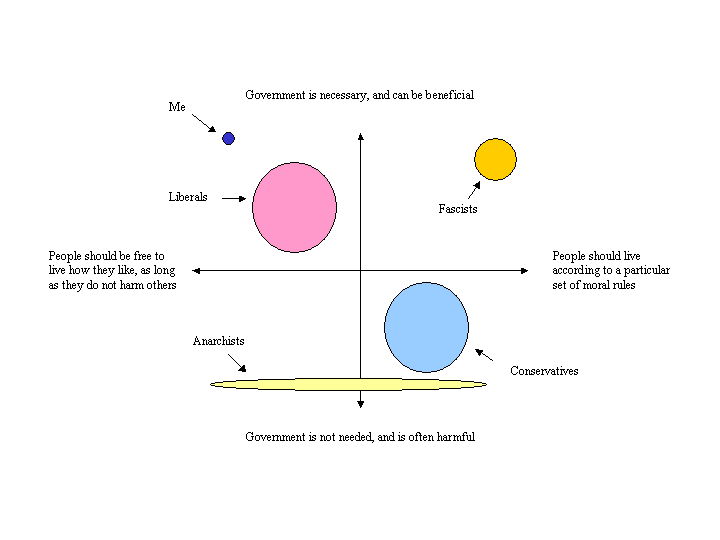
One more complex model that I think is useful takes two considerations into account:

  • How necessary do you think government is? Can it be beneficial?
  • How important are an individual’s own values, compared to those of their community?

On one axis, there is the range of views from ‘government is beneficial and absolutely essential’ to ‘government is harmful and not needed.’ On the other is an axis from ‘individuals should be free to live however they want’ to ‘people should live according to an external moral code’.

All combinations are possible. Anarchists agree that government is not needed and probably harmful, but disagree about whether we should all follow a particular ethical framework and, if so, what the framework should resemble. Some anarchists assume that – freed from government – people would probably arrange themselves into communistic little autonomous communities. Others prefer rather more militant notions of what anarchism might involve.

People of all political stripes disagree about the extent to which traditional or religious values should motivate how people behave, as well as the degree to which they are embedded in law. For instance, some people would like government to enforce morality by treating adultery as a criminal offence, or by criminalizing abortion, or by restricting the use of climate damaging fuels, or by forbidding companies from bribing public officials, etc, etc.

Of course, there is a big difference between enforcing ‘harm principle’ ethics, where only actions that damage unconsenting bystanders are restricted, and a more open-ended enforcement of morality by government. For people deeply concerned about how one person doing what they wish can prevent others from having the same freedom, government is often seen as an essential mechanism for preserving the overall liberty of everyone.

One element that is not well captured in this model is the range of different moral codes people want to see applied. These include everything from ‘traditional family values’ to various forms of religious fundamentalism to non-religious but dogmatic social philosophies like Ayn Rand’s Objectivism.

Still, I think this framework has some use, when it comes to understanding the range of political views that exist.

[Aside] To clarify my own view, I naturally recognize that governments can be extremely harmful: even oppressive to the point of murderousness. That being said, I think they are necessary because of how interconnected the world has become and, at their best, can do enormous good.

How much can one person steal?

Perhaps one of the reasons why intellectual property law is in such a strange state now is because of how much the sheer value a single person can steal has increased.

The most a human being has ever lifted (briefly) during Olympic weightlifting was 263.5 kg, lifted by Hossein Rezazadeh at the 2004 Summer Olympics. Right now, the price of gold is about US$1,300 an ounce for Canadian Gold Maple Leaf coins. That means the world weight lifting record (or just under 8500 Troy ounces) comprised about C$12 million worth of gold.

Compare that with the losses potentially associated with a book or DVD getting pirated early, or a pharmaceutical manufacturing process getting released to a generic drug manufacturer, and it seems clear that the value in goods that a person can now steal is substantially higher. I remember one memorable illustration of this in fiction, from Jurassic Park. In it, corporate spy Dennis Nedry tries to steal 15 dinosaur embryos, developed as the result of painstaking genetic reconstruction undertaken by his employers. He is offered something like $1.5 million for these (I don’t remember exactly how much), but they were surely worth more to both his employer and to whoever was trying to acquire them.

Lots of other pieces of fiction focus on the fate of valuable intangible commodities. For instance, in William Gibson’s Neuromancer, the principal thing being stolen (at considerable difficulty and loss of life) was three musical notes, which in turn served as a control on a computer system.

When people are stealing gold, or diamonds, or cattle, or DVD players there is a fairly set limit to how much they can actually make off with. Furthermore, after such thieves are caught, there is a good chance that much or all of their loot can be restored to its rightful owners. Compare that to some savvy teenager who comes across a valuable bit of information and publishes it online: the value is potentially enormous, and the scope for ‘setting things right’ pretty much non-existent. Of course, locking up grandmothers whose computers have been used to download a Lady Gaga song or two isn’t a sensible thing to do, regardless.

Rights: inherent or chartered?

Reading one of the lengthy historical discussions of anti-Semitism in Richard Rhodes’ The Making of the Atomic Bomb, I came across a section on how Jews made an agreement with Louis the Pious, the son of Charlemagne, to be granted legal protections in exchange for becoming the ruler’s property. Rhodes says that: “Their rights were thus no longer inherent but chartered.” (p.177 paperback)

This made me think about the distinction between how constitutional rights are described in Canada and in the United States.

The Canadian Charter of Rights and Freedoms “guarantees the rights and freedoms set out in it subject only to such reasonable limits prescribed by law as can be demonstrably justified in a free and democratic society.” It also describes such things as freedom of conscience and religion as “fundamental freedoms,” though it does not directly describe where ‘fundamental’ freedoms come from. Arguably, the preamble to the Charter, which says that Canada is “founded upon principles that recognize the supremacy of God and the rule of law” provides a clue about where the drafters think rights could come from, though it is ambiguous and unclear.

By contrast, the American Declaration of Independence states that it is a self-evident truth “that all men are created equal, that they are endowed by their Creator with certain unalienable Rights, that among these are Life, Liberty and the pursuit of Happiness.” It seems clear what the drafters of this document thought about the origin of rights, though this raises the question of what their status and origin are taken to be within a secular state.

I have written before about how I don’t think there is anything inherent to human rights. They are not built into the structure of the universe, and they do not make themselves evident, whole and fully formed, when sensible people think about how human societies should be structured. Furthermore, they are often in conflict with one another, and a simple rights-based philosophy doesn’t provide much guidance on how to deal with situations where different rights-based claims are in competition.

Is it better, then, to have inherent rights or chartered ones? With chartered rights, there is a clear sense of what they are and where they came from. Potentially, there can also be explanation for why they are granted. We could, for instance, explain that freedom of speech exists in our society because we recognize the benefits it creates, and the harms associated with denying it. Inherent rights may, in a certain sense, be more robust. If we pretend that certain human rights really are part of the structure of the universe – or unambiguously derived from thought and logic – then we have a certain defence against the suppression of minority rights by the majority.

Of course, if we are worried about the masses being insufficiently cautious about the rights of minorities, we can express those concerns in a chartered framework. We can underline the value of protecting minority rights, and explain how only granting effective protections against majority bullying can those benefits be maintained.

Google and net neutrality

At Google headquarters recently about 100 people showed up to protest Google’s apparently eroding support for ‘net neutrality.’ Net neutrality is the idea that the internet should not restrict the modes of communication that can be used across it, nor the sorts of devices that can be connected to it.

Lots of companies oppose net neutrality because it means they should not discriminate between traffic from different sources. Data traversing the internet – broken up into pieces called packets – includes everything from pirated DVDs being passed around using peer-to-peer filesharing systems to corporate phone calls being routed though voice over internet protocol (VoIP) telephone systems to songs being downloaded for money from the iTunes store. Lots of companies would like to slow down or block file sharing, restrict services like VoIP, and allow people to pay more for faster paid downloads.

One big reason why this is worrisome is that it could prevent the emergence of new technologies. VoIP seems like a good example. Routing telephone calls through the internet challenges the monopoly of fixed-line telephone companies. Low cost VoIP calls have been a source of competition for them, and have probably produced improved services at lower prices for consumers. A future version of the web where companies can slow down or block traffic of undesirable types could be a version where new such technologies get strangled at birth.

That said, abandoning net neutrality could have some advantages, by improving network performance for those who use relatively low-bandwidth services like email and text websites. It could also facilitate the emergence of interesting new technologies, which are not viable on the internet as it exists now. For instance, the sometimes slow and clunky load times were one of the reasons why Google Wave proved to be a failure.

Given their enormous influence on the content and structure of the internet, the position of Google on net neutrality is of considerable public importance. The full details of their deal with Verizon – which is rumoured to allow special treatment of certain sorts of traffic – have not yet been publicly announced. When they are, there will surely be a lot of scrutiny and interest from the geekier components of the general public, as well as those with a particular interest on how technology policies affect societal change.

In Canada, Bell is probably the most vocal opponent of net neutrality, while Michael Geist may be the most prominent defender. I wrote a bit about net neutrality earlier, as well as about the related technology of deep packet inspection.

Democracy and minority rights

Judge Vaughn R. Walker’s ruling on California’s Proposition 8 is a good demonstration of how it is possible for the serious expert consideration of ethics and law to produce better policy-making than direct or representative democracy does:

Proposition 8 fails to advance any rational basis in singling out gay men and lesbians for denial of a marriage license. Indeed, the evidence shows Proposition 8 does nothing more than enshrine in the California Constitution the notion that opposite sex couples are superior to same-sex couples. Because California has no interest in discriminating against gay men and lesbians, and because Proposition 8 prevents California from fulfilling its constitutional obligation to provide marriages on an equal basis, the court concludes that Proposition 8 is unconstitutional.

Gay marriage is restricted around the world not for any rational reason whatsoever, but because large numbers of voters are prejudiced and uncomfortable with the idea.

While it is encouraging when gay marriage is legalized by legislation or popular referendum, I think it is ethically preferable when courts assert its necessity. That is because the power to determine the scope of minority rights should not rest with the will of the general public. Establishing minority rights on that basis is precarious and unjust. Rather, societies that aspire to be ethical have to acknowledge the fact that the majority cannot be allowed to strip minorities of fundamental rights, and that laws that do so ought to be struck down, regardless of how popular they are.

America’s upcoming midterms

In some ways, it is not surprising that American policy-makers are intensely focused on short-term popularity. Every two years, the entire House of Representatives and a third of the Senate are up for re-election. Anxiety about getting turfed about by annoyed voters naturally makes politicians hesitant to support anything where the pain is near-term and the benefits far off.

Looking forward to this November’s midterm elections, most people expect the Democrats to get a thumping. Just how big a thumping is, of course, a matter of discussion. During the past few months, many people have raised the possibility that the Democrats could lose control of the House of Representatives. Now, some are wondering if they might lose the Senate as well. That possibility is certainly less likely, since only a third of the Senate is elected at a time. For the Republicans to gain control, they would basically need to win every competitive seat while not losing any that are considered safe for them.

Turnouts are always lower for midterm elections than for those that also include presidential voting. Indeed, mechanisms for getting supporters to actually vote are a key part of electoral tactics. That can include things like incorporating referenda on issues that fire up your base, whether they are on banning gay marriage or trying to simplify unionization. Another is to instill fear in your supporters that their opponents are about to triumph. Indeed, one reason why members of the Obama administration have been hinting about the possibility of Republican victories in November is to try to frighten Democratic supporters to the polls.