Some respite for bluefins

As of today, the European Commission has banned the fishing of Bluefin Tuna (Thunnus thynnus) in the Mediterranean and Eastern Atlantic. Good for them, though it is a bit late. Stocks of this impressive and long-lived creature have already been decimated globally.

[Update: 21 September 2007] Jennifer Jacquet has more about this, over on Shifting Baselines.

[Update: 2 December 2007] Shifting Baselines has even more on this.

Sexual politics and the HPV vaccine

It says a lot about our society that the development of a vaccine for Human Papillomavirus has been greeted with controversy rather than appreciation. It is absurd that a treatment that has been shown to be effective in the prevention of cervical cancer is being interfered with out of misguided concerns that it will increase the incidence of teenage sex. It seems unlikely that many young woman make their decision about whether or not to engage in sexual activity with the possibility of HPV-induced cervical cancer as a major consideration. (If they do, there are plenty of other STIs to give them pause.) Even if it could be documented that a vaccination program would increase teenage sexual activity to some appreciable degree, a very strong argument can be made that preventing the pain and death associated with cervical cancer is an outcome of sufficient importance to justify the choice to vaccinate. Furthermore, the overall response smacks of sexual double standards. If this were a vaccine that had a strong preventative capacity for both men and women, it seems unlikely that there would be so much furore about its administration.

The tactic of trying to alter the decision-making of teenagers through the reduced availability of life-saving medicines is hardly a behaviour that should be promoted or tolerated. The Globe and Mail gets it essentially right in a recent article, arguing that the purpose of a public health system is: “seizing opportunities to avoid needless death, to improve quality of life when we can and to extend it wherever and whenever we can.” Hopefully, the political opposition surrounding HPV vaccination will be overcome, and the procedure will become as routine as vaccination against Measles or Hepatitis B (itself largely transmitted through unprotected sex).

Truth in advertising

The kind of false environmentalism embodied in the Prius has been panned repeatedly on this site. Now, the government of Norway has decided that automobiles cannot claim to be “green,” “clean” or “environmentally friendly.” Bente Oeverli, a Norweigan official, explains that: “Cars cannot do anything good for the environment except less damage than others.”

Moral obligations to view advertising?

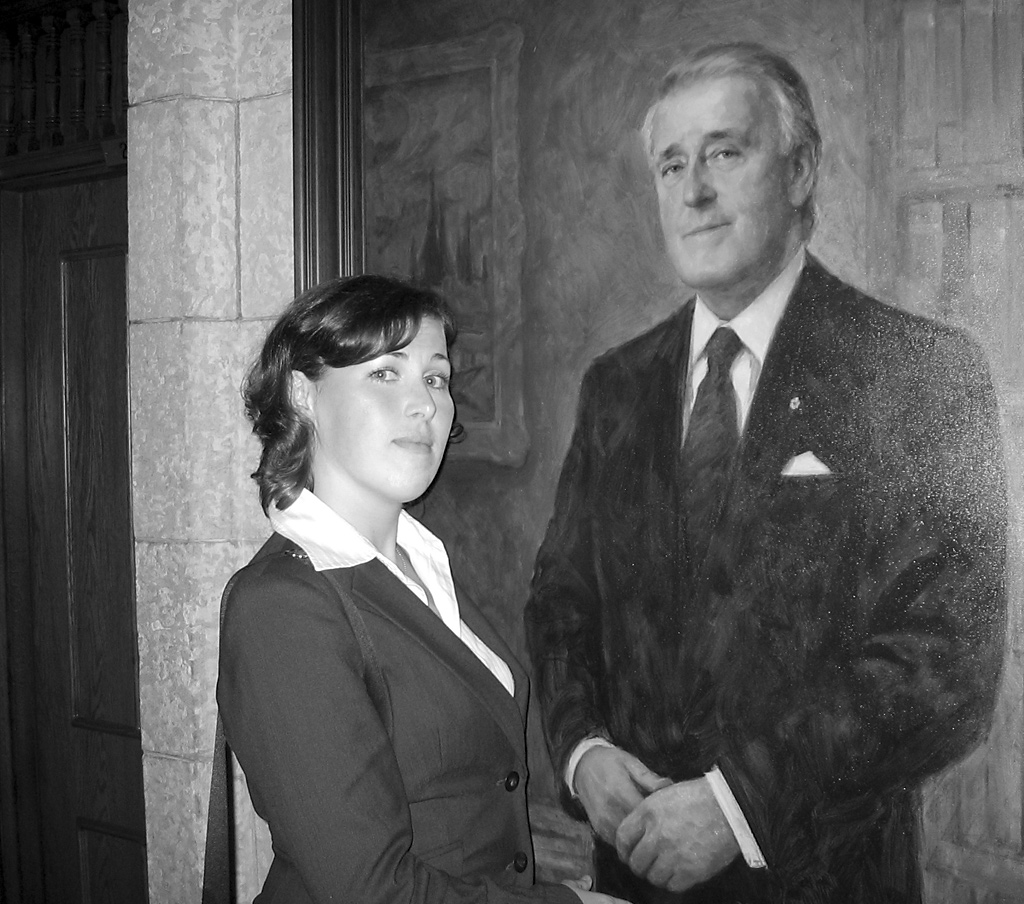
Ashley Thorvaldson and Brian Mulrooney

Normal users of the internet are frequently confronted with banner ads: often obnoxious graphics trying to hock all manner of products and services. More sophisticated users will now find themselves a bit surprised, when using a public computer, because they long ago stopped seeing these displays on their own machines. This trick is achieved through the use of the Firefox browser, the AdBlock plugin, and Filterset G. With these three pieces of code running, the vast majority of graphically based ads on the internet simply vanish.

Now, an editorial on CNet suggests that using such technology may be immoral. In effect, web sites are providing you with content in exchange for your pupils grazing ever-so-briefly across the advertisements that pay their bills.

While I don’t feel convinced one way or the other about the moral issues involved in this particular case, it is an interesting kind of moral problem. The nature of what is ‘theft’ in a digitized world remains an intensely disputed one. This is the fundamental product of going for a world where products cost a significant amount per unit (with additional costs for design) to one where things may cost a lot to design, but can often be copied for free. That goes for everything from pop CDs to New York Times editorials, and dealing with it is one of the more interesting legal and business issues of the present time.

A closer look at the War Museum controversy

Still pondering the controversy about the display in the Canadian War Museum, I decided to go have a look at it first-hand. On the basis of what I saw, I am even more convinced that the display is fair and balanced, and that it should not be altered in response to pressure from veterans.

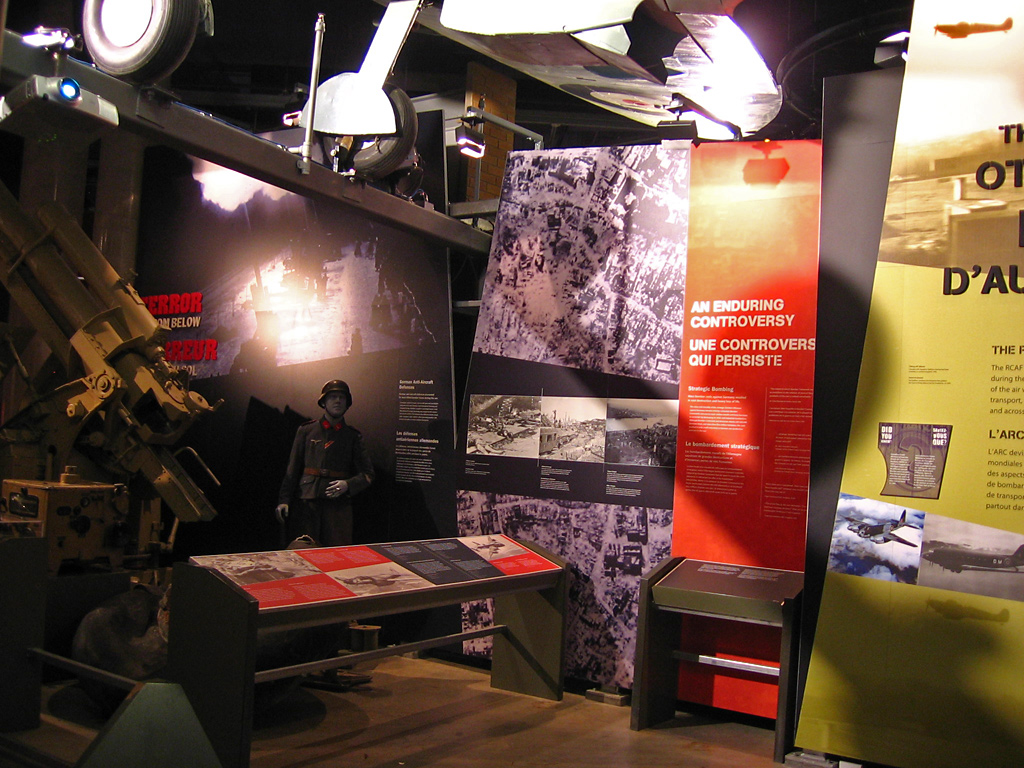
Here, you can see the panel in question in its immediate surroundings:

An Enduring Controversy, and surroundings

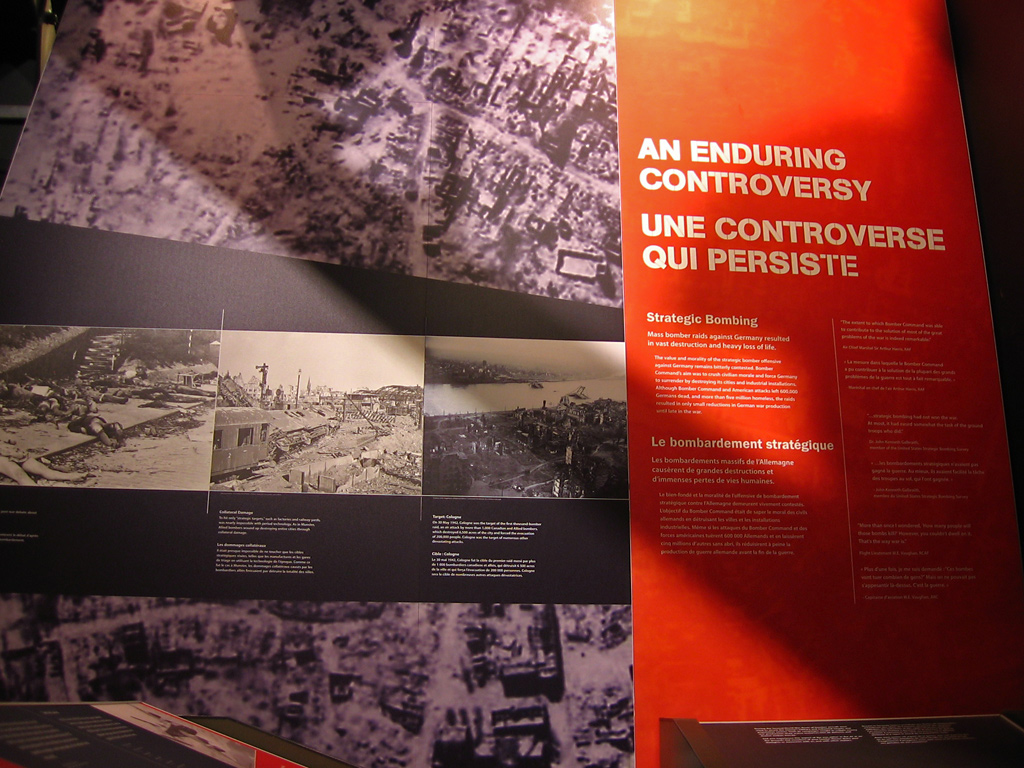
This is one small part of a large area discussing the air component of the Second World War. A shot with a narrower field of view shows the controversial panel itself more clearly:

Enduring Controversy

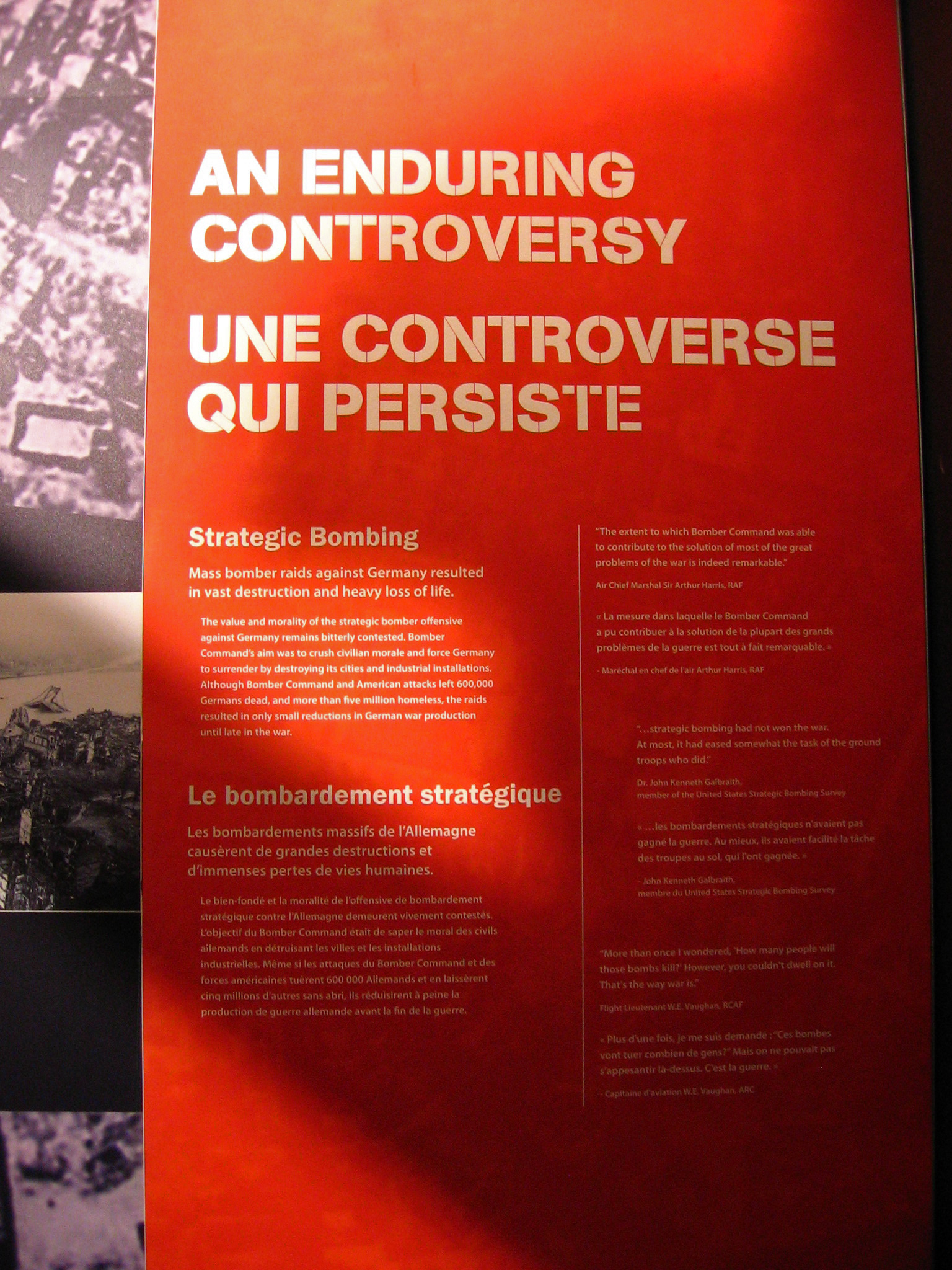
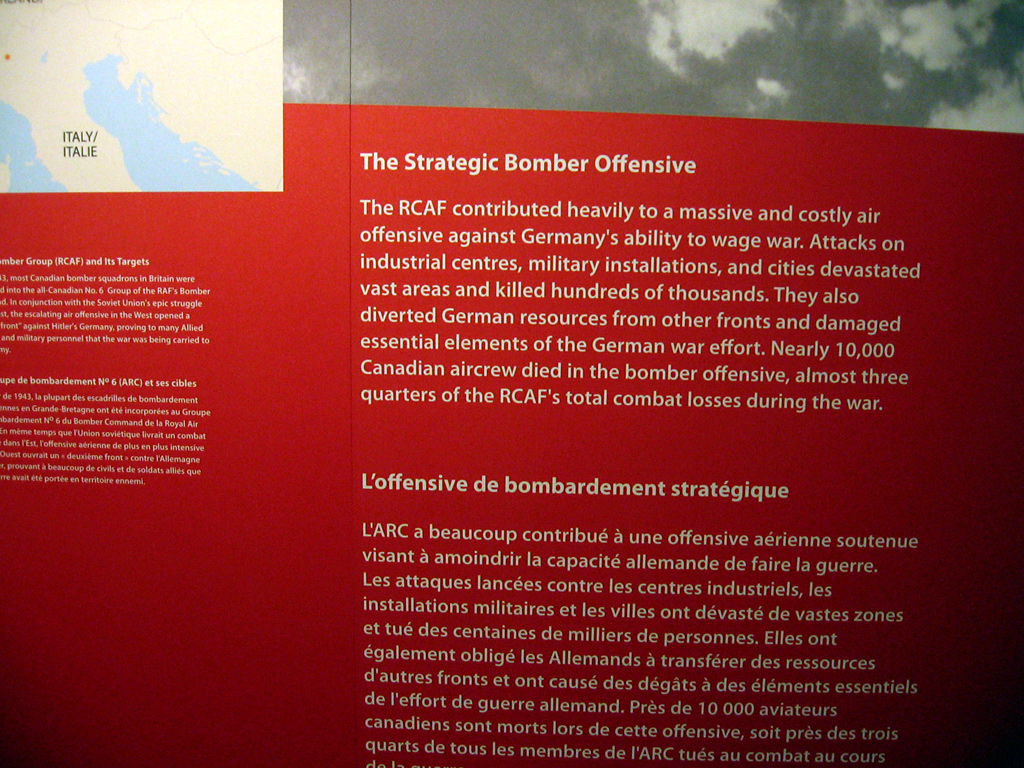
Here is a large close-up shot of the panel text. Nearby, a more prominent panel stresses the deaths of Canadian aircrew and the degree to which aerial bombing “damaged essential elements of the German war effort.” This alternative panel is located right at the entrance to this section of the museum.

If anyone wishes to comment to the museum staff, I recommend emailing or calling Dr. Victor Rabinovitch, the President and CEO. His contact information, along with that of other members of the museum directorate, is available on this page.

The ugliness of war

Artillery monument, Ottawa

Today’s Ottawa Citizen has an article about how the Canadian War Museum is being pressured to change some of the text in its Bomber Command exhibit. Veterans had complained that it makes them out to be war criminals. The text reads:

“The value and morality of the strategic bomber offensive against Germany remains bitterly contested. Bomber Command’s aim was to crush civilian morale and force Germany to surrender by destroying its cities and industrial installations. Although Bomber Command and American attacks left 600,000 Germans dead and more than five million homeless, the raids resulted in only small reductions of German war production until late in the war.”

The museum consulted four contemporary historians, after complaints from the National Council of Veteran Associations, and they each affirmed the accuracy of the text. Two of them, however, lodged some complaint about the tone employed.

All this strikes at one of the tough moral questions that arises when you treat war as the subject of law. If the London Blitz was a crime, surely the bombing of Berlin, Tokyo, and Nagasaki were crimes as well. The targeting of civilians was a crime committed by those who chose where the planes should drop their deadly cargo. The dropping of the bombs was a crime committed by those who followed the illegal orders. (See: this related post) Alternatively, one can adopt the view that none of these undertakings were criminal. I suspect that neither perspective is a very comfortable one for those who were involved, but it seems difficult to come up with something both different and defensible.

In the end, it seems wrong to give anyone the comfort of thinking they were on the ‘right’ side and this somehow excused what they did. Their actions are equally valid objects of moral scrutiny to those of their opponents, though they are much less likely in practice to be thus evaluated.

None of this is to say that all the combatant states in the Second World War had equally good reason to get involved, nor that there is moral equivalence between the governmental types in the different states. What is hard to accomplish, however, is the translation of such high level concerns into cogent explanations for why former Canadian strategic bombers should be honoured while Germans launching V2’s into London should not be. The generally unacceptable character of the intentional bombing of civilians is firmly entrenched in international law; as such, the sensibilities of current veterans do not warrant changing the text.

[Update: 30 August 2007] Randall Hansen, an associate professor at the University of Toronto, has written a well-argued editorial in the Ottawa Citizen attacking the museum’s decision to change the wording.

Footprints all over the web – Google Web History

Red brick facade and fire escapes

When I am online, I usually have at least one Google service open. At home, I usually have a Google Mail window open at all times, as well as Google Calendar. At work, it is only the latter. What I didn’t know until today is that whenever you are logged into your Google account, Google is tracking your web usage through a system called Web History. Accessing the system allows you to ‘pause’ the recording and even delete what is already there. While the listings disappear from your screen, there is good reason to doubt whether they vanish from Google’s records.

It is common knowledge that Google saves every search query that gets input into it, and does so in a way that can be linked to an individual computer. The web history service, however, has more troubling implications. Whether you are at work, at home, or at an internet cafe, you just need to be logged into any Google service for it to be operating. Since more than one computer can be logged into a Google account at once, and there is no indication on either machine that this is happening, anybody who gets your password can monitor your web usage, as well as your email and any other Google services you use. Given how common keyloggers have become, this should worry people.

One very helpful feature Google could implement would be the option to show when and where you last logged into your account. That way, if someone has been peeking at your email from London while you have been in Seattle, you know that it may be time to change your password. Also desirable, but much less likely to happen, would be a requirement that services like GMail store your information as an encrypted archive. Even if the encryption was based on your password and a relatively weak cipher, it would make it impractical for either Google or malicious agents with access to their information storage systems to undertake the wholesale mining of the information therein.

The final reason for which this is concerning has to do with cooperation between companies and governments. It is widely rumoured that companies including Microsoft and Yahoo have helped the Chinese government to track down and prosecute dissidents, by turning over electronic records held outside China. Given the increasingly bold snooping of both democratic and authoritarian governments, a few more layers of durable protection built into the system would be prudent and encouraging.

Predictable law exam complete

Yellow flowers

The international law has been written, and nobody who took the course can possibly complain about its content. Indeed, it was astonishingly predictable. They snuck on fourteen different possible topics, and I am pretty sure every one of them was either on a previous exam or taken directly from our reading list. As such, the main problem in each answer was effectively summarizing everything you knew about it, rather than wracking your brain in search of anything to write. I wrote on:

  1. Why have international legal efforts to regulate the global atmospheric environment had such mixed success?
  2. Is it proper for the World Trade Organization to be concerned with the elimination of economic inequalities within or between states?
  3. What are the considerations that lead states to comply with provisions on international law?

I only heard after the exam that the assessors might be less than pleased about me answering a question so closely related to my thesis. If so, there is nothing that can be done for it now. Overlap is also a bit of a concern between the second question I answered on this exam and the second question I answered on yesterday’s theory exam. Clearly, I cannot write about either inequality or the WTO during tomorrow’s developing world exam. As such, it is probably go time to brush up on the security issues that exist in the developing world. Just nineteen hours or so away from being finished, now.

No crime to gobble

In the United States, there is a Presidential tradition of pardoning turkeys. Of course, it is dubious whether the turkeys had committed any capital offenses requiring a pardon beforehand. At least the tiger executed recently in British Columbia had done something that may have been criminal if done by a human. Birds of the genus Meleagris seem guilty of nothing more than being rather unusual looking.

The White House has an official photo gallery of presidents performing the ceremony. I like the shot of Truman. George Bush Senior seems oddly distanced from the proceedings. There is something a bit sick about “representatives of the turkey industry” presenting one bird to be spared in this way, while raising millions more in utterly degraded conditions and slaughtering them. It gives one a bit of insight into why Grant Hadwin wanted to cut down the one tree in B.C. being protected by the logging industry, while they were clear-cutting the rest of the province.

Christie precedent overturned

Vault and Gardens, Oxford

The Canadian Supreme Court seems to have overturned Christie v. AG of B.C. et al. This 2005 decision held that the poor could not be charged the 7% tax on legal services that existed in British Columbia at the time. In the Reasons for Judgment, the B.C. Supreme Court stated:

[The Act] constitutes indirect taxation and is a tax on justice contrary to the Magna Carta and the Rule of Law…

I am prepared to grant the following declarations: A declaration that the Act is ultra vires in the Province of British Columbia to the extent that it applies to legal services provided for low income persons.

The court held that those earning under $29,000 should no longer need to pay the tax. It also reimbursed, with interest, the $6,200 that had been seized from Christie for non-payment of the sales tax on behalf of poor clients.

Dugald Christie, the man behind the 2005 BC case, was a Vancouver lawyer who had dedicated himself to helping the poor get representation within the legal system. He died about ten months ago while bicycling across Canada to raise money for that cause. Prior to his death, Christie lives in a small room at the Salvation Army’s Dunsmuir House, where he apparently worked twelve hours a day encouraging lawyers to do more pro bono work. He founded the Western Canada Society to Access Justice, which consists of sixty legal clinics across British Columbia, and has since expanded into Saskatchewan and Alberta.

The Supreme Court has now held that:

“a review of the constitutional text, the jurisprudence and the history of the concept does not support the respondent’s contention that there is a broad general right to legal counsel as an aspect of, or precondition to, the rule of law.”

I was surprised to see that a right to council isn’t actually included in section 11 of the Charter of Rights and Freedoms. The idea that a normal person can have a fair trial without legal council doesn’t seem a very plausible one.