Events in Oxford, Wednesday

For people in Oxford, there are some interesting events this coming Wednesday (May 10th):

Oxford University Centre for the Environment Symposium:
“What Future for Environmentalism?”

10.00 Introduction

10.05 Noel Castree, Manchester University, “‘The Paradoxes of Environmental Politics”

10.45 David Pepper, Oxford Brookes University, “Ecotopianism: Transgressive or Regressive?”

11.25 Andrew Dobson, Keele University, “The Invisibility of the England and Wales Green Party – Why, and Does it Matter?”

12.05 General questions and discussion

12.30 Lunch

1.30 George Monbiot, journalist and writer, “Just Green”

2.10 Diana Liverman, Oxford University, “Environmentalisms and the Response to Neoliberalism in Latin America”

2.50 Joan Martinez Alier, Barcelona Autonomous University, “Social Metabolism and Ecological Distribution Conflicts”

3.30 – 4.00 Final discussion and close

As far as I can tell, all of these events are taking place in their building on South Parks Road.

Many thanks to Taylor Owen for forwarding me an email about it. Such is the decentralized nature of Oxford that, despite being on every mailing list I’ve come across, I hadn’t heard a word about it before. There is also a lecture that evening:

The Africa Society and Rhodes Scholar Southern Africa Forum Joint Panel Discussion Series:
Framing the Continent in 2005: Implications for the Future

Marked by the Make Poverty History Campaign, LiveAid, the G8 summit, and the Commission for Africa, 2005 was dubbed by many as the ‘Year of Africa.’ As we move into 2006 it is worth reflecting on the impacts-positive and negative-of these high profile initiatives and the subsequent media attention.

5:00pm to 7:00pm
Rhodes House: Jameson Room

I will be attending both.

PS. A compilation of Oxford Environment related information and events can be found here. The OUCE website is very counter-intuitive if you are trying to figure out what’s going on there. I couldn’t even find a page with information on this Wednesday’s event.

Second summer day

Contrail and tree branches

With Kai at a party in London and Alex in Vienna for the marathon, this is my first night alone in the Church Walk flat. It follows a day that was excellent in many ways. The weather had the same brightness and warmth of yesterday, and it was accompanied nicely by the Feist CD that Jonathan recommended to me, called “Let it Die.” A few weeks will be necessary to really comprehend the style, but I could tell immediately that I like it. Already, the CD strikes me as unusually versatile – with a style that’s hard to pin down. The tone is similarly liable to shift dramatically between songs: from playful to forlorn. I rather like the song in French.

After meeting with Dr. Hurrell and reading in the Wadham MCR for a few hours, I spent the evening walking and conversing with Roz. At one point, we got excellent veggie burgers from a place on Walton Street called Peppers. The smell and clientele reminded me of the Jamaican place across the street from the hostel in Manhattan where I stayed in the days after the blackout in 2003. Their burgers are both very filling and surprisingly tasty, for a vegetarian product in the UK. Given that it’s just a few blocks away and is open late, it risks becoming the Pita Pit of this place of residence (a reference that anyone from UBC should understand).

Earlier, Rosalind and I wandered through Trinity College, which I had previously seen only from the outside, and the Wadham gardens. They have begun to change dramatically, with the coming of sun and longer days. For someone who arrived in Oxford in late September, it’s still something of a surprise to see groups of trees with leaves on them. I am looking forward to a summer of working, cycling, and researching here.

Migration news: geeky stuff

The migration from Blogger to WordPress is going well. I have the colours and formatting on the new blog more or less where I want them. I already much prefer the commenting and management system of WordPress. I just need to come up with a sharp new banner and tweak a few small things. Then, I will shift the WordPress version to the front page. I think I can do so without breaking the links to the old Blogger posts: at least until Google indexes them on the basis of their new permalinks.

Now that I am getting used to it a bit, I prefer the cleaner lines and overall layout of the new blog, as well as the greater versatility of the content management system.


  • Between the 20th and 24th of June, the Oxford Playhouse is staging Paradise Lost. I shall make a point of going. Roz says that she is also keen to come, if she hasn’t headed off to Rome for the summer by that point.
  • Tomorrow afternoon is the first OUSSG executive meeting, meant to sort out what to do about the dinners this term. It will be good to finally meet the rest of both the new and old executive in a context meant for planning.
  • I got a quartet of very diverse fictional books from a free box in Nuffield that Margaret directed me towards, when I was waiting for my supervision. I’ll have a look through them in the summer.

Further thesis planning

The thesis discussion with Dr. Hurrell has further convinced me that I am on a good track. We also sorted out an agreeable pattern for this term’s work this evening: two essays for the core seminar, two papers specifically for him, the research design essay, and a third essay for him to be written during the subsequent break, if necessary. Based on my standard of 3000 word papers, that will mean 21,000 words of writing for this term, in total. (Not counting dozens of blog posts, of course)

While discussing the thesis topic, we edged closer to a real question. The idea, at this point, is to choose two examples of international environmental agreements, then investigate the role that science and scientific communities played in their formulation. Two possible examples at the Stockholm Convention – wherein the coordination of science and policy can be said to have gone fairly well – and the Kyoto Protocol – where the relationship is muddier and the policy outcome less effective. The methodology would centre around looking at the preparatory materials and history of both conventions, as well as interviewing participants. On the theoretical side, I would examine writing on the connections between science and policy in this and other areas, as well as as much philosophy of science as I can push through my limited mental faculties.

The above, expanded and fused with a preliminary survey of the literature, will form the body of the 6000 word research design essay I submit at the end of this month.

Long summer bike ride

Unidentified bird

Happy Birthday Greg Polakoff

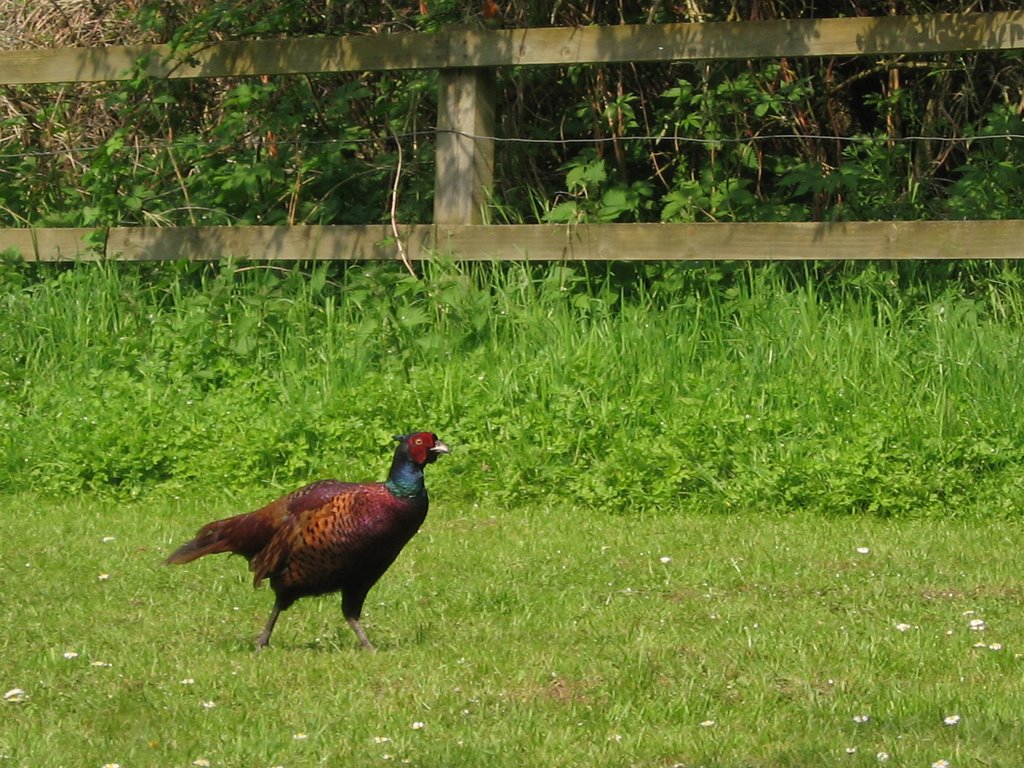
Today was unambiguously the first summery day in Oxford. As seemed to befit it, I went on my longest bike ride so far: 42.6km from Oxford to Blenheim Palace and Woodstock, then back via Kidlington. I’ve heard that Blenheim Palace and gardens are really nice, but I definitely wasn’t willing to pay eleven Pounds to get in. Instead, I found a shady spot outside Woodstock and read Kerouac’s On the Road for a few hours. While sitting in the shade, molested but unbitten by flies, I actually saw what I can only conclude was a pheasant: a big, red, darting sort of bird that ran off and hid when I tried to photograph it. I also saw huge numbers of cow, sheep, and horses – as well as rabbits and lots of birds.

After leaving Woodstock, I found the road between Kidlington (which is on the way to Oxford) and Deddington (which I walked to one night). Once I realized that Deddington was a further nine miles from where I found that road, I veered off eastwards and found the much smaller town of Tackley. Throughout the ride, there was nice countryside. It would have been perfect but for the strangely insistent sun and the truck that caused me to slam my hand against a metal fence by not signaling when it was exiting from a roundabout. If I hadn’t checked, it would have been overall splattering from under-correction, rather than one nasty bang from over-correction.

I am enjoying On the Road. It has what I would call a Catcher in the Rye narrator: someone focused on being self-sufficient, somehow outside the system, but still caring and generous. The book makes me want to take another road trip in the US.

Instead, I should spend the rest of tonight burnishing thesis ideas for presentation to Dr. Hurrell tomorrow.

Quantitative methods reform

Quantitative methods reform I just attended a meeting of the Graduate Joint Consultative Committee (GJCC) that was focused on reforming the statistics course for next year. For those not up to speed, the quantitative methods section of the M.Phil in International Relations was considered disastrously bad by almost all the students and faculty. On the basis of a petition signed by 27 of the 28 people in the program, as well as many personal complaints, a major overhaul has been commissioned. I still have my doubts about whether a faculty so dismissive of statistically-based IR can provide an adequate introduction in eight weeks, but with luck the new course will be dramatically better than ours was.

Mostly, the suggestions seem to be quite good. Yuen Foong Khong is chairing the IR Working Group on Research Methods, and the major change being suggested is to reclaim more of the quantitative methods teaching into the department, rather than relying on relative outsiders. The plan calls for cutting the number of STATA workshops from six to two and introducing some short problem sets that involve the kind of computation we had to do on the exam, but hadn’t ever done prior to it.

The most important thing is that there is broad recognition within the department that this year’s quantitative methods training was unacceptably bad. I would call it a major blot on an otherwise excellent program.

On Monday, these recommendations will go to the Graduate Studies Committee. Apparently, it basically need to be hammered out before the end of the term, if it is going to be substantially different next term. For the sake of those who will enter the program later, let us hope that the review is extensive and effective.

I have a handout detailing all the proposed changes that I can lend to anyone who’s interested.


  • This announcement has me thinking about the Kilimanjaro climb I want to do in summer of 2007.

Thesis planning

In four weeks’ time, I need to submit a 6000 word paper outlining my research question and methodology. Today, I gave a twenty minute presentation that basically outlined my area of interest and touched upon some possibilities. Until I’ve done more of a review of the literature, choosing a specific topic is probably unwise. There is much to do, and time for it is short.

The general research area is environmental politics: by which I mean the study of international agreements and actions related to the physical environment. Examples include climate change, fisheries, and pollutants. Within that playing field, I have also identified two directing interests: the relationship of science to policy, and the connections between all of this and development.

Science and policy

The natural sciences have a number of characteristics much admired and emulated by social scientists – as IR scholars frequently categorize themselves. As generally understood (and Tristan is going to murder me on this), science is a set of tools and approaches that allows people to learn about the true nature of the world. Theories are developed to account for observations and they are tested using other observation. Deficient theories are refined or rejected and progressively better understandings emerge. This is a very old and powerful account of the nature of scientific approaches.

From a global environmental politics (GEP) standpoint, the first area of interest here has to do with epistemic communities. That’s basically a fancy word for ‘fields’ or ‘disciplines.’ Members of such communities have their own vocabularies and ways of doing things: they have tools and competencies. Critically, they also have credibility in certain areas. What is interesting for my thesis is how science, credibility, and politics interact. When the Union of Concerned Scientists speaks out on nuclear testing or climate change, they wade into fundamentally political waters. Why are people generally willing to listen to what they have to say? On a related note, how do those seeking particular policies select and generate science that can be used to bolster their case; to what extent is science in environmentally relevant areas politicized, or otherwise prescriptive in non-obvious ways?

Another way in which GEP is concerned with science has to do with bureaucratic politics. That’s to say, how different constituent parts of a decision-making organization interact. An example would be the relationship between Congress, the presidency, and other actors in the formulation of American foreign policy. A standard account holds that these subsidiary groups vie for influence while engaged in complex negotiations with one another. Depending on how constructivist you care to be, you can also talk about constitution through iterated interaction. Analyzing global environmental regimes (for instance, the Kyoto Protocol) through a bureaucratic politics framework means examining which organizations helped to form it and what role they are playing now. The practical and theoretical connections between environmental scientists and organizations they dominate and the overall policymaking landscape are certainly worthy of investigation.

The development dimension

The two big environmentally relevant development issues, as I see them, are the emergence of new industrializing powers and the material conditions that have contributed to the absence of development in other areas. It says something that while I raised both in my presentation, everyone who responded mentioned only the question of China and India, never the one of the least developed states.

Anyone who glances at the state of commodities markets today can see that a China growing at near-double-digit rates has a huge appetite for energy and raw materials. The overall impact of that trend on the state of the world environment promises to be huge: more so when you acknowledge that China isn’t the only populous state growing rapidly. If we are to hope that these states will follow a more sustainable path to prosperity than the currently developed states, we are going to need institutional and legal structures that are both up to date with the best of environmental science and politically aware enough to craft incentives so that good outcomes will actually be achieved.

In contrast to the rapidly emerging economies are those that are not obviously improving in basic measures like life expectancy and health. Environmental factors probably play a role here as well: desertification, climate change, and the like. Likewise, an important role is played by factors that are both environmental and political, such as health and the search for raw materials. The more people with whom I speak, the clearer it becomes that this area is probably not a very interesting one for most people in the department, at least in terms of the considerations that go into thesis topic selection. Doing anything interdisciplinary with people in Oxford studying fields like health or geography seems to be quite difficult.

Plans

Between the areas mentioned above, there are many lifetimes worth of research that could be done. I want to find a question that is specific, novel, and original and that will allow me to make prescriptive suggestions for the improvement of some important area of environmental governance. As I progress towards that topic, I will put more information here. Of course, comments are extremely welcome.

PS. I got back the numerical result for my qualifying exam from Dr. Hurrell today: 68%. Missing a distinction by such a small margin makes me wish I had studied harder.

Happy May Day

Morris Dancing on May Day

Happy Birthday Roham Alvandi

This morning’s May Day celebrations, which I attended with Kai and Roz, were interesting and unique. They felt like a special glimpse into parts of England never seen: what I might have experienced if I had succeeded in finding a Guy Fawkes Day celebration, in the fall. Up near the northern end of the Port Meadow, we watched the early Morris Dancing in the cold and drizzle. Unlike whatever was happening at the Magdalen Bridge, this was a largely suburban affair: adults with umbrellas and a smattering of children clearly taking more or less well to the rain and early hour. At the end of the dancing there was a straightforward participatory dance that reminded me a great deal of the kind of square dancing we used to do as part of gym class in high school.

Roz and I left the celebration after a cup of coffee to wander southwards and see a bit more of what was going on. There was more Morris Dancing on Broad Street, as well as fairly large numbers of people outside everywhere. Remarkably for England at an odd hour, all the pubs were open. Indeed, after watching some energetic and potent drumming at the corner beside Carfax Tower for a while, we stopped at Freud’s for a 9:00am glass of champagne on the way home, as is apparently one of many interlocking traditions here.

Having decided to simply stay up for the 6:00am departure, I didn’t find myself able to keep staying up. Problematically, my intended short nap ended in mid-afternoon. It is time, then, to re-deploy to the SSL and carry on reading about the end of the Cold War (which we all know Ronald Reagan won singlehandedly). Thankfully, my productivity last night wasn’t entirely confined to reading The Economist and fixing hundreds of posts in the new WordPress blog: I also charted out the outline of my thesis presentation for tomorrow afternoon.

Late night May Day plans

At 2:17am I made plans to attend the May Day celebration on the Port Meadow at 6:00am. Given that I am already feeling excessively awake – for no reason I can easily identify – I think I will just stay up until then. There’s nothing like a neo-pagan fertility rite to welcome the arrival of springtime. According to Wikipedia:

Traditional English May Day rites and celebrations include Morris dancing, crowning a May Queen, celebrating Green Man day and dancing around a Maypole. Much of this tradition derives from the pagan festival of Beltane. May Day has been a traditional day of festivities throughout the centuries. It is most associated with towns and villages celebrating springtime fertility and revelry with fetes and community gatherings. Perhaps the most significant of the traditions is the May Pole, around which traditional dancers circle with ribbons.

There is more information available here.

Apparently, Emily’s sculptor-father is in charge of the celebrations taking place on the Port Meadow. This makes them especially interesting for those of us in the program, and especially those of us who have met him.

Science, the environment, and development

Today’s seminar for the Global Economic Governance Program was really excellent, discussing the future of the World Bank and International Monetary Fund. On the panel were Jon Cuncliffe, Paul Collier, and Ngaire Woods. Overall, I would say that they agreed more than they disagreed. They primarily identified and discussed two areas of interest: the global financial consequences of the emergence of China and India and the role the Bank and the Fund should play in assisting development within countries that are either stagnating, or finding themselves at the start of an awkward path to reasonable prosperity.

While there, I realized that development might be the missing factor for my thesis. Conversing with Peter Dauvergne by email, he has identified the incredible variety of work already being done in the field of science and environmental politics. I need more of a focus if I am to say something new. To focus on the scientific and environmental questions that exist within the two areas listed above might be a good way to move forward. It captures concerns like China’s growing need for energy and resources, as well as issues like the problems of desertification and lack of decent access to water in sub-Saharan Africa.

Potentially, this is a way of bringing a lot of reading I’ve been doing that is somewhat peripheral to both the program and my thesis back into line. I don’t think it would be wise to extent the topic to consider health, which is also a fascinating intersection between science and development, but to use development to create a balanced triad between science and environmental politics might lend direction and balance, without going off topic.

Dr. Dauvergne also suggested that I read the last few years worth of issues of Environmental Politics: the journal from the MIT Press which he edits, as well as a thesis entitled Advocates, Experts or Collaborative Epistemic Communities by Lindsay Johnson, an MA student of his.

Comments would be especially appreciated on this, since I need to present my preliminary research plan on Tuesday at 11:00am.

Of news and time management

When corresponding with friends back in Canada, I am frequently reminded about how out-of-touch with national news I have become while in the UK. For me, the Harper government is a distant and largely hypothetical possibility, still in the stasis of post-electoral uncertainty. I remembering wandering around surprised on the night of the election, finding it difficult to comprehend how a party that had been in power for all the time I had been aware of politics could suddenly be outed. It is still that general sense that dominates my intuitive perspective on the present Canadian political situation. That and the fervent hope that we don’t descend into the insanity of social crusading and fiscal and strategic recklessness that have taken hold so ominously and harmfully in the United States.

I don’t think there is much I can plausibly do to keep in touch beyond skimming the Globe and Mail website and Google News Canada every day or so. Between reading for the core seminar and thesis reading, I already have a great deal to do. I am frequently frustrated by the impossibility of doing as well as can be managed in all possible areas. It makes you constantly guilty when you aren’t doing something classed as productive (course reading, scholarship applications) or semi-productive (cycling, reading The Economist). Also, it is the conversations you have with friends about current events that are the ultimate spur to be knowledgeable about them. Without debate tournaments or pub and living room arguments about Canadian politics, my lack of knowledge is rarely revealed. While Emily seems to be powerfully in touch with Canadian news – perhaps her time at Goldman Sachs taught her how to do so when busy and abroad – nobody else is likely to bring up current Canadian events as a topic of conversation.

The solution is to work towards squeezing out all activities that are not at least semi-productive, eliminating the gaps that make you feel as though you’re not doing as much as you should be. Once you are doing more-or-less all you can be, you can be forgiven for some oversights. Everything I do should be part of some plan or project.

That said, I am going to get back to reading about AIDS.