Letters

After long delay, I dispatched my response to Alison’s letter today. Indirectly, doing so was a reminder of the sheer number of important, interesting people who are out there to keep in touch with. There are even many fellow Oxford students who I see much less than I would like. Thankfully, there have also been reminders of late that even those with whom I lack contact for extended periods do not become entirely alienated from me as a result. At different times, Kate, Viktoria P, and Sarah W have all been reminders of this. To know that is comforting to someone off-continent from family and the bulk of friends.

I also finished re-reading Dune today. I read it for the first time during the first Bowron Lakes expedition, many years ago, with Alison Benjamin and my friend Chevar. Back then, I remember finding it very long and difficult, though enjoyable. It’s certainly a book with extensive verisimilitude. Herbert does an impressive job of constructing a whole universe for it to take place within: complete with politics, history, and religion. Like all the best science fiction, the themes of Dune speak to enduring human concerns and possibilities.

Preliminary QT results

This afternoon, in the exam schools, twenty-five names were posted on the board: results for our qualifying test. Since there are 28 people in the program, that means that three people have either asked not to have their names displayed or failed.

I was among the twenty-one who are known to have passed. Among the twenty-five listed, there are also four distinctions. I am told this is the highest number in at least five years. Last year, there were two. My energetic congratulations to Iason, Bryony, Matthew, and Robert Wood. The three unknowns could be any combination of passes, fails, and distinctions.

We will have numeric grades posted to us sometime in the next few days. Since the results are now officially in, I have re-posted the three questions that I chose to answer.

PS. On an unrelated note, Emily and I are meant to give a tour of Oxford to Martin Ziguele, Former Prime Minister of the Central African Republic, tomorrow morning. Tonight, he is presenting before the Strategic Studies Group, meaning I will be having dinner with him, Sheena, and Claire in New College.

At the cusp of a new term

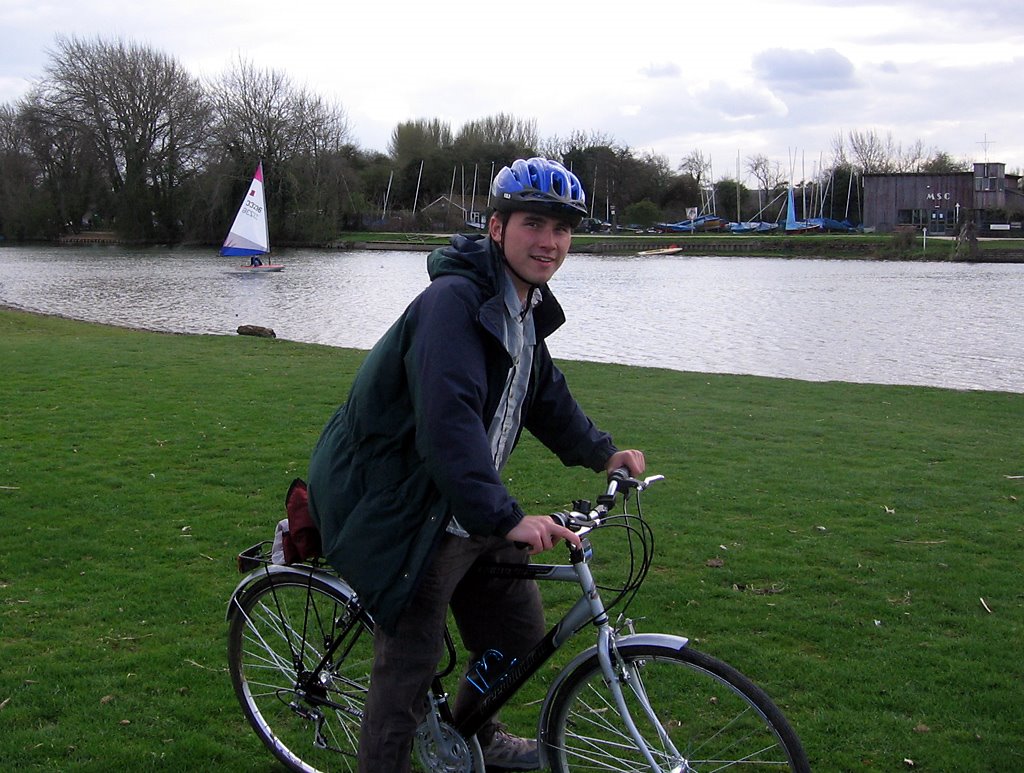
Bike gears

Trinity term officially begins today, which means half again as much reading and paper writing as has taken place so far, all in the course of the next eight weeks. The core seminar for this term is the development of the international system from 1950 to present, which basically means great power diplomatic and military history. I think we’re all appreciative of the fact that it’s territory we’ve basically all covered to one extent or another before. You could hardly get this far if you hadn’t.

Looking back over the break, it has been quite a good one. I travelled to Chichester, Arundel, and Malta. I saw Sarah get married. I spent a week with my mother. I met a number of new and interesting people. I read some good books. I applied (unsuccessfully) for a number of scholarships, as well as submitting a paper to the MIT International Review. I wrote the qualifying test, in fairly respectable fashion. I moved to a new place. I cycled a few hundred kilometres, in aggregate. That’s pretty good for six weeks.

New duties

Along with the Vice-Presidential position, I have been given responsibility for the Strategic Studies Group website. I can already tell that it is orders of magnitude more complex than any website I’ve ever operated before. Looks like I will spend some portion of the next year learning how to use MySQL databases and the various content-management applications that keep the thing going. If all goes wrong, I made a full backup before I touched anything – a very time consuming task when there are thousands of sub-directories.

The first step, of course, is to quickly learn the nuts and bolts of posting informational updates. Later, I can really get acquainted with the innards of the site and the way it operates. Despite the fact that it doesn’t seem to use much more bandwidth than a sibilant intake of breath, they have an absurdly large amount allotted.

[6:03pm] Within hours of taking over the OUSSG site, I managed to crash it completely, by not understanding the way the content management system, the SQL databases, and the FTP server talk to one another. I managed to fix it by manually editing a configuration file, since the way I screwed it up completely disabled the web-based CMS. I am going to leave the whole thing alone for a while now…

Housewarming party

Dancing in our kitchen

The housewarming party was a great success. The timing was good, the attendance was good, and the environment was good. At least half the program showed up, and probably a rather higher fraction. Food and drink were consumed; the completion of the QT was celebrated; and people interacted with one another in a way well outside the academic. In particular, it was interesting to meet the significant others of a number of fellow members of the program: Iason, Emily, and Tarun – for instance.

I am sure the gathering could have been a fine sociological opportunity, but I was far too entangled to reach any judgment. I just hope that people enjoyed themselves.

PS. There’s something about playing a Melissa Ferrick song in the UK and having it recognized that is profoundly cool. In the end, it is the unexpected that propels us forward in the social universe.

alea iacta est

The thing is done. I think it very unlikely I failed but, like everyone, I also think it unlikely that I did brilliantly. The questions I answered:

  1. To what extent can the outbreak of war in Europe in 1939 be explained by the lack of an effective military deterrent against Hitler.
  2. Which is the more useful concept in explaining international relations: anarchy or identity?
  3. How much greater are a person’s duties to eliminate injustice among her fellow citizens than to eliminate injustices among states or within other states?

I got a single-page letter back from the British Council right afterwards. With the Chevening out as a possibility, all the big scholarships for next year are gone.

Preparations complete

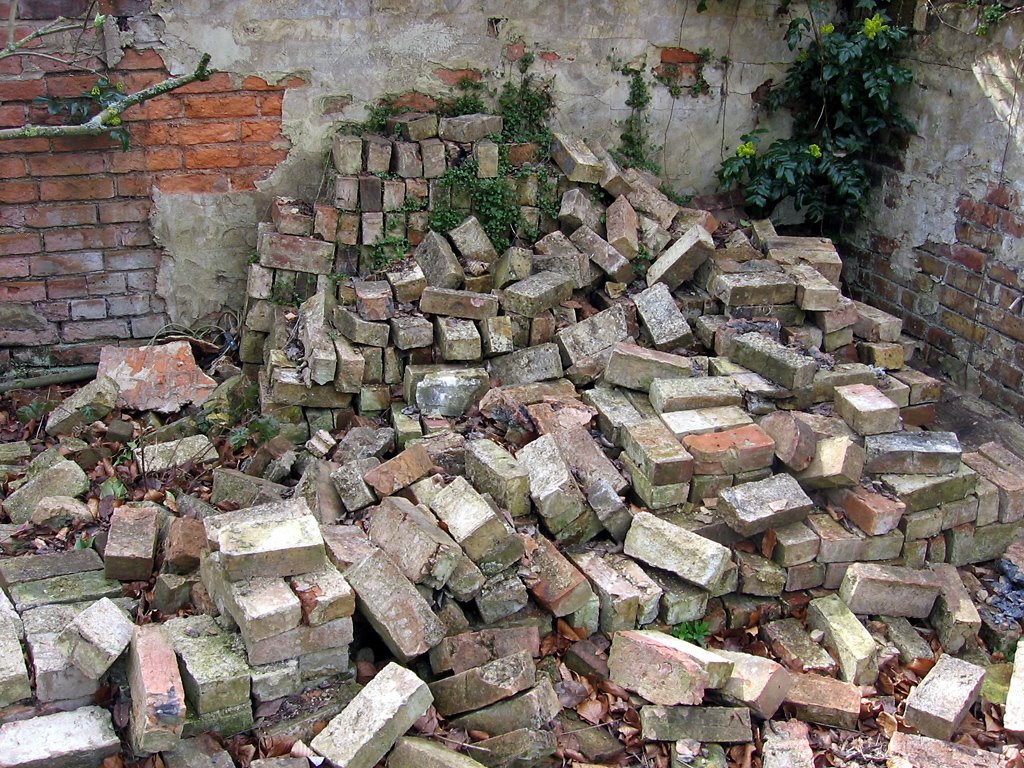
All just bricks in the wall

Living in a place with a proper kitchen has already taught me just how much better grilled cheese sandwiches with fried and marinated tofu are than the sort assembled on your desk, beside the computer. Like cleaning my room or sorting things, preparing relatively elaborate food (by my standards) is one way to escape the anxious clock-watching that my pre-exam hours tend to centre around.

During the last few hours, I have found myself at a bit of a loss, in terms of deciding what to study. Normally, I would be studying specific facts I thought likely to appear on multiple-choice or short-answer questions, but this test will include neither. You cannot cram broad themes and historical periods.

I really dislike the nights before exams: they are one of those grim times in life – like during exams themselves – when you are excessively aware of your position in time. In almost all circumstances where that is the case, it is because something at least potentially bad is about to happen. The feeling of being inescapably fixed in a constrained time-stream can effectively strip away the sense of being prepared or capable. Likewise, the feeling of being exceptionally awake contrasts unnervingly with my standard perpetual quasi-tiredness.

I should go for a walk.

[8:10pm] After a long and aggressive bike ride in the drizzle, I feel dramatically better. I headed north up Woodstock Road, eventually turning west onto a road that took me to Cassington. From there, I followed steeples along a much smaller road until I was in Yarnton. By then, I was pretty thoroughly lost – and yet, I sensed Oxfordness to the South and managed to get home before it was even really dark. The bit between Cassington and Yarnton – which you can see on this Google map – was definitely the nicest. It was the kind of countryside that makes one think about stealth camping, of the kind Meghan Mathieson pioneered with me.

Soon to be examined

Photo by Alex Stummvoll

The second-to-last pre-QT day has passed. It’s a good sign that I find myself going over things again, somewhat uncertain of how I should spend the rest of the time. That I am doing so seems to be an indication that I am fairly well covered, already. Thankfully, none of the examiners is a historian. As such, we are likely to get less badly criticized for failing to mention this or that theory or historian. As with the theory section, it is argumentation that is crucial.

Since a big part of the test is rhetoric, the wisest course seems to be to choose the questions to which you can give the most elegant answer – rather than the ones you know most about. That is why I am studying everything in reasonable detail – with a focus on times, countries, and questions that interest me – rather than preparing specific topics in hopes that they will appear.

Seeing Claire again this morning was really good. The return of friends to Oxford is the best thing about classes resuming.

A quick appeal to fellow students

Regarding the gathering of MPhil students on Thursday, after the QT: neither me, Alex, or Kai have a real stereo. If someone could lend us something with enough power to provide music for the party, we would be grateful. We have lots of music, but are distinctly lacking in watts.


  • iPod the Fourth arrived today; may it outlast its predecessors. I appreciate that it is actually possible to update two iPods at once, using my iBook. Even with the 20GB version available again, I suspect I will use the 1GB Shuffle frequently. The big advantages of the Shuffle are its size and simplicity: an excellent second iPod.
  • Today also brought the results of the interviewing section of the qualitative methods exam: which I passed, with nice things said about my work.
  • The clock tower near out flat tolls 156 times a day. I quite like the sound and experience of it; it makes me feel more in control of where I am, in relation to all temporal events.

Science fiction and positivist social science

While thumbing through a copy of Frank Herbert‘s Dune that I bought for a Pound at a used book shop, I realized the extent to which the highest ideals of strongly positivist social science can be found in science fiction. Because of the complexity of his notion of politics – and the interconnections between politics and other phenomenon, like religion – Herbert’s perspective extends somewhat beyond social science as often envisioned. Much closer to the ideal is some of the work of Isaac Asimov, which I will come to in a moment.

Dune itself can be read if an interesting (if fictional) study of politics. The Bene Gesserit notion of politics as fundamentally bound up in the structural relationships between different entities would not be hugely out of place in an American international relations faculty. The connections drawn up in Dune between transport, resources, and power are also relevant to contemporary politics. Of course, at times Dune is quite a self-aware allegory for the situation in the Middle East. I was entertained to find a discussion of coercion and consent as dual means for maintaining power in the novel. With a bit of terminology changed, it could be in a textbook on Machiavelli and Gramsci.

A better example of positivism embraced in science fiction is the concept of psychohistory: as described in Isaac Asimov‘s Foundation novels. Basically, psychohistory is envisioned as a science that can accurately predict the development of human society in the long term, and for large numbers of people. While it can’t make specific predictions about precise moments in time, it can predict massive systemic reorganizations over the course of anywhere between decades and millennia. It’s a strong endorsement of the idea that history is guided by comprehensible forces.

One interesting twist is that even with the benefit of psychohistory, the arch-positivists in the Foundation novels must still be actively involved in shaping the development of the system they examine. Also, for the predictive power to be maintained, people must not be aware of the fact that psychohistory is being applied. To say much more would spoil a number of key surprises in an iconic science fiction series, but the connections between science fiction and social science – within the historical context that spawned both – might reveal some important things about the kind of project some people understand themselves as being engaged in, as regards the world around them.

An alternative explanation is that, after spending so much time trying to force as much IR as possible into my head, I can’t see things any other way. When an eight year old boy is given a hammer, he suddenly discovers that everything needs pounding.

Of upcoming jobs and tests

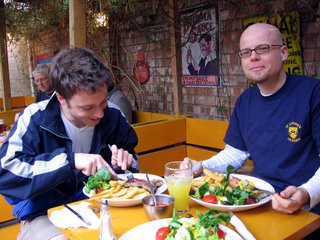
Das Roommates

Happy birthday Jennifer Ellan

Anyone who has been walking in the central part of Oxford lately will understand why my fallback idea of a summer job in the tourist industry is probably a sound one. The digital camera wielding masses increase in numbers and density with every passing weekend. Quite probably, the spectacle presented by my classmates and I walking around in the whole outrageous sub fusc outfit will provide them with the kind of experience they came here in search of. Working as a tour guide is a position that appeals to me. It would involve being outside, as well as really getting to know Oxford. Once the QT is over, I will investigate what is involved in getting such a job, and when one would have to begin. Naturally, my preference would be for something more academic, if it were available.

QT preparation carries on respectably. Based on my conversations with a great many people, it has become plain that your argumentative style is of absolutely critical importance on an Oxford examination. Questions at UBC were generally just a vessel, into which you were expected to pour factual information, within an argumentative context that was not always terribly important. Check marks would appear beside things like references to particular treaties, authors, or battles. Here, such references are still required, but will only get you anywhere within an argument that is quite tightly directed, as well as in keeping with certain rhetorical guidelines.

The first strategy suggested by that kind of test is to ‘can’ responses – in the way that people prepare cases to use at debate tournaments before they leave. Most people with whom I have spoken are doing something along these lines. They are choosing theoretical positions or historical topics and preparing specifically for them, in anticipation of the fact that some combination of questions they have prepared will be on the test.

This strategy does not appeal to me very much. Perhaps I flatter myself in thinking that I can come up with a more interesting answer on the spot, but I don’t think my hopes with regards to the value of spontaneity are entirely misplaced. They do tend to ask questions about standard issues (such as appeasement or the causes of the first world war), but they tend to include a bit of a twist in the question that requires your response to be written along a somewhat unfamiliar grain. Perhaps those who have extensively prepared on specific topics will be less capable of paying appropriate attention to the adaptation that questioning style requires. Given how much my supervisor and others have stressed the importance of both answering and interrogating the particular question, that would be problematic.

In the three days of revision I have left, I will finish reading the papers that I have traded with classmates. I will also give my boiled down notes another going-over or two, try to memorize a few specific ideas from particular theorists and historians, and possibly re-read things I have written here about readings that particularly caught my interest. It is those things – the ones that I felt some passion for at the time I learned about them – that I have by far the best hope of remembering and of writing something convincing about.


  • Alex, Kai, and I are throwing a housewarming party on Thursday night, after the QT. It is unofficially Flying Spaghetti Monster themed. Those who have not yet been touched by his noodly appendage can read the Wikipedia article or the open letter that began the movement.
  • A valuable discovery made today: a quadruple Starbucks espresso on ice only costs 10% more here than in Vancouver. Surprisingly, it only has about 360mg of caffeine in it, compared to more than 400 for a Venti-sized drip coffee. (Based on figures provided by Starbucks spokesperson Lara Wyss.) For my part, I enjoy eating the ice at the end.
  • With a wrench and all the torque I could muster, I tightened every possible bolt on my bike. Hopefully, this will put a stop to the spontaneous mid-ride disassembly that was making my trips more anxious than they might otherwise have been.
  • The latest additions to my (ever longer) discretionary reading list are Jack Kerouac’s On the Road and Alexandr Solzhenitsyn’s The Gulag Archipelago. I saw them side by side in Blackwell’s and could hardly resist buying one or the other. Perhaps a job there would be a good idea.