Days spent reading yield boring photos

Codrington Library basement

There is a strong negative correlation between the number of people in the Cornmarket Starbucks and the number in the Codrington Library. Having spent much of the day reading in each, I can provide evidence that is this statement is true both for different times within a specific day and between days. Unfortunately, when the Codrington closed at 6:30pm, I was left with fewer choices. In the absence of an effective reading partner – who girds you to the task through social pressure – the location of an appropriate study space is crucial. Both together can lead to awesome bouts of productivity of the sort that make it just barely plausible that I got in here by a means other than computer or administrative error. The general absence of such explosions, this term at least, sometimes leads to my questioning the wisdom of that selection.

I’m still not sure how I feel about the whole constructivist argument. While much of it strikes me as likely to have more explanatory power than realism, theory in the abstract is an intractable thing. I think this is slightly akin to how tactics exist both as conceptual possibilities and actual things employed in battle. By the time they are used in the second way, they’ve lost a lot of the rigidity and theoretical elegance of their former role. They get muddy and smashed up. One sort might help you win the day and the other sort might not, but it’s only when they’ve been applied in such ruthless circumstances that you will ever know. Hopefully, we will eventually get to something like that point with these theoretical discussions. More likely, we will just keep sparring like armchair generals over the relative importance of infantry flanking operations and effective artillery placement.

For good or ill, my assessment of theorists frequently comes down to their basic ability to get an idea across. I remember explaining to Tristan my theory of what it takes to become a famous theorist: you need to have a concept that is novel and that can be explained by someone reasonably knowledgeable about it to someone intelligent but entirely ignorant of it. Moreover, this needs to be able to take place at a party of the kind I attend: ie, those quiet enough to allow a conversation to occur. This is a standard that really famous theorists will meet many times. There are a large number of ideas from Plato, or Hobbes, or Rousseau, or Marx, or Adam Smith, that can be explained under these circumstances.

The extension of this is that, in order to be a theorist whose ideas I am likely to seriously contemplate, you need to be able to lay them out cogently in a piece of writing that I am not overwhelmingly tempted to skim through at the end, or clean my room instead of reading. By such measures, Alexander Wendt succeeds. “Anarchy is What States Make of it” has a strong, comprehensible, and interesting argument. This is especially welcome given how incomprehensible the terminology of sociology can become. The fact that I only needed to teach my spell checker four or five words while taking notes on it is a point in favour of Wendt’s piece. Another good sign is that Wendt is generally better to quote directly than to paraphrase: something that is rarely true of academic writing, and certainly not true of Waltz – that great pillar around which the whole of IR theory seems to revolve, whether deservedly or not.

Wendt’s discussion of how a circumstance can be socially constructed but also not subject to change is very interesting. Perhaps that’s because it saves the appearances of the world as viewed by realists without being based on their ontological assumptions – always a neat trick. It’s also an effective response to the lingering doubt I feel about the explanatory power of such sociological viewpoints. If it’s all a muddy, mutually constitutive haze out there, how can we hope to understand it or do anything? If mutual constitution can produce circumstances that are strictly delineated and self-reinforcing, it seems that it is capable of conforming more closely to the often unbending character of world politics.

Housing trouble

A serious snag has arisen in the housing situation. Wadham College won’t let me give up my contract to live in Library Court until the 17th of June, unless I can find another Wadham student who wants the room. Finding someone who wants to live here for just one term seems as though it would be difficult to arrange, though it remains a possibility.

Another possibility is to find someone who wants to live in the new flat between April and June. I could then move in for the following year once my time in Wadham ends. This seems like it might be less difficult than the first option, since somebody from any college could take one of the rooms in the Church Walk flat.

Still further possibilities include having the other two intended residents simply find a different third roommate. It may be easier to do so for the year-and-a-bit period than for just a couple of months. Meanwhile, I would sort out some alternative accommodation. The final possibility would be for all three of us to search out a different place. This seems the least sensible alternative (provided nothing else comes up regarding the Church Walk flat), especially since all three of us would like to move there in April, if it was possible.

Perhaps I can convince Wadham to relent. Alternatively, perhaps I can find someone who wants to take over tenancy of 11 Library Court for a few months. The location is certainly excellent. Indeed, if anyone reading this is interested or knows someone who might be, please pass me the message.


  • I should start developing a short and intensely focused wish list of things for my mother to bring from Vancouver. Obvious choices include MEC clothing: especially button up shirts of a solid colour with breast pockets, olive or khaki pants, and shoes to replace my one increasingly dilapidated pair. One critical item: twelve of so of the kind of four-coloured pens I take all my notes with.
  • I realized this evening that you can search for degree and decimal minute coordinates in Google Earth. For instance, searching for: “49 20.018 -122 56.200” will shift the view to rocks overlooking Deep Cove. I’ve been adding markers for my favourite hikes, cities I’ve visited, etc. It’s actually slightly thrilling to throw in the coords for a friend’s apartment in Helsinki (recorded to help find your way back there a few months ago) and then see the exact building come up.
  • Also interesting, with the default disk cache of 400MB, Google Earth seems to be capable of showing every place I’ve looked at during the last few days at the highest level of detail at which it was previously viewed. It also seems to retain all the major roads in North America and the UK, even when not connected to the internet.

Un jour lent

Unexpected tunnel effect

Leaving the St. Cross bop relatively early last night was probably a good idea. I actually managed to get a respectable amount of work done today. I’d say that’s because of the combination of the dreary weather outside and the feeling of deadlines actually creeping up on me: weapons at the ready. While I’m not sure if this little pause was terribly well spent, it’s clear that it is coming to an end. Over the course of the day, I read Reus-Smit, Checkel, and lots of Wendt. If this week’s seminar doesn’t degenerate into another theoretical shouting match, I should be able to participate in the discussion.

General school stuff

Portions of two scholarship applications got finished this morning. So far, such efforts have not yielded the cost of postage expended so far in applying, but I am hopeful this tide can be turned. I also read up on British tenancy law, which seems to be reasonably straightforward, though somewhat different from its Canadian equivalent. We will need to pay attention to getting a good tenancy agreement for the flat we will hopefully be renting for the summer and next year.

I should probably volunteer to write a paper for Dr. Hurrell next week. I can write it on the constructivism question, on the basis of the readings and the core seminar discussion. That way, I won’t have two papers due in seventh week, when the second core seminar paper for this term is due. I can write that on the topic for the seventh week discussion.

Upcoming talk

There is a talk this coming Thursday that I will be attending and encourage anyone who is interested to attend as well:

“The impact and role of major international scientific assessments on global environmental governance”
Dr Robert Watson, Chief Scientist, The World Bank
Thursday 23rd Feb, 5.15pm
Martin Wood Lecture Theatre: adjacent to the Clarendon Laboratory on Parks Road at the corner with Keble Road.

Given that is is very closely related to my intended thesis topic, I will certainly be attending.

New Oxford Craigslist

Andy Kim, a member of my program, has apparantly brought about the creation of a Craigslist for Oxford. According to him, it is “for housing, selling things, and all sorts of other weird things that generally happen on craigslist. It has its pluses and minuses, but I think it generally makes for a better connected community. ” Oxfordians should consider having a look. There isn’t much there yet, but I am sure that will change with time.

It’s not a service I’ve used myself, but I remember that Zandara found her really cool flat in Vancouver through it, so it must have its uses.


  • I am sure everyone remembers about the bloggers’ gathering on Tuesday, but I thought I should plug it again anyhow. If I am going to miss the Strategic Studies Group meeting for it, there had better be at least a few people there.
  • Ainsley Harriott flavoured cous cous makes a really good snack, especially if you add some olive oil. You can get four or five bowls of the stuff for the price of a Sainsbury’s sandwich. The “Spice Sensation” flavour is especially good, and reminds me of Indian food.
  • Google Earth is out for Mac. I spent at least an hour this evening checking out places I know well. Hornby Island is not at all where I thought it was, though my experience of getting there never actually involved navigating. I’ve also been adding markers for friends around the world. I’ve added everyone who has sent me a letter. Once you have entered the data point, you can set the program to fly between them in sequence. I may never do reading again.
  • What are you meant to do when you read something really unsettling on another person’s blog? It’s exceptionally hard to identify a person’s tone over this kind of medium, especially when you don’t really know them any other way. The choices seem to be to leave a comment that might miss the mark entirely or just ignore their post. Are painfully generic words used in attempted condolence better than nothing?

An Oxford absurdity

According to Esther and Wikipedia, it seems that anyone who completes a BA or BFA at Oxford automatically gets a Master of Arts (MA) degree seven years after matriculating, for a nominal fee. According to Wikipedia: “Despite the fact that no greater academic achievement is involved, the MA remains the most important degree in Oxford.”

Since I won’t have done an undergraduate degree here, it seems as though I will never get one of these nominal MAs. As such, once I finish my degree I will have the 28th highest possible rank, and it will never increase. If I had done a BA here, seven years after matriculating I would have risen to the 12th highest rank (provided I went on to do an M.Phil), or the 18th highest, if I just left it at the BA. In either case, I would outrank: “Doctor of Medicine if not also a Master of Arts”

There are apparently 46 ranks of Oxford graduates, the top 18 of which can only be earned if you have one of these MAs, with the exceptions of Doctors of Divinity and Civil Law (not Medicine). Only those with this titular MA can become full members of the university. The highest Oxford academic rank: “Doctor of Divinity” and the lowest: “Bachelor of Education.”

Despite spending two years and an absurd amount of money, I will end up with a degree that is nominally less important than one you get automatically. Completely absurd.

Random vignettes

Censored by Google

UK Pub Smoking Ban

The major reason for which I dislike spending time in most British pubs is apparently soon to be eliminated; I mean, of course, the carcinogenic clouds that seem to be a feature therein. It’s amazing, actually, that people persist in an activity that kills about half a million Americans every year, according to the Centres for Disease Control and World Health Organization. People should consider a pass-time that kills only a tiny fraction of that number: like serving in Iraq. Whatever enjoyment people derive from it, it clearly doesn’t make sense in cost-benefit terms. It demonstrates the extent to which the rational actor model fails in the face of various biochemical and sociological factors.

While my inclinations generally run in a libertarian direction, smoking is largely exempted from the categories of things legitimately subject only to personal choice. Especially in the case of commercial venues, smoking involves exposing other people – including employees who are there night by night – to the myriad dangers involved in the practice. From a personal perspective, it will make it more enjoyable to go to pubs – which is an activity with almost monolithic power, when it comes to the ways in which students relate socially in groups here.

In two words: I approve.

Olympic commentary

Mica informs me that Canada now has eleven Olympic medals. Well done, I say. That said, the only really intense Olympic experience I ever had was during my second year in Totem Park, where the whole undergraduate resident student body became caught up in Canada’s successful race for the men’s and women’s gold medals in hockey. I even watched the game between Belarus and unknown country X (where unknown country X is the one everyone expected to win) where the puck bounced off the goalie’s mask and into the net. Almost all of the time, sports are really boring. Sports and nationalism together: occasionally interesting.

In two words: why not?

Productivity, etc

I finished this week’s Economist today, as well as several of the readings on constructivism for next week’s core seminar. Medium-term projects now include:

  1. Finishing two more scholarship applications
  2. Arranging transport and accommodation for Sarah Johnston’s March 18th wedding in Chichester
  3. Sort out accommodation for next year
  4. Get a wedding gift for Sarah and a birthday gift for my mother

Without a looming essay deadline to motivate, I will need to learn to focus energies on the basis of other kinds of deadlines. While it might require an enormous personal adjustment, it’s just the king of thing that’s necessary in order to exist as a crude proxy of the kind of ‘highly effective people’ whose habits are written about. Thankfully, since my habits are written about almost exclusively by me, nobody need know about the instances where I wander ever so slightly from the path of enlightenment through massive doses of academic prose.

In two words: read more!

Of hair and housing

Kitchen of the potential flat

Another round in an ancient battle played out today. I mean, of course, the battle that has raged over the length of my hair. There is a camp that encourages it to become ever-longer: a camp served by apathy and thrift on my part, but opposed by my will. Short hair is manageable hair, which does not become an embarrassment if briefly slept upon or subjected to a hat. The viability of the hat option makes temperature control more feasible. In short, the advantages of short hair are legion. Of course, the longer-hair crowd always wins out in the short term, as the stuff extends day by day. I always win in the medium term, once I muster the energy to blast it back. The first red line is when it becomes capable of touching my eyes; the second when it begins sticking out over my ears; and the third when it starts behaving unpredictably on the back and sides of my head. By then, it has become a dangerous snarling mass.

When you think about it, winning in the medium term is the best we can ever hope for as human beings. I’m now probably mostly made of Oxford tap water, where once I was made of Vancouver tap water. My ability to continue rebuilding myself out of water and digestive biscuits is ultimately capped by entropy: the central reason for which we are all doomed in the end. As such, it if in the 5 to 50 year time scale that we have the opportunity to snatch what victories we may from the jaws of irrelevance.

Speaking of medium-term victories, Kai and I may have found a suitable flat for next year. It’s located right near St. Antony’s, on Church Walk. It’s farther from Sainsbury’s and the centre of town, but about the same distance from the Department, and closer to Jericho and some nice commercial areas. It’s a basement suite, located underneath some kind of institute. As such, there will be nobody upstairs to bother us or be bothered evenings and weekends. It also includes a sizable back yard: almost as large as all of Library Court. We could definitely hold some nice garden parties there. The three bedrooms all have safety windows looking outside at ground level. (The third bedroom would be occupied by our silent partner.) The kitchen looks good and even the smallest of the bedrooms would more than adequately serve me.

At £85 a week for the two large bedrooms and £75 a week for the small converted living room, it seems quite pricey. That said, my termly battels in Wadham have exceeded £900 for each term and inter-term break period. Having a better kitchen would also encourage me to eat in more often, as well as affording me the chance to actually store prepared food. Those prices include power, water, and broadband internet access (obviously the most vital of the three). In short, the flat itself is very nice with advantages of location and design.

The biggest potential problem has to do with availability. The lease runs from September to September, which is standard, but the three current residents are all moving out in April. They are looking for someone to serve out the rest of their lease, then take one on for next year. My accommodation in Wadham runs until the 17th of July, but I am inquiring as to whether I could move out before the start of Trinity Term instead. Then, I could live in the new flat from the start of April until our exams end in July 2007, at which point we would presumably find people to play the same lease-finishing role as we would be playing from April to September of this year.

This will be the first time I’ve actually lived in accommodation that is private to this extent. I say ‘to this extent’ because the building does belong to St. Antony’s College and it would be through them that we would be letting it. Even so, it is much closer to private accommodation than Library Court, Fairview, or Totem Park have been.

I am excited about the prospect of living there.

PS. The haircut, which I got from the same place on the Cowley Road as the last one, is neither the best nor the worst I’ve received. The best was in Venice and now comprises the picture I show to barbers; the worst was in London, and I am sure it’s now part of my CIA dossier. This one is slightly worse than the last haircut I got in Oxford.

Qualitative methods changing tack

Wadham washing machines

Happy Birthday Kate Dillon

Tomorrow’s qualitative methods lecture, to be given by Dr Sudhir Hazareesingh, is on the topic of “Bonapartism and popular political culture.” This sounds exceptionally esoteric, following four classes divided between the broad areas of Foreign Policy Analysis (woe to anyone who wrote the take-home exam on that topic) and Institutions. That said, holding “a general discussion about the role of myth in politics” sounds like a particularly interesting way to spend a couple of hours. It’s more in keeping with the kind of social and historical examination that Bryony and I were talking about yesterday.

The OED calls myth: “a popular conception of a person or thing which exaggerates or idealizes the truth.” I don’t know if that’s the most useful definition, largely because of the difficulty of accessing a ‘truth’ that exists independently or is particularly important. One of the examples given seems to illustrate this point:

Disraeli set himself to recreate a national political party out of the wreckage of Peel’s following. A new myth had to be evolved.

Without knowing anything about the situation being described, the dynamic can be recognized. The need to create a new story to replace or update an old one is a frequent and comprehensible thing. It’s part of what makes politics such a maddeningly difficult thing to deal with.

Myth – whether in the form of national foundational myths, justifications for state authority, or narratives about national history – seems to have played a fundamental role both in domestic political development and the development of the international system. The social role of myth, it seems, is to serve as a heuristic for justifying and understanding. Just think about Canada’s self-definition as the peacekeeping ‘helpful fixer’ or the American conception of being the ‘city on a hill.’ Neither has always reflected reality; it may be more useful to think about them as touchstones of national identity. That doesn’t mean they are always automatically accepted, but rather that they provide a data point that is always within the range of consideration. Myths provide a hook upon which other ideas can hang, as well as a barrier behind which complexity can be concealed.

Bloggers’ gathering reminder

To remind everyone, the second Oxford bloggers’ gathering is to take place next Tuesday at 8:00pm at The Turf. I hope I will get the chance to meet a few more of the people whose posts I have been reading.


  • As I have learned through clips on the Comedy Central website, The Colbert Report is brilliant: a worthy companion to The Daily Show. I especially like the hubris of the segment: “Bring ‘Em Back or Leave ‘Em Dead.” I recommend having a look.
  • My brother Mica is still seeking advice on his video production efforts.
  • In a cross-over I never expected, Bill Emmott – editor of The Economist – has a letter in this week’s Savage Love. Since both are publications I read weekly, I was entertained to see them thus paired. In the spirit of Mr. Colbert, I give a tip of the hat to each of them.
  • Removing dust blotches from every single photo of the day is really annoying!
  • I used to consider Xanga to be the very bottom of the blogging barrel, in terms of the overall level of quality of sites hosted there. MySpace has absolutely shattered that record. I have never seen a MySpace page that is even tolerable, much less attractive. They tend to have complex, garish backgrounds that do not scroll with the stuff in front of them and include that sin of sins: embedded music. It’s like being thrown back to the Internet circa 1995, and it’s an ugly ugly experience.

Cause I dreamed I went to England…

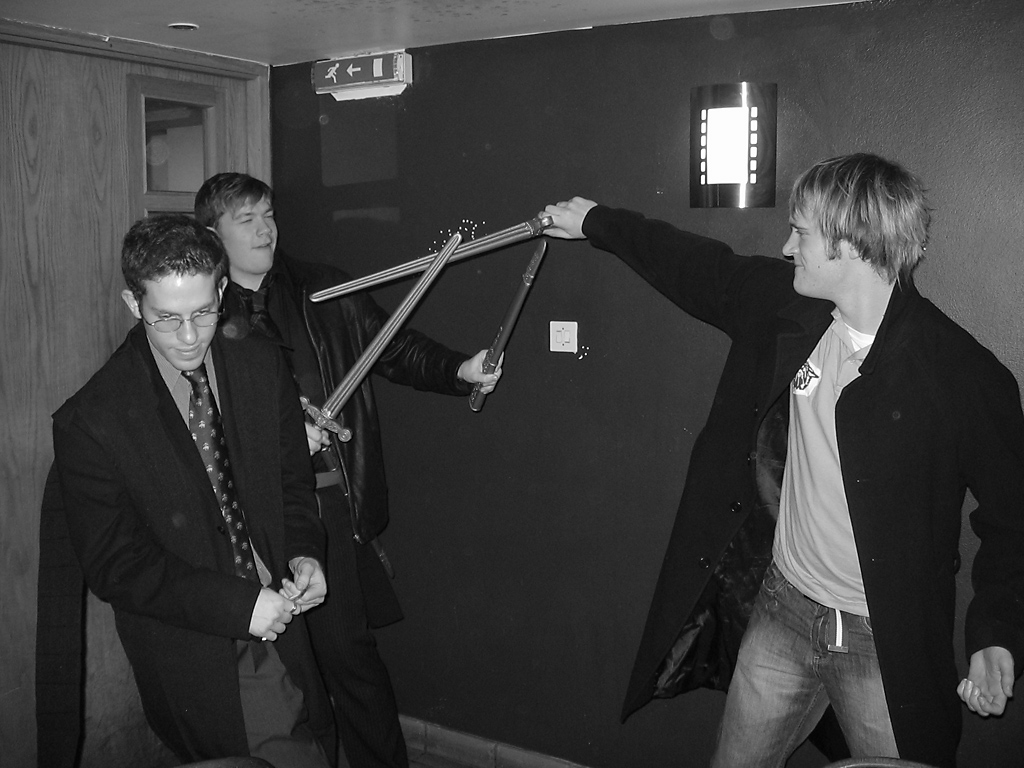
St. Cross Swashbuckling

The social side of today went better than the academic. Our core seminar was little more than a tired re-hashing of entrenched positions, which didn’t really advance academic argument. It was really quite combattive. We are in the territory now where egos are defined and, frankly, not a great deal of really important work is getting done. Theory for its own sake is much less interesting than thought applied to practical problems.

After the seminar, I met a group of IR people for half priced drinks at the Duke of Cambridge, on Little Clarendon Street. Despite my haste to get to the Strategic Studies meeting, Emily furnished me with some kind of fruit cocktail concoctions. I hope her ambition to go dancing later was achieved.

The Strategic Studies election is a bit of a joke. While there are two candidates for President: Sheena Chestnut and Matt Pennycook, both from my program, I am the only candidate for Vice. I won’t need to go quail hunting with any potential donors. Nobody at all is running for Secretary, though Claire is submitting an application tomorrow. Having an exec dominated by members of the M.Phil in IR would be interesting.

The Strategic Studies presentation itself was on China and Taiwan, and was generally reflective of the conventional wisdom on the matter. Afterwards, I went to St. Cross and met with Claire and a number of her fun friends. There was even fencing involved – both within the confines of St. Cross and outside in Oxford’s rain-drenched streets. I quite enjoy the social atmosphere at St. Cross, as well as the particular characteristics of Claire’s friends there.

Now, I should turn my attention to my complete lack of wearable clothes and the bulk of reading on constructivism to be completed for next week. Tempted as I am to grab a plane ticket to Rome and a train ticket to Turin, I should probably stay the course here. Getting a bit ahead might even help disrupt the boom and bust cycle that has been characteristic of the program thus far. As I discussed with a classmate outside the Duke of Cambridge, it seems more like we are being tested over and over than we are actually being taught specific things.

I really need to take the initiative and start reading more about environmental politics and spending time at the Environmental Change Centre. That, and spending more time with St. Cross people.

Dead Wolf Marketplace

Up on South Parks Road, there is a sheet-metal covered barrier that is at least twelve feet high – topped with several strands of razor wire. In front, there are concrete blocks and along the top there are fixed and movable security cameras. This barricade is built around the Oxford Animal Lab, which hundreds of people have been protesting and which has gone through several building contractors because they keep getting scared off by death threats. The builders now wear balaclavas, for fear of being harassed when off the site.

Less than a kilometer away, as I was walking through the covered market in search of a shop where Louise told me I might find more kinds of tofu, I passed six dead wolves hanging from hooks. I was astonished. Six headless, fur-covered, quadrupedal corpses split down the middle and hanging along the edge of a pathway that people bustle down with bags of new shoes.

The obvious charge is one of hypocrisy, but my response to the dead creatures was nowhere near so rational. It was a shock and disgust that persists hours later – despite efforts to wash it away with organic cola (disgusting) and ciabatta with cheese and roast veggies.

Along with the rows of dead rabbits (their heads in plastic bags so as to help people avoid anthropomorphizing them), the quail, and all the rest of the meat, they produce a smell that permeates the whole market and that lingers in my nostrils. Colour me confirmed in my vegetarianism.

[Edited: 7:46pm] Having consulted a wolf expert in circumstances too strange to go into, the consensus if that the aforementioned quadrupeds are assuredly not wolves. My imperfect photos reveal fur that is the right colour, but legs that are decidedly too thick. Headless, they remain unidentified.

Take-home exam woes

Spiral stairs

As I sat in Wadham’s hellishly hot subterranean computer lab, thinking about the Inuit Circumpolar Conference and Principal-Agent Theory, it became increasingly obvious that the latter is really not at all useful for understanding the former. Had I known what the exam question was going to be, I certainly would have chosen a different case study. Now, it is rather too late, so I shall carry on trying to dig myself out of this hole. I did specifically ask the professor whether the ICC would be a good institution to look at, and received a response in the affirmative. As such, I am not wholly responsible for this debacle.

Submitting my exam, which I am actually less unhappy about than the above paragraph indicates, I was surprised to find that envelopes cannot be slid under the office doors inside the Department of Politics and International Relations. This seems like a fairly severe design flaw in an academic building, where slipping a completed paper under a profs door is a time honoured method of submitting work securely.

From the department, I walked Emily to St. Antony’s. En route, I learned that she attended a session about the entrance examinations for All Souls. To become a prize fellow, you take fifteen hours of examinations on various subjects, followed by a viva examination with all the present members who care to show up. At most, two people a year are admitted. Those who are get seven years of funding and accommodation for any kind of study in Oxford. Technically, I could even become a medical doctor in that space of time, based on the generally shorter degrees here. Not that I could stand all the blood and syringes.

It might be worth spending the fifteen hours even to make the attempt and fail. At least you could say that you gave it a shot, and you would still be in distinguished company. Some very eminent people have been disappointed by this particular examination.

Along with my qualitative methods examination, I submitted my ‘manifesto’ for the Strategic Studies election. It’s an odd system, where people vote by email and you can only run for one position. Inspired by Matt’s example, in running for President, I put myself into the Vice-Presidential running. After all, there will only be one chance to be a member of this executive. I don’t know whether I am running against five people or none. Nominations close on Tuesday and the final list of candidates will be announced on the 21st. I shall keep you posted on what develops.

The seems to be a tiny bit of an academic pause in the next little while. There are always readings to be done, of course, but I don’t think I have any papers due next week. Our second core seminar paper is due on the 28th and I should be starting a paper for Dr. Hurrell soon, but I do have a bit of a space here to work with. Maybe I can finally finish Neorealism and its Critics: a book that I have struggled to wade through in three different countries over the course of the last three months or so.

Take-home exam and contemplation of dreams

Bikes near the train station

Morning and early afternoon: reading and writing

I am really enjoying The Wind-up Bird Chronicle. As with most fiction, that is a result of the narrator. You need to see their project as valuable, yet not something you could or would do yourself. As such, they are doing you a service by living in that capacity in your stead. You get the results back in neat lines on pages. In good fiction, those results feel a lot like memory. They get overlaid upon your own memory, as though you had thought those things yourself in moments similar to the ones portrayed.

I have been dreaming copiously of late. I can set the countdown timer on my phone for ten minutes, lie down, and dream something – even in the middle of the day. Sleeping for an hour or to, I might have a half dozen dreams: all of which I can remember for a minute or two afterwards, but none that I will remember an hour later. I don’t know if this is just a meaningless phenomenon or whether it represents some kind of ongoing psychological condition. It’s certainly not something that’s normal for me.

It’s nice to imagine that my brain is doing some kind of internal housekeeping or reorganization and, as such, sleeping is not a waste of time. Rather, it will allow me – very soon now – to come at all problems with a piercing new intelligence and command of language and memory.

I read a few chapters of Murakami’s book between reading and writing pages for my take-home test. It’s hard to evaluate the Inuit Circumpolar Conference from the perspective of the principal-agent framework. Firstly, that’s because there isn’t actually a lot of information out there about it. Secondly, the framework seems better suited to institutions with a more defined structure. That said, understanding the ICC is important – for a number of reasons I identify in the latest draft – and it’s probably at least a bit important to understand the extent to which this framework works for it. That makes writing the exam much less of a chore.

During all of this, I listened to Tegan & Sara.

Late afternoon and evening

I met Louise at the train station and spent a while with her getting coffee and then groceries before she went off for dinner with friends and German backpackers and I returned to Wadham to carry on working on my take home exam. Getting it done completely tonight, or even just to the point where it requires only final linguistic and conceptual editing, would liberate tomorrow – a benefit that is not to be sneered at.

I will, after all, have another week’s reading to do for Tuesday and Thursday, as well as writing a manifesto for the Security Studies Group election. Next’s week’s general topic is international society and international law, and the specific question which to which I must prepare and answer is:

What is meant by the concept of international society? In what ways does it represent a challenge to realism?

Thankfully, this is something that I already know at least a bit about. Coming up next in qualitative methods: “Archives, Texts, and Sources,” beginning with “Bonapartism and popular political culture.”