
Category: Politics
All posts on what Bismarck called “the art of the possible”
Professional organizers
The ongoing Washington protest has given me my first real exposure to an interesting group of people – professional organizers of protests. These are people who provide direct action training, run websites, work with the press, etc. The organizers are progressive people – to be sure – and I am sure they are selective about the causes they support.
The organizers are distinct from activists in that activists are usually firm believers in a specific cause. The activists in this particular protest are the people who are willing to get arrested to express their strong opposition to the Keystone XL pipeline.
Those people are obviously necessary, but it has been interesting to learn a bit about the general logistical side of things – watching people work in dark cubicles on a Sunday, updating websites and watching the news coverage roll in.
Reasoning behind going to Washington
Over on BuryCoal, I have posted an explanation of why I am going to the Keystone XL protest in Washington D.C.
I hope it is comprehensible, despite having been tapped out during an unusually exhausting Greyhound journey and posted using snatches of WiFi from passing coffee shops and motels.
Rating the raters
Nate Silver of FiveThirtyEight has an interesting post about sovereign public debt default ratings from Standard & Poor’s. He argues that their ratings from five years ago did not reflect the risks that arose with the financial crisis.
Despite their potentially misleading character, the financial system relies on such ratings to be a proxy for probability of default. A bondholder with a good rating should be less likely to default than one with a poor rating, and a highly rated security should be a safe investment, If the ratings produced by rating agencies are not a good proxy for risk, it may be a mistake to continue to give them such an important role within the financial system and financial regulation.
Of course, that raises the question of what to use as a superior indicator for risk.
Why I left Facebook
I have been worried about Facebook for years. I worry about how personal information on users is their most valuable asset, and the ways in which they may seek to profit from it. More generally, I worry about the unintended consequences of creating massive searchable databases on social interactions.
What actually prompted me to ‘deactivate’ (not ‘delete’ yet) was two things.
Excessive time demands
First, Facebook is too time-demanding. People expect me to keep up to speed on their many postings, despite how there are hundreds or even thousands of status updates that appear every day. If you advertise your event on Facebook and I miss it completely, it is probably because I was trying to get some reading done, or enjoying a walk and a cup of coffee, or dealing with my neverending flood of unanswered email and so I missed the status update message or invitation for a few days.
If you really want me to know about something, you must at least send me a text or an email. Putting notice on Facebook (or Twitter, or your own website) is not a sufficiently attention-grabbing action to ensure that I will see it.
As I am writing this, I am ignoring a sizeable collection of projects that are in need of attention. I should be working on finding an apartment in Toronto, packing up my current apartment, and making plans for how to move. I should be researching possible doctoral programs, working on my research proposal, and corresponding with possible references and supervisors. I should also be reading various books from various stacks of semi-read tomes, refining my low carbon mutual fund idea, improving my chess, getting exercise, exploring some elements of Ottawa that are still unknown to me, planning a trip to Washington D.C., planning a trip to New Orleans, writing articles and letters to editors, processing and uploading photos, going out and taking new photos. I should be taking university courses, learning practical skills, responding to letters, searching for photographic gigs, learning to drive, joining clubs, going camping, and improving my data backup regime.
All of those tasks are better uses of time than Facebook.
Privacy
Second, I am worried about facial recognition. The only barrier to it becoming absolutely ubiquitous seems to be the availability of data on our faces. The cameras are already out there, and the software and the computing power to turn pixels representing faces into names are coming inevitably.
Someone with a lot of determination can dig around the internet and probably find dozens of photos of me to feed into a facial recognition algorithm. While I was on Facebook, however, this process was simplified to the point of easy automation. In thousands of photos, I had been specifically identified and even had the region of the photo containing my face marked.
Still not too isolated
So far, I have been glad to be off that particular grid. Anyone who actually wants to contact me has a wide variety of ways to do so. My email address and cellphone number are both on the ‘contact me’ page of my blog, and my blog comes up immediately when you Google my name. If that is too much work for a person to go through, it seems fair to say that they didn’t really want to contact me in the first place.
I don’t want to delete my Facebook account completely because it does have some value to me as an archive. Nearly all my photos from Oxford are in there, with tags and comments affixed. If Facebook provided a way to download all that as an elegant, accessible archive that can be used offline I would be happy to do so. I doubt, however, that they will ever provide such a tool. All their plans hinge on attracting people to the site and making them visit as often as possible. Helping them untangle themselves and walk away with whatever data they find valuable runs completely counter to that. Facebook actually lets you download your photos easily in quite a good archive format.
I will miss the chance to see what distant friends are up to easily, and to have the occasional fortuitous bit of contact with them. I will try to remember to send an out-of-the-blue email every once in a while.
P.S. I left LinkedIn too, but who cares about LinkedIn?
This American Life on patents
A recent episode of the This American Life podcast centres around technology patents, with emphasis on the so-called ‘patent trolls’ who harass legitimate companies using dubious patent claims, in hopes of getting cash settlements.
Designing an ideal patent system is an interesting question from a utilitarian perspective. It seems beneficial to encourage innovation and protect small companies with novel ideas from giant companies that might steal them. At the same time, patents can be used by big companies to bully small ones, and when obvious ideas are given patents it can prevent useful technologies from becoming widely available.
Dewar letter regarding asbestos
Around Canada Day, I wrote a letter to Paul Dewar, my Member of Parliament, about Canada’s export of crysotile asbestos. It seemed classier than holding up a giant “Shame on Canada, Asbestos = Cancer” sign during the Royal Visit.
Today, I got a response setting out his position on the issue:
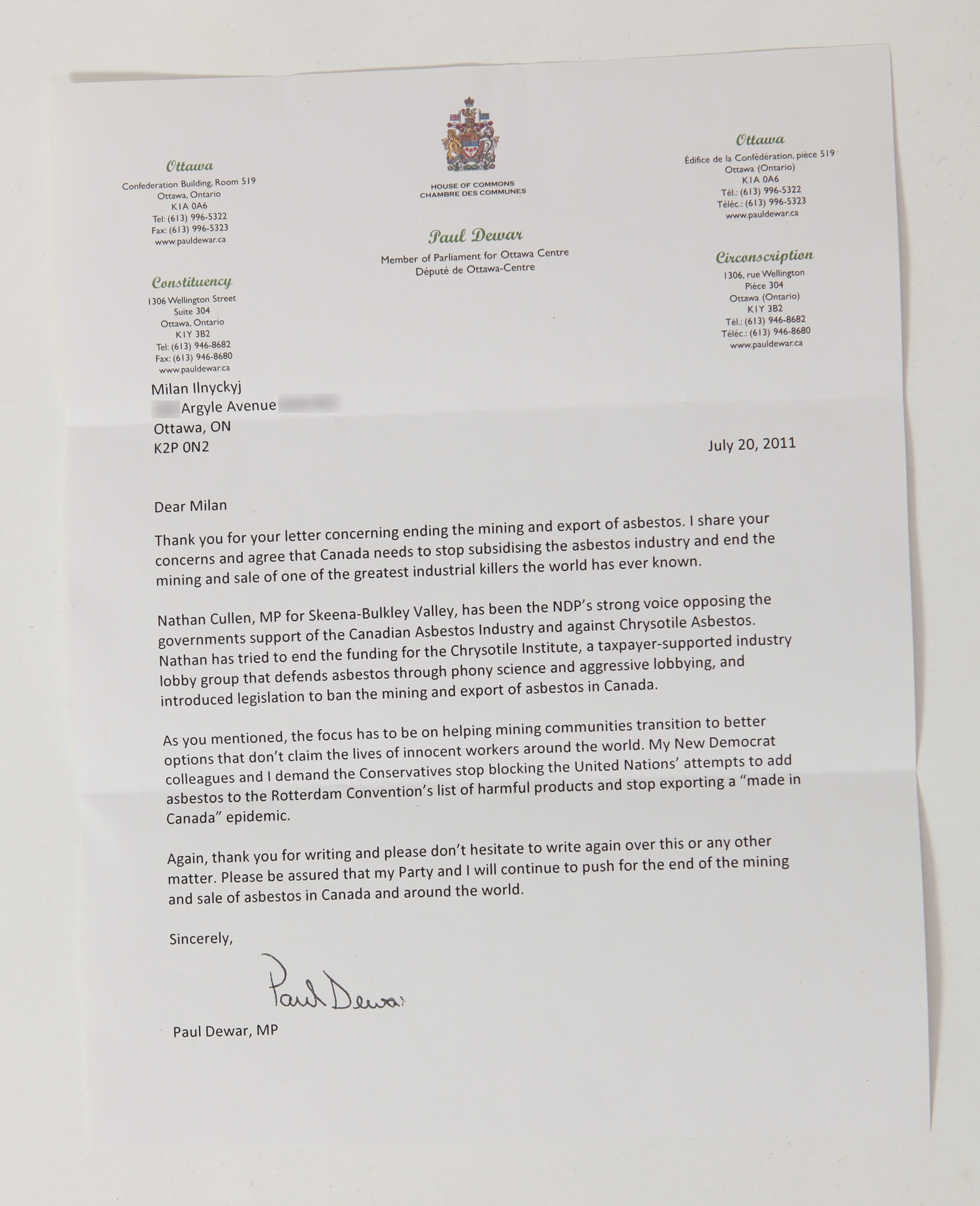
Any pro-asbestos residents of Ottawa Centre should start bombarding him with strongly worded letters immediately. I am curious what sort of response they would get; hopefully, the same statement of policy with an explanation of why Dewar disagrees with those who favour Canada’s current policy of asbestos support.
It’s good that he has staked his colours to the mast on the issue. Constituents who are concerned about the issue of asbestos should make sure he has voted along these lines the next time the issue arises in the House of Commons. By then, I expect, I will have a new MP (due to me moving).
Asbestos export is an issue I first raised here some time ago.
Automated facial recognition
As processing power becomes cheaper and smarter software is produced, it seems inevitable that more and more people and organizations will begin to identify people automatically by recognizing their faces with surveillance cameras.
London’s Heathrow airport is planning to install such a system, and Facebook may be the ultimate database to let freelancers do it themselves.
To me, it is all rather worrisome. At a basic level, life becomes more paranoid and less creative and interesting when you are being watched at all times and all of your actions are being archived forever. It’s only a matter of time before photos from every fun party ever are being combed through by investigative journalists hoping to catch someone who has become famous in an embarrassing-looking situation. Facial recognition allows for the creation of databases that can be used for truly evil purposes, from suppression of political dissent to stalking and blackmail.
Like nerve gas, facial recognition technology is probably one of those things that it would be better if we could un-invent.
Should I renew my subscription to The Economist?
Since I was in high school, I have been reading this British news magazine weekly, and not without good reasons. It is essential reading for university debators in Canada. If you don’t keep up to speed on what is written there, you are likely to get blindsided when your opponents bring it up. While their editorial stances are not always entirely convincing, they do defend them with evidence and good arguments. You will never sound entirely stupid while trying to defend their positions.
The Economist is also a magazine that seems to maintain attention in many other quarters. It is the only magazine I have frequently seen circulated in Ottawa offices. The biggest argument in favour of reading it may be that others do, and that by continuing to do so I keep myself appraised of what is happening. As a way of remaining reasonably well informed about happenings in many different spheres of life, all over the world, it may be a uniquely valuable publication.
There are also arguments against renewal. Some have argued that I would be better off spending more time reading other sources of news. Some have argued that I should read less news altogether: most of it is depressing, and most of it I can do absolutely nothing about.
Time is another issue. Your average weekly issue consists of about 100 pages of small, tightly-spaced text. I find that it takes at least five hours to read carefully, and significantly longer when there are lengthy special reports, technology quarterlies, and the like included. I could probably find ways to use that time that would be more useful or pleasant.
The cost is a bit of a consideration, at more than $400 for three more years. That is especially true given ongoing job uncertainty.
There is also the matter of climate change. The Economist does seem to accept the basic science that says that continuing to burn fossil fuels threatens humanity. Some of the time, the seriousness of the problem is reflected in the positions they take. At the same time, they have definitely failed to demand that politicians prioritize climate change over other issues, particularly economic growth. They have also frequently celebrated the discovery and development of fossil fuel reserves. Increasingly, it seems like they must be covert supporters of geoengineering. They realize that climate change needs to be dealt with, and know what would be involved in achieving that outcome by cutting fossil fuel use. They are unwilling to wholeheartedly endorse the rapid abandonment of fossil fuels, so the implicit position is to their accept the climatic consequences or try to eliminate them by technical means.
So, what do people think? To renew or not to renew?
Don’t kill the Webb!
With the last Space Shuttle mission ongoing, people are naturally asking what the future of space exploration is going to be. It seems clear that ambitious plans like a manned mission to Mars are a non-starter in the current fiscal climate. That being said, one of the major reasons why such missions are basically off the table is because they are not very useful. It would be very difficult to get human beings to Mars and then return them alive to Earth, but it wouldn’t teach us much about the universe.
By contrast, the James Webb Space Telescope is designed to be the successor to Hubble: one of the most successful scientific instruments of all time. Much of what we know about the universe has been established, confirmed, or refined using data from that instrument. As such, it is saddening to hear rumours that the Webb telescope may be scrapped fur budgetary reasons, if NASA experiences funding cuts of a certain magnitude.
It seems to me that would be a great shame. While the Webb will cost billions of dollars, it will also actively push forward the boundary of human knowledge and give us a better sense of what the universe is like. Launching it is something that humanity ought to do, even if we are experiencing economically difficult times. Basic science is something that builds upon itself, as new data is collected and new experiments are carried out. It is impossible to know in advance what the consequences of some seemingly obscure bit of cosmology or astronomy or physics will be. For instance, who would have predicted that special relativity would one day permit the precise geographic location of inexpensive receivers, using coordinated time signals from satellites (GPS).
For the sake of the important human undertaking of understanding our universe, we should find the money for the Webb.