Language changes in Canada’s foreign policy

Canadian Standards Association logo

Apparently, the Conservative government has ordered Canada’s diplomats to stop using the terms ‘child soldier’ and ‘international humanitarian law.’ I heard about it on CBC’s The Current before leaving for work today, and it doesn’t seem to have been picked up much by the mainstream press. Apparently, “gender equality” is also on the chopping block. The changes may have been partly motivated by the continuing saga of Omar Khadr.

The basic points made by those interviewed on The Current are sound ones: that this is an underhanded way to effect foreign policy changes, especially given how the Conservative platform in the last election basically ignored that area of policy-making. Also, the changes run against Canada’s tradition of advocating the humanitarian side of international law, including through the efforts of the Mulroney government to address some of the issues involving children in war situations.

If this government wants to take a public position to back away from international humanitarian law and the protection of children exploited in wartime, they are within their rights to do so. Trying to do it by stealth, however, is a disservice to Canada’s internationalist traditions, its civil servants in the foreign service, and the Canadian public. Developments in areas like the prosecution of war criminals are among the most significant and positive in the recent history of international relations. It would be a shame if Canada took up an obstructionist position (either openly or covertly), especially at a time when the new American administration might be able to soften the rejectionist American stance on institutions like the International Criminal Court.

Foreign Policy on the end of oil

Foreign Policy has put out a special report on oil, entitled “The Long Goodbye.”

Topics covered include the ‘resource curse,’ geopolitical and pipeline issues in Europe, as well as nuclear and renewable forms of energy. It is nice to see major publications starting to devote serious consideration to the inevitable end of the hydrocarbon era.

Compensation for climate change

In Ethiopia, ministers from ten African countries are meeting to work out negotiating positions for the upcoming climate change talks in Copenhagen. One likely position will be a demand for financial compensation in response to the harm caused by climate change.

In principle, some compensation is probably justified between those who have knowingly engaged in actions that cause climate change and those that have suffered as a consequence. In practical terms, however, things are rather more complex. For one thing, it is dubious whether all of the governments with populations affected by climate change would effectively and equitably distribute any payments.

The world’s priority needs to be on getting effective mitigation action started. Without that, adaptation costs will eventually exceed what even rich states are able to spend on their own citizens. Effective negotiating tactics to drive a global mitigation agenda are really what especially vulnerable states should be concentrating on now. Some of these – such as paying for avoided deforestation – may have a similar character to a compensation scheme.

The 350 movement

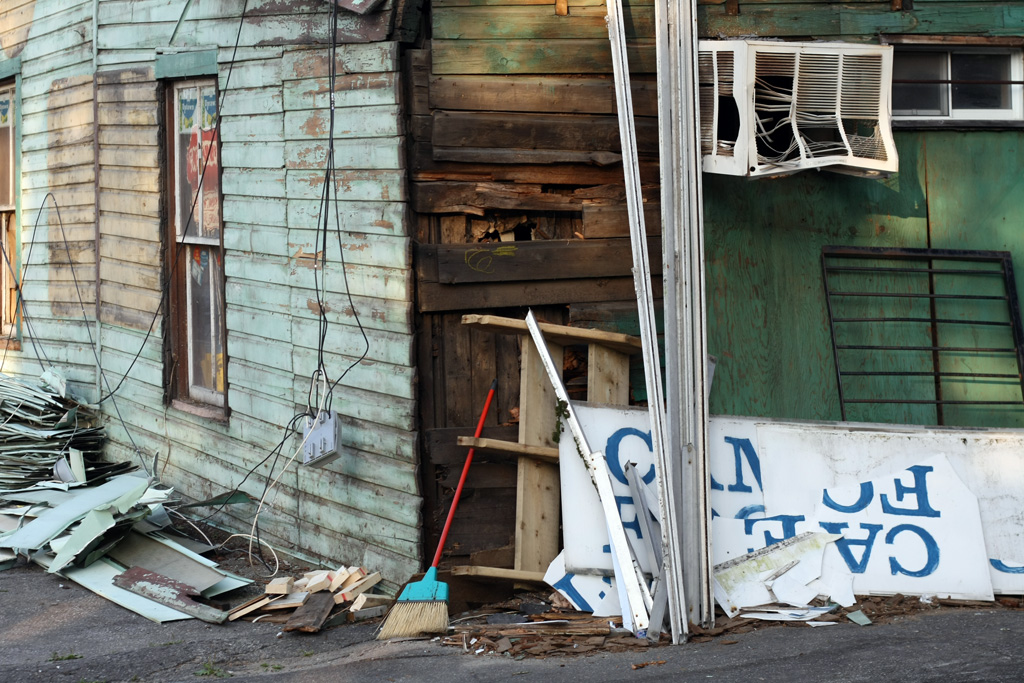
Derelict store, Ottawa

Right now, the atmospheric concentration of carbon dioxide (CO2) is around 385 parts per million (ppm), up from about 280 ppm before the Industrial Revolution. Scientists, economists, and others disagree about what figure to accept as a ‘safe’ maximum concentration, with uncertainty enduring both about what temperature increase any particular concentration level will mean and what the social, political, physical, and biological consequences would follow.

Probably the most cautious group of all, with regards to what concentration is safe, is Bill McKibben’s 350.org, with their target of a reduction to 350 ppm. One major supporter is top NASA climatologist James Hansen:

If humanity wishes to preserve a planet similar to that on which civilization developed and to which life on Earth is adapted, paleoclimate evidence and ongoing climate change suggest that CO2 will need to be reduced from its current 385 ppm to at most 350 ppm.”

By contrast, many environmental organizations have expressed support for targets between 450 ppm and 550 ppm, usually while hoping that such an increase would not generate more than 2°C of additional warming. Whether it would do so or not depends primarily on the relative strength of feedbacks within the climate system.

With extremely aggressive cuts in human greenhouse gas emissions, it could be possible to stabilize concentrations below their current levels. One major reason for this is the oceans. When CO2 is added to the atmosphere, it is akin to adding more CO2 to the area of air at the top of a soda bottle. Left alone, some of that extra CO2 will end up dissolved in the soda. In precisely the same way, if human beings were to stop emitting CO2 today, the levels would gradually begin to decline, until the amount of CO2 dissolving into the ocean became equal to the amount bubbling out of the oceans: a stable equilibrium with constant macroscopic properties. As such, the oceanic acidification that arises from climate change does, to some extent, reduce the amount of warming that would result from any set quantity of CO2 emissions.

Recentlly, Bill McKibben appeared on The Colbert Report, where he did quite a good job of getting his message across despite Colbert’s unique style of interview. (Link for those in Canada)

Marx and Engels

Reading a book review, I was surprised to learn that the lifestyle of Karl Marx and his entire family was bankrolled by Friedrich Engels running his family’s Manchester textile mills, which he had previously condemned as terribly inhumane to their workers:

Engels left Manchester to work with Marx on the “Communist Manifesto” and the two of them spent the late 1840s criss-crossing Europe to chase the continental revolutions of the time, ending up in England. Marx had started work on “Das Kapital”, but there was a problem. He had by then acquired an aristocratic German wife, a clutch of small children and aspirations for a comfortable bourgeois lifestyle, but no means of support.

Engels (whose name resembles the word for “angel” in German) offered an astoundingly big-hearted solution: he would go back to Manchester to resume life in the detested family cotton business and provide Marx with the money he needed to write his world-changing treatise. For the next 20 years Engels worked grumpily away, handing over half his generous income to an ever more demanding Marx. He also collaborated intensively on the great work, contributing many ideas, practical examples from business and much-needed editorial attention. When at last volume I of “Das Kapital” was finished, he extricated himself from the business and moved to London to be near the Marx family, enjoying life as an Economist-reading rentier and intellectual.

He also raised an illegitimate son of Marx. It is surely ironic that the most famous critic of capitalism lived by virtue of his friend practicing it in one of its most notoriously cruel forms.

Ethics and autonomous robots in war

The increasing use of autonomous robots in warfare raises questions about how they can be used ethically and in concordance with international law on armed conflict. While unarmed robots like those used by bomb squads are ethically unproblematic, those with both weapons and an independent capability to make decisions about their use are quite different. This is especially true if they will be used in environments where civilians could be injured or killed.

The BBC has an article about some of the concerns that have been raised and issues that have been considered. In some ways, the trade-offs are similar to those with existing technologies. For instance, there is often a trade-off between how much risk an army exposes its own personnel to, and how effectively it can avoid causing civilian casualties.

Why climate change could be catastrophic

Wrenches and sockets

The basic equation of climate change is simple enough: add greenhouse gases to the atmosphere and you warm the planet. Of course, there are endless complications in areas like changes in precipitation, sea level, etc.

There are, however, a relatively small set of reasons for which climate change could potentially enormously problematic, or even a civilizational threat. That is to say, one that has the capacity to eliminate or virtually eliminate civilizations with the major characteristics of being industrial, such as level of technological advancement and share of the population whose primary vocation is farming.

The probability of all of these is unknown, and may be very low. Still, they bear consideration when we are deciding how precautionary an approach we should take when it comes to reducing emissions. Also, more than one of these could happen simultaneously.

1) It could happen very quickly

While the normal order of business for climatic changes seems to be gradual change, there is some evidence that it is possible to cross some threshold and experience massive sudden changes. An example would be the mass melting of icecaps in Greenland and Antarctica, producing several metres of sea level rise in a matter of decades. Rapid sea level rise (albeit perhaps not to that degree) has happened before, as the result of other ‘forcings’ that affect the climate system.

More rapid change would be harder to adapt to than slower change. Rather than having to make gradual changes to how we grow food, use water, etc, we would be confronted with the immediate necessity of making big, expensive, and politically difficult changes.

2) It could take place to an extreme extent

The ultimate extreme – seeing our oceans boil away and the planet turn into a burning hell like Venus – is probably impossible. That being said, a much less dramatic change could still strain the ability of human beings to cope. There is a general consensus that warming of more than 2°C would be ‘dangerous’ and that each additional degree would heighten problems such as agricultural failure and lack of access to fresh water.

A business-as-usual course of greenhouse gas emissions that takes atmospheric concentrations to over 1000 ppm by 2100. If climate sensitivity is high (say, 8°C) then the warming that results could average 25°C above pre-industrial levels, worldwide (with more warming in high latitudes). That would surely cause massive agricultural problems and leave many areas uninhabitable. Even with sensitivity at the high end of the IPCCs probable range (4.5°C), 1000 ppm conditions could generate warming of over 15°C.

3) It could become self-sustaining

The climate system contains a number of positive feedback effects, where warming causes a change that produces more warming. Examples include sea ice melting to reveal more heat-absorbing ocean, melting permafrost releasing methane, and tropical forests drying out and burning.

If the natural world began to regularly emit more greenhouse gasses than it was removing from the atmosphere, even cutting human emissions to zero would not prevent further climate change. Our only options would be various forms of geoengineering: air capture to remove greenhouse gasses directly from the atmosphere, or techniques to alter how the planet absorbs and reflects solar radiation.

If there is a threshold beyond which runaway climate change begins, humanity might find itself trapped between facing an unknown level of warming (to stop only when the system finds a new equilibrium) or taking the desperate step of trying to actively engineer the climate.

4) It could foster conflict

Even without any of the scenarios above, it is plausible that climate change could kick off major conflicts. Bangladesh and Florida could be permanently submerged. Major river systems could see massively decreased flows. Major famines could result, etc.

If the climate changes experienced were abrupt, the danger of conflict would be further heightened, as states made desperate attempts to cope and populations relocated.

In the end, our best chance for dealing with climate change is for states to begin cooperating when they still have a good amount of time and lots of resources to direct at the issue. Also, when their will to cooperate isn’t being reduced by Hobbesian tensions. By investing reasonable amounts now in transforming our energy system and protecting carbon sinks – as well as by creating increasingly powerful incentives to reduce greenhouse gas emissions – states can not only prevent the scenarios above from occurring, they can also switch the energy basis of their society from dirty and unsustainable fossil fuels towards renewable forms of energy that can be relied upon indefinitely.

[Update: 4 February 2009] Here is a post on the danger of self-amplifying, runaway climate change: Is runaway climate change possible? Hansen’s take.

Rejecting solar in California

In another example of the renewable energy NIMBY phenomenon, various groups are opposing the 850 megawatt Calico solar farm under consideration in California.

I think the seriousness of climate change makes such opposition wrongheaded. Yes, there will be some negative environmental impacts associated with installing 34,000 solar dishes in the Mojave Desert. That being said, the negative impacts associated with failing to reform our enery system – and thus provoking catastrophic climate change – are far worse.

If we are willing to tolerate mountaintop removal mining and the oil sands, we should certainly be willing to see solar facilities installed in the most promising areas for them.

Weakening demographic transitions?

Shirt drying in the sun

It has long been common knowledge that there is a general correlation between rising income in states and falling fertility. While women in very poor states give birth to an average of around eight children, those in the richest places can only expect to give birth 1.5 times on average. Because individual wealth is generally rising around the world, it has been assumed that this transition will help to stabilize the global population sometime this century.

Research by Mikko Myrskyla, at the University of Pennsylvania, suggests that things may not be so clear-cut. While rising income does correlate with lower fertility in states with a low grade in the Human Development Index (HDI), the trend seems to reverse when scores rise above about 0.9, out of a possible 1.0. Back in the 1970s, no state scored higher than 0.89. Now, more than two dozen do.

The research suggests that wealthy states with high HDI scores will not see their populations peak and begin to contract, but rather that they will stabilize and level off. This has a number of implications. Firstly, it could mean that the long-anticipated pension and health crises associated with having fewer workers per retiree might be less severe than expected. Secondly, it could affect immigration patterns and policies. Many people have been assuming that immigration would be the only way for rich states to maintain their populations. If this proves untrue, it could have a significant political, social, and economic impact. Thirdly, stable populations with rising wealth and very high rates of per capita resource and energy usage (and waste production) could spell special trouble for the climate and the environment generally.

When it comes to global population, it is difficult to know what sort of policies would promote environmental sustainability. As I suggested before, reproductive abstinence in the rich world does seem like a plausible way to reduce the total biophysical impact of humanity. It seems fair to say that the probability of any social and economic arrangement being compatible with environmental sustainability rises as the global population falls. A world with three billion people seems fundamentally less likely to experience environmental catastrophe than one with the same political and economic systems but a population of nine billion. Preventing an excessively high population from developing is thus a way of hedging against very bad outcomes, while making it more likely that there will be sufficient resources and waste-absorption capabilities for all those alive to live decently. If Myrskyla’s research is correct, one mechanism for achieving that aim that was previously considered all-but-automatic may in fact not be.

Should we try to avoid collapse?

Over on George Monbiot’s site, he and Paul Kingsnorth are debating whether we should try to save industrial civilization.

One interesting quote from the discussion:

Strange as it seems, a de-fanged, steady-state version of the current settlement might offer the best prospect humankind has ever had of avoiding collapse. For the first time in our history we are well-informed about the extent and causes of our ecological crises, know what should be done to avert them and have the global means – if only the political will were present – of preventing them.

While there are plenty of environmentalists who assert that only a deep green approach that rejects all aspects of our current capitalist and integrated global society can succeed, there is the competing case that our current system is one that contains the possibility of sustainability, in a way that alternative systems do not.